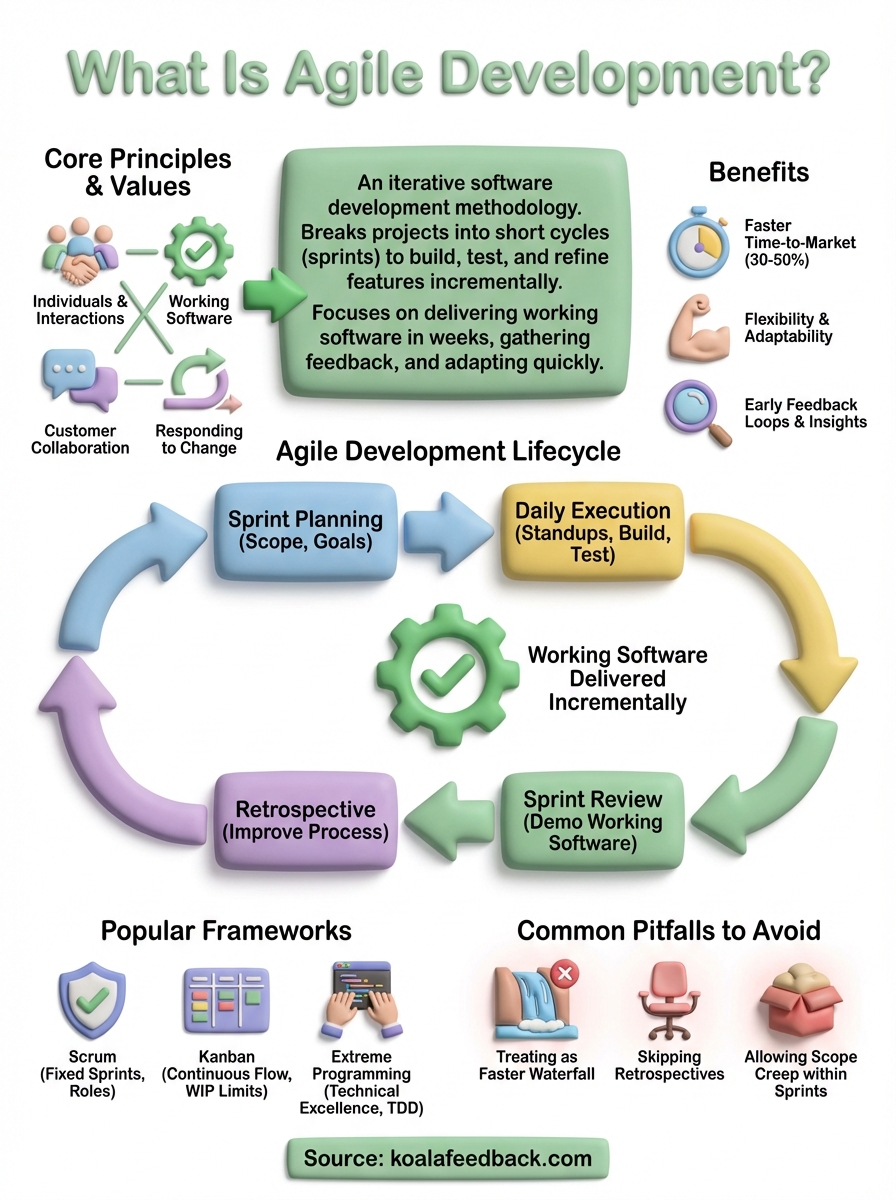
Agile development is a software development methodology that breaks projects into short cycles called sprints, allowing teams to build, test, and refine features incrementally. Instead of planning everything upfront and waiting months for a final product, agile teams deliver working software in weeks, gather feedback, and adjust their approach based on what users actually need. This iterative process puts flexibility and collaboration at its core, making it easier to respond when requirements change or new priorities emerge.
This guide walks you through everything you need to know about agile development. You'll discover why companies across industries have adopted this approach, learn the core principles that make agile work, explore popular frameworks like Scrum and Kanban, and see how the development lifecycle unfolds in practice. We'll also cover common mistakes teams make when implementing agile and how to avoid them, giving you a clear path to adopting this methodology successfully.
The software landscape has shifted dramatically over the past decade. You face constant pressure to release features faster than your competitors while meeting rising user expectations for quality and responsiveness. Traditional development methods that lock teams into rigid, year-long plans no longer work when market conditions change weekly and customer preferences evolve monthly. Understanding what is agile development means recognizing that your ability to adapt quickly determines whether you stay relevant or fall behind.
Your competitors are shipping updates every two weeks, gathering real user data, and iterating based on what actually works. If you wait six months to release a "perfect" product, you've already lost valuable market opportunities and customer insights that could have shaped your development. Agile development gives you the competitive advantage of early feedback loops, letting you test assumptions with real users before investing months in features they might not want.

Traditional planning assumes you can predict the future. Agile acknowledges that you cannot, and helps you respond intelligently when reality differs from your initial vision.
Organizations that adopt agile methodologies report 30-50% faster time to market compared to waterfall approaches. This speed compounds over time because each sprint generates learning that informs the next cycle, creating a feedback system that helps you build exactly what your users need rather than what you guessed they might want.
Business requirements change constantly in 2026. Your stakeholders discover new priorities mid-project, regulatory frameworks shift, and user behaviors evolve faster than annual planning cycles can accommodate. Agile development structures your work so you can pivot without throwing away months of effort or demoralizing your team.
Teams using agile frameworks can reprioritize their backlog between sprints, directing resources toward emerging opportunities or critical issues without disrupting work already in progress. This flexibility protects your investment because you're never more than a few weeks away from adjusting course based on new information.
You cannot simply announce "we're doing agile now" and expect results. Implementation requires deliberate planning, structured execution, and commitment from everyone involved in your development process. The transition from traditional project management to agile practices takes most teams three to six months before they see consistent benefits, but you can start delivering value within your first sprint if you approach the change systematically.
Your first step is getting everyone on the same page about what agile development actually means for your organization. You need to train your team on agile principles, ceremonies, and roles before attempting your first sprint. Schedule workshops where team members learn about daily standups, sprint planning, retrospectives, and how their individual responsibilities shift in an agile environment. This education phase prevents confusion later when someone asks why you're holding so many meetings or why requirements keep changing.
Your team cannot execute what they do not understand. Invest time upfront to build shared knowledge about how agile transforms your workflow.
Beyond technical training, you must secure stakeholder buy-in by explaining how agile benefits the business. Your executives and product owners need to understand that they will see working software every few weeks instead of comprehensive documentation, and that changing priorities mid-sprint disrupts the team's velocity. Set clear expectations about their role in providing feedback and making timely decisions.
Selecting the right agile framework depends on your team size, project complexity, and organizational culture. Scrum works well for teams of five to nine people working on products with clear feature sets, while Kanban suits teams handling continuous work streams with varying priorities. You might start with Scrum if you need structured ceremonies and defined roles, or adopt Kanban if your team values visual workflow management and flexibility over rigid sprint boundaries.
Do not copy frameworks blindly. Successful implementation means adapting methodologies to fit your context rather than forcing your team into someone else's process. If two-week sprints feel too short, try three weeks. If daily standups do not add value, experiment with three times weekly check-ins. The agile manifesto values responding to change over following a plan, which includes changing how you practice agile itself.
Launch your initial sprint by selecting a small, achievable scope that your team can complete in one to two weeks. Pick user stories that deliver tangible value even if the feature set feels minimal. Your goal is proving that the process works and building confidence, not shipping your entire product backlog. Define your definition of done before sprint planning so everyone knows what "complete" means for each story.
Track your progress daily and hold your first retrospective with genuine openness to feedback. Ask your team what slowed them down, what helped them succeed, and what they want to change for the next sprint. Use these insights to refine your process incrementally rather than overhauling everything after one iteration.
The foundation of what is agile development lies in the Agile Manifesto, a document created in 2001 by seventeen software developers who saw traditional project management failing their teams repeatedly. They outlined four core values and twelve principles that prioritize people, working software, and responsiveness over rigid processes and documentation. These values give you a philosophical framework for making decisions when priorities conflict or when your team faces uncertainty about the best path forward.
You build better software when you value individuals and interactions over processes and tools. Your team's ability to communicate openly and collaborate effectively matters more than following procedures perfectly or using expensive project management software. This does not mean you abandon structure, but rather that you adapt your processes to serve your people instead of forcing people to serve your processes.
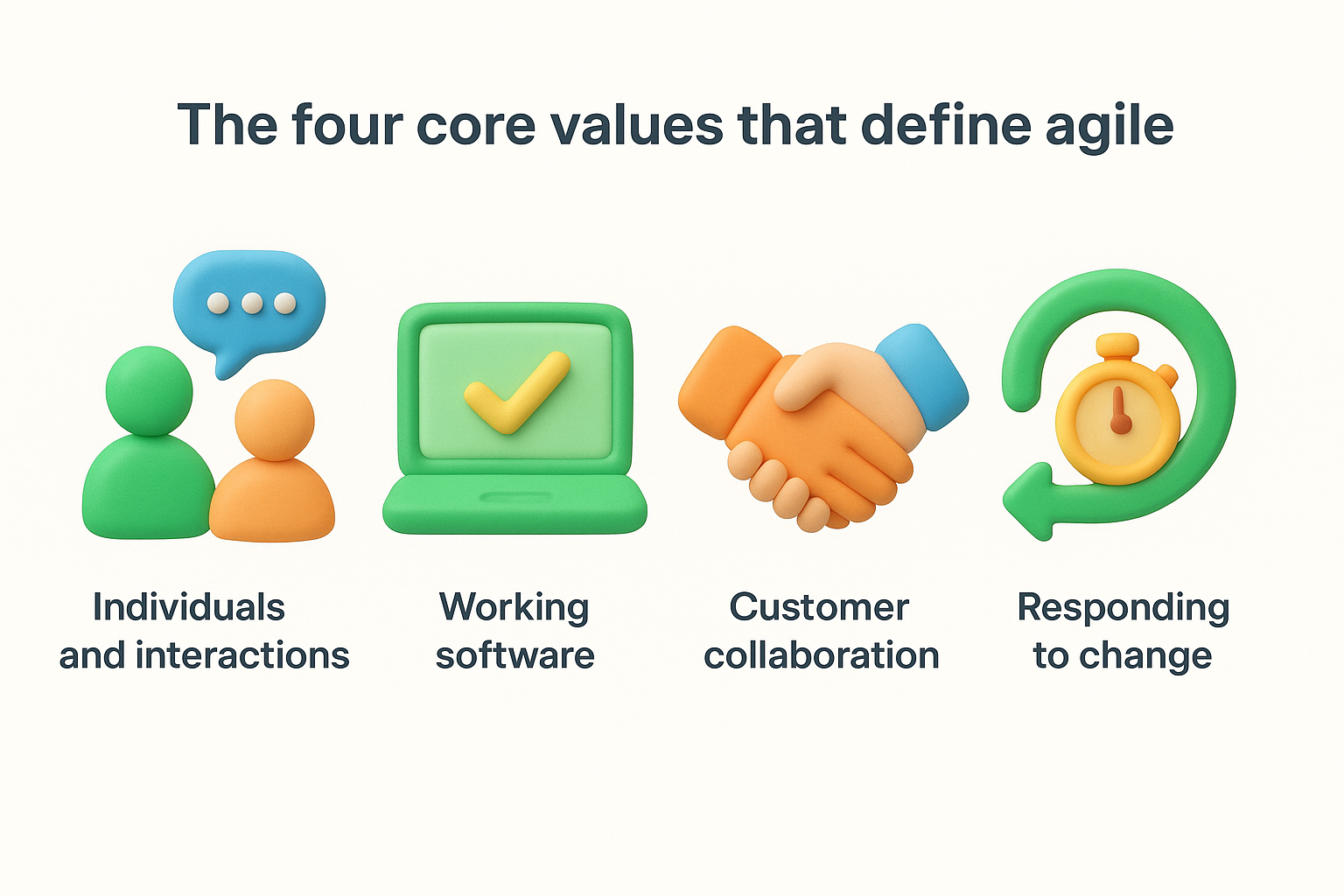
Working software over comprehensive documentation means you prioritize delivering functional features that users can test and evaluate. Documentation still has its place, but you create it to support development rather than as an end goal. Your stakeholders care more about seeing a working prototype in two weeks than reading a hundred-page requirements document that might be obsolete before development starts.
The manifesto tells you to respond to change over following a plan because plans represent your understanding at one point in time, while change reflects new information that makes your product better.
Customer collaboration over contract negotiation transforms how you work with stakeholders and users. Instead of defining every requirement upfront and treating changes as scope creep, you build partnerships where continuous feedback shapes the product throughout development. Contract negotiation focuses on defining the relationship and payment structure, while collaboration handles the actual product decisions.
The manifesto's twelve principles translate values into actionable guidance. You satisfy customers through early and continuous delivery of valuable software, welcoming changing requirements even late in development because agile processes harness change for competitive advantage. Your team delivers working software every few weeks, with preference for shorter timescales that give you faster feedback loops.
Business stakeholders and developers work together daily throughout your project, ensuring alignment and quick decision-making. You build projects around motivated individuals by giving them the environment and support they need, then trusting them to get the job done. Face-to-face conversation remains the most efficient method of conveying information within your development team.
Working software serves as your primary measure of progress, not completed documentation or tasks checked off lists. Agile processes promote sustainable development where sponsors, developers, and users maintain a constant pace indefinitely, avoiding the burnout that comes from death marches toward arbitrary deadlines.
Understanding what is agile development requires familiarity with the specific frameworks teams use to implement agile principles. Each framework provides structured practices and defined roles that help you translate agile values into daily work, but they take different approaches to organizing sprints, managing backlogs, and measuring progress. Choosing the right framework depends on your team's size, project complexity, and how much structure you need to maintain consistent velocity.
Scrum organizes work into fixed-length sprints lasting one to four weeks, where your team commits to completing a specific set of user stories from the product backlog. You hold four core ceremonies during each sprint: sprint planning at the start, daily standups for coordination, sprint reviews to demonstrate completed work, and retrospectives to identify improvements. This cadence creates predictability that helps stakeholders understand when they will see new features.
Three roles define how your Scrum team operates. The Product Owner maintains the backlog and prioritizes work based on business value, the Scrum Master removes blockers and facilitates ceremonies, and the Development Team builds the actual features. This separation ensures someone always advocates for users, someone protects the team from disruptions, and the builders focus on creating working software without competing priorities.
Scrum works best when you have clear product goals and stakeholders who can make decisions quickly, giving your team the direction they need to plan effective sprints.
Kanban takes a different approach by focusing on continuous flow rather than fixed sprints. You visualize your entire workflow on a board with columns representing each stage of development, from backlog through deployment. Cards representing individual tasks move across the board as work progresses, giving everyone instant visibility into what's happening and where bottlenecks emerge.
The power of Kanban comes from Work In Progress (WIP) limits that restrict how many items can sit in each column simultaneously. These limits prevent your team from starting ten features and finishing none, forcing you to complete current work before taking on new tasks. WIP limits also expose process problems because when a column fills up, you must address the bottleneck rather than ignoring it.
Extreme Programming (XP) builds agile practices around engineering discipline and code quality. Your team writes automated tests before implementing features through test-driven development, pairs programmers together to review code continuously, and integrates changes multiple times daily to catch conflicts early. These practices reduce technical debt and ensure your codebase remains maintainable as features accumulate.
XP works particularly well when you face uncertain requirements that will evolve as users interact with your software. The framework's emphasis on refactoring and continuous integration means you can change direction without accumulating messy code that becomes impossible to modify later.
The agile development lifecycle transforms abstract principles into concrete steps your team executes repeatedly throughout a project. Each iteration follows a predictable rhythm of planning, building, reviewing, and improving, creating a cycle that delivers incremental value while adapting to changing requirements. Understanding what is agile development in practice means seeing how these ceremonies and activities connect to produce working software every few weeks rather than following a theoretical framework.
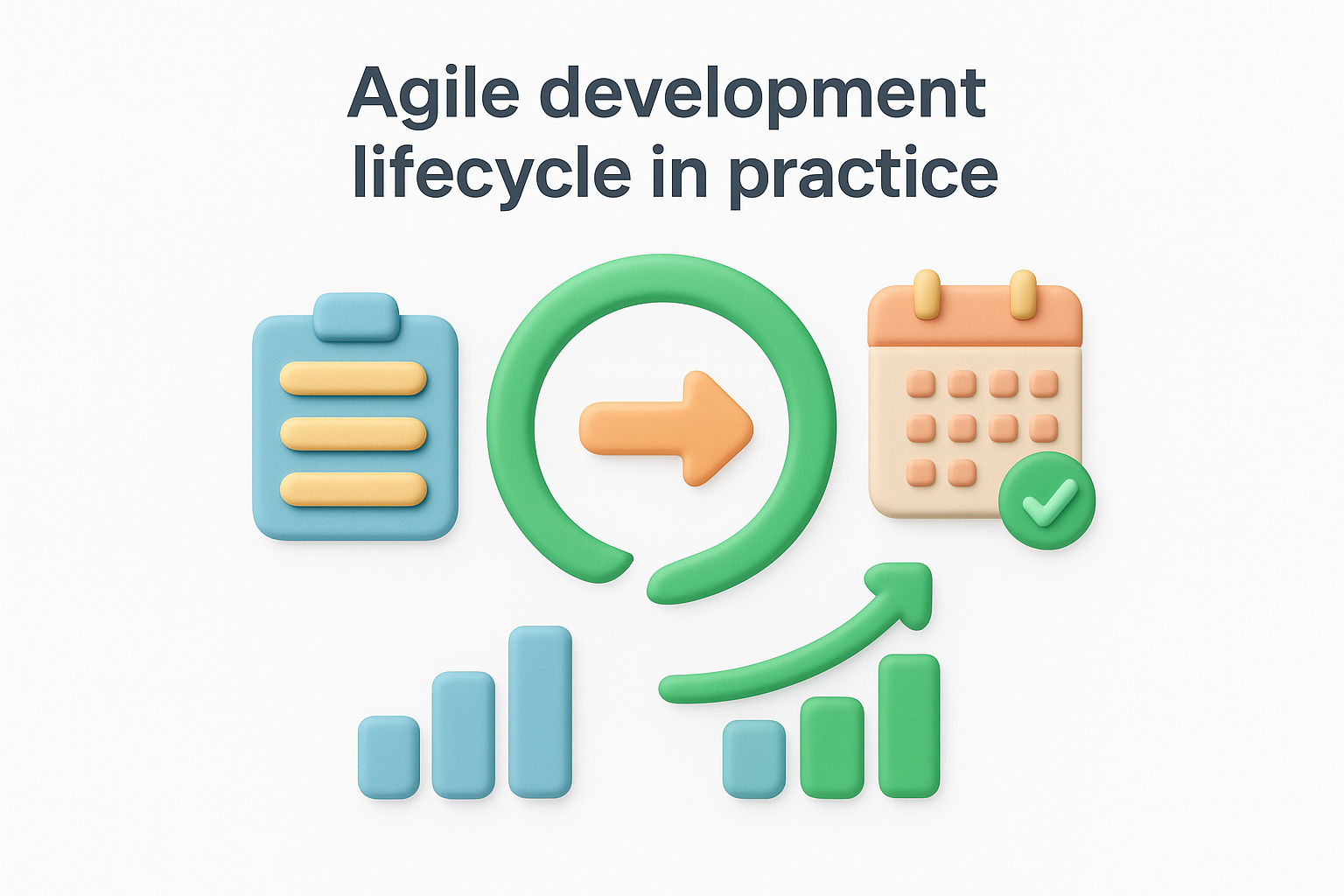
Your sprint begins with a planning session where the team selects user stories from the product backlog and commits to completing them within the sprint timeframe. The Product Owner presents prioritized stories based on business value, and developers estimate the effort required using story points or time-based metrics. Your team discusses acceptance criteria for each story, identifies dependencies, and ensures everyone understands what "done" means before the sprint starts.
Planning sessions typically last two hours for each week of the sprint, meaning a two-week sprint gets four hours of planning time. You break large stories into smaller tasks during this meeting, assigning work based on team members' expertise and capacity. This upfront investment prevents confusion later and ensures your sprint goal remains achievable.
Your team holds brief standup meetings each morning where everyone answers three questions: what they completed yesterday, what they plan to work on today, and what blockers they face. These meetings last fifteen minutes maximum and focus on coordination rather than problem-solving. When someone identifies an obstacle, you note it and schedule a separate conversation with the relevant people rather than derailing the entire team.
Daily standups create transparency that helps you spot problems early, when they're still easy to fix, rather than discovering critical issues during sprint reviews.
Between standups, your team practices continuous integration by merging code frequently and running automated tests to catch conflicts. Developers collaborate through pair programming or code reviews, ensuring knowledge spreads across the team and reducing the risk that only one person understands critical components.
Each sprint ends with two critical ceremonies that drive improvement. The sprint review demonstrates working software to stakeholders, gathering feedback that shapes future priorities. You show actual functionality rather than presentations or mockups, letting users interact with features and provide immediate reactions. Retrospectives follow reviews, giving your team space to discuss what worked well, what caused friction, and what experiments to try in the next sprint.
Even teams that understand what is agile development in theory struggle when translating principles into practice. You will encounter predictable obstacles that derail velocity, frustrate team members, and make stakeholders question whether agile actually works. These pitfalls emerge from misunderstanding core concepts or trying to blend incompatible practices from traditional project management. Recognizing these common mistakes before they damage your implementation saves months of wasted effort and prevents the disillusionment that leads teams to abandon agile entirely.
Your team falls into this trap when you plan entire projects upfront, then divide work into two-week chunks labeled "sprints" without actually adapting based on feedback. This approach misses the point entirely because you lose the flexibility and learning that make agile valuable. Real agile development means you plan only what you need for the current sprint in detail, maintaining a rough roadmap for future work that evolves as you gather user insights.
You avoid this mistake by resisting the urge to define every requirement before your first sprint starts. Build only enough vision to guide the next few iterations, then let actual results shape your subsequent priorities. Your stakeholders may feel uncomfortable with this ambiguity initially, but delivering working software every few weeks builds the trust necessary for this approach to succeed.
Retrospectives provide the continuous improvement mechanism that separates high-performing agile teams from struggling ones. When you skip them or rush through without genuine discussion, you repeat the same mistakes sprint after sprint because nobody takes time to identify problems and experiment with solutions. Your team accumulates frustration about processes that do not work but never fixes them.
Retrospectives turn your sprints into learning cycles rather than just production cycles, making each iteration smoother than the last.
Protect retrospective time as rigorously as sprint planning. Create psychological safety where team members can discuss problems honestly without fear of blame, then commit to trying at least one new approach each sprint based on what you discover.
You damage your team's ability to plan accurately when stakeholders add new requirements mid-sprint or developers keep expanding stories beyond their original scope. This behavior destroys the predictability that helps you forecast delivery dates and prevents your team from experiencing the satisfaction of completing committed work. Sprint commitments become meaningless when they change daily.
Combat this by protecting sprint boundaries fiercely. New requests go into the backlog for future sprints regardless of urgency, and stories that grow beyond estimates get split with remaining work moved to later iterations.
Understanding what is agile development means recognizing that you build better software through iterative cycles, continuous feedback, and adaptive planning rather than rigid upfront specifications. You deliver working software every few weeks, gather real user insights, and adjust priorities based on what actually matters to your customers. This approach gives you the flexibility to pivot when requirements change while maintaining momentum toward your product vision.
Success with agile requires commitment to its core ceremonies like sprint planning, daily standups, and retrospectives. You need clear communication channels with stakeholders, defined roles within your team, and willingness to experiment with processes until you find what works for your context. Most importantly, you must build feedback loops that capture user input systematically and inform your development priorities. Koala Feedback helps agile teams centralize user requests, prioritize features based on demand, and share roadmaps that keep stakeholders aligned on sprint goals and product direction.

Start today and have your feedback portal up and running in minutes.