You keep hearing Agile and Scrum used like they mean the same thing, but your team still can't agree on how to actually run a sprint or plan a roadmap. That confusion costs you time, and it usually shows up as mismatched expectations between product managers, developers, and the users waiting on features. Understanding agile development vs scrum isn't academic. It changes how you structure work, assign roles, and decide what ships next.
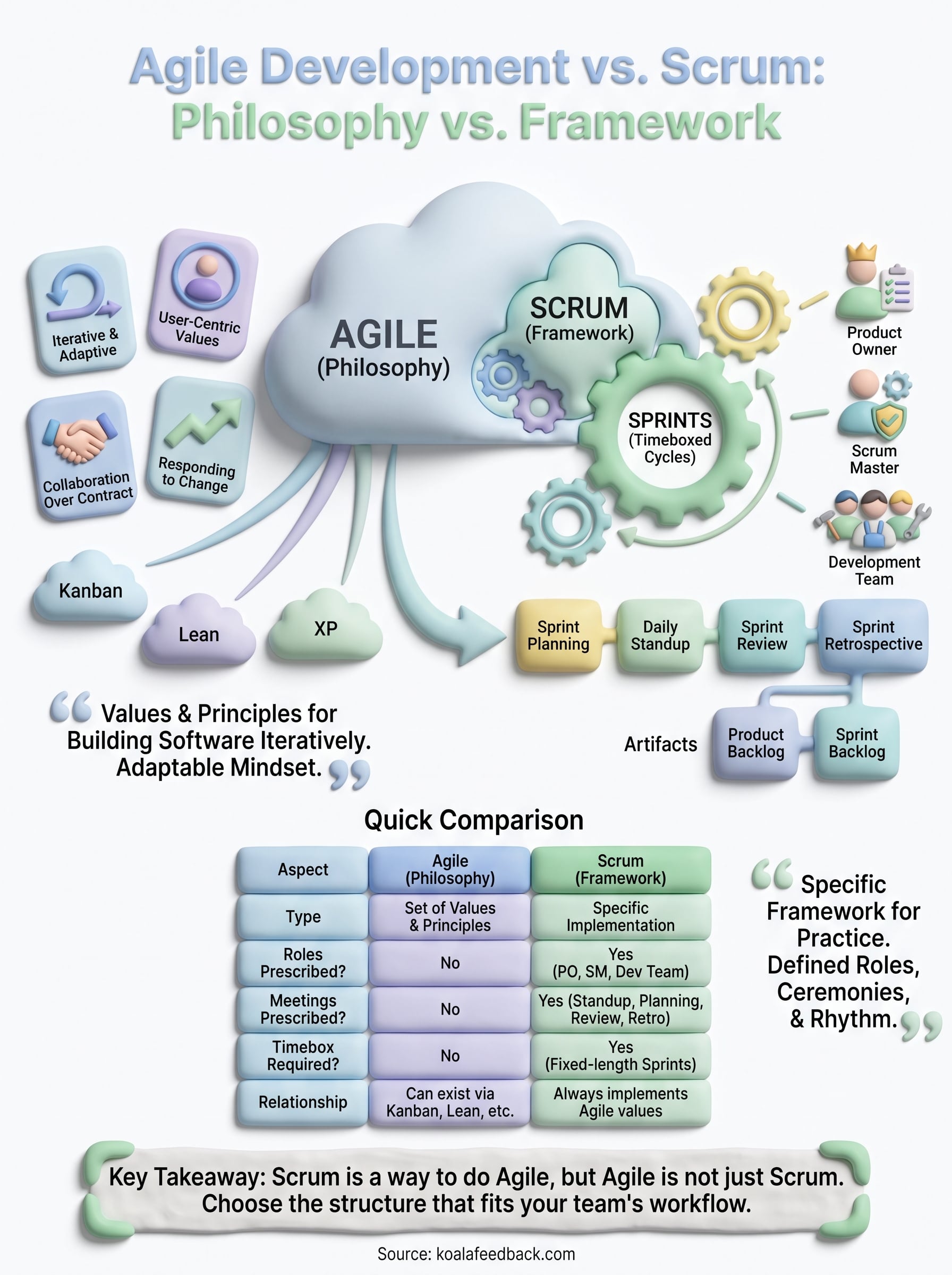
Here's the short answer: Agile is a philosophy, a set of values and principles for building software iteratively. Scrum is one specific framework for putting those principles into practice, with defined roles, ceremonies, and sprint cycles. Every Scrum team is doing Agile, but not every Agile team uses Scrum. Once you see that relationship clearly, the scrum vs agile development debate stops being confusing.
In this article, we'll break down what separates the two, where Scrum fits inside the broader Agile umbrella, and how other frameworks like Kanban compare. We'll also cover how prioritizing feedback and communicating your roadmap, something we deal with daily at Koala Feedback, fits naturally into either approach, so you can pick the right structure for your team.
Misunderstanding the relationship between these two terms creates real friction on product teams. When a manager says "let's be more agile" but means "let's run Scrum ceremonies," the team ends up bolted into daily standups and two-week sprints without ever adopting the underlying mindset of responding to change over following a plan. That mismatch is why the agile development vs scrum question keeps coming up in retrospectives and hiring interviews alike. Getting the distinction right isn't pedantic, it determines whether your team is flexible by design or just following a checklist.
Agile traces back to the Agile Manifesto, published in 2001 by a group of software developers who valued individuals and interactions, working software, customer collaboration, and responding to change. It never prescribed roles, meetings, or timeboxes. Scrum, by contrast, gives you the scaffolding: a Product Owner, a Scrum Master, a Development Team, sprint planning, daily standups, sprint reviews, and retrospectives. Kanban, Extreme Programming, and Lean are other frameworks that also implement Agile values, just with different mechanics. Confusing the philosophy with one of its implementations is the root of most of the disagreements you'll see in planning meetings.
Scrum is a way to do Agile, but Agile is not a way to do Scrum.
Teams that treat Scrum as a synonym for Agile tend to over-index on ceremony and under-index on principle. You'll see standups that run twenty minutes because nobody remembers they're meant to surface blockers, not report status. You'll see sprint commitments treated as immovable contracts, which directly contradicts the Agile principle of welcoming changing requirements. The framework becomes the goal instead of the tool, and teams lose the adaptability that made Agile appealing in the first place.
Seeing the two side by side makes the split obvious:
| Aspect | Agile | Scrum |
|---|---|---|
| Type | Set of values and principles | Specific framework |
| Prescribes roles? | No | Yes (Product Owner, Scrum Master, Dev Team) |
| Prescribes meetings? | No | Yes (standup, planning, review, retro) |
| Timebox required? | No | Yes (fixed-length sprints) |
| Can exist without the other? | Yes, via Kanban, XP, Lean | No, Scrum always implements Agile values |
Getting this right pays off in how you communicate progress to stakeholders and users. If you know you're running Scrum specifically, you can set expectations around sprint-based delivery dates. If your team is Agile but not strictly Scrum, say running Kanban with a continuous flow, you can promise faster, less predictable releases instead. Either way, the clarity helps when you're building a public roadmap or triaging a feedback backlog, because your users deserve to know what "in progress" actually means for your process, not just a generic Agile buzzword.
Picking a framework isn't about which one sounds more modern. It's about matching structure to how your team actually works and what your product needs right now. The agile development vs scrum decision usually comes down to team size, how predictable your workload is, and how much your stakeholders need fixed delivery dates versus continuous shipping.
Scrum works well when you need predictable cadence and clear accountability. Choose it if your team fits these conditions:
Government contracts, client-facing agencies, and teams reporting to a board often lean on Scrum because the ceremony creates built-in checkpoints for reporting progress.
Choose Scrum when you need rhythm and reporting; choose a lighter Agile approach when you need speed and flexibility.
Smaller teams, ongoing maintenance work, or products with unpredictable, incoming requests often do better with Kanban or another lightweight Agile flavor instead of full Scrum. If your backlog changes daily, sprint commitments become fiction the moment you write them down. A continuous flow model, where work moves through columns as capacity allows, keeps you honest about what's actually shippable. Startups iterating fast on an MVP, support teams triaging bugs, and infrastructure teams handling unplanned incidents all fit this pattern better than sprint-based Scrum.
If you're unsure, start with Scrum's structure for three sprints, then run a retrospective specifically asking whether the ceremonies helped or slowed you down. Teams that find standups and sprint reviews genuinely useful should keep Scrum. Teams that find themselves gaming the sprint board to look on-track should drop the timeboxes and try Kanban instead. Either way, keep collecting user feedback continuously, since that input should drive your backlog regardless of which framework structures your delivery.
Zooming out from the agile development vs scrum question helps to see where Kanban and Waterfall fit into the picture too, since teams often default to whichever term they heard most recently rather than the one that matches their workflow. Waterfall sits outside the Agile family entirely: it's a sequential model where you finish requirements, then design, then build, then test, with no planned overlap or revisiting earlier phases. Agile, Scrum, and Kanban all reject that rigidity in favor of iterative delivery, but they differ in how much structure they impose on that iteration.
A table makes the practical differences easier to scan than another paragraph of definitions:
| Model | Iteration style | Roles required | Best for |
|---|---|---|---|
| Waterfall | Sequential phases, no overlap | Project manager, phase leads | Fixed-scope projects with stable requirements |
| Agile (general) | Iterative, adaptive | None prescribed | Any team valuing flexibility over rigid planning |
| Scrum | Fixed-length sprints | Product Owner, Scrum Master, Dev Team | Predictable cadence, regular stakeholder demos |
| Kanban | Continuous flow | None prescribed | Unpredictable or ongoing work, support queues |
Kanban implements the same Agile values as Scrum, just without sprints or fixed roles. Work items move through columns like "To Do," "In Progress," and "Done," limited by work-in-progress caps rather than time boxes. That makes it a better match for teams whose priorities shift daily, since there's no sprint commitment to break.
Waterfall plans everything up front; Agile, Scrum, and Kanban all plan for change, they just differ in how much rhythm they add.
Waterfall isn't obsolete. Construction, manufacturing, and regulated industries with fixed compliance requirements still rely on it because sequential sign-offs reduce risk when specifications can't change midstream. If your product roadmap depends on continuous user feedback instead, though, any of the Agile-family approaches will serve you better than Waterfall's locked sequence.
Picture a ten-person SaaS team building a project management tool. They run two-week sprints, and every sprint starts with the Product Owner pulling the top-voted requests from their feedback portal into the backlog. The Scrum Master keeps standups to ten minutes, the sprint review doubles as a demo for a handful of power users, and the retrospective flags friction before it compounds. This is Scrum doing what it does best: turning a pile of feature requests into a predictable delivery rhythm that stakeholders can plan around.
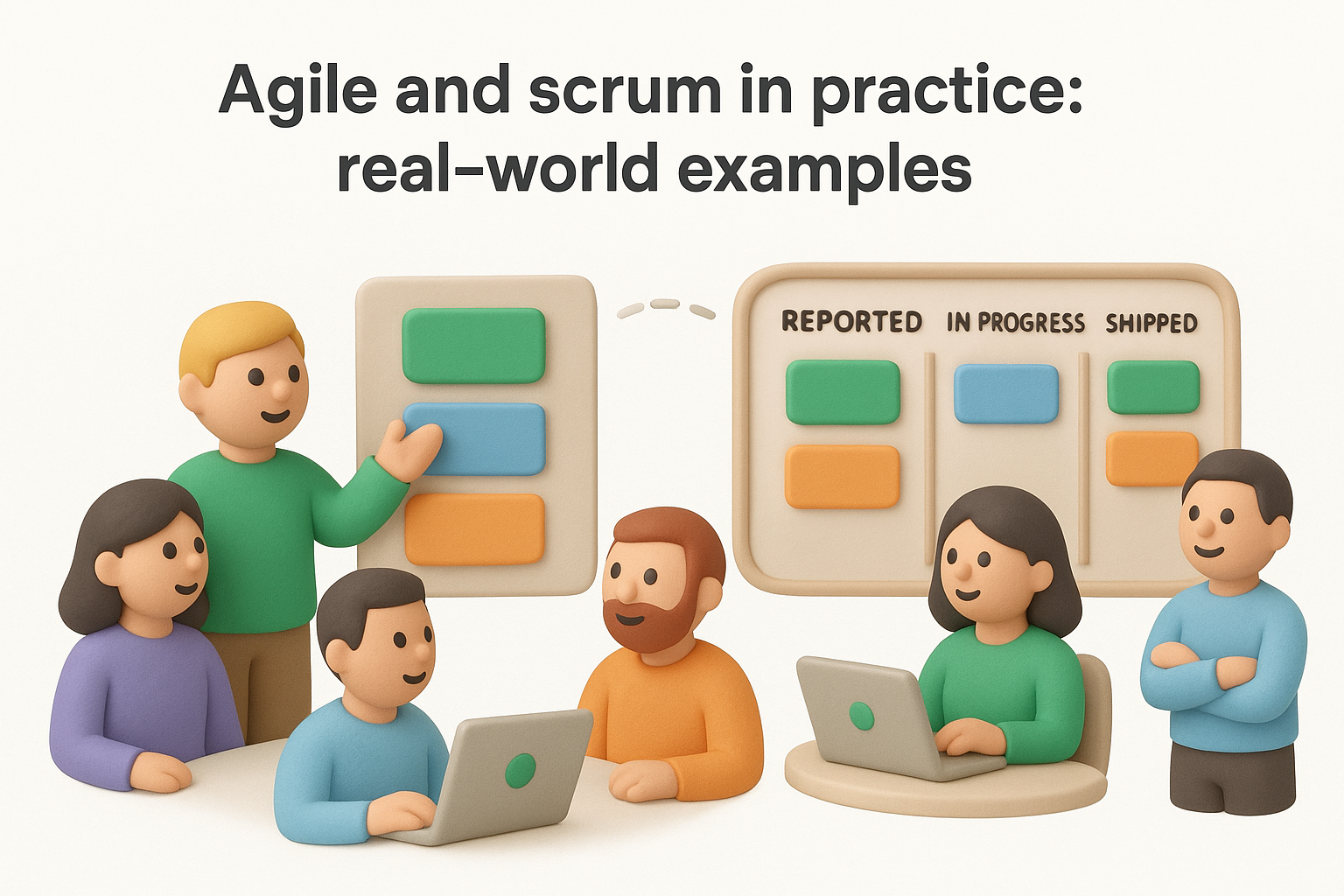
Now picture a five-person support and maintenance team for the same product. Bug reports and small tweaks arrive daily, and locking them into a two-week sprint would mean either padding the backlog with filler or breaking commitments constantly. Instead, they run a Kanban board with columns for "Reported," "In Progress," and "Shipped," capped at three items in progress at a time. Nothing sits idle waiting for the next sprint to start, and urgent fixes jump the queue without derailing a sprint commitment. This is Agile without Scrum's ceremony, and it fits the unpredictable nature of the work far better.
The best teams don't force one framework everywhere; they match the framework to how the work actually arrives.
Both teams still owe their users the same thing: a clear answer to "what's happening with my request?" That's where customizable statuses on a public roadmap earn their keep, regardless of which framework produced the update. A status like "Planned," "In Progress," or "Complete" means the same thing to a user whether it came out of a Scrum sprint review or a Kanban board's "Shipped" column. Koala Feedback's roadmap tool exists exactly for this handoff, translating internal process, Scrum or otherwise, into a status update your users can actually understand.
The agile development vs scrum question isn't really a competition. Agile gives you the values, Scrum gives you one way to put those values into a repeatable rhythm, and Kanban or another lightweight flavor might serve you better if your work arrives unpredictably. What matters is picking the structure that matches how your team actually delivers, then staying honest about whether it's still working after a few sprints or cycles.
Whatever framework you land on, your users only care about one thing: knowing what happens to the feedback they gave you. Sprint reviews and Kanban columns are internal details, but a clear, public status update is what builds trust. If you want that translation to happen automatically instead of through scattered spreadsheets and Slack threads, see how Koala Feedback can help you turn any workflow into a roadmap your users actually understand.

Start today and have your feedback portal up and running in minutes.