You signed up a new user. They poked around your product for a few minutes, maybe clicked through a couple of screens, and then disappeared. No second login. No upgrade. Gone. The problem likely wasn't your product itself. It was how long it took that user to experience why your product matters. That gap between signup and "aha, this is useful" is exactly what the time to value metric measures, and it's one of the most underrated predictors of retention in SaaS.
TTV tells you whether your onboarding, feature set, and product experience are actually delivering results fast enough to keep people around. A slow TTV means users churn before they ever see the payoff. A fast one means they stick, upgrade, and advocate. The tricky part is that shortening TTV isn't just an onboarding problem, it's a product development problem. You need to know which features matter most to users so you can surface them sooner. That's where tools like Koala Feedback come in: when you collect and prioritize real user feedback, you build a clearer picture of what drives value for your customers.
This guide breaks down what TTV actually is, how to calculate it for your product, and concrete strategies to shorten it. Whether you're a product manager trying to reduce churn or a founder optimizing your onboarding flow, you'll walk away with a framework you can act on immediately.
The subscription model is unforgiving. Users who don't see value quickly don't renew, and in most SaaS products, the window to make that impression is measured in days, not weeks. The time to value metric sits at the intersection of onboarding, product experience, and retention, which means it tells you more about business health than almost any other single number you can track.
Churn doesn't usually happen at renewal. It happens on day three when a new user can't figure out your core feature. It happens on day seven when they haven't had a single moment where the product clicked. High TTV means users accumulate frustration before they accumulate results, and frustrated users churn quietly without ever telling you exactly why they left.
The fastest path to reducing churn isn't a discount at renewal. It's making sure users experience your product's value before they have a reason to leave.
Users who reach a meaningful outcome early in their lifecycle have significantly higher retention rates across the board. When someone completes a key action in your product within the first session or two, they're far more likely to return, explore further, and eventually upgrade. Every day that passes without a clear win for the user is a day closer to them churning, and you may never know it happened until it already did.
Most product teams focus on activation rates when they think about early user experience. Activation matters, but TTV also directly shapes your expansion revenue, which includes the upgrades, seat additions, and plan changes that drive growth in mature SaaS businesses. Users who reach value fast don't just stay longer. They become the ones who push their teams to adopt your tool and advocate for higher-tier plans.
A slow onboarding experience compresses the entire customer lifecycle. If your average contract is 12 months and it takes a user 60 days to see real results, you've already burned through roughly 16% of the relationship before it actually started. That's 16% less time to build the trust that turns a retained user into an expansion revenue opportunity.
Your analytics might show you where users drop off. Your support tickets might show you where they get confused. But tracking TTV gives you a unified signal that connects onboarding friction directly to business outcomes. When TTV runs long for a specific user segment or plan tier, that's a clear indicator that something in your product experience isn't matching what those users actually need.
Fixing those gaps requires knowing what users want, not just where they struggle. That's why combining TTV data with structured user feedback is so useful. When you understand both the timeline to value and the features users say would get them there faster, you can make product decisions that move both metrics in the right direction, rather than guessing which improvement will have the most impact.
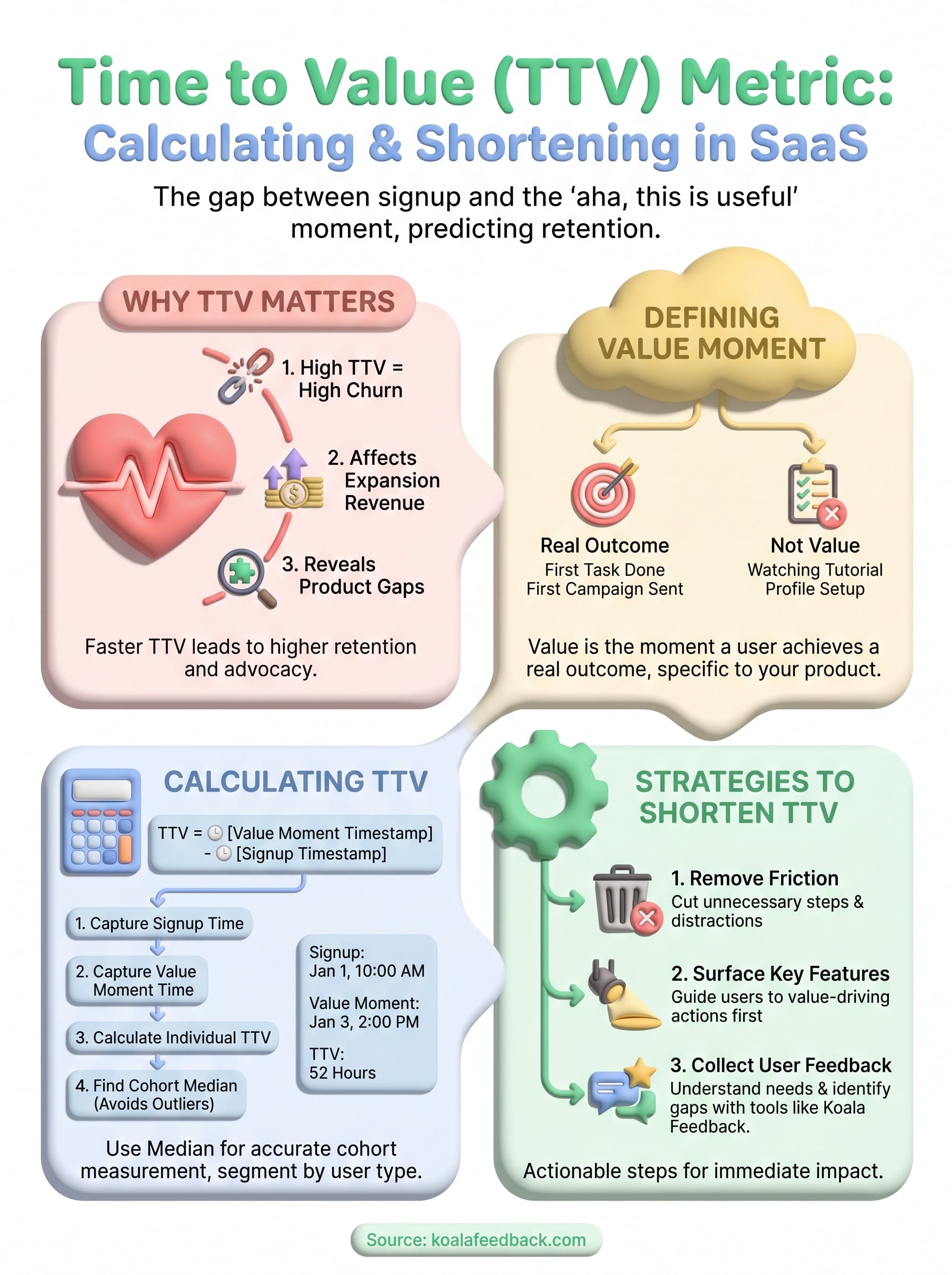
Before you can track the time to value metric, you need a clear answer to one question: what does "value" actually mean in your product? This sounds obvious, but most teams skip it and end up measuring the wrong thing. Value isn't a user completing your onboarding checklist or watching a tutorial video. Value is the moment a user achieves a real outcome that made them sign up in the first place. That moment is different for every product, and getting it wrong means your TTV data will point you in the wrong direction.
Generic definitions of value don't hold up under scrutiny. For a project management tool, value might be the first time a user completes a task and marks it done with their team. For an email marketing platform, it might be sending a campaign and seeing open rate data return. Your value moment needs to map directly to the core promise your product makes, not to a completion percentage on an onboarding flow. Here are some examples of how different SaaS products might define their value moment:
The right value moment is the one your best long-term users would point to if you asked them when the product first felt worth keeping.
Start by looking at behavioral data for users who converted or renewed, then work backwards. What action did they all complete early in their lifecycle that churned users did not? That action is almost always your value moment. Running short user interviews or posting a quick survey through your feedback portal, asking long-term users when the product first clicked for them, will surface the same patterns fast. Recurring answers across multiple users are the clearest signal you have that you've found the right moment to anchor your TTV measurement around.
Once you have your value moment defined, document it clearly across your entire product team so everyone from engineering to customer success uses the same benchmark consistently. A shared definition makes every downstream decision about onboarding and feature prioritization more reliable and easier to act on.
Calculating TTV is straightforward once you have your value moment defined. The core formula subtracts the timestamp of a user's signup from the timestamp of when they first completed your value moment. That gap, expressed in hours, days, or sessions depending on your product, is your raw TTV for that individual user. Aggregate those numbers across a cohort and you get a metric you can actually act on.
TTV = Timestamp of value moment - Timestamp of signup

You calculate this for each user individually, then take an average or median across a cohort. The median is often more useful than the mean because a small number of slow-moving users can pull your average up significantly without reflecting the experience most users actually have. For example, if 80% of your users reach value within three days but five enterprise accounts took 30 days, your mean will be misleadingly high. Use median as your default and flag outliers separately for investigation.
Here is a simple structure for what to track:
| Data point | What to capture |
|---|---|
| Signup timestamp | Date and time the user created their account |
| Value moment timestamp | Date and time the user completed the defined value action |
| TTV (individual) | Value moment timestamp minus signup timestamp |
| TTV (cohort) | Median TTV across all users in a given period |
Not every user arrives with the same context, and your TTV calculation should reflect that reality. A free trial user exploring your product independently moves differently than an enterprise account with a dedicated onboarding team. Segment your TTV calculations by plan tier, acquisition channel, or company size so you can see where the real friction lives rather than treating all users as one uniform group.
A single average TTV number hides more than it reveals. Segment first, then optimize.
Tracking TTV over time, by weekly or monthly cohort, also tells you whether the changes you make to onboarding or your feature set are actually moving the metric in the right direction rather than just feeling like progress.
A raw TTV number on its own doesn't tell you much. Knowing that your median TTV is four days only becomes useful when you compare it to something, whether that's your own historical data, a meaningful threshold you've set based on trial length, or general patterns across similar SaaS products. Benchmarking the time to value metric gives you the context to decide whether your current number represents a real problem or reasonable performance for your product type and audience.
Your most reliable benchmark is your own historical data, specifically the TTV of users who became long-term, high-value customers. Pull the cohort of users who retained past 90 days or expanded to a higher plan, calculate their median TTV, and set that as your target threshold. This internal benchmark is more useful than any industry average because it reflects what works specifically for your product and user base, not a generalized number pulled from a different context with different users.
Your best customers already showed you what good TTV looks like. Use their data to define the standard.
Treating all users as a single group hides the segments where your onboarding is actually breaking down. Once you have your baseline, break your TTV data into meaningful groups so you can see exactly where the friction lives. Common segments that reveal useful patterns include:

Comparing TTV across these segments shows you exactly which groups are struggling and lets you direct onboarding resources where they'll have the most impact. If enterprise users consistently take three times longer than SMB users to reach value, that's a signal to build dedicated onboarding paths for each group rather than applying a one-size-fits-all fix across your entire user base.
Shortening your time to value metric doesn't mean stripping out features or rushing users through a watered-down experience. It means removing friction from the path that leads to your value moment so users get there faster without missing anything essential. The goal is a tighter, clearer route to the outcome they signed up for, not a shortcut that leaves them confused later.
Most onboarding flows contain steps that serve internal needs rather than user goals. Profile setup fields, optional integrations, and preference screens that don't connect to your core value moment all add time without adding payoff. Audit your current onboarding by mapping every step to a single question: does this bring the user closer to their value moment? Any step that fails that test should be cut, deferred, or made optional. Removing three or four low-impact steps often tightens TTV significantly without any other changes required.
The fastest onboarding isn't the one with the most features highlighted. It's the one with the fewest distractions between signup and the user's first real win.
Users who encounter irrelevant features early tend to get lost and disengage before reaching value. Instead of showing everything your product can do upfront, focus the early product experience on the specific actions that lead directly to your defined value moment. This might mean reordering your UI, adding contextual prompts at key steps, or building a guided path for first-time users that surfaces only what they need right now.
Collecting structured user feedback is one of the most reliable ways to know which features actually drive early value. When users tell you which capabilities they wished they'd found sooner or which steps felt unnecessary, you get direct input for improving onboarding without guessing. Prioritizing those improvements based on real feedback means your changes target actual friction rather than assumed friction, and that distinction makes every product iteration more effective and easier to justify to your team.
The time to value metric is one of the few numbers that connects your onboarding experience directly to retention, expansion revenue, and long-term growth. Everything in this guide, from defining your value moment to segmenting TTV by cohort, only works when you build it on accurate, direct input from your actual users. You can't shorten the path to value if you don't know which steps users find useful and which ones slow them down.
That's where structured feedback collection changes the picture entirely. When users tell you which features they needed sooner, which steps felt unnecessary, and what finally made the product click, you have the raw material to make onboarding decisions that actually reduce TTV. Guessing costs you time and churn. Real feedback costs you neither. Start collecting and prioritizing the feedback that shapes your product roadmap with Koala Feedback and build the clarity your team needs to move faster.

Start today and have your feedback portal up and running in minutes.