The seven steps in the process of product development are generate ideas, screen them, set a strategy, build a roadmap, prototype, test, and launch. The product development process examples below pair each step with a real company that did it well. Founders hunting for a first idea will learn most from Slack and 3M. Teams buried in feature requests should read the Lego and GitLab stories. If you are about to build, Dropbox and Gmail show how to learn before you commit. If you are close to shipping, Instagram's launch is the one to study.
Most guides stop at definitions like "ideation, design, testing." That leaves you guessing what each stage looks like on a real team, what it should produce, and when you are allowed to move on. Teams that skip a step usually pay for it later, because a wrong guess costs the least to fix at the start.
Each section covers what the step involves, one real-world example, and how to apply it on your own team. At Koala Feedback we build tools for collecting user feedback and sharing roadmaps, so we lean on examples where customer input drives decisions.
Idea generation is the first stage of the product development process. You collect customer problems and possible solutions, and you hold back judgment. The aim is volume with evidence, so every idea links to a real person or a real data point.

Good ideas rarely arrive in a brainstorm alone. They surface in the places where customers already talk to you:
The output is a raw, tagged list of ideas with a source attached to each. Nothing gets ranked yet.
Slack began as a side effect. Tiny Speck, a studio spread across several cities, built an internal chat tool while making an online game called Glitch. When Glitch shut down in 2012, the team saw that the internal tool was the stronger product. A preview went out in August 2013 and the public launch followed in February 2014.
3M's Post-it Notes followed a similar path. A weak adhesive developed in 1968 sat unused until a 3M employee wanted bookmarks that would stay put in a hymnal without damaging the pages. In both cases the idea came from a problem someone felt first hand.
The best ideas come with a witness: someone who had the problem before you built the fix.
Start by giving feedback one home. A feedback portal such as Koala Feedback lets users post ideas, vote, and comment. It also deduplicates and categorizes requests automatically, so five people asking for the same thing show up as one idea with five votes. Signing up is free and a portal takes minutes to set up.
Then follow three rules for this stage:
Screening narrows the pile to the few ideas that deserve strategy work, using the same criteria for every idea. The usual criteria are customer need, business impact, strategic fit, feasibility, effort, and risk. The goal is to replace the loudest voice in the room with a shared score.
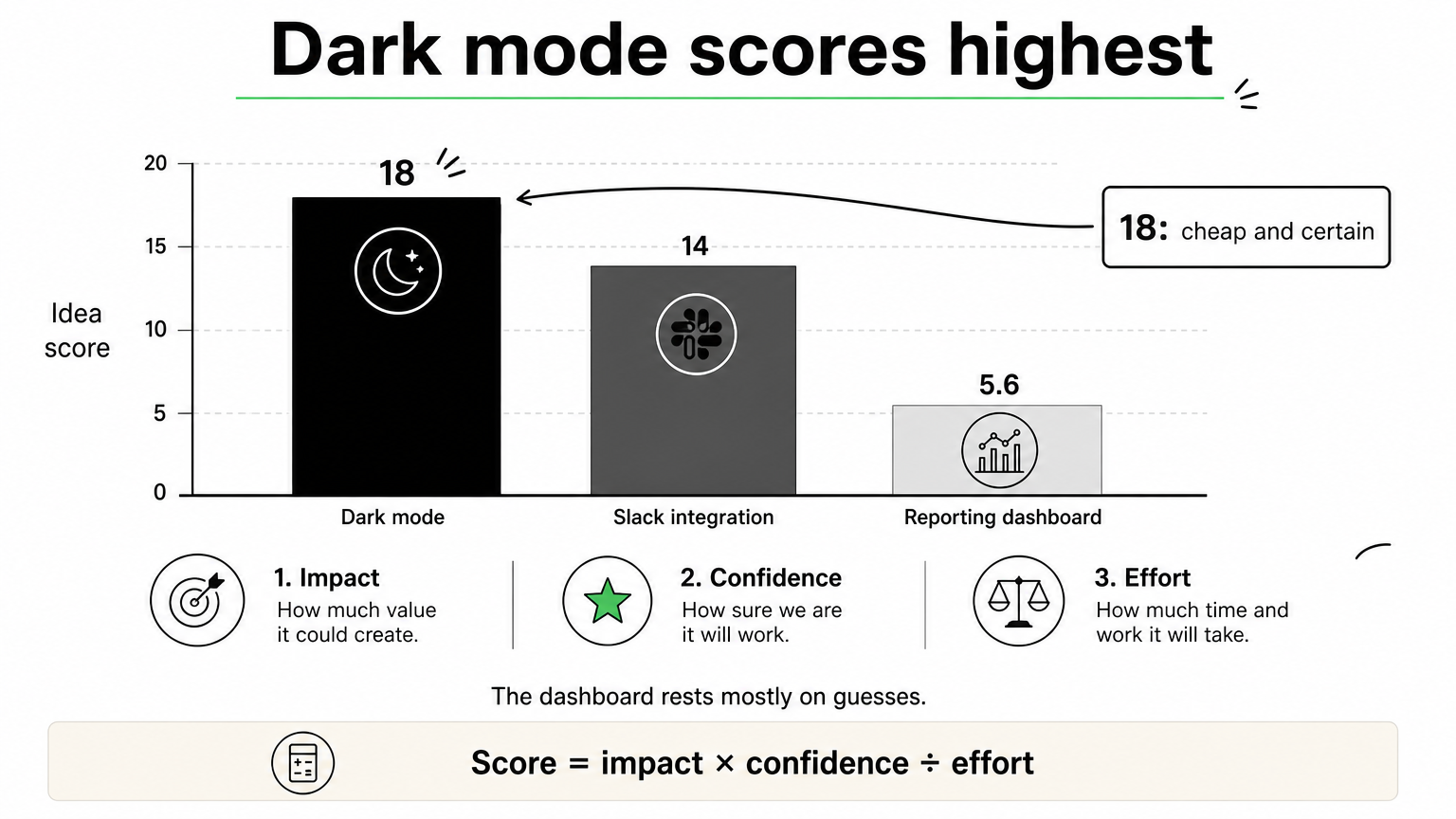
A simple scoring model is enough. Rate each idea from 1 to 10 for impact and for confidence, meaning how much evidence you have. Rate effort from 1 to 10, then multiply impact by confidence and divide by effort. Here is how three ideas for a SaaS product might score:
| Idea | Impact | Confidence | Effort | Score |
|---|---|---|---|---|
| Slack integration | 8 | 7 | 4 | 14 |
| Dark mode | 4 | 9 | 2 | 18 |
| Reporting dashboard | 9 | 5 | 8 | 5.6 |
Dark mode wins because it is cheap and certain. The dashboard looks exciting but rests mostly on guesses, so it needs more evidence before it earns a place on the shortlist.
Lego Ideas runs screening in public. Fans submit a model design, and a project needs 10,000 supporters before Lego reviews it. After that, a Lego review team decides whether the design can become a real set.
The two layers do different jobs. Public votes measure demand. The internal review checks whether the idea can actually be made and sold. Neither filter is enough alone.
Votes tell you what people want. Review tells you what you can build.
Treat votes and comments on a feedback board as one input, not the verdict. Then hold a 45-minute scoring session with product, design, and engineering, so effort and feasibility scores come from the people who know them.
End the session with a decision, not a discussion:
A product strategy states why the product should exist, who it is for, which problem it solves, and how you will know it worked. It is the direction. The roadmap in the next step is the plan that follows from it.
A one-page strategy for the new product development process covers six things:
Writing these down early removes ambiguity. Every later decision, from scope trade-offs to launch messaging, can be checked against the page.
In 2006 Tesla published a short plan that laid out its whole strategy. Build a sports car first. Use that money to build a more affordable car, then use that money to build an even more affordable one. Offer zero-emission electric power along the way.
The Roadster arrived in 2008, the Model S in 2012, and the Model 3 in 2017. Each product had a clear job, which was to fund and de-risk the next one. A strategy does not need to be long. It needs to be specific about sequence and purpose.
A strategy is a sequence of bets, each one paying for the next.
Write the page in plain language, then test it. A new teammate should be able to explain in 30 seconds who the product is for and what success looks like. If they cannot, the strategy is still fuzzy.
Answer these four questions before you move on:
A product roadmap turns strategy into a sequenced plan that shows what you intend to build and why. Strong roadmaps organize work by themes and status instead of promised dates, so the plan can change as you learn.
The simplest useful format is now, next, later:
Give every item an owner and the customer problem it addresses. A roadmap also works as a communication tool for your team, executives, and customers, so write it for readers who were not in the room.
GitLab publishes its product direction for each area of the product and keeps much of its issue tracker open. Customers can see what is planned and comment directly on the work. Users join the process by adding use cases, pushing back on priorities, and seeing why items move.
Public roadmaps cost you some privacy, but they earn trust and feedback. They also force discipline. When customers can read the plan, vague items and silent slips stand out.
A roadmap you can show customers is a roadmap you have thought through.
Koala Feedback's public roadmap shows features as planned, in progress, or completed, and customizable statuses help you manage expectations. The free Starter plan includes 3 boards and 5 statuses, which is enough to publish a first roadmap.
Whichever tool you use, keep three habits:
Prototyping builds the cheapest artifact that can answer your riskiest question before you commit to full development. A prototype can be a sketch, a video, or a manual service, and it does not have to be code.
Pick the form based on what you need to learn:
Match the form to the question. Use a proof of concept for "can we build it?", a mockup for "will people understand it?", and an MVP or concierge test for "will anyone want it?"
File syncing is hard to explain and hard to build. In 2007 Drew Houston made a three-minute demo video that showed Dropbox working before the full product existed. He posted it on Digg, and the beta waiting list reportedly jumped from 5,000 to 75,000 overnight.
Zappos took the manual route. Founder Nick Swinmurn photographed shoes in local stores, posted them online, and bought a pair only after someone ordered it. That concierge-style test showed people would buy shoes online before any inventory system existed.
The cheapest prototype is the one that proves demand before you write the product.
Name your riskiest assumption first, then choose the cheapest prototype that tests it. Set the pass line before you show anything. Otherwise every result looks like a win.
A quick routine:
Testing checks that the product works, that people can use it, and that they want it, before everyone gets access. It combines internal quality assurance with alpha, beta, or acceptance testing by real users.
A well-run test phase has a few fixed parts:
Testing also needs exit criteria that you write before you start. Without them, a test phase drifts on until someone gets tired.
Gmail launched on April 1, 2004, by invitation only, with 1 GB of storage as its headline feature. It kept the "Beta" label until July 2009. Invitations kept the user base small enough to learn from, and real daily use shaped the product over those years.
The lesson is that a beta is a controlled experiment, not a soft launch. You choose who gets in, what you want to learn, and how long you keep learning.
A good beta limits who gets in so you can learn faster than you grow.
Write your exit criteria before the first tester logs in. Make them observable. An illustrative set: no open critical bugs, and most testers complete the core task without help.
Then run the beta in short loops. Ship a fix, ask the same testers whether it worked, and log what they say in your feedback board. The same board you used for idea capture can collect beta reports, which keeps early and late feedback in one history.
A launch is a release plus coordination across product, marketing, sales, and support. Learning starts the day after. Measure against the success metrics from your strategy, not against a feeling that the launch went well.
A launch plan for any new product development process covers:
Instagram began as Burbn, a check-in app with many features. Kevin Systrom and Mike Krieger watched which features people actually used and stripped the product down to photos, filters, and sharing. They launched on iOS on October 6, 2010. The app drew 25,000 users on the first day and passed one million registered users by December 2010.
The launch worked because the product was narrow. It did one thing, on one platform, and earlier usage data had told the team which thing to keep. A small, clear launch is easier to explain, support, and measure.
Launch the smallest product that does one job well, then let usage tell you what to add.
Pick three metrics from your strategy, for example adoption, activation, and retention, and review them 30 days after launch. Compare the numbers with the targets you wrote in stage three.
Then close the loop. Every surprise from the retrospective becomes a new item in your idea list, and the cycle starts again at stage one. The process works best as a loop, not a one-time sequence.
The seven steps in the process of product development fit together. Ideas feed screening, screening feeds strategy, strategy shapes the roadmap, and the roadmap decides what you prototype, test, and launch. The companies above did not follow a rigid script, but each one did the work of its stage and learned something before moving on.
Start where you are weakest. If feedback is scattered, fix stage one first. If you ship without learning, add exit criteria to your tests. When you want one place to collect ideas, rank them by votes, and share your roadmap, set up a free feedback portal with Koala Feedback.

Start today and have your feedback portal up and running in minutes.