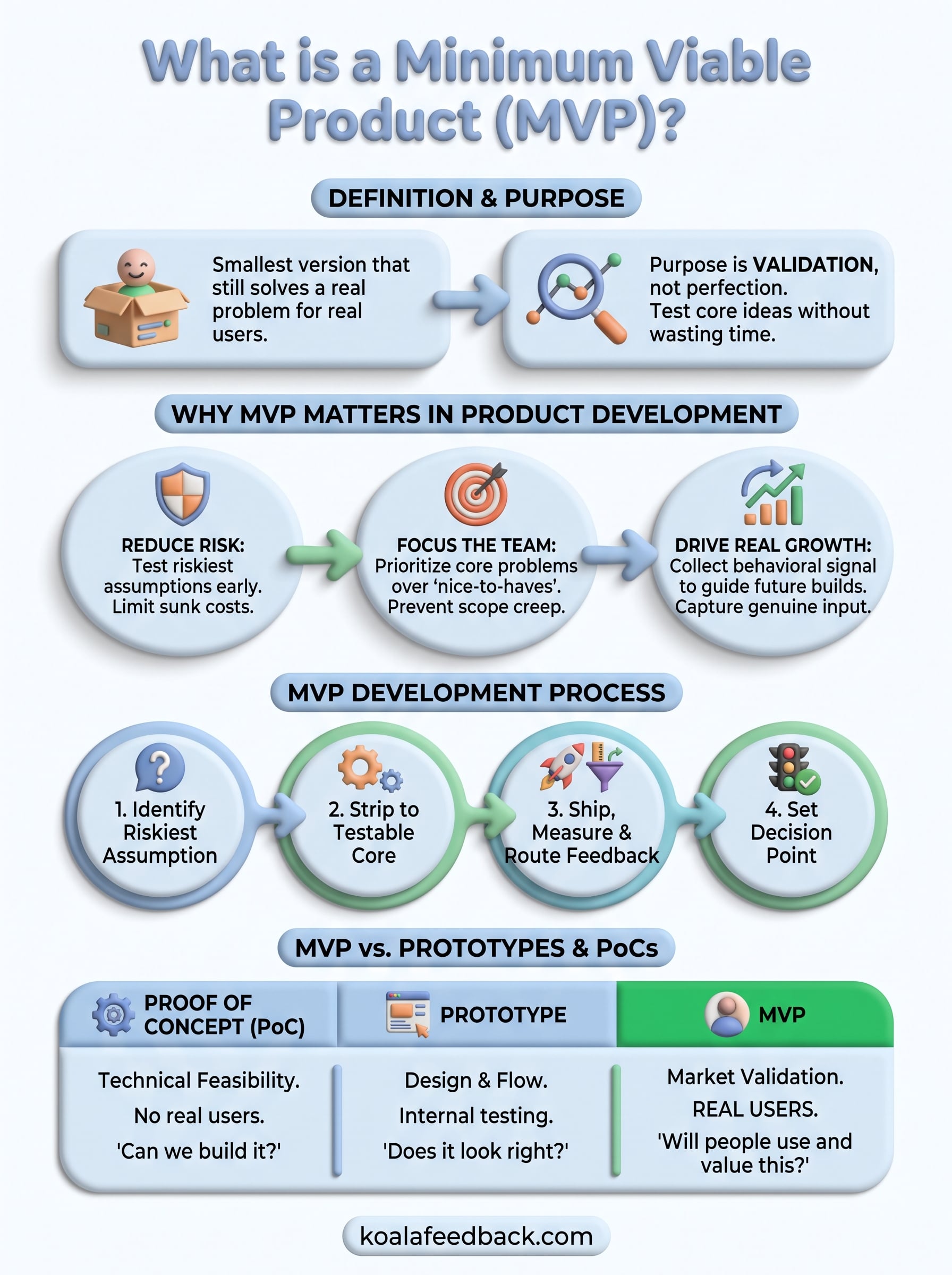
You keep hearing the term thrown around in sprint planning, investor pitches, and roadmap meetings, but nobody stops to explain it properly. What is an MVP, exactly, or put another way, what does MVP stand for, and why does every product team act like it's the only way to build something new? A minimum viable product is the smallest version of your product that still solves a real problem for real users, nothing more, nothing less.
The short answer: an MVP is a working release built with just enough features to let you test a core idea with actual customers, without spending months on functionality nobody asked for. Its purpose is validation, not perfection. You ship it, watch how people use it, and let that behavior guide what you build next instead of guessing.
In this article, we'll break down the full definition of MVP, walk through why product teams rely on it, and cover how it fits into the broader product development process. You'll also see how planning and running an MVP step by step and gathering the right user feedback, something we deal with daily at Koala Feedback, turns an MVP from a rough first attempt into a product people actually want.
Understanding what is the purpose of an mvp starts with admitting a hard truth: most new product ideas are guesses dressed up as plans. Teams assume they know what users want, then spend six months and a chunk of the budget building it, only to find out nobody asked for half of it. An MVP flips that order. Instead of building first and asking questions later, you build the smallest thing that tests your riskiest assumption, then let real usage tell you if you're right. That's the actual goal of defining an mvp: turn opinions into evidence before you commit serious engineering time.
An MVP isn't a smaller version of your product. It's the fastest path to proof that your product idea is worth building at all.
Building software is expensive, and building the wrong software is worse than expensive, it's a sunk cost you can't get back. When you launch a minimum viable product, you're deliberately limiting your exposure. If the core idea fails, you've lost weeks, not quarters. If it works, you've got a validated foundation and, just as importantly, a group of early users who already trust you enough to keep giving input. This is where the define mvp product conversation usually gets confused with cutting corners. It's not about shipping something broken. It's about shipping something narrow enough to learn from quickly.
Without an MVP mindset, roadmaps balloon. Every stakeholder has a favorite feature, and without a filter, all of them end up in version one. An MVP forces the hard questions of MVP feature prioritization early:
Answering these honestly keeps scope creep out of your first release and keeps your team pointed at the same target instead of six different ones.
Once your MVP is live, its real job begins: collecting signal through a working product feedback loop. This is where a lot of teams stumble, not because the MVP was wrong, but because they had no organized way to capture what early users were telling them. Scattered emails, Slack messages, and support tickets don't scale into decisions. Routing that input into a structured feedback portal lets you see patterns instead of noise, spot which requests keep surfacing, and prioritize your next build based on actual demand rather than the loudest voice in the room.
Someone has to own the line between "minimum" and "viable," and that's usually the job of the mvp product owner. They're the one pushing back when a feature request threatens to delay validation, and the one translating early user feedback into the next iteration's priorities. Without that ownership, MVPs drift into either bloated first releases or stripped-down products that don't actually solve the problem they were meant to test. Get that role right, and the MVP stops being a one-time milestone and becomes the first loop in an ongoing cycle of building, learning, and improving.
Defining an mvp minimum product isn't about brainstorming a feature list and then cutting it in half, and any honest step-by-step guide to building an MVP says the same. It starts with naming the one problem your product exists to solve, then working backward to the smallest build that proves you solved it. If you can't state that problem in a single sentence, you're not ready to build yet, you're ready to interview more users.
Every product idea rests on a handful of assumptions: people want this, they'll pay for it, they'll use it regularly, and testing demand and feasibility means checking each one. Rank those assumptions by how much damage they'd do if wrong. Your MVP should be built to test the riskiest one first, not the easiest one to code. Skipping this step is how teams end up validating something safe while the actual make-or-break question goes untested.
Once you know what you're testing, list every feature that could plausibly support it, then cut ruthlessly. A useful filter: if removing a feature wouldn't change what you learn from the launch, remove it. This is the practical answer to what is the minimum viable product mvp in execution, not theory, and it lines up with the core characteristics of an MVP. It's the smallest working slice that still lets a real user complete the core task end to end.
Getting the build live is only half the job. You need a system for capturing what happens next.
Teams that skip step three usually end up guessing again, which defeats the purpose of building a viable product mvp in the first place. Koala Feedback's prioritization boards exist specifically for this stage, turning scattered early feedback into a ranked list you can actually act on.
Decide in advance what "validated" looks like: a usage threshold, a retention number, a conversion rate. Without that line drawn ahead of time, teams tend to rationalize whatever result they get, which quietly turns your MVP into a sunk-cost trap instead of a genuine test.
Theory only gets you so far. Seeing what is an mvp product in practice, through real MVP case studies, makes the definition click faster than any explanation. The companies below didn't start with the polished products you know today. They started with something deliberately small, tested a single assumption, and let real usage decide what came next.
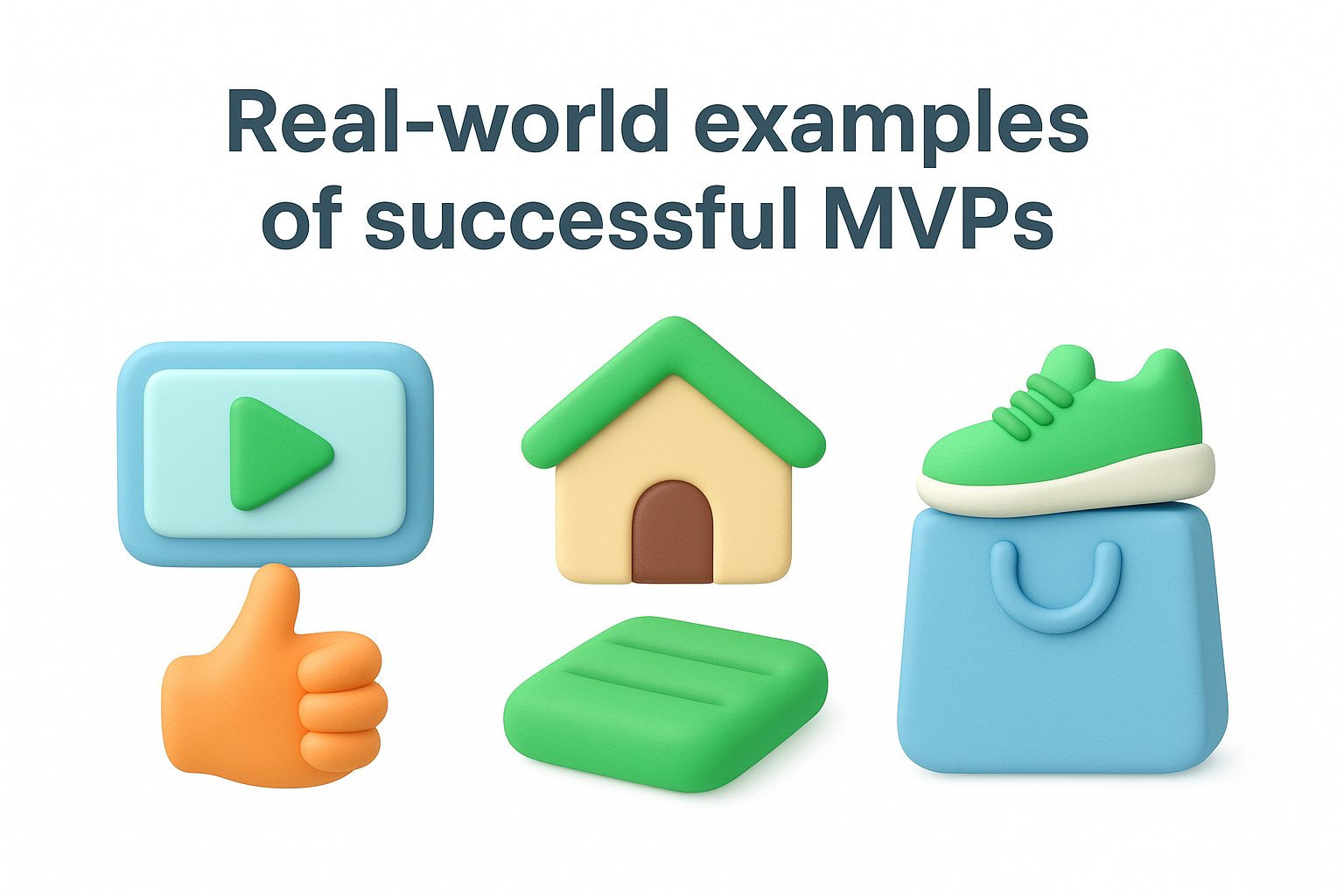
Before building a single line of the file-sync technology, Dropbox's founder posted a short explainer video showing how the product would work. That video wasn't software, it was a validation test dressed up as a demo. Signups jumped overnight, proving people wanted the solution before the team invested months in the hard engineering problem of reliable file syncing across devices.
Airbnb's founders didn't build a booking platform first. They photographed their own apartment, listed air mattresses on a simple site, and hosted guests during a local conference. That scrappy test answered the real question, whether strangers would pay to stay in someone's home, before any of the reservation, payment, or review systems existed.
Zappos' founder photographed shoes from local stores and posted them online without holding any inventory. When someone ordered, he bought the pair at retail price and shipped it himself. It lost money on paper, but it proved people would buy shoes without trying them on first, the core assumption the entire business depended on.
The best MVPs test one risky belief with the least amount of work possible, not the whole business plan at once.
| Company | What they tested | MVP built | What it proved |
|---|---|---|---|
| Dropbox | Demand for seamless file sync | Explainer video | People wanted the solution enough to sign up |
| Airbnb | Willingness to book strangers' homes | Simple listing site, air mattresses | Strangers would pay for a non-hotel stay |
| Zappos | Willingness to buy shoes online, unseen | Manually fulfilled online store | Online shoe sales were viable |
Each example shares the same structure: a narrow test, real users, and a decision made from evidence instead of opinion. None of these teams waited for a finished product to start learning, and none of them are hypothetical case studies invented for a pitch deck. That's the pattern worth copying, not the specific tactics.
Confusion here trips up a lot of teams, mostly because what does mvp mean in product development gets blurred with three other terms that sound similar but do completely different jobs. A prototype, a proof of concept, and an MVP all show up early in a product's life, but only one of them is meant to be used by real customers. Mixing them up leads to wasted builds, like polishing a prototype that was never meant to ship, or asking a proof of concept to generate revenue it was never designed to produce.
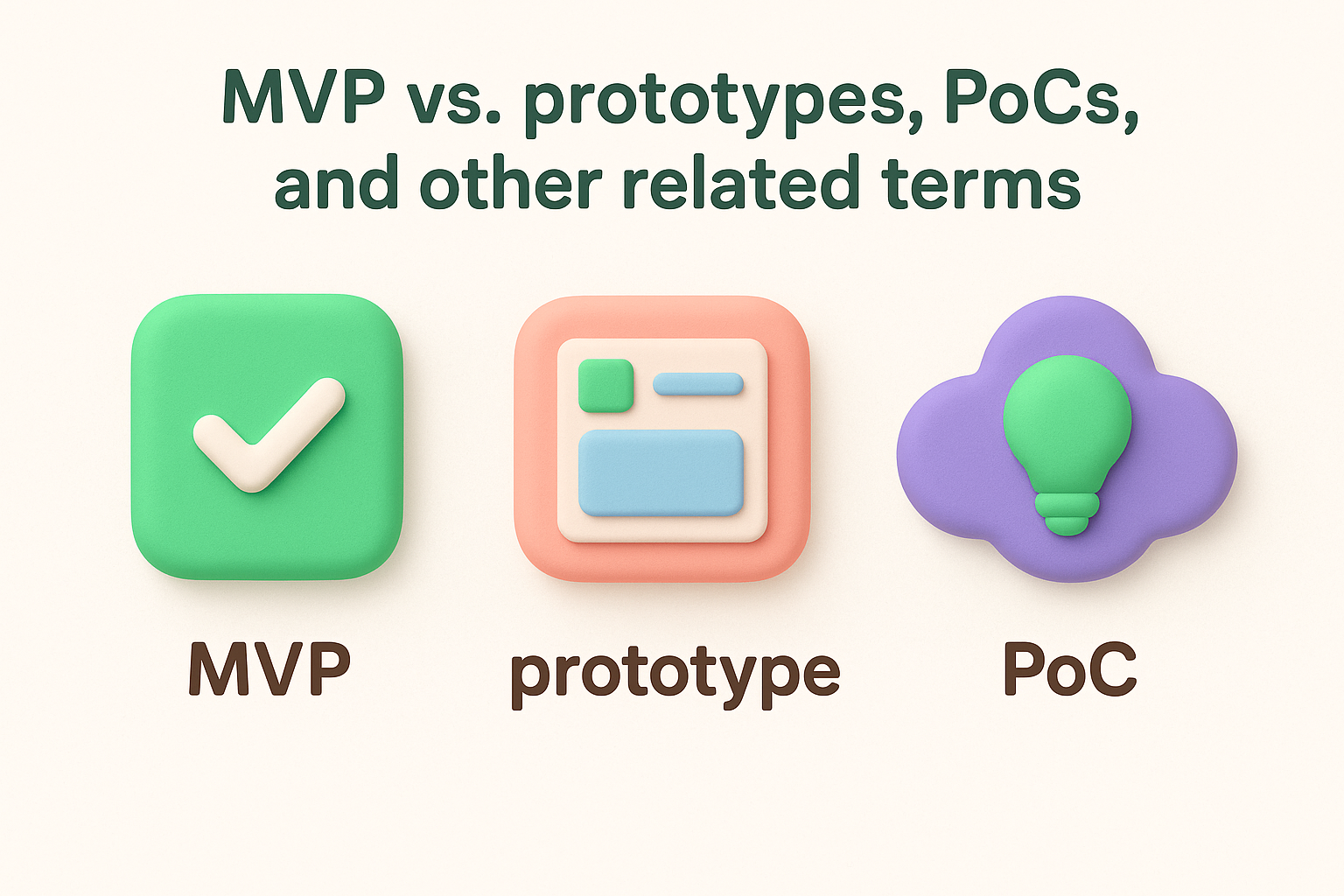
A proof of concept, or PoC, answers one narrow question: can this even be built? It's internal, rough, and never touches a real customer. If your team is unsure whether an integration, algorithm, or piece of hardware will actually function the way you need, a PoC settles that before you spend a dollar on user-facing design.
A prototype comes next, and it's about design validation, not code. Click-through mockups, wireframes, or a Figma flow let stakeholders and testers react to layout and interaction before engineering starts. Nobody completes a real task inside a prototype; they're reacting to a simulation of one.
A PoC proves it can be built, a prototype shows how it will feel, and an MVP proves people will actually use it.
Only the MVP is a working, shippable release that solves a real problem end to end. That distinction matters more than any of the others, because it's the only stage where you're collecting genuine behavioral data instead of opinions about a mockup.
| Term | Built for | Used by real customers? | Answers |
|---|---|---|---|
| Proof of Concept | Technical feasibility | No | Can we build this? |
| Prototype | Design and flow | No, tested internally or with select users | Does this make sense visually? |
| MVP | Market validation | Yes | Will people use and value this? |
Getting this right also clears up the definition of mvp minimum viable product for anyone still treating it as a synonym for "early beta" or "version one with fewer features." It's a distinct stage with a distinct job: proving demand with real usage, not just gathering opinions on a design file.
An MVP only earns its name when you use it to learn, not just to launch. The minimum viable product you ship is a starting point, and the real work happens once real users start reacting to it. Skip the feedback loop, and you're back to guessing, just with extra steps and a live product to show for it.
Build small, test the riskiest assumption first, and set up a real system for capturing what users tell you before you write another line of code for version two. That's the difference between a product that evolves with its users and one that stalls out after launch because nobody organized the input coming in.
If you're ready to turn early feedback into a prioritized, actionable roadmap instead of a pile of scattered requests, centralize and act on user feedback with Koala Feedback and build what your users actually want next.

Start today and have your feedback portal up and running in minutes.