You have an idea that could solve a real problem. But building the full vision takes months and burns through resources you might not have. Ship too early with something half baked and users bounce. Wait too long perfecting features and someone else captures the market. Every product team hits this tension between speed and substance when building their first version.
A strong MVP cuts through this by focusing on six core characteristics that separate products users adopt from prototypes that collect dust. This guide walks through each characteristic with practical steps you can apply. You'll learn how to define clear value, design usable experiences, instrument for learning, and build foundations that support growth. Each section shows you what to prioritize now and what to save for later iterations.
Feedback loops transform an MVP from a static release into a learning engine. Without structured channels to capture what users actually do and say, you're building in the dark. The most successful MVPs treat user input as raw material for iteration, not just validation that you were right. This characteristic separates products that evolve with real needs from those that defend initial assumptions.

Your MVP validates assumptions through real behavior, not surveys or focus groups. Users vote with their actions when they return to your product, ignore certain features, or abandon flows halfway through. Building feedback channels into your MVP gives you both qualitative insights (what users say they want) and quantitative signals (what they actually use). These two data streams together show you where to invest next.
The fastest way to waste an MVP is to launch it without mechanisms to capture and learn from user behavior.
Koala Feedback centralizes feedback from multiple sources into one organized system. Users submit ideas through your branded portal, vote on requests from others, and add context through comments. The platform automatically deduplicates similar feedback so you see clear patterns instead of scattered noise. This structure helps you spot which problems appear most often and matter most to your user base.
Track feature requests by vote count, submission frequency, and user segment. Share planned work, current progress, and completed features on a public roadmap that keeps users informed. Transparency around what you're building next reduces duplicate requests and shows users you listen. Customizable statuses let you set realistic expectations for each item.
Link feedback directly to your prioritization framework using boards organized by product area or theme. Review top voted items against technical feasibility and strategic fit. Use Koala Feedback data to defend roadmap choices to stakeholders with evidence of user demand rather than opinions.
The second of the key characteristics of an mvp centers on focus. Your MVP solves one specific problem for one specific group of users better than any alternative they currently use. This clarity makes the difference between products that gain traction and those that confuse potential users. Spreading your effort across multiple value propositions dilutes impact and makes it harder to measure what actually works.
Identify the specific user segment you serve first. Describe their situation, constraints, and the outcome they need to achieve. This target user should be narrow enough that you understand their workflow and pain points in detail. Document the core job to be done in one sentence that captures both the task and the context where they need to complete it.
Your value proposition states what outcome users get and why your approach delivers it better than alternatives. Write it in plain language that your target user would use to describe their problem. Test whether someone unfamiliar with your product can understand what benefit they receive after reading your value proposition once. Strong propositions focus on user outcomes, not your features or technology.

The clearest value propositions let users instantly recognize their own problem in your words.
Review every planned feature against your core value promise. Remove anything that serves a different user segment, solves a secondary problem, or adds complexity without directly improving the main outcome. This ruthless prioritization keeps your MVP focused and shippable. Save cut features in your backlog for future iterations based on user feedback.
Run quick conversations with target users after they try your MVP. Ask them to describe what problem it solves without prompting them with your own language. Users who can articulate the value clearly in their own terms validate that your promise landed. Confusion or vague descriptions signal you need to simplify your positioning or core experience.
The third of the characteristics of an mvp demands that users can complete their core task without confusion or dead ends. Usability means someone new to your product can navigate from problem to solution in one unbroken flow. Technical functionality alone does not make an MVP viable if users cannot figure out how to extract value from it. This characteristic focuses on eliminating friction between user intent and successful outcome.
Start by defining the shortest path from landing on your product to achieving the core outcome. Document each step users must take and identify where they need to make decisions. This map shows you which screens, actions, and transitions are absolutely required versus nice to have. Keep the journey linear when possible to reduce cognitive load.

Build interfaces that guide users toward the next logical action without requiring instructions. Use clear labels, familiar patterns, and visual hierarchy that highlights primary actions over secondary options. Test whether someone unfamiliar with your product can complete the core flow on their first attempt. Simplicity in design often means removing elements rather than adding them.
Users judge your MVP within seconds of their first interaction, so make the path to value obvious.
Identify every point where users might hesitate, backtrack, or abandon the flow. Cut unnecessary form fields, reduce required clicks, and eliminate steps that do not directly contribute to the outcome. Friction often hides in mandatory account creation, complex configuration, or unclear error messages. Address these blockers before adding polish or features.
Watch target users attempt your core flow without guidance. Note where they pause, click the wrong element, or express confusion. These observations reveal usability gaps your team missed because you know the product too well. Run these walkthroughs with five different users to spot patterns in how people naturally try to use your MVP.
The fourth of the characteristics of an mvp requires that your team can actually build and operate what you designed within real constraints. Feasibility means matching your scope to available technical skills, time, and infrastructure rather than chasing ideal solutions. An MVP that takes six months to ship or crashes under modest usage fails before users can provide meaningful feedback. This characteristic keeps ambition grounded in what you can deliver reliably today.
Assess your team's current technical capabilities honestly before committing to features. Choose technologies and architectures your developers already know rather than learning new stacks during MVP development. Consider available bandwidth across engineering, design, and operations when setting your timeline. Ambitious features that stretch your team beyond capacity delay launch and increase the risk of critical bugs.
Define a release scope that takes weeks not months to reach users. Break down your MVP into the smallest shippable version that still delivers core value. Speed matters because faster cycles let you gather feedback and iterate before burning through resources or losing market timing. Smaller scopes also make it easier to course correct when you discover new information.
The best MVPs ship fast enough that your initial assumptions stay relevant when users finally see the product.
Your MVP must function reliably during core user workflows without crashes or data loss. Test critical paths under expected load to catch failures before users do. Performance should feel responsive enough that users can complete their task without frustration. You do not need enterprise scale but you need enough stability that users trust your product with real work.
Document features you consciously defer to later iterations so the team stays aligned on current scope. Skip complex edge cases, advanced configurations, and secondary workflows that serve niche scenarios. Record these decisions in your backlog with context about why you postponed them. Clear postponement boundaries prevent scope creep and keep your team focused on shipping the viable core.
The fifth of the characteristics of an mvp requires that you measure actual usage and gather evidence about what works. Instrumentation means building tracking and feedback mechanisms into your product before launch, not after you wonder why users behave unexpectedly. Testing with real users validates whether your solution actually delivers value in real situations rather than controlled demos. This characteristic transforms guesses into data and opinions into insights.
Define specific metrics that indicate whether users achieve the core outcome your MVP promises. Choose metrics tied directly to value delivery such as task completion rate, time to first success, or return usage frequency. Avoid vanity metrics like page views that look good but tell you nothing about actual value. Write down your success threshold for each metric so you know when your MVP proves itself or when you need to pivot.
Instrument your MVP with event tracking that captures every key user action along the core flow. Add simple feedback prompts at natural moments such as after users complete a task or when they abandon a process. Integrate Koala Feedback into your product so users can submit requests and vote without leaving your interface. These channels must exist in your first release because you cannot retrofit data from users who already left.
Waiting to add tracking until after launch means losing the most valuable early user signals forever.
Design small controlled tests that isolate one assumption at a time such as whether users prefer option A or B for a critical choice. Change only one variable per experiment so you understand what drives different outcomes. Document your hypothesis, expected result, and actual finding for each test. Structured experiments prevent you from drawing wrong conclusions from noisy data.
Track behavioral data that shows what users do through analytics while collecting stories that explain why they behave that way through interviews and feedback. Numbers reveal patterns across your user base while conversations surface motivations and frustrations you cannot measure. Combine both signal types to build complete understanding rather than relying on metrics or anecdotes alone.
The sixth of the characteristics of an mvp ensures your product can evolve based on learning rather than requiring rewrites when you need to add features. Building for iteration means making architectural choices that support change without throwing away your initial work. This characteristic separates MVPs that scale naturally from those that become technical debt after the first release. Your early code and design decisions either enable or constrain every future improvement.
Structure your MVP with separate modules that handle distinct responsibilities so you can improve one area without rewriting everything. Keep interfaces between components simple and well defined to make swapping or extending pieces straightforward. This modular approach lets you add features by building new components rather than modifying fragile existing code.
Feed insights from user feedback and usage data directly into your product roadmap decisions. Update your backlog priorities based on which features users actually request versus what you assumed they needed. Regular refinement keeps your roadmap aligned with real demand rather than outdated assumptions from before launch.
Your MVP roadmap should change as users teach you what matters most to them.
Resist the urge to optimize performance or handle rare scenarios before you validate core value. Focus your iteration efforts on features that affect most users most often rather than perfecting narrow edge cases. Premature optimization wastes time on problems you might never actually face.
Watch for patterns in feedback and metrics that suggest your core assumption was wrong versus execution issues with the right idea. Pivot when users consistently fail to see value despite using your product correctly. Double down when users love the core but ask for refinements to the existing approach.
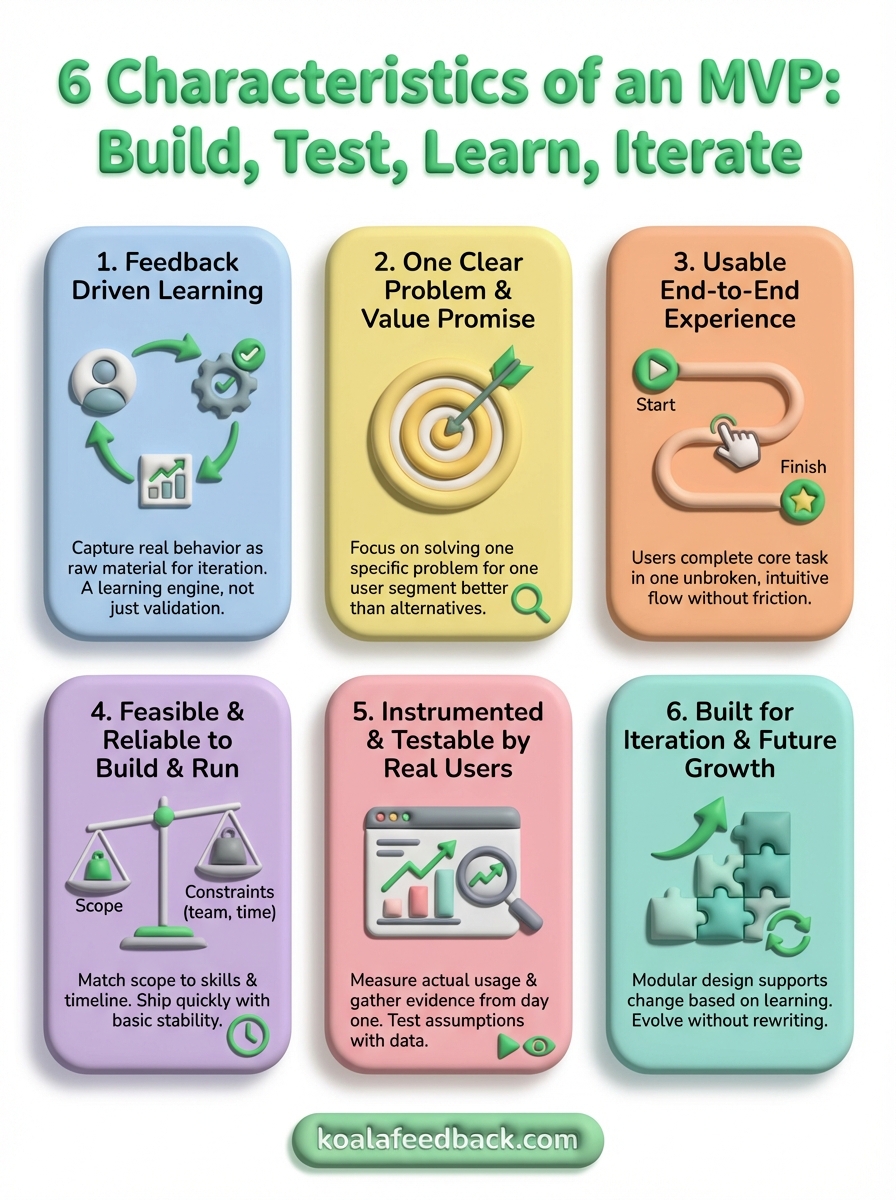
The six characteristics of an MVP work together to balance speed with substance. Your product needs feedback loops that capture real usage signals, a sharp value promise that solves one clear problem, and a usable experience that gets users to their outcome. Build something feasible for your team to ship quickly while meeting basic reliability standards. Instrument everything so you can measure success and test assumptions with actual users. Structure your code and design to support iteration based on learning rather than defending your first version.
Strong MVPs ship fast, gather evidence, and evolve. Koala Feedback gives you the feedback infrastructure you need from day one to capture user input, organize requests, and share what you plan to build next. Start turning user signals into better product decisions today.

Start today and have your feedback portal up and running in minutes.