A new product strategy in marketing is the plan that decides who a new product is for, which problem it solves for them, how you position and price it, where you promote it, and how you will measure success. It sits between building the product and announcing it. Without it, a launch is a press release and a hope. With it, every team knows the target buyer, the core message, and the number that counts as a win.
Koala Feedback helps SaaS product teams collect feedback, prioritize requests, and share public roadmaps. We see how launches go better when teams listen to users before they build and before they announce. That habit sits at the center of good launch planning, and it shapes the advice below.
This article explains why a strategy matters and how to build a marketing strategy for a new product, step by step. It then covers the development stages and frameworks worth knowing, walks through a SaaS example with real numbers, and shows how to measure the result. You also get a positioning template you can copy and a list of mistakes to avoid.
A new product strategy matters because it makes a launch accountable. It forces you to name the buyer, the problem, the message, and the target before you spend money. Teams that skip this step usually ship a good product to an audience that does not understand why it matters.
Most failed launches share the same few causes. The product is positioned vaguely, so no one can say in two sentences who it is for. Messaging lists features instead of describing a problem the buyer already feels. Product, marketing, and sales tell three different stories. Sales or support learn about the product the week it ships. Nobody agreed on what success looks like, so nobody can say afterward whether it worked.
There is also a behavioral reason to plan. Buyers tend to stay with what they already use, even when switching would help them. Habit, a wish to avoid regret, and the mental effort of change all work against you. A new product has to give people a clear reason to move, and a strategy is where you build that reason.
A launch without a strategy is an announcement. A launch with one is a plan with a target, an owner, and a deadline.
People mix up four terms. Keeping them apart stops you from writing a vague document that tries to do everything.
| Term | Question it answers | Typical scope |
|---|---|---|
| Product strategy | Where is the product heading, and why? | Years |
| New product development strategy | How do we find, test, and build the product? | Months to a year |
| Marketing strategy for a new product | Who buys it, why, at what price, and through which channels? | Pre-launch through the first months |
| Launch plan | Who does what, by which date? | Weeks |
This article covers the third row. It draws on the others, but its job is to turn a product into demand.
Build the strategy in this order: set a goal, define the buyer, validate demand, position the product, choose price and channels, prepare your team, and plan measurement. Each step feeds the next, so skipping one weakens everything after it.
Start with a single primary goal. It might be revenue, adoption, engagement, or cross-sell growth. Pick one, because a launch that chases four goals gets none of them. Then write the goal as a number with a date, such as "280 active users within 90 days."
Next, describe the buyer in terms of the problem, not demographics. Write down the situation that makes them look for a solution, what they do today, and what that costs them in time or money. If you sell to more than one type of buyer, write one short profile per type, because each type cares about different things.
Confirm that the problem is real before you invest in a campaign. Talk to 8 to 10 people in your target group, review support tickets and feedback posts, and test your description of the problem on them. If they use different words than you do, adopt their words in your messaging.
Then write your positioning. A simple template works well:
For [target customer]
who [has this problem or need],
[product name] is a [category]
that [main benefit].
Unlike [main alternative],
it [key difference].
A quick test of the result: can someone in sales, marketing, and support each explain the product in two sentences without checking notes? If not, the positioning is not finished.
If your own team cannot explain the product in two sentences, your customers will not manage it either.
Price against the value the buyer perceives and the alternatives they already know, not against your cost. Decide whether tiers, usage-based pricing, or a free entry path fits your buyer. Prices often start higher while the product is new and fall as competitors arrive, so plan how you will revisit it.
Choose two or three channels, not ten. For a SaaS product, strong first picks are an email to existing users, an in-app message, a public roadmap, and one in-depth guide or page. Match the channel to where your buyer already pays attention.
For the message, answer "what's in it for me?" for each buyer type. Lead with the problem and the outcome. Mention features only as proof that you can deliver the outcome.
Brief everyone who will talk to customers before launch day. Sales needs the pitch and the comparison with alternatives. Support needs answers to the likely questions. Name one owner for the launch, because shared ownership usually means no ownership.
Finally, decide which metrics you will watch and how often. Tie each metric to the goal you set in the first step. The measurement section later in this article gives specific metrics for each goal type.
Three models give your strategy a structure: the stages of new product development, the Ansoff matrix, and the adoption curve. They answer different questions. The stages tell you when to act, Ansoff tells you how risky your launch is, and the adoption curve tells you whom to reach first.
Most models describe seven stages of new product development. Marketing has a job in every one of them, not only the last.
| Stage | What happens | Marketing's job |
|---|---|---|
| 1. Idea generation | Collect ideas from users, staff, and the market | Surface real customer problems |
| 2. Idea screening | Cut the list by profit potential and user value | Score ideas against evidence of demand |
| 3. Concept development and testing | Turn the idea into a detailed concept and test it | Run interviews and test messages |
| 4. Business analysis | Forecast sales, costs, and profit | Estimate demand and a price range |
| 5. Product development | Build prototypes and versions | Recruit testers and gather feedback |
| 6. Market testing | Try the product and plan in realistic conditions | Test message, price, and channels |
| 7. Commercialization | Launch to the market | Run the plan and track results |
Many frameworks also list marketing strategy development as its own step, usually between concept testing and business analysis. That is the document you are building in this article.
The Ansoff matrix sorts growth options by whether the product and the market are new or existing.
| Strategy | Product | Market | What it means for you |
|---|---|---|---|
| Market penetration | Existing | Existing | Sell more of what you have |
| Market development | Existing | New | Take the product to a new segment |
| Product development | New | Existing | Launch a new product to current customers |
| Diversification | New | New | New product and new buyer, so highest risk |
A new product sold to your current customers is the safest launch, because you already know their problems and where to reach them. A new product for a new market needs more education and more budget.
Buyers adopt new products in waves, commonly named innovators, early adopters, early majority, late majority, and laggards. Early groups tolerate rough edges and want a real advantage. The early majority is pragmatic. It wants documentation, support, and proof that the product fits its existing processes.
Plan your message for the wave you are in. Free trials and easy setup help early adopters try the product. Case-style proof, clear support, and compatibility details help the majority commit.
Win the first wave with a clear advantage, then win the next wave with proof and support.
Here is an illustrative example of marketing a new product strategy from goal to numbers. A B2B project management SaaS with 2,000 paying customers plans to launch a reporting add-on. The figures are assumptions chosen to show how the math works, not benchmarks.
The team writes down the plan in a handful of lines:
The validation step is where a tool like Koala Feedback fits. Voting and comments show how many users want the same thing, and the Starter plan, which is free, includes 3 boards, unlimited users, and 100 active posts. A public roadmap with statuses such as planned, in progress, and completed then lets the team announce the feature before launch and keep interested users informed.
The team works backward from the goal to see whether it is realistic.
| Funnel step | Assumption | Result |
|---|---|---|
| Customers | Total base | 2,000 |
| See the banner or email | 60% | 1,200 |
| Try the add-on | 40% of those reached | 480 |
| Still active after 30 days | 60% of those who try | 288 |
The plan produces 288 active users, which clears the 280 target by a small margin. That thin margin tells the team where to focus. If only 30% try the add-on, the result drops to 216, so the banner copy and the guide matter most. The funnel also shows where to look first when results come in below plan.
Work backward from your goal through each funnel step, and you will know which step to fix first.
Measure the launch with a small set of metrics tied to your primary goal, and review them often in the first weeks. Early numbers show whether your message lands while you can still change it.
Choose the row that matches the goal you set at the start. Then add one or two supporting numbers, not a dashboard of twenty.
| Primary goal | Metrics to watch |
|---|---|
| Revenue | New revenue, pipeline influenced, average deal size |
| Adoption | Activation rate, share of customers using the product |
| Engagement | Weekly active use, depth of feature use |
| Retention and expansion | Churn, upgrades, cross-sell rate |
| Awareness | Sign-ups, site traffic, branded search |
Check the numbers weekly for the first 30 days, then monthly. Compare each one with the funnel you planned, as in the example above.
These errors appear again and again:
Most of these come back to one fix. Define success first, then work backward to what each team must do.
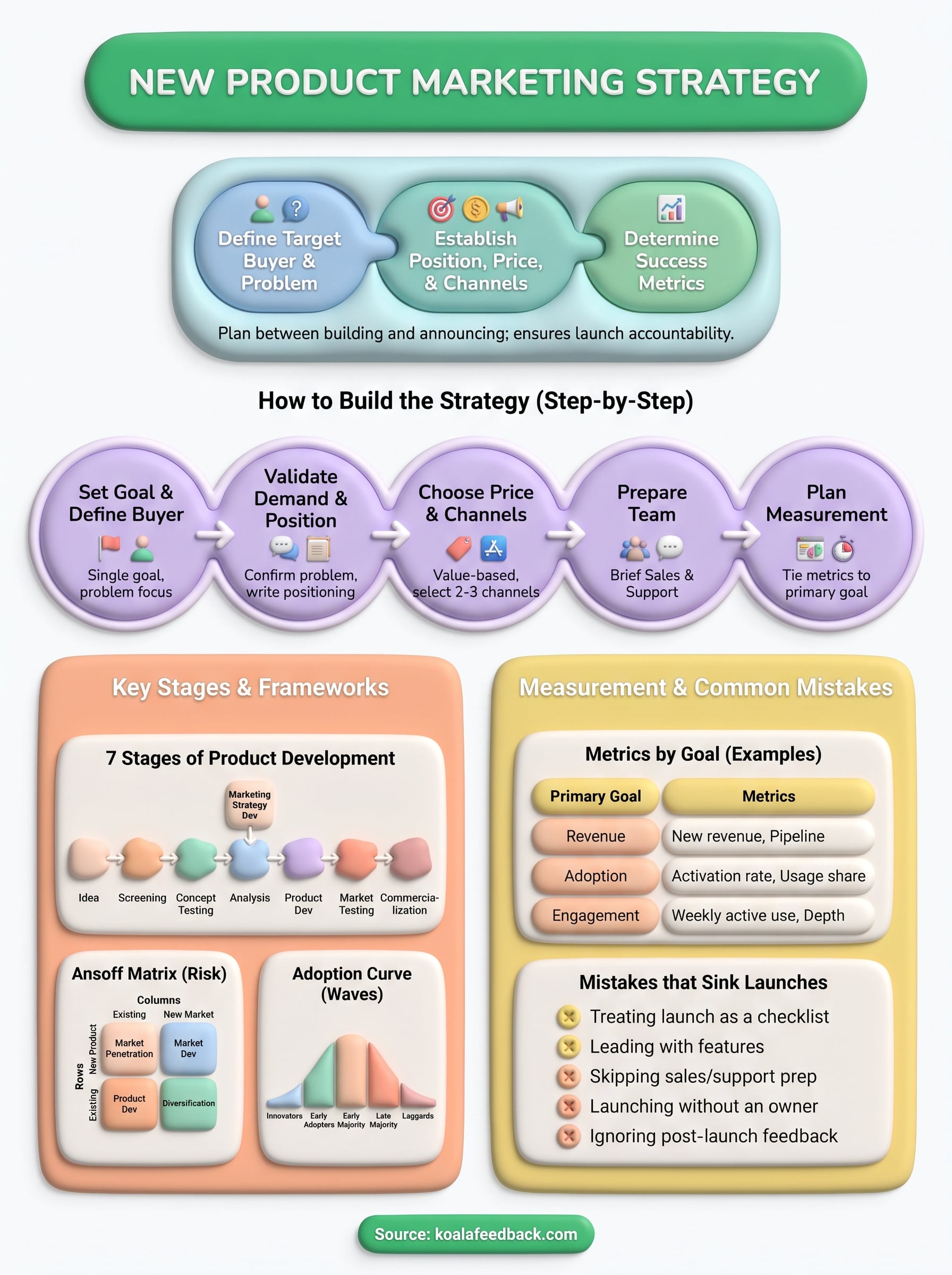
A new product strategy in marketing comes down to five decisions: the buyer, the problem, the position, the price and channels, and the measure of success. Validate the problem before you build the campaign, and enable every team before launch day. Then track a few metrics against a plan you wrote in advance.
If you want to test demand and keep early users informed, a feedback portal with a public roadmap is a practical place to start. You can set up a Koala Feedback portal for free in minutes and see what your users want before you plan the launch.

Start today and have your feedback portal up and running in minutes.