This introduction to the customer satisfaction survey starts with the short answer. A customer satisfaction survey is a brief questionnaire that asks customers how they felt about a purchase, a support conversation, or your product as a whole. You get a rating, often a comment, and a clear signal about what to keep doing and what to fix.
The idea is simple, but results depend on details: when you ask, which questions you pick, and how you open the survey. A cold, vague opening gets ignored. A short, honest one gets answers.
This article covers why these surveys matter, how to build one step by step, how the standard scores work, how to open a survey with copyable examples, and how to turn the answers into action. Koala Feedback builds tools for collecting and acting on user feedback, so we know where surveys help and where a feedback portal fits better.
Customer satisfaction surveys matter because they replace guesses with evidence from the people who pay you. Sales numbers tell you what happened. A survey tells you how customers felt about it.
Many unhappy customers never complain. They quietly stop buying, cancel a subscription, or switch to a competitor. A short survey sent right after a support ticket closes or an order arrives gives them an easy way to speak up, and gives you a chance to fix the problem while the relationship is still alive.
A rating question produces a score you can compare month to month, by product, or by team. If your score drops from 78% to 71% after a pricing change or a new release, you see it within weeks instead of at the next renewal. The comment box then supplies the reason behind the number, which is where the useful detail lives.
A score tells you that something changed, and the comments tell you why.
A survey only answers the questions you ask. It will not reveal the feature a customer wishes you had or a problem you never thought to mention. Treat it as one input next to support conversations, reviews, and an open channel for ideas.
Build a customer satisfaction survey by choosing one goal, one moment, and one metric, then writing three to five questions. Everything else is polish.
Decide what decision the results will inform. Timing matters because memory fades fast. Good triggers are a closed support ticket, a delivered order, or the end of the first week or month of using your product. Asking "how are we doing overall?" at a random moment produces vague answers, so tie the survey to a specific interaction.
Three scores cover most needs. Pick one as your headline number and do not mix them in a single short survey.

| Metric | Typical question | Scale | How you calculate it |
|---|---|---|---|
| CSAT (customer satisfaction score) | How satisfied were you with your experience? | 1 to 5 | Responses of 4 or 5, divided by all responses, times 100 |
| NPS (net promoter score) | How likely are you to recommend us to a friend or colleague? | 0 to 10 | % promoters (9 to 10) minus % detractors (0 to 6) |
| CES (customer effort score) | How easy was it to get your issue resolved? | Often 1 to 7 | Average rating, or share of "easy" answers |
Here is a worked CSAT example. You send a survey after 200 support tickets and 140 customers answer 4 or 5. That is 140 divided by 200, so your CSAT is 70%.
The common five-point scale runs from very dissatisfied, dissatisfied, neutral, satisfied, to very satisfied. Use it consistently. Questions you can adapt:
Keep one open-ended question and avoid double-barreled wording such as "How satisfied are you with our price and quality?" Customers cannot answer two things with one rating. Aim for under two minutes of effort.
One goal, one moment, one headline metric: surveys that try to do more get fewer and worse answers.
A strong opening says who is asking, how long it takes, and what you will do with the answers, in two or three sentences. People decide in seconds whether to continue.
Include these four elements and nothing more:
Skip long thanks, company history, and legal text. Put privacy details behind a link.
After a support interaction:
Hi [Name], thanks for contacting our support team. Could you rate your
experience in three quick questions? It takes about a minute, and your
answers go straight to the team that helped you.
After a purchase:
Your order has arrived, and we would like to know how it went. Please
answer four short questions about buying from us. Your feedback helps us
fix what is slowing people down.
Inside a product:
You have been using [Product] for a month. How is it going? Answer three
questions and tell us what to improve. Responses are anonymous.
Each one names the trigger, sets a time limit, and promises a use for the answers. Replace the brackets, keep the structure.
Ask for a minute, name the reason, and promise a use for the answers.
Feedback from the customer through a customer satisfaction survey only pays off when you read it, sort it, and respond to it. Collecting scores that nobody discusses is the most common failure.
Start with the headline score, then split it by segment, such as plan, product area, or support agent. Suppose 100 customers answer an NPS question: 50 are promoters, 30 are passives, and 20 are detractors. Your NPS is 50% minus 20%, which is 30. Then read the comments from detractors first and group them into themes. Three complaints about the same step beat thirty scattered remarks.
Reply to unhappy respondents within a few days, and tell everyone what changed because of the survey. This makes the next survey more likely to be answered. A survey captures reactions to something that already happened. For unprompted ideas and requests, give customers a place to submit them and vote. Koala Feedback does this with a feedback portal, voting, and a public roadmap that shows what is planned, in progress, and done. The free Starter plan includes 3 boards, unlimited users, and 100 active posts.
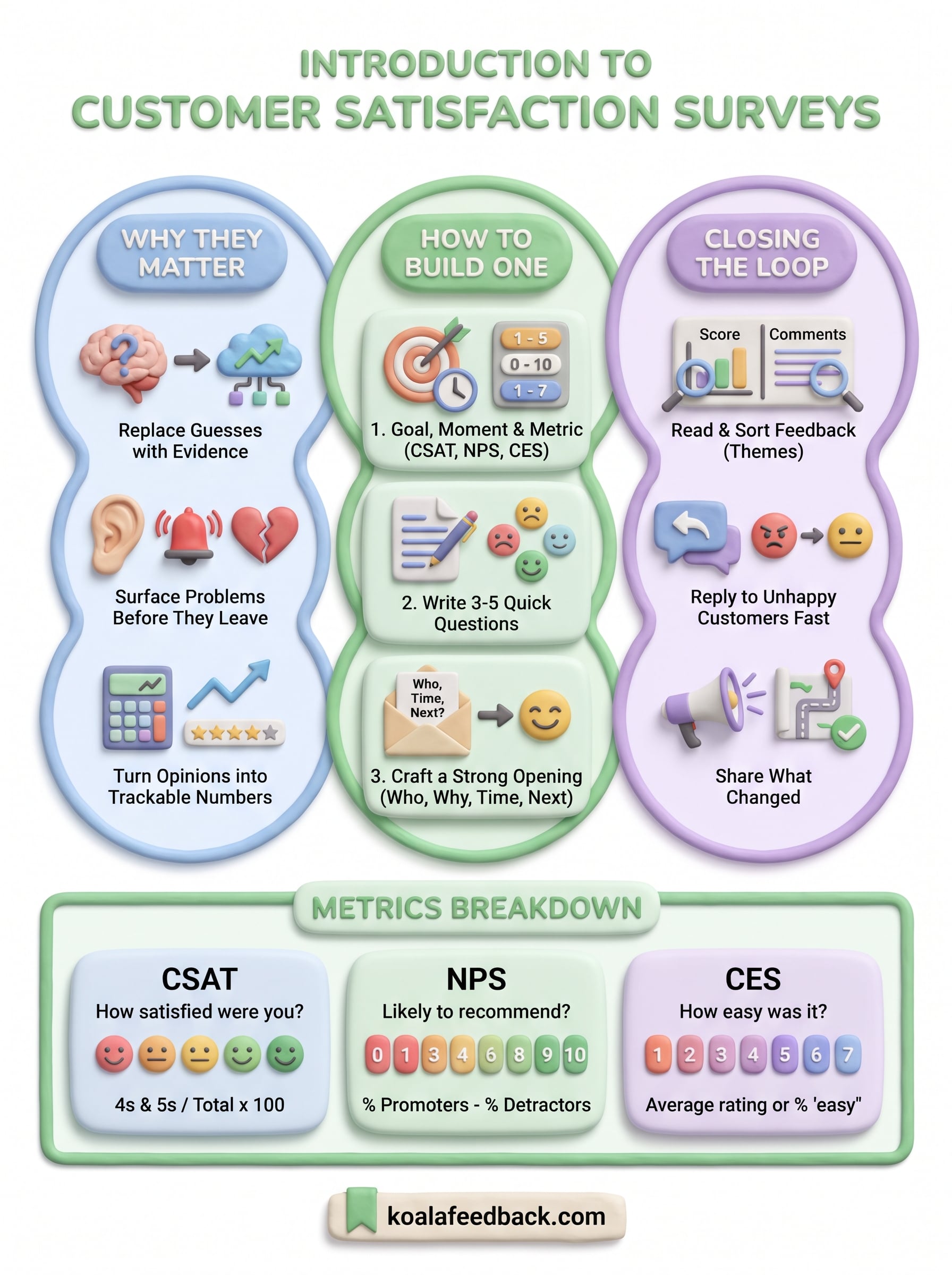
A customer satisfaction survey is a short, well-timed set of questions that tells you how customers feel and why. Pick one moment, one metric, and an opening that states who you are, how long it takes, and what you will do with the answers. Then read the comments, act on the themes, and tell customers what changed.
Surveys show you how people react. To also hear what they want next, give them a place to say it. You can set up a free Koala Feedback portal in minutes and start collecting ideas alongside your survey results.

Start today and have your feedback portal up and running in minutes.