Improving customer loyalty takes three moves: fix whatever pushes customers away, make every interaction feel personal and easy, and give people a reason to return that goes beyond a discount. The nine tactics below cover those moves. If you run a software product, start with the feedback loop and post-purchase follow-up. If you sell physical goods, rewards, personalization, and fast service pay off first. Small teams should pick two or three tactics and run them well.
Customer loyalty is a customer's repeated choice to buy from you when alternatives are a click away. It is hard to win because acquiring new customers keeps getting more expensive. It is worth the effort because retention drives profit. Research by Frederick Reichheld of Bain & Company, often cited, found that a 5% increase in customer retention can lift profits by 25% to 95%, depending on the business. Most teams still give more attention to new leads than to the customers they already have.
Each item below explains how the tactic works, who it suits, and how to start it, so you can compare them quickly. We build Koala Feedback, a feedback and roadmap tool, which is why item one is about listening to customers. The other eight need no special software.
Closing the feedback loop means customers can tell you what they need and then see what you did about it. For a software business, a feedback portal with voting and a public roadmap is one of the most direct ways of increasing customer loyalty, because it turns silence into visible progress.
Customers forgive a missing feature faster than they forgive silence.
Koala Feedback gives your customers one place to submit ideas, vote, and comment on requests. It automatically deduplicates and categorizes incoming posts, so ten people asking for the same export option show up as one request with ten votes instead of ten scattered tickets. You then sort posts into prioritization boards by product area or feature set, which lets you see demand in votes rather than by who shouted loudest.
The loyalty effect comes from the public roadmap. You move each request through customizable statuses such as planned, in progress, and completed, so a customer who asked for something can check where it stands without writing to support. You can also set up the portal with your own domain, colors, and logo, so it feels like part of your product instead of a third-party form.
This tactic fits product managers, SaaS owners, and development teams who get more requests than they can build. It works from early-stage startups to established companies, because the problem is the same everywhere. Requests arrive by email, chat, and calls, and nobody can say what customers want most. Look for these signs that it is time:
Skip it if you will not respond to what people post. An unattended portal hurts loyalty more than having none.
Koala Feedback portals can be up and running in minutes, and a custom domain takes a few more. Signing up is free. Follow these steps:
Choose a plan by the number of boards and statuses you need. Starter also includes unlimited users, and Growth adds custom statuses and file uploads.
| Plan | Price | Boards | Statuses | Admins | Active posts |
|---|---|---|---|---|---|
| Starter | Free | 3 | 5 | 1 | 100 |
| Growth | $29/month, billed annually | Unlimited | 6 | 5 | Unlimited |
| Business | $89/month, billed annually | Unlimited | Unlimited | 5 | Unlimited |
The free Starter plan is enough to test the habit with your most engaged customers before you pay for anything.
Personalization means using what a customer has bought, used, or asked for to decide what you send and recommend. Done well, it makes people feel known, which is central to enhancing customer loyalty. Done badly, it is a first name in a subject line.
Personal means relevant to what the customer did, not what you happen to know about them.
Start with behavior, not demographics. A software company can send a short tutorial to customers who have not touched a key feature after 14 days. A coffee roaster can send a reorder reminder timed to the usual gap between bags. In both cases, the message exists because of something the customer did.
Next, give customers control over what they receive. Let them choose topics and frequency, and make unsubscribing easy. Personalization that feels like surveillance destroys the trust it was meant to build, so rely on data that customers gave you or created by using your product.
Any business with purchase or usage data can personalize, even with a spreadsheet and a basic email tool. You do not need a huge database. You need a few clean fields and a clear question about what each segment needs next. The data that matters most:
Hold off on complex recommendation engines until simple segments already work. Most small teams get more from two good segments than from twenty weak ones.
Begin small and prove the effect before you expand.
A rewards program works when it is simple, valuable, and tied to behavior you want, such as repeat orders or referrals. It is the most familiar way of improving customer loyalty, and also the easiest to get wrong, because discounts alone attract people who leave when the discounts stop.
A rewards program rents loyalty. The other tactics in this list earn it.
You pick a currency (points, tiers, perks, or credits), decide what earns it, and let customers redeem it for something they want. The format should match how your customers buy.
| Reward type | How it works | Best for | Watch out for |
|---|---|---|---|
| Points | Earn per dollar spent, redeem for discounts | Retail, food, frequent purchases | Complicated redemption rules |
| Tiers | Higher status unlocks better perks | Brands with many repeat buyers | Customers stuck at the bottom tier lose interest |
| Referral bonus | Both sides get a credit when a friend buys | Products people recommend | Rewarding fake or low-quality signups |
| Early access | Loyal customers see features or products first | Software, limited releases | Delivering access that feels trivial |
| Birthday or anniversary gift | Small gift on a date | Any consumer brand | Collecting dates you never use |
Run the numbers before you launch. Say customers spend $40 per order, earn 1 point per dollar, and redeem 400 points for a $10 reward. They reach the reward after ten orders, and the program costs you 2.5 cents per dollar spent. That cost only applies to customers who keep buying, which is the behavior you want.
Rewards fit businesses where customers buy often: retail, food, beauty, subscriptions, and services. For B2B software, points feel out of place. Use perks that match the relationship instead, such as early access to betas, annual plan credits, or invitations to product roadmap calls.
Make redemption easy. If a customer needs to read a long terms page to claim a reward, the program creates friction instead of loyalty, and people notice.
Fast, helpful support is one of the strongest levers for increasing customer loyalty, because it shows what a company does when something goes wrong. A customer with a problem is already deciding whether to stay, and your reply is the deciding moment.
Every support ticket is a loyalty test the customer did not choose to take.
Good service has three parts: speed, resolution, and tone. Speed means the customer hears back quickly. Resolution means the problem is solved without five rounds of back and forth. Tone means the reply sounds like a person who cares, not a template.
Self-service and automation help, as long as they have a clear exit. A chatbot or help center can handle password resets and shipping questions. When a customer is upset or the issue is unusual, a human should be easy to reach. Hiding the contact option saves you money in the short term and costs you the customer in the long term.
Every business needs this, but it matters most when purchases are high-value, recurring, or complex: software, subscriptions, big-ticket goods, and services. If you are a small team, you can still compete with larger brands, because a founder replying personally feels better than a ticket number.
Signs your service is hurting loyalty:
Suggested internal targets are a reply to email within one business day and a reply to live chat within a few minutes. Adjust them to your volume.
Friction is any step that makes buying, using, or getting help harder than it should be. Removing it improves customer loyalty because people return to brands that are easy, and leave brands that make them work.
Customers rarely leave over one big failure. They leave over many small annoyances.
Friction hides in places beyond checkout. Delivery, returns, cancellation, reward redemption, and finding help are all part of the journey. Each is a moment where a customer decides whether the effort is worth it.
| Stage | Common friction | Typical fix |
|---|---|---|
| Signup or checkout | Forced account creation, long forms | Guest checkout, fewer fields |
| Onboarding | Empty screens, unclear first step | Guided first task, sample data |
| Delivery | No tracking, vague dates | Tracking links, accurate estimates |
| Returns and refunds | Hidden policy, slow refunds | Clear policy, prepaid labels |
| Billing | Surprise charges, hard-to-find invoices | Plain pricing, self-service invoices |
| Cancellation | Hard to find or reach a person | Simple flow, ask why, offer a pause |
Making cancellation easy sounds like it hurts retention. In practice, a trapped customer is a critic, and an easy exit with a pause option often brings people back later.
This tactic suits any business that sees drop-offs or complaints at a particular stage. Online stores often find the biggest gains at checkout and returns. SaaS teams usually find them in the first session after signup.
Start where the data points. If analytics show that 60% of visitors who add an item to the cart never finish checkout, fixing that step beats redesigning your homepage. If your support tickets cluster around billing questions, simplify billing first.
Post-purchase support is the work you do between the first order and the second. It is where product loyalty becomes brand loyalty, because a customer who got real help after buying has a reason to trust you with the next purchase.
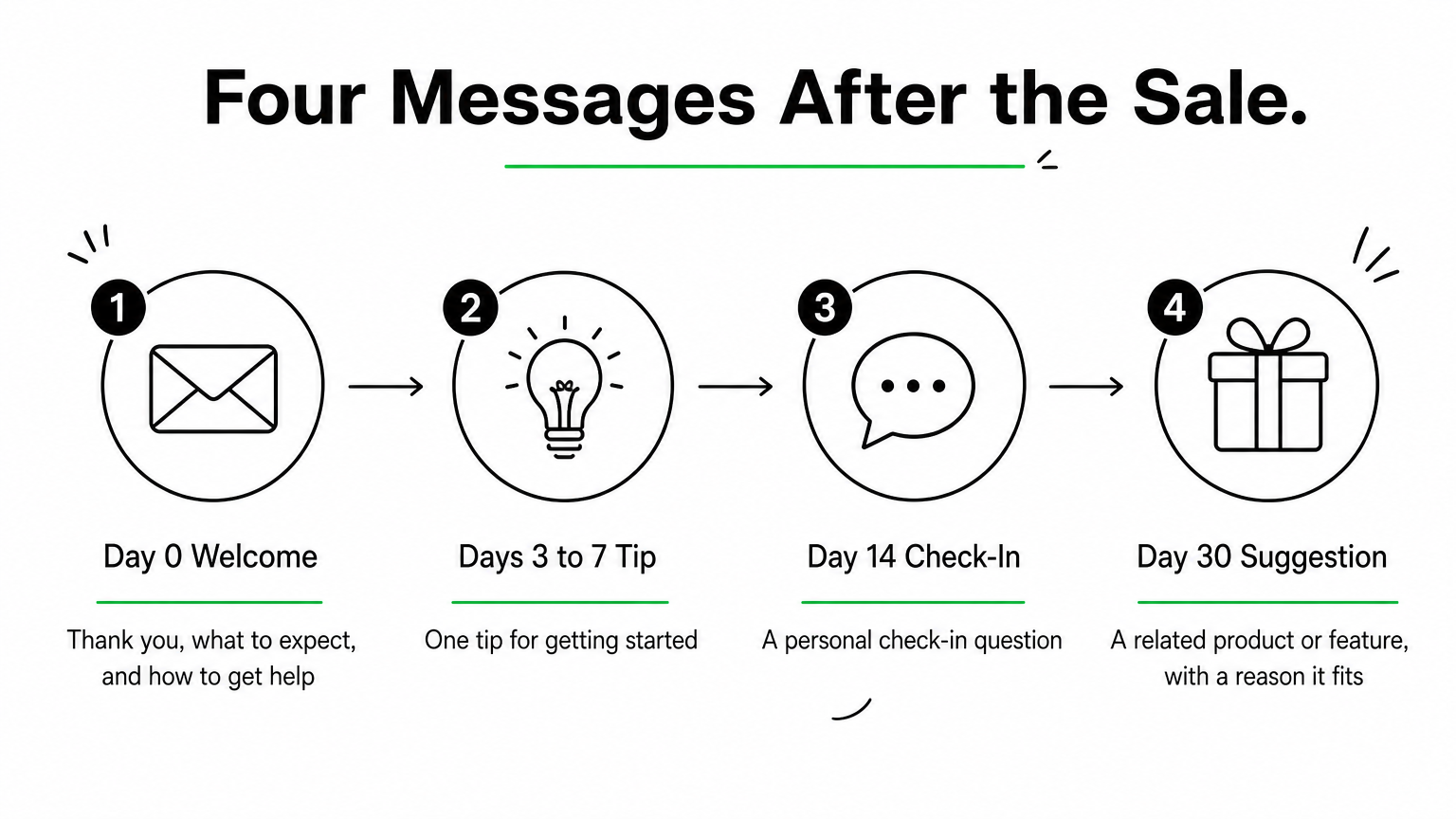
The sale is where the relationship starts, not where your job ends.
Think of it as a short sequence of helpful, expected messages. A thank-you with delivery or setup details comes first. Then come a tip on getting the most from the product, a check-in, and finally a relevant suggestion for what to try next.
For software, the same idea applies to onboarding. Identify the action that predicts retention, such as sending a first invoice or inviting a teammate, and guide new customers toward it in the first 30 days. A customer who reaches that milestone is far more likely to stay than one who stalls.
This fits businesses where a second purchase or a renewal matters: subscriptions, consumables, SaaS, and anything with a learning curve. It also suits customers who love one product but have never tried the rest of your range.
Consider a skincare brand with a customer who bought one cleanser. A message two weeks later asking how it is working, followed by a suggestion for a matching moisturizer, feels helpful. A generic discount blast feels like noise. Follow-ups should start from what the customer actually bought.
Use a simple four-message sequence and adjust the timing to your product:
Here is a check-in template you can copy:
Subject: How is [product] working for you?

Hi [first name],

You started with [product] two weeks ago. What is one thing it has helped you do, and one thing that still feels harder than it should?

Just reply to this email. A real person reads every answer.

[Your name], [Company]
Read the replies yourself for the first month. They show you where onboarding breaks down faster than any dashboard.
A customer community is a place where your customers meet each other, not just you. It supports improving customer loyalty because belonging is a stronger reason to stay than a coupon, and members help each other so you do not have to answer every question.
People leave a company much more easily than they leave a group of friends.
Communities take many forms: a forum, a Slack or Discord group, a social media group, a user meetup, or a members-only newsletter. The common thread is that customers talk to each other about how they use your product, share results, and ask questions.
The business benefits go beyond loyalty. Experienced members answer beginners' questions, which lowers support load. Conversations show what customers really care about, in their own words. Over time, the most active members become advocates who bring in new customers without being asked.
Communities suit products that people use to get better at something or to express who they are: software tools, fitness, crafts, gaming, and professional services. They fit poorly with commodities that customers buy once and forget, where there is nothing to talk about.
You also need someone to tend it. A community without a host fills with spam or goes quiet within weeks. Be honest about whether you can commit a few hours a week before you start.
Consistent quality is the baseline for every other tactic in this list. Customers stay with products that work and companies that do what they said, and no loyalty program can fix a product that keeps disappointing people.
Rewards cannot rescue a product that disappoints.
Every claim you make is a promise: the delivery date at checkout, the uptime on your pricing page, the feature in your ad, the price you quoted. Loyalty grows when reality matches the promise and erodes when it does not. When prices rise, quality slips, or an ad overstates a product, customers feel misled, and that feeling is hard to reverse.
Mistakes will still happen. How you handle them matters as much as how rarely they occur. Own the error quickly, explain what went wrong in plain words, fix it, and tell the customer what changes. A customer who sees a company handle a failure well often trusts it more than before.
This tactic matters most for businesses that ship physical goods, run an online service, or have recently changed pricing. Those are the situations where a gap between promise and delivery shows up fast. It also suits any team that has grown quickly and may have outpaced its processes.
Watch for these warning signs:
Measuring loyalty tells you which of the other eight tactics are working. Track a small set of numbers on a regular schedule, and tie each change you make to a metric so you stop guessing about what improves retention.
A loyalty effort you do not measure is just a hope with a budget.
No single number captures loyalty, so combine a few. Behavior metrics show what customers do. Sentiment metrics show what they feel.
| Metric | What it tells you | How to calculate |
|---|---|---|
| Repeat purchase rate | Share of customers who buy again | Customers with 2+ orders ÷ total customers |
| Churn rate | Share of customers who leave in a period | Customers lost ÷ customers at start |
| Net Promoter Score (NPS) | Willingness to recommend | % promoters (9 to 10) minus % detractors (0 to 6) |
| Customer lifetime value | Revenue expected over the relationship | Average order value × orders per year × years retained |
Two examples show why the numbers matter. If 1,000 customers start a month and 50 cancel, monthly churn is 5%. That sounds small, but 0.95 compounded over 12 months leaves about 54% of the original group, so you lose almost half of those customers in a year. For NPS, if 100 survey responses give 50 promoters, 30 passives, and 20 detractors, your score is 50 minus 20, which equals 30.
Every business can do this, from a solo founder with a spreadsheet to a large team with analytics software. You need three things: a list of customers, a record of when they bought or used your product, and a way to ask them a question.
Look at cohorts rather than totals. Compare customers who joined in January against those who joined in June. If the later cohort retains better, something you changed worked. If worse, check what changed in between.
The nine tactics share one idea: customers stay when you listen, deliver, and make staying easy. Fix quality and promises first, then reduce friction and strengthen support. Personalization, rewards, and community add reasons to come back, and measurement shows what is working.
You do not need to do everything. Pick the two tactics that match where customers struggle or leave, run them for a quarter, and check the numbers. If you run a software product and your customers keep asking what is coming next, a visible feedback loop is a strong place to begin. You can collect and prioritize customer feedback with Koala Feedback, and signing up is free.

Start today and have your feedback portal up and running in minutes.