You know acquiring new customers costs five to seven times more than keeping existing ones. Yet many businesses still pour most of their budget into acquisition while watching loyal customers slip away. The result? Higher costs, thinner margins and constant pressure to fill the leaky bucket. Meanwhile, competitors who nail customer loyalty are spending less, earning more and building sustainable advantages that compound over time.
This guide walks you through 10 concrete benefits of customer loyalty that directly impact your bottom line. You'll see how loyalty reduces costs, increases revenue, improves retention and creates competitive moats. We'll cover practical ways to measure these benefits, from tracking customer lifetime value to calculating savings in acquisition spend. You'll also learn how tools like Koala Feedback help you turn user input into loyalty by closing the feedback loop and showing customers their voice matters. By the end, you'll have a clear framework for building and measuring loyalty as a growth engine, not just a nice to have metric.
Customer loyalty starts when people feel heard. When you actively collect feedback and demonstrate you're acting on it, customers see they're not just transactions but partners in shaping your product. This feedback loop transforms satisfied users into loyal advocates who stick around because they know their voice matters. The challenge is turning scattered feedback into organized insights that drive decisions and signal to customers that you're listening.
Loyal customers want to invest in your success, and feedback gives them a direct channel to do exactly that. When you provide regular opportunities for input through surveys, feature requests and user forums, you invite customers into your product development process. This ongoing dialogue makes them feel valued and creates emotional investment beyond your product's functional benefits. Customers who contribute feedback are three times more likely to renew because they see their fingerprints on your roadmap.
Collecting feedback means nothing if you never acknowledge what you received or explain what happens next. Closing the loop requires telling customers when their suggestion moves from submitted to under review to planned. You need to update them when features ship and credit them when appropriate. This transparency proves you're not just gathering data but actually using it to improve their experience.
Koala Feedback pulls scattered user requests into one system where you can categorize, deduplicate and prioritize based on votes and business impact. You get clear visibility into what matters most to your user base rather than reacting to whoever emails loudest. The platform shows you patterns across feedback sources so you can make confident decisions about what to build next and why.
"Customers who see their feedback implemented become your most vocal supporters, driving word of mouth and retention without additional marketing spend."
Public roadmaps let customers see exactly what you're working on and understand where their requests fit. Koala Feedback makes it simple to share planned, in progress and completed features with custom statuses that manage expectations. This visibility reduces support questions about feature availability and builds trust that you have a clear direction.
When your product, engineering and support teams can see which features loyal customers request most, they can prioritize work that strengthens retention. Koala Feedback gives everyone access to the same feedback data so decisions reflect actual user needs rather than internal assumptions. This alignment ensures the benefits of customer loyalty guide your roadmap instead of getting lost in departmental silos.
Loyal customers consistently deliver higher revenue per transaction and better profit margins than new buyers. They already trust your product, so they spend more freely, buy premium tiers and accept price increases that would drive away shoppers still evaluating alternatives. This revenue advantage compounds over time as loyal customers deepen their relationship with your brand and expand their usage. The result is a customer base that generates predictable, growing revenue without the constant discounting and promotion costs needed to attract first-time buyers.
Repeat customers spend 67 percent more on average than new customers because they understand your product's value and have confidence in their purchase decisions. You don't need to convince them with heavy discounts or extended trials. They return because previous experiences proved the investment worthwhile. Focus on nurturing this trust through consistent delivery and you'll see order values climb naturally as customers upgrade, add features and explore your full catalog.
When customers are loyal, they care less about price and more about continued value. You can maintain higher prices because loyal buyers aren't constantly comparison shopping or waiting for deals. They've already decided you're worth it. This pricing power protects margins even when competitors undercut you, since loyal customers weigh switching costs and relationship history against minor savings.
Personalized recommendations based on purchase history and product usage patterns help loyal customers discover complementary products they actually need. Cross-sell and upsell feel helpful rather than pushy when they're relevant. You boost basket size while improving the customer experience because loyal buyers appreciate discovering solutions they didn't know existed.
Measure how much loyal customer cohorts contribute compared to one-time or occasional buyers by segmenting revenue reports by purchase frequency and tenure. This data proves which benefits of customer loyalty deliver the biggest financial impact and helps you justify investing more in retention programs that drive long-term profitability.
"Loyal customers generate three times more revenue per visit than new customers, making retention the most cost-effective growth lever available."
One of the most measurable benefits of customer loyalty shows up in your cost structure. Acquiring new customers requires advertising spend, sales effort and onboarding resources that add up fast, while keeping existing customers loyal costs a fraction of that investment. Loyal customers also need less hand-holding and fewer support tickets because they already understand how your product works. This cost advantage flows straight to your bottom line, freeing up budget to invest in product improvements that strengthen loyalty even further.
Research shows acquiring a new customer costs five to seven times more than retaining an existing one, yet many businesses still allocate budgets as if acquisition were cheaper. Calculate your customer acquisition cost (CAC) by dividing total marketing and sales expenses by new customers gained, then compare that to your retention program costs per existing customer. The gap proves why retention should dominate your growth strategy.
Loyal customers who use your product regularly encounter fewer basic issues and resolve problems faster when they do need help. They've learned your interface, understand common workflows and often check documentation before contacting support. This familiarity reduces ticket volume and shortens resolution time, lowering your per-customer support cost significantly.
When you analyze what makes customers loyal, you can find new prospects who match those patterns rather than casting wide nets that waste budget on poor fits. Target lookalike audiences based on your most engaged users' characteristics and you'll acquire customers predisposed to loyalty at lower cost per acquisition.
"Retention focused businesses spend 60 percent less on customer acquisition while growing revenue faster than competitors chasing new logos."
Track how much you spend acquiring versus retaining each customer segment and calculate support costs by cohort tenure. These metrics quantify exactly how loyalty reduces your cost base and justify shifting resources from acquisition to retention programs that deliver better returns.
Repeat purchases are the clearest sign that customer loyalty is working. When customers come back again and again, they demonstrate trust in your product and satisfaction with their experience. This behavioral pattern reduces your dependence on unpredictable acquisition channels and creates stable, recurring revenue you can count on. The key is understanding what drives both behavioral loyalty (actual repeat purchases) and emotional loyalty (preference for your brand) so you can strengthen both simultaneously.
Behavioral loyalty shows up in purchase frequency and consistency while emotional loyalty reflects genuine preference for your brand over alternatives. You need both. Customers might buy repeatedly out of habit or convenience (behavioral) without feeling any attachment, making them vulnerable to competitors. True loyalty combines regular purchases with positive sentiment that keeps customers engaged even when better prices appear elsewhere. Track both metrics to understand whether you're building lasting relationships or just temporary patterns.
Your loyalty program should incentivize the behaviors that drive retention, not just transactions. Reward customers for actions like leaving reviews, referring friends and engaging with your content alongside their purchases. This approach builds emotional connections that outlast any single transaction and encourages customers to participate in your community rather than simply complete orders.
Use engagement data to identify customers whose activity is declining before they disappear completely. Reach out with targeted offers or check-ins that acknowledge the changed behavior and invite them to share concerns. This proactive approach prevents churn by addressing issues while customers still care enough to respond.
"Companies that actively monitor engagement signals can reduce churn by 25 percent through early intervention with at-risk customers."
Calculate your retention rate by measuring what percentage of customers remain active month over month or year over year. Track churn rate as the inverse and watch repeat purchase frequency to spot trends early. These metrics quantify the benefits of customer loyalty initiatives and help you optimize programs based on actual retention impact.
Customer lifetime value (CLV) measures the total revenue you can expect from a single customer relationship over its entire duration. This metric captures one of the most powerful benefits of customer loyalty because it shows how retention compounds over time. A customer who stays for five years might generate ten times more value than someone who churns after six months. By focusing on loyalty, you increase CLV across your customer base and shift from constantly replacing lost customers to maximizing returns from existing relationships.
CLV calculates projected future revenue minus acquisition and service costs for each customer segment. Understanding this number tells you exactly how much you can afford to spend acquiring customers while staying profitable. High CLV customers justify higher acquisition costs and more generous retention investments. Calculate CLV by multiplying average purchase value by purchase frequency and customer lifespan, then subtracting the costs to acquire and serve them.
Every percentage point increase in retention directly lifts your average CLV because customers stick around longer and buy more frequently. Track how loyalty program members compare to non-members in terms of purchase frequency, average order value and tenure. This comparison proves which retention initiatives actually move the needle on lifetime value.
"A five percent increase in customer retention can boost profits by 25 to 95 percent by extending customer lifespans and increasing their cumulative value."
When you know your average CLV by segment, you can allocate marketing spend rationally by investing more in acquiring and retaining high-value customer types. Stop treating all customers equally and shift resources toward segments with the longest lifespans and highest spending patterns.
Group customers into CLV tiers based on their projected value and tailor your retention efforts accordingly. Your highest-value segment deserves white-glove service and premium benefits while lower tiers receive automated engagement. This segmentation ensures you're investing loyalty resources where they generate the best returns.
Loyal customers become voluntary marketers who spread positive messages about your brand without you asking. They naturally share their experiences with friends, leave reviews and defend your reputation when others question your value. This word-of-mouth marketing costs you nothing but delivers trust signals that paid advertising can never replicate. People trust recommendations from friends and family far more than any ad campaign, making advocacy from loyal customers one of the most valuable benefits of customer loyalty you can cultivate.
Word-of-mouth recommendations from existing customers drive 13 percent of all consumer sales and convert at higher rates than cold outreach. Loyal customers share naturally because they feel proud to associate with your brand and want others to experience the same value. Create opportunities for this organic sharing by making your product remarkably good and easy to talk about.
Ask satisfied customers to leave reviews on major platforms and share their success stories through testimonials or case studies. User-generated content like photos, videos and social posts provides authentic proof that real people love what you sell. This social proof reduces purchase anxiety for prospects and costs almost nothing to produce.
"Customers influenced by recommendations are four times more likely to make a purchase and stay loyal 37 percent longer than those acquired through other channels."
Structure referral programs that give value to both referrer and new customer so everyone benefits from participation. Track which customers refer most frequently and recognize their contribution with exclusive perks or public acknowledgment.
Balance incentives carefully so rewards enhance rather than undermine authenticity. Customers should refer because they genuinely believe in your product, not just for compensation. Excessive rewards can make advocacy feel transactional and damage the trust that makes referrals effective in the first place.
Loyal customers provide deeper, more actionable feedback than casual users because they care about your product's success and understand it well enough to offer meaningful suggestions. They've lived with your product long enough to spot genuine problems and opportunities rather than surface-level complaints. This data quality advantage makes loyalty one of the most valuable sources of product intelligence you can access, turning your customer base into a research panel that continuously reveals what matters most.
Customers who feel loyal to your brand invest time in thoughtful responses when you ask for input. They explain context around their requests, describe how they use features and provide detailed examples of pain points you need to address. This depth surpasses the shallow feedback you get from users who barely know your product.
Blend behavioral metrics like usage frequency and feature adoption with qualitative feedback from surveys and support conversations to understand both what customers do and why they do it. Quantitative data shows patterns while qualitative input explains the reasoning behind those patterns, giving you complete visibility into customer needs.
"Companies that combine behavioral data with direct customer feedback make product decisions 40 percent faster and with higher confidence than those relying on single data sources."
Use consolidated feedback to prioritize features that retain your most valuable customers rather than chasing every request. Filter insights through the lens of which improvements strengthen loyalty metrics like retention rate and engagement frequency. This focus ensures you build what actually drives the benefits of customer loyalty instead of distracting nice-to-have features.
Distribute loyalty insights to every team that touches customers so product understands what to build, marketing knows what to emphasize and support can anticipate common questions. This alignment prevents departments from working with conflicting assumptions about what customers need.
Strong customer loyalty creates defensive barriers that protect your market position and make it difficult for competitors to steal customers. When customers feel deeply connected to your brand, they resist switching even when rivals offer similar products at lower prices. This competitive insulation represents one of the most strategic benefits of customer loyalty because it compounds over time, turning your customer base into an asset competitors cannot easily replicate through advertising or discounting alone.
Loyal customers accumulate emotional and practical investments in your product that make leaving painful. They've customized settings, built workflows, stored data and developed habits around your solution. Breaking these patterns requires effort they'd rather avoid, so they stick with you instead of starting from scratch elsewhere. Increase this friction by offering features that deepen integration into their daily operations.
When competitors undercut your pricing, loyal customers weigh relationship history against minor savings and usually choose to stay. They trust that your higher price reflects superior value they've already experienced. This price insulation protects margins and prevents destructive price wars that benefit no one.
"Loyal customers are 50 percent less likely to switch for a 10 percent price reduction compared to casual buyers who actively compare alternatives."
Your loyal base provides built-in demand for new offerings because they trust you'll deliver quality. Test products with loyal customers first to validate demand before broader launches and use their feedback to refine positioning.
Everyone makes mistakes, but loyal customers forgive yours when you maintain consistent values and quickly address problems. They give you chances to recover that competitors would never receive.
Customer loyalty extends beyond transactions to shape how the market perceives your company and how employees feel about their work. When customers consistently choose you and advocate for your brand, you build a reputation that attracts both buyers and talent. This reputation becomes self-reinforcing as external recognition improves internal pride, which drives better customer experiences that generate more loyalty. The cultural impact represents one of the most overlooked benefits of customer loyalty because it transforms your organization from the inside out.
Your market reputation depends heavily on whether customers trust you and tell others about positive experiences. Loyal customers create this trust signal by returning repeatedly and recommending you publicly. This pattern builds a brand identity centered on customer satisfaction that differentiates you from competitors focused solely on acquisition.
Top candidates research company reputations before applying, and strong customer loyalty signals tell them you build products people genuinely love. They want to work for brands customers trust because it validates their career choice and gives their work meaning beyond a paycheck.
Employees feel proud when customers express genuine appreciation and choose you over alternatives. This pride increases engagement and reduces turnover because people want to stay at companies that earn customer devotion.
"Companies with high customer loyalty scores report 32 percent higher employee satisfaction and 25 percent lower turnover than competitors with weaker loyalty metrics."
Celebrate customer success stories, positive reviews and renewal milestones across your organization so everyone sees the impact of their work on customer relationships. This visibility aligns teams around loyalty as a core value.
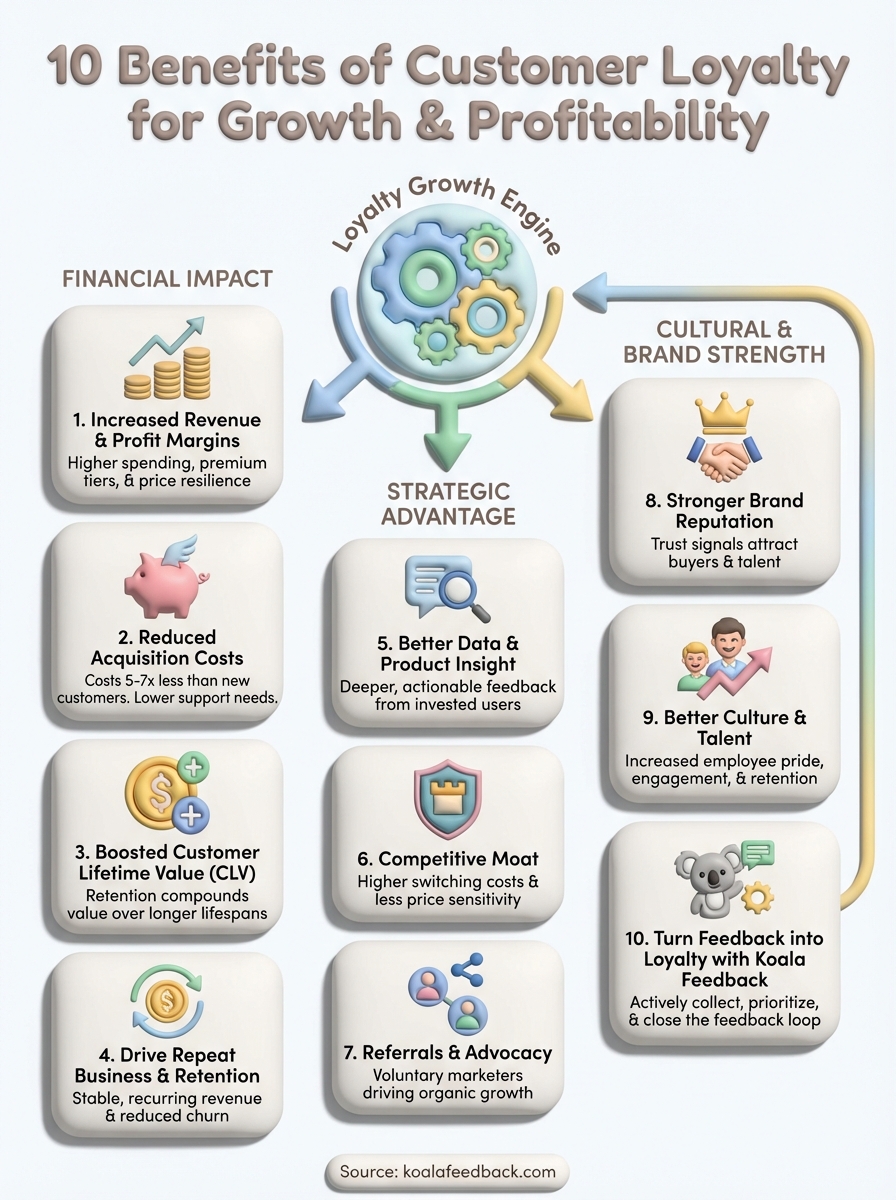
The benefits of customer loyalty extend far beyond simple repeat purchases. You've seen how loyalty reduces acquisition costs by up to seven times, increases revenue per customer by 67 percent, and builds competitive moats that protect your market position. Each benefit compounds the others, creating a growth engine that becomes more powerful over time as your loyal base expands.
The difference between businesses that merely track loyalty and those that actively cultivate it comes down to treating feedback as a strategic asset. When you close the loop on user input and demonstrate you're listening, customers transform from passive buyers into engaged partners who drive your product direction and defend your brand in the market.
Start building customer loyalty with Koala Feedback by centralizing your feedback, prioritizing what loyal customers request most, and sharing transparent roadmaps that prove their voice shapes your decisions. Your most valuable customers are ready to tell you exactly what they need. Make sure you're listening.

Start today and have your feedback portal up and running in minutes.