The best loyalty programs for customer retention make coming back to your business worth more than switching away. Points and punch cards suit frequent, low-ticket purchases like coffee or groceries. Tiered programs suit businesses where customer spend varies widely. Paid memberships suit stores with recurring perks like free shipping. Referral and community programs suit software and subscription companies, where customers stay when they feel heard and rewarded for advocacy.
Most owners know that keeping a customer costs less than finding a new one. The trouble is that a rewards program launched without a clear mechanism just trains shoppers to wait for the next discount. The real question is which structure changes behavior for your customers, and what it costs you to run.
This guide explains how loyalty programs affect retention, then walks through six program types with real examples, the businesses each one suits, and the traps to avoid. It ends with a framework to choose, launch, and measure your own program. At Koala Feedback we help SaaS teams collect and act on customer feedback, so you will also see where listening to customers fits into loyalty.
Loyalty programs improve retention by attaching a reward to repeat behavior, so the next purchase becomes more attractive than a competitor's offer. They work through habit, accumulated value, and information. They do not work through discounts alone, and the data shows why.
Four mechanisms do most of the work in any program, whatever its type:
Each mechanism raises the cost of walking away without raising your prices.
A loyalty program retains customers because leaving means giving up something they have already earned.
Penn State Extension, citing research by Keiningham and colleagues, reports that supermarket loyalty members spend about 48% more on average than nonmembers. In clothing retail the gap is about 18%. Those are large differences, but treat them carefully. Customers who already shop often are the ones most likely to join, so some of that gap is self-selection rather than program impact.
Cost matters too. The same Penn State source cites an estimate that running a program typically takes 2% to 5% of revenue, depending on software, data handling, and how you communicate rewards. A program has to lift retention enough to pay for that.
Programs that hand every member the same discount often attract casual shoppers who simply wait for the next offer. Traffic and transactions rise, but each sale is made at a lower price, and retention does not improve.
The fix is to reward accumulated behavior instead of mere membership, and to keep the basics strong. Product quality, service, and availability still decide whether a customer returns after the reward is spent.
A points-based program awards points for purchases or actions and lets members redeem them for rewards. It is the most familiar format, so customers need no explanation, which makes it the easiest first program to launch.
Members earn points when they buy, and sometimes when they review, refer, or sign up for emails. They redeem points for credit, discounts, or free items. Customers track balances through a loyalty card, an online account, or an app. Points programs usually come in three forms:
Starbucks Rewards is the best-known case. Members earn stars when they pay through the app or a preloaded account, then redeem them for food and drinks. Because payment and rewards live in one place, joining becomes part of the daily routine.
Here is a punch-card example at small scale. A cafe sells a $5 latte and offers the tenth one free. A member pays $45 for ten drinks worth $50, a 10% effective discount, and has to visit ten times to get it. Someone with six punches has a reason to come back this week.
Points work best for frequent, low-ticket purchases such as coffee, groceries, beauty, and pet supplies. Watch for two problems. Customers must be able to tell what a point is worth, so state it plainly, for example "1,000 points equals $10 off." And if you use paper cards, tell members that a lost card means lost rewards before they start collecting.
Points work when customers can tell at a glance what a point is worth.
A tiered program gives better benefits as customers spend more or buy more often. It suits businesses with a wide range of customer value, because it gives your best customers recognition and everyone else a goal.
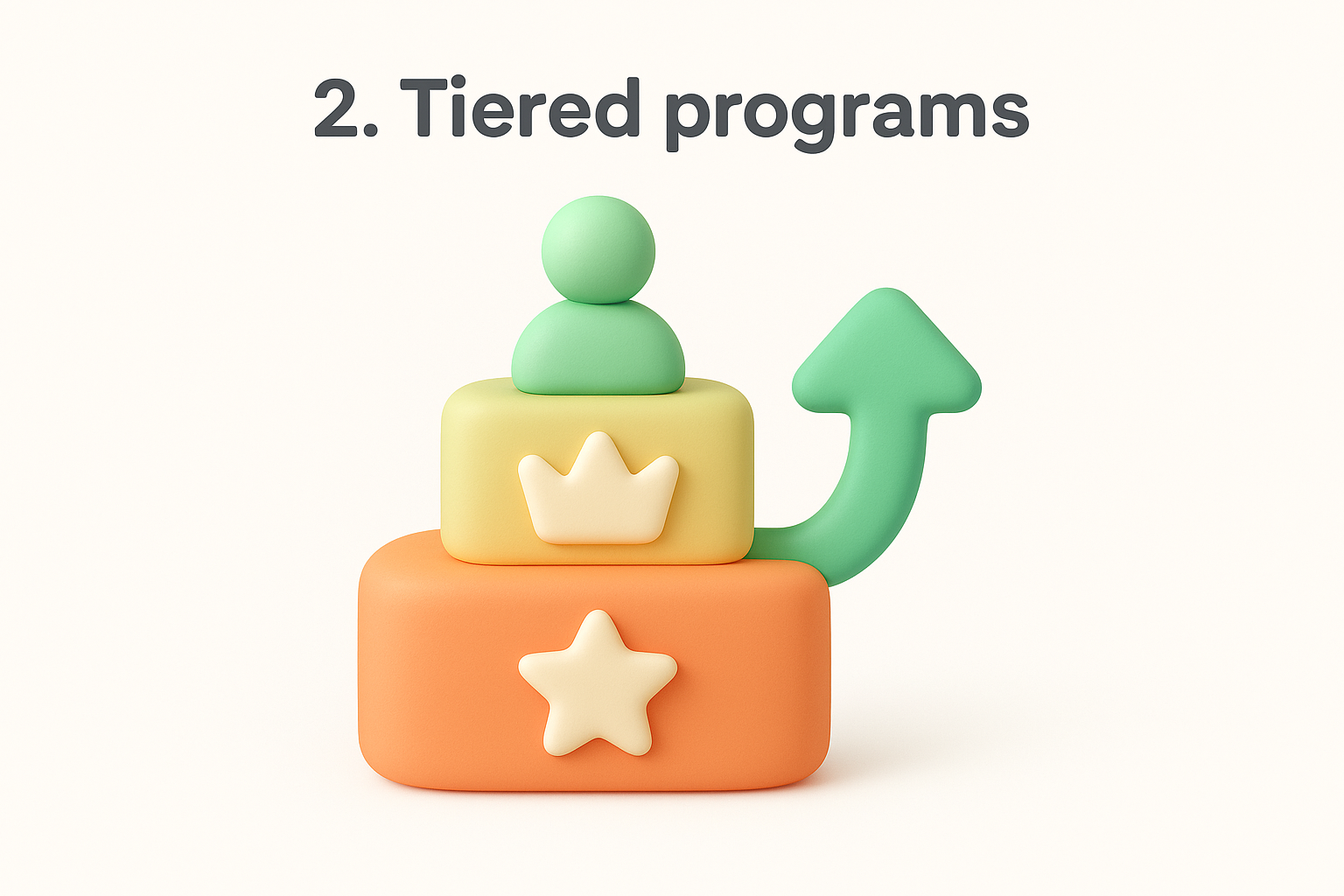
Customers start at an entry level and move up by reaching a spending or activity threshold within a set period. Each tier adds benefits such as higher earning rates, early access, free shipping, or special events. The lever for retention is the gap between tiers. A customer who is $50 short of the next level has a strong reason to place another order instead of buying elsewhere.
Sephora's Beauty Insider has three tiers. Joining is free, and members unlock higher tiers by spending within a year:
| Tier | Annual spend to qualify | Typical perks |
|---|---|---|
| Insider | $0 (free to join) | Birthday gift, points on purchases |
| VIB | $350 | Bigger discounts, member events |
| Rouge | $1,000 | Earliest access, VIP invitations |
Airlines run the same logic. Delta's SkyMiles Medallion levels are based on annual qualifying spend, and each level adds upgrades and priority service.
Tiers fit retailers, travel brands, and any business where a small group of customers produces most of the revenue. Keep the structure to three or four levels. Make every tier's benefit something members value, such as access or service, not just a badge. Too many levels or unclear qualification rules confuse customers and weaken the pull to move up.
Tiers keep customers buying because the next level always looks within reach.
A paid membership charges customers a fee in exchange for ongoing benefits. It is the strongest retention tool on this list when the perks are used constantly, because a customer who has already paid has a reason to buy from you first.
Members pay monthly or annually for benefits such as free shipping, member pricing, exclusive content, or priority service. The fee creates commitment, and the benefits must show up in everyday use. A fee only feels worthwhile if the customer sees the payoff quickly, for example on their second order.
A simple hypothetical shows the math. Suppose a membership costs $99 a year and removes an $8 shipping fee. A member needs 13 orders to break even, so you should expect the program to appeal mainly to customers who order at least monthly.
Amazon Prime is the benchmark. For one fee, members get fast free shipping, video and music streaming, and deals on events like Prime Day. The bundle pulls customers toward one store for shopping and entertainment. Target Circle 360 and Walmart+ follow the same pattern, adding delivery perks that fit into members' weekly routines.
Paid programs suit businesses with frequent purchases and obvious recurring benefits, such as delivery, free returns, or content. They are a poor fit when customers buy once or twice a year. The main risk is perceived value. If members cannot name what they gained, they will cancel at renewal, so remind them of their savings.
A paid membership retains customers only when its value is visible in everyday use.
A referral program rewards customers for bringing in friends and family. It retains the referrer, who becomes a visible advocate for your brand, and it brings in new customers who arrive with built-in trust.
You give existing customers a unique link or code. When someone they refer signs up or buys, the referrer receives a reward, and the new customer often receives one too. Rewards can be credits, discounts, free service time, or extra product capacity. Rewarding both sides raises participation, and tying the reward to the referred person's first purchase keeps costs tied to real revenue.
Dropbox famously grew with a two-sided referral offer that gave extra free storage to both the person who invited a friend and the friend who joined. The reward was more of the product itself, so it cost little and made users more dependent on the service. Zendesk gives a service-based version of the idea: offer a free month of service when a referred friend makes a purchase.
Referrals fit SaaS tools, subscriptions, local services, and any product people talk about. Follow these design rules:
The best referral reward is more of what customers already like about your product.
A value-based program builds loyalty on shared beliefs instead of discounts. Customers stay because buying from you supports something they care about, such as a charity, the environment, or a local community.
You tie each purchase to a cause. A common structure donates a percentage of sales, or a fixed amount per item, to a cause the customer helps pick. The retention effect comes from identity. A customer who feels good about what their purchase supports is less likely to defect over a small price difference.
Zendesk suggests partnering with a nonprofit that connects closely to your mission, which makes the claim more believable.
Ben & Jerry's ties its brand to social and environmental causes, and many shoppers buy its pints in part because they share those values. The shoe brand Etnies planted a tree for every shoe sold in an Earth Day campaign. In both cases the reward is the cause, not a coupon.
Value-based programs suit mission-driven brands whose customers already care about the cause. Authenticity decides everything. Report what the donations achieved, and pick a cause that clearly connects to your business. Do not let the mission stand in for a good product, because values attract customers and quality keeps them.
Customers stay for a cause only when it is real and the product is still good.
A community or early-access program rewards customers with access, voice, and recognition instead of discounts. It is the best match for software, because users who shape the product tend to stay with it.
Members get benefits money cannot buy: first access to launches, invitations to events, a place to talk to other customers, and a say in what gets built. The reward is belonging. For a product company, that means customers can request features, vote on others' ideas, and see what the team plans to build.
Nike's membership gives members exclusive product access and ties them into its SNKRS, Nike Run Club, and Nike Training Club apps. IKEA Family offers styling workshops, member events, and free coffee in stores. Neither relies on discounts alone.
A SaaS version runs on a feedback portal and a public roadmap. With Koala Feedback, customers submit ideas, vote and comment on requests, and follow features as they move through customizable statuses like planned, in progress, and completed. Portals can be live in minutes, a custom domain takes a few minutes more, and signing up is free.
This program suits SaaS companies, product-led businesses, and brands with enthusiast customers. The danger is silence. If members submit ideas and never hear back, the program backfires. Close the loop on every request, even when the answer is "not planned."
Customers who help shape your product have a reason to stay for what comes next.
Choose the program that matches how your customers buy, launch it in a small, simple form, and measure retention against a baseline. Skip the elaborate design at the start. A basic program you can run well beats an ambitious one you cannot.
Start from your purchase pattern and budget. A punch card can start for a few hundred dollars, while a custom app can run to tens of thousands of dollars or more.
| Business type | Best starting program | Why it fits |
|---|---|---|
| Cafe, grocer, salon | Points or punch card | Frequent, low-ticket visits |
| Retailer with uneven customer spend | Tiered | Rewards top customers, motivates the rest |
| Ecommerce store with repeat orders | Paid membership | Shipping value shows up fast |
| SaaS or subscription company | Referral plus community | Retention depends on trust and product fit |
| Mission-driven brand | Value-based | Customers already share the cause |
Retention rate is ((customers at end of period − new customers acquired) ÷ customers at start) × 100. Suppose you start a quarter with 1,000 customers, end with 1,150, and 300 of them are new. Your retention rate is (1,150 − 300) ÷ 1,000 = 85%.
Track it alongside these measures:
| Metric | What it tells you |
|---|---|
| Participation rate | Share of customers who join |
| Repeat purchase rate | Whether members return more often |
| Redemption rate | Whether rewards feel reachable and useful |
| Customer lifetime value | Whether members are worth more over time |
Compare retention before and after launch, since members and nonmembers differ from the start.
Measure retention before and after launch, not just member against nonmember.
Four mistakes recur. Rewards that do not suit the audience get ignored, such as a winery offering red-wine discounts to a white-wine drinker. Complicated earning rules hide the value. Abrupt changes frustrate members, so give several weeks of notice and compensate for lost rewards if you end a program. And no program rescues a weak product. Zendesk advises having a solid business foundation first, because a program exposes any gap in service or quality.
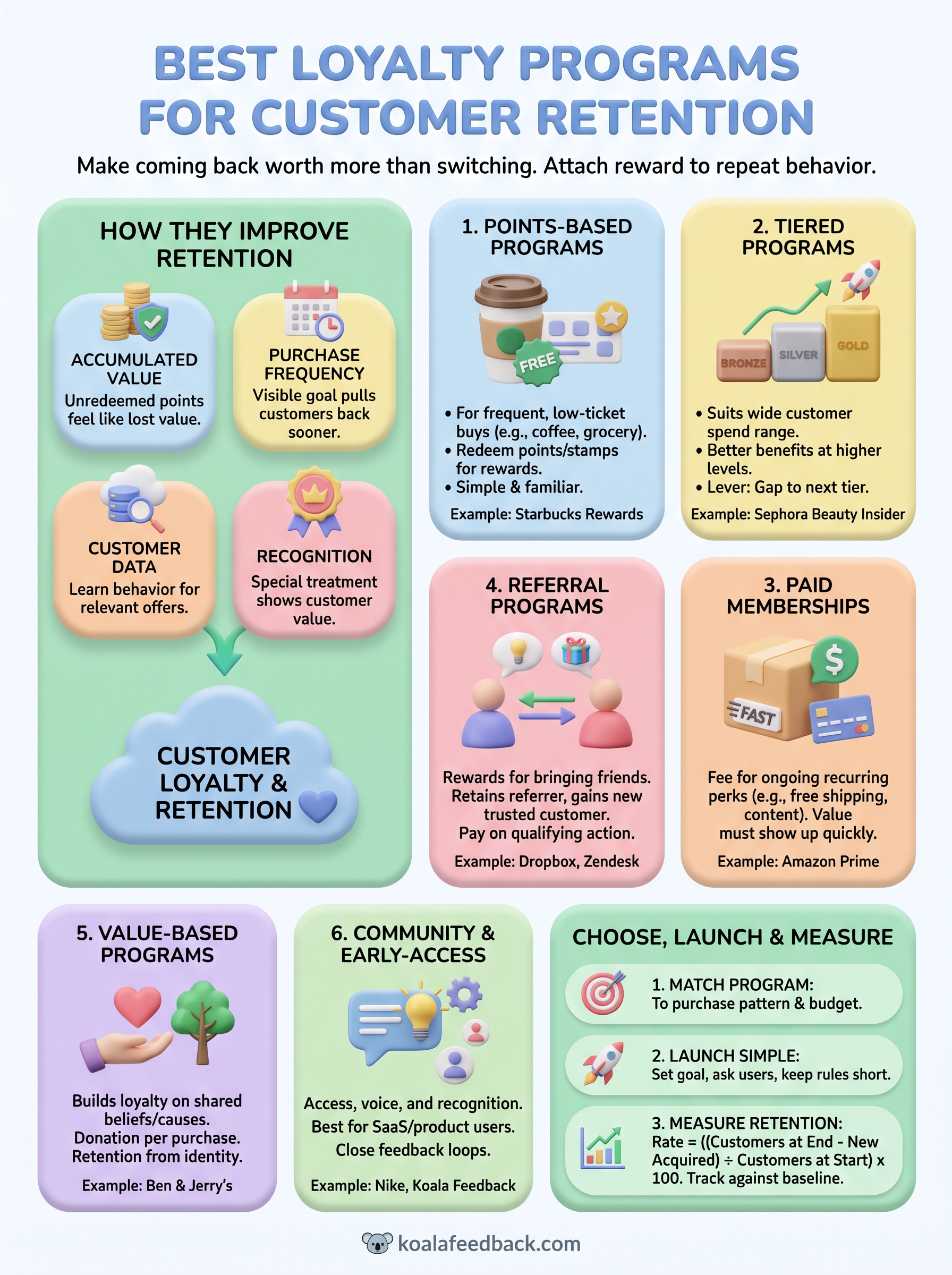
Loyalty programs retain customers when they attach real value to repeat behavior. Points suit frequent buyers, tiers reward your best customers, paid memberships win on convenience, referrals turn customers into advocates, values programs build identity, and community programs give users a voice. Pick one, keep it simple, and measure retention before and after launch.
If you run a software product, the cheapest loyalty lever you have is listening and showing customers you acted. Set up a feedback portal and public roadmap with Koala Feedback and let your users see their ideas move from planned to shipped.

Start today and have your feedback portal up and running in minutes.