If you're studying for a food handler certification exam, you've probably hit this exact question and paused: what is the most direct cause of customer loyalty? It shows up on quizzes because it tests whether you understand what actually keeps people coming back to a restaurant, not just what feels nice to have. Friendly service and a clean dining room matter, but the training material points to one answer as the most direct driver.
The correct answer is food safety standards. Consistently safe, properly handled food is what protects customers from illness and builds the trust that turns a first-time visitor into a repeat customer. Good service and tasty menu items support loyalty, but they don't matter if a customer gets sick from a meal, which is why food safety training programs treat this as the foundational answer.
In this article, we'll break down why food safety ranks above friendly staff, delicious food, and good recordkeeping on most certification exams, walk through how each answer choice is typically framed in quiz questions, and explain the reasoning examiners expect you to apply. We'll also touch on how the same principle, consistency builds trust, applies well beyond restaurants, including how businesses track and act on customer feedback to keep loyalty strong over time.
Ask any restaurant owner what keeps tables full, and price cuts or seasonal promotions often top the list of guesses. Food handler certification exams reject that instinct on purpose. The most direct cause of customer loyalty in these training materials is food safety, because a single case of foodborne illness erases every discount coupon a business ever printed. Customers forgive a slow Tuesday special or a menu price hike far faster than they forgive getting sick. That's the logic examiners want you to internalize: safety is the baseline that makes every other loyalty tactic possible.
Price promotions attract attention, not commitment. A two-for-one deal pulls in a crowd for one visit, but it doesn't answer the question a customer subconsciously asks every time they eat out: will this meal make me sick? Once that question gets answered wrong, no coupon undoes the damage. Food safety standards work differently. They operate silently in the background of every transaction, and customers rarely think about them until something goes wrong. That invisibility is exactly why the training material treats safety as the root cause rather than a nice-to-have feature.
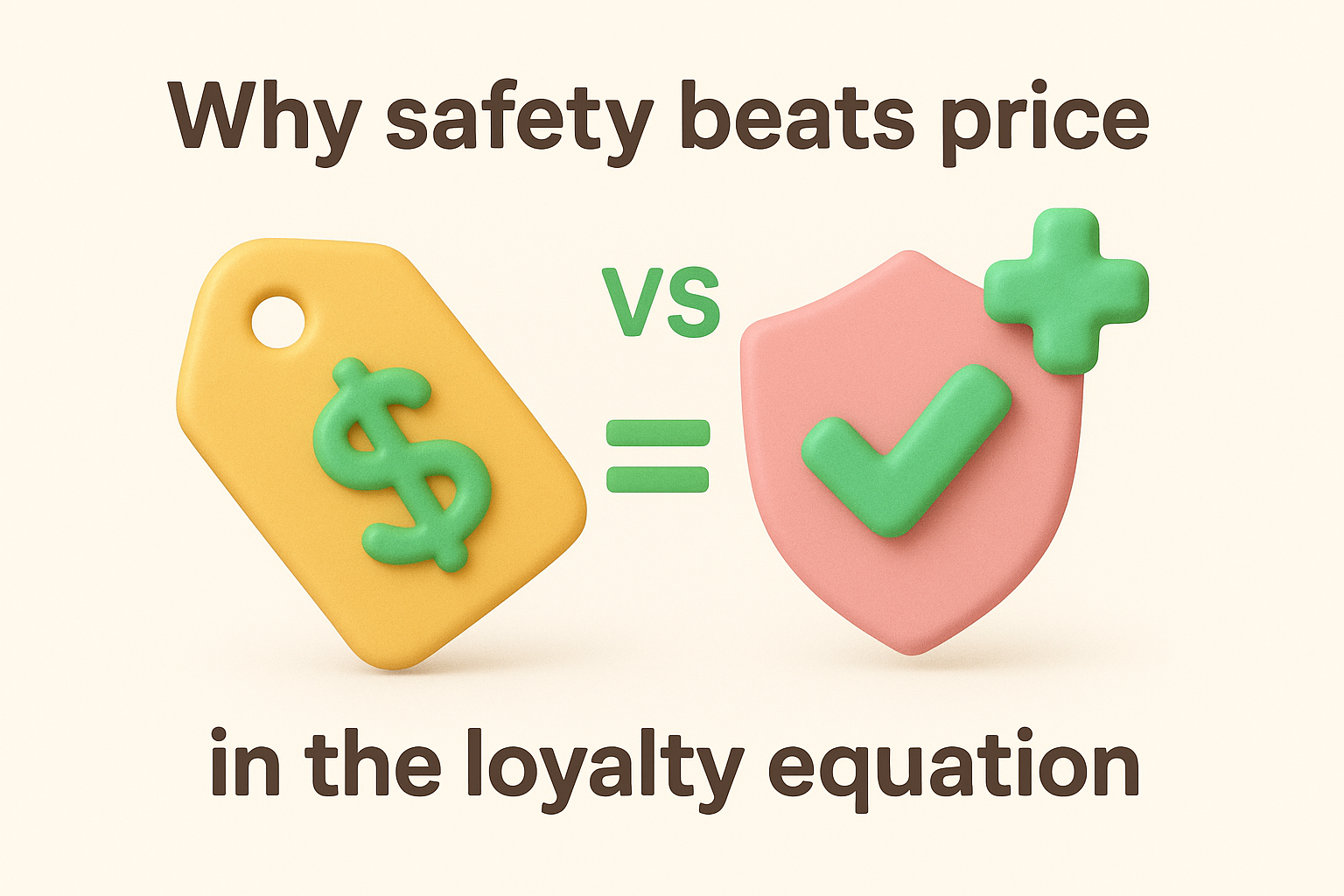
A satisfied customer forgives higher prices; a sick customer never comes back.
Discounting feels productive because it produces an immediate spike in traffic. Managers see the numbers move and assume they've built loyalty, when really they've just bought a temporary bump. Price-driven customers tend to be the least loyal segment of any audience; they'll leave the moment a competitor undercuts you by fifty cents. Restaurants that lean on promotions instead of operational discipline often find themselves running discounts forever just to keep the same seats filled.
Meanwhile, a single food safety violation can undo years of promotional spending overnight. Health department closures make local news, show up in online reviews, and stick in a community's memory far longer than any advertised special. That asymmetry, a small upside from discounts against a catastrophic downside from a safety failure, is why exam writers frame food safety training as the answer that protects the whole business, not just one line on a P&L. The FDA's Food Code exists precisely because regulators recognize how quickly one incident can undo years of goodwill.
Loyalty built on safety and consistency compounds over years, the same way trust in any relationship strengthens with repeated proof. Every meal served without incident adds a small deposit to a customer's mental account, and that account eventually pays out as repeat visits, referrals, and tolerance for the occasional price increase. Discounts, on the other hand, reset to zero the moment they end. This is the same pattern that shows up in software and service businesses: companies that prioritize operational reliability over short-term deals retain customers far longer than the ones that compete on price alone.
| Loyalty Driver | Typical Effect | How Long It Lasts |
|---|---|---|
| Price discount | Short-term traffic spike | Days to weeks |
| Friendly service | Pleasant single experience | One visit, unless repeated consistently |
| Food safety standards | Foundational trust | Builds over years, erased instantly by one failure |
Understanding this table helps explain why the exam question insists on one answer instead of accepting several reasonable ones. Customer loyalty isn't the sum of nice touches; it's the product of never violating the one thing customers can't forgive.
Knowing that food safety drives loyalty is only half the lesson. The harder part is building systems that make consistency automatic instead of accidental. Consistent experience means a customer gets the same safe, reliable meal on their tenth visit as they did on their first, and that reliability is what the exam question is really testing. Restaurants that treat food safety as a checklist item rather than a daily habit tend to slip the moment things get busy, and that's exactly when mistakes happen.
Businesses often want to differentiate through personality: a signature greeting, a unique plating style, a quirky menu description. Those touches matter, but they should sit on top of a rock-solid operational foundation, not replace it. Standardized procedures for temperature checks, handwashing, and storage remove guesswork from the equation, which means new hires perform the same way as your most experienced staff. When every shift follows the same protocol, customers experience the same safe outcome regardless of who's working the line that night.
Consistency isn't the boring part of the business. It's the part customers are actually loyal to.
Passing a food handler exam proves someone understands the rules once. Building loyalty requires those rules to become muscle memory. Ongoing training reinforces habits long after the certificate gets filed away, and it catches the small shortcuts that creep in during rush hours. A short checklist posted near the prep station does more for daily compliance than a one-time class ever will:
Running through a list like this daily turns food safety into a routine rather than a rare inspection event, which is exactly the kind of behavior that protects repeat customers over the long run.
Gathering feedback matters just as much as following procedure, because customers notice patterns even when nothing goes visibly wrong. A restaurant that pays attention to recurring complaints about undercooked items or inconsistent portions can fix the root cause before it becomes a health incident. This is where the same principle extends beyond restaurants into any service business: teams that systematically collect and act on customer feedback catch small inconsistencies before they compound into lost trust. Tools built for tracking recurring issues, whether it's a paper log in a kitchen or a digital feedback board for a software product, all serve the same purpose: turning scattered complaints into a pattern you can actually fix.
Overall, consistency isn't glamorous, but it's what separates businesses that earn loyalty from those that just chase it one promotion at a time.
Most versions of this question offer four answer choices: food safety standards, delicious food, friendly staff, and good records. Each one sounds plausible, which is exactly why the question trips people up. Delicious food feels like the obvious answer since taste is why people choose a restaurant in the first place. Friendly staff seems right too, since hospitality shapes how a visit feels. And good records sounds responsible, even bureaucratic enough to be correct. But certification exams are built to test whether you can separate what feels important from what actually drives repeat business, and only one option holds up under that scrutiny.
Taste matters, but it's subjective and inconsistent by nature. One customer's favorite dish is another customer's complaint, and flavor preferences shift with mood, diet, and trend. Delicious food brings someone in the door once; it doesn't guarantee they'll trust the kitchen enough to return if that same meal later makes them sick. Exam writers treat taste as a draw, not a foundation, because flavor alone can't protect a business from the reputational damage of a safety failure.
Friendly service creates a pleasant moment, but moments fade faster than habits. A warm greeting doesn't undo food poisoning, and customers rarely credit hospitality when deciding whether a restaurant is safe to return to. Friendly staff support loyalty the way a nice frame supports a painting, but they're not the reason someone trusts what's on the plate. The exam treats this option as a distractor because it addresses experience, not the underlying safety that experience depends on.
Recordkeeping matters for accountability and inspections, but records only document what already happened. A perfectly filled-out temperature log doesn't protect a customer if the actual food handling behind it was sloppy. Good records support food safety; they don't cause loyalty on their own. This is a common trap on exams, mistaking documentation of a process for the process itself.
| Answer Choice | Why It Seems Right | Why It's Not the Direct Cause |
|---|---|---|
| Delicious food | Drives initial visits | Subjective, doesn't prevent illness |
| Friendly staff | Improves experience | Doesn't address underlying safety |
| Good records | Shows accountability | Documents practice, doesn't create it |
| Food safety standards | Protects customer trust directly | Prevents the one failure customers won't forgive |
Every wrong answer on this question describes something customers enjoy. Only one describes something customers depend on.
Seeing all four options side by side makes the logic click. Delicious food, friendly staff, and good records each support a good experience, but none of them directly prevent the single failure that destroys loyalty outright. Food safety standards sit underneath all three, which is why exam writers consistently mark it as the one most direct cause of customer loyalty, regardless of how the other answers get worded on a given test.
Theory only sticks when you can see it play out in a real business, so let's look at how the same principle, catch small problems before they become trust-breaking failures, shows up in practice. Whether it's a kitchen or a software company, the pattern is identical: someone notices a recurring signal, traces it back to a root cause, fixes the process, and tells customers what changed. That last step matters as much as the fix itself, because silent improvements don't rebuild trust the way visible ones do.
Consider a multi-location burger chain that started noticing scattered one-star reviews mentioning undercooked patties. Taken individually, each review looked like a fluke, a distracted cook on a busy night. But when a regional manager pulled every complaint into one spreadsheet, a pattern emerged: the issue clustered around the same shift times across several stores, pointing to a training gap rather than bad luck. The chain rewrote its grill checklist, added a mandatory thermometer check at that shift change, and retrained staff at every affected location. Repeat visits at those stores climbed within two months, not because the food got tastier, but because the underlying food safety standards finally matched what customers assumed was already happening.
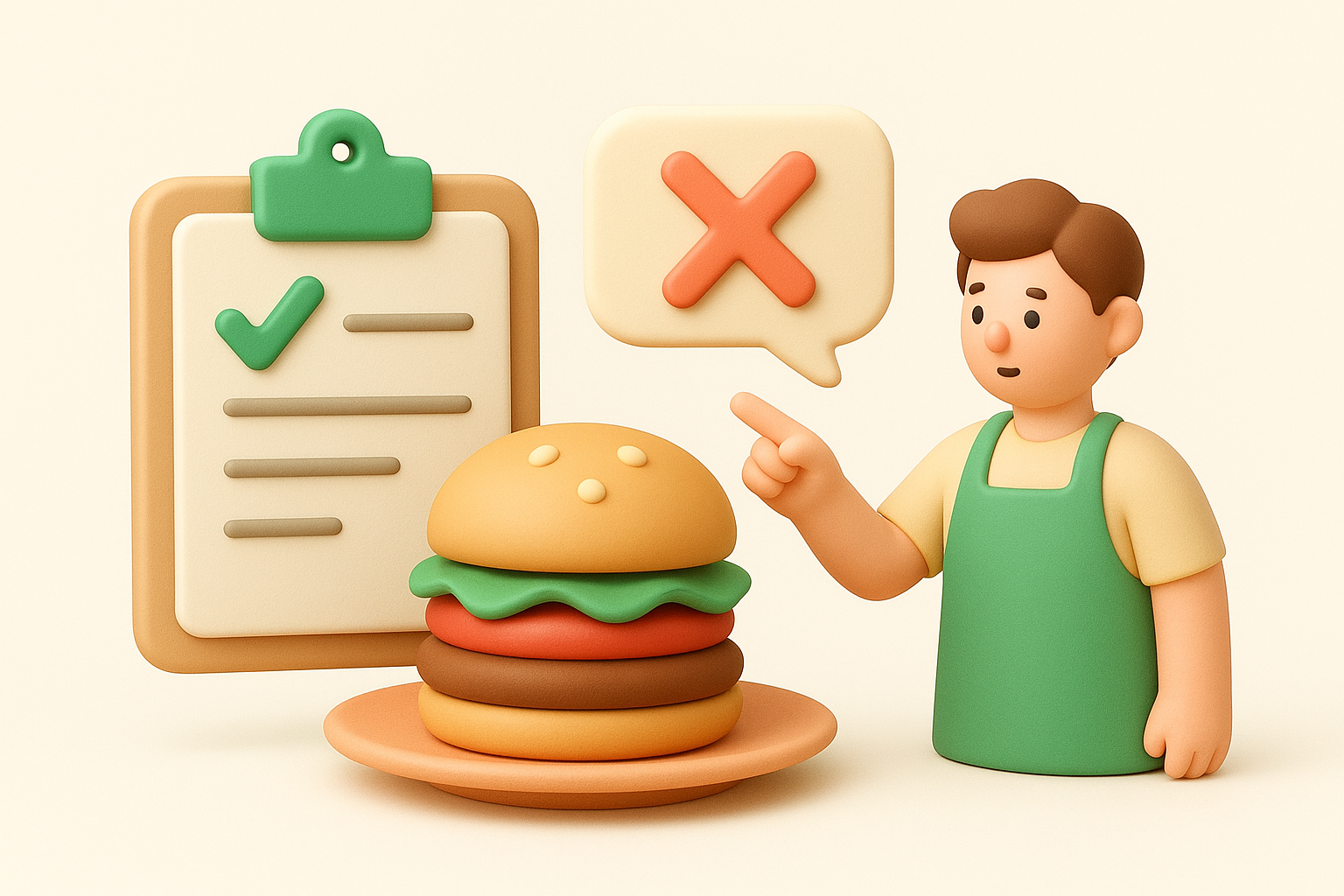
The fix that rebuilds loyalty is rarely the flashy one. It's the boring process nobody notices until it's missing.
Software businesses face a version of the same problem, just with feature gaps instead of undercooked food. Picture a project management tool getting the same integration request from a dozen customers, each submitting it through a different support ticket. Buried across email threads, that pattern is invisible. Centralized in a single feedback portal, it becomes obvious within a week. One mid-size SaaS company did exactly this: it consolidated scattered requests into a public board, let customers vote on what mattered most, and shipped the top request within a quarter. Churn among the accounts that had asked for it dropped noticeably, because those customers watched their input turn into a shipped feature instead of disappearing into a support queue.
Both examples share the same three moves, regardless of industry:
That third step is where most businesses fall short. Fixing the problem without telling anyone still leaves customers guessing whether their feedback mattered, which quietly erodes the very trust you're trying to build.
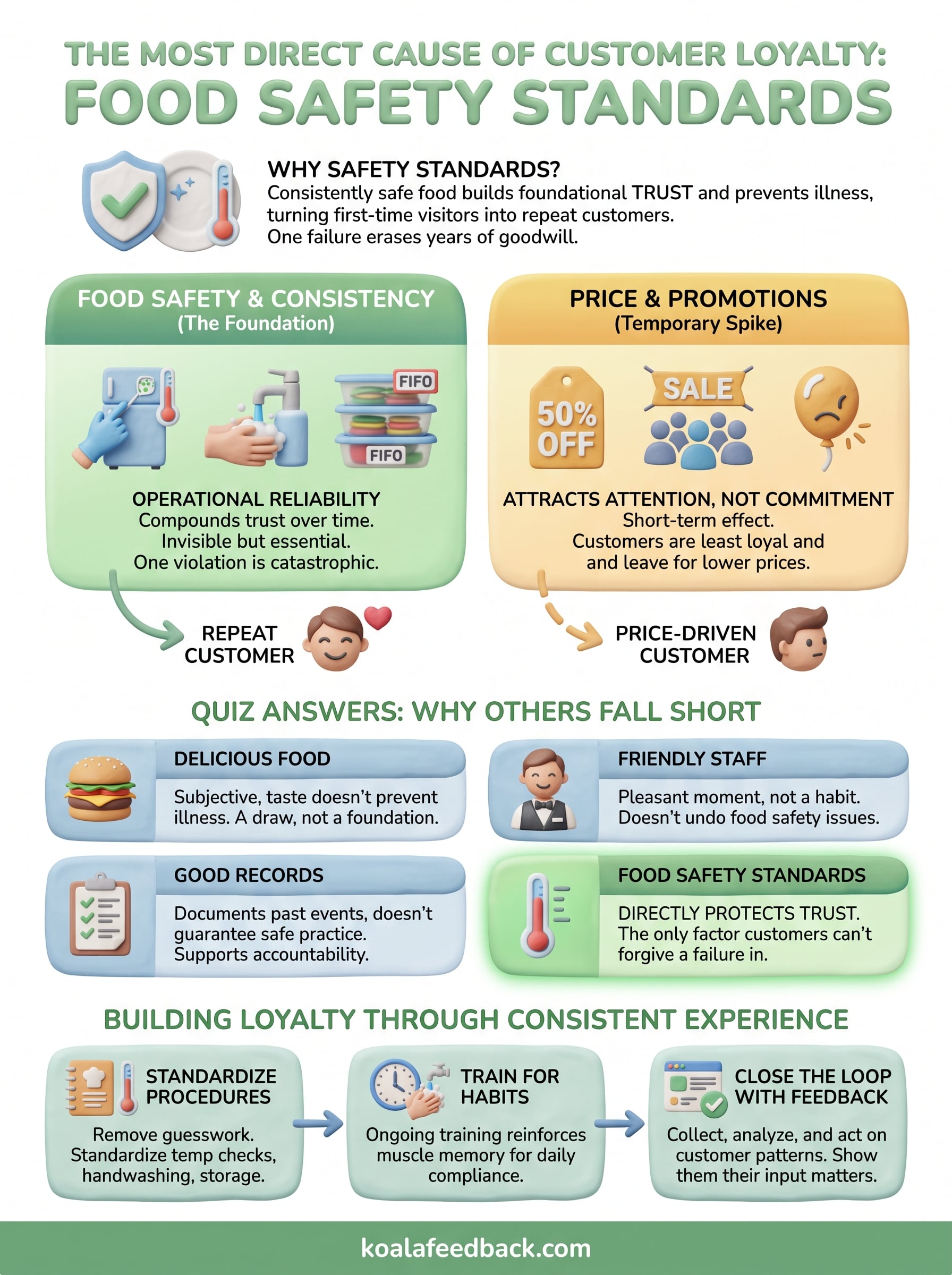
So when a food handler exam asks what is the most direct cause of customer loyalty, remember the logic behind the answer, not just the word itself. Food safety standards beat taste, hospitality, and paperwork because they protect the one thing customers can't forgive a lapse in. Everything else you build, friendly service, standout menu items, tidy documentation, works only when that foundation holds.
That same principle carries past the kitchen. Any business that wants repeat customers needs a system for catching small problems before they become the kind customers don't come back from. Collecting scattered complaints in one place, spotting the pattern, and closing the loop publicly is what turns feedback into retention instead of noise.
If you're running a product or service and want that same discipline for tracking what your customers actually need, see how Koala Feedback helps teams turn feedback into loyalty.

Start today and have your feedback portal up and running in minutes.