You already know why product innovation matters for growth, but abstract advice about "thinking differently" doesn't help you make better decisions. What you need is proof: real companies, real changes, real revenue. Looking at an example product innovation from a company you already recognize tells you more than any framework ever could, because you can see exactly what they changed and what happened next.
This article breaks down seven cases where a product innovation example led directly to measurable business growth, not just buzz. You'll see companies that added features, rebuilt entire product lines, or shifted their business model based on what users actually asked for, and the results they got from it. Each case includes what triggered the change and how the company executed it.
We picked these examples of product innovation because they share a common thread: the companies listened to user feedback before building. That's not a coincidence. At Koala Feedback, we see this pattern constantly in the teams using our platform to collect and prioritize requests. Read on for product innovation examples you can actually apply to your own roadmap, not just admire from a distance.
Before 2007, phones were split into two camps: devices for calls and texts, and separate gadgets for music or web browsing. Apple collapsed that split with a single touchscreen device that merged a phone, an iPod, and a mobile browser into one product. Multi-touch navigation replaced physical keyboards, and the App Store, added a year later, turned the iPhone into a platform other developers could build on. That's the kind of shift people point to when they want an example product innovation that redefined an entire category rather than just improving one.
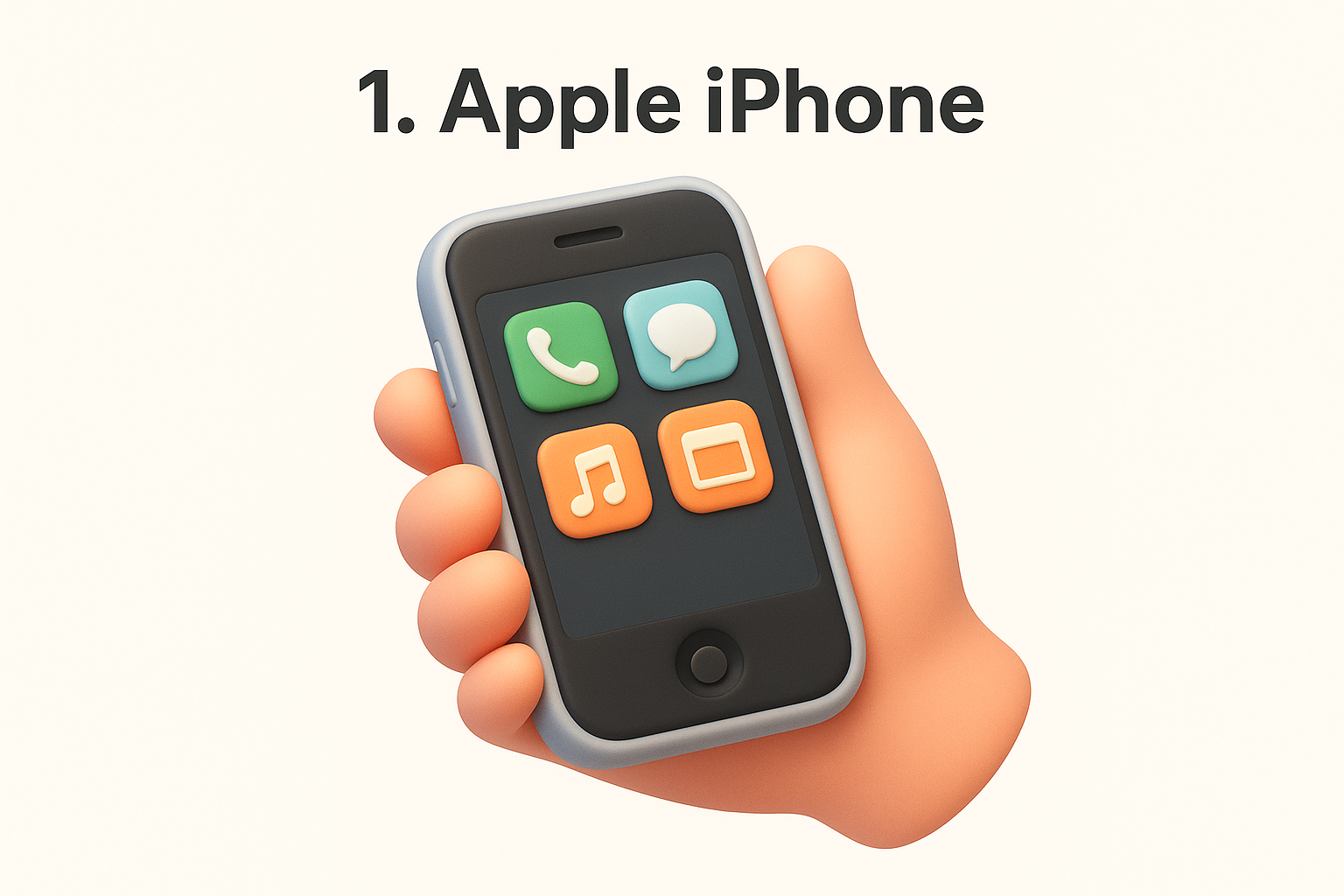
Apple sold over 6 million iPhones in the first year, and by 2023 the iPhone line accounted for roughly half of Apple's total revenue. The App Store alone generated an ecosystem worth hundreds of billions in developer payouts, according to Apple's own App Store facts and figures report. Beyond direct sales, the iPhone locked customers into Apple's broader ecosystem of iPads, MacBooks, and services like iCloud.
A single well-executed product can reshape an entire industry's definition of what a device should do.
This was a radical product innovation, one of the types of product innovation that rethinks a category from the ground up rather than tweaking an existing phone. It combined new hardware (capacitive touchscreens), new software (iOS), and a new business model (the app marketplace) into one launch.
Most teams won't get a shot at reinventing a category, but the underlying lesson still applies. Apple didn't just add features; it removed friction that users had learned to tolerate. Look at your own product for the workarounds users have quietly accepted as normal. Those tolerated frustrations are often where the next big opportunity hides, and they rarely show up unless you're actively using product discovery techniques to ask users what still annoys them.
Netflix started as a DVD-by-mail service, but the real shift came when it bet on streaming before broadband was reliably fast enough for most households. On-demand streaming replaced the wait for a mailed disc, and Netflix backed it with a recommendation engine that used viewing history to suggest what to watch next. Later, the company doubled down by funding original series like House of Cards, turning itself from a distributor into a studio. This is a frequently cited product innovation example because it shows a company willing to cannibalize its own profitable business to chase a bigger one.
Netflix grew from roughly 20 million subscribers in 2011 to over 300 million globally by 2025, according to its own investor shareholder letters. Streaming cut distribution costs dramatically while widening the addressable market to any country with internet access, a growth strategy built into the product itself.
Betting on where technology is heading, not where it currently stands, is what separates disruptors from fast followers.
This combined a business model innovation (subscription streaming instead of rentals) with a data-driven service innovation (personalized recommendations).
Don't wait for perfect market conditions. Netflix moved on streaming while infrastructure was still catching up, and that early positioning became a durable advantage.
Tesla didn't invent the electric car, but it made one people actually wanted to buy. Long-range battery technology solved the range anxiety that killed earlier EV attempts, and over-the-air software updates meant the car improved after purchase instead of depreciating the moment it left the lot. Autopilot pushed further, layering driver-assist features on top of hardware that shipped in every vehicle, ready to activate as software matured. Anyone hunting for an example of product innovation built on continuous iteration rather than a one-time launch should look here.
Tesla's revenue grew from under $500 million in 2012 to over $96 billion in 2023, per its own annual shareholder deck. Software updates and Autopilot subscriptions created recurring revenue most automakers still can't match, and the brand's tech-forward image let Tesla charge premium prices despite being a relatively new manufacturer.
Treating a physical product as a platform you keep improving, not a finished good, changes what customers expect from every competitor after you.
This blends process innovation (over-the-air updates), product innovation (battery and drivetrain design), and business model innovation (direct sales, bypassing dealerships).
Ship your product, then keep shipping through a repeatable product improvement process. Tesla proved that ongoing updates build loyalty that a single great launch never could.
James Dyson built over 5,000 prototypes before landing on a cyclonic separation system that pulled dust out of the air without a bag clogging suction over time. Every existing vacuum maker had accepted that bags lose suction as they fill, and customers just lived with it. Dyson refused that premise and engineered around it, then kept pushing the same idea into cordless sticks, hand dryers, and air purifiers. It's a clean product innovation example because the innovation came from solving a mechanical problem competitors had stopped questioning.
Dyson went from a single UK inventor to a company reporting over £7.1 billion in global revenue by 2023, according to its own technology and financial reports. Charging a premium price for a vacuum sounded absurd in the 1990s, but customers paid it once they saw the suction never dropped.
Refusing to accept an industry's obvious flaw as unfixable is often the whole innovation.
This is a textbook case of innovation rooted in product design, built on engineering persistence rather than market timing or business model changes. The core mechanism, not the packaging or pricing, is what set it apart.
Question the defects your industry treats as normal. If competitors all share the same flaw, customers have simply stopped expecting better, until someone gives it to them.
Airbnb's founders couldn't afford rent in San Francisco, so they put air mattresses in their living room and rented them to conference attendees who couldn't find a hotel, about as bare-bones as a minimum viable product gets. That scrappy fix became a peer-to-peer marketplace where anyone could list a spare room or entire home. Trust was the real obstacle, so Airbnb layered in verified reviews, host profiles, and secure payments to make strangers comfortable transacting with strangers. Few product innovation examples show a business model built entirely around solving a trust problem rather than a technical one.
Airbnb went from a single air mattress in 2007 to over 5 million hosts and 8 million listings worldwide, according to its own investor materials. The platform hit profitability without owning a single property, undercutting an entire hotel industry built on physical assets.
Removing the trust barrier between strangers can unlock a market bigger than the product itself.
This is a business model innovation, turning underused personal assets into inventory and building the trust infrastructure needed to make that inventory sellable.
Sometimes the biggest barrier to growth isn't your feature set, it's trust. Identify what's stopping users from saying yes, then build the verification and safety nets that remove it.
Slack started as an internal tool built by a gaming company that never shipped its game. The team noticed their own channel-based messaging system was more valuable than the product they were building, so they pivoted entirely. Instead of email threads and scattered files, Slack organized conversations into searchable channels, integrated with tools teams already used, and made onboarding a new hire feel instant rather than a week of forwarded emails. It's a widely cited product innovation example because the innovation came from a failed pivot, not a planned strategy.
Slack reached 10 million daily active users within five years of launch and was acquired by Salesforce for $27.7 billion in 2021, according to Salesforce's own acquisition announcement. Freemium pricing let teams adopt Slack without approval from IT or finance, a textbook case of product-led growth spreading bottom-up inside large enterprises.
Sometimes the product worth building isn't the one you set out to make.
This counts as a process innovation paired with a go-to-market innovation: freemium adoption that spread through individual teams before landing enterprise-wide contracts.
Pay attention to internal tools your own team builds out of necessity. The workaround you created to solve your own problem might be more valuable than your original roadmap.
Spotify entered a market where piracy had already trained users to expect free music, so beating that habit meant more than just legal access. Algorithmic personalization became the core product, with Discover Weekly and Daily Mix playlists built from listening data rather than editorial picks. Genuinely useful recommendations turned a commodity catalog, songs any competitor could license, into something that felt tailored to each listener. You could call this the product innovation example that proves data itself can be the differentiator, not just the content sitting on top of it.
Spotify passed 675 million monthly active users and 263 million paying subscribers by 2024, according to its own quarterly investor reports. Personalization kept free-tier users engaged long enough to convert to premium, and the freemium model funded licensing costs that would have sunk a subscription-only competitor at launch.
When every competitor sells the same catalog, personalization becomes the product.
This is a service innovation built on data science, using listening behavior to differentiate an otherwise identical product from competitors selling the same songs.
Collect customer behavior insights early, even before you know exactly how you'll use them. Spotify's recommendation engine only got good because years of listening history existed to train it.
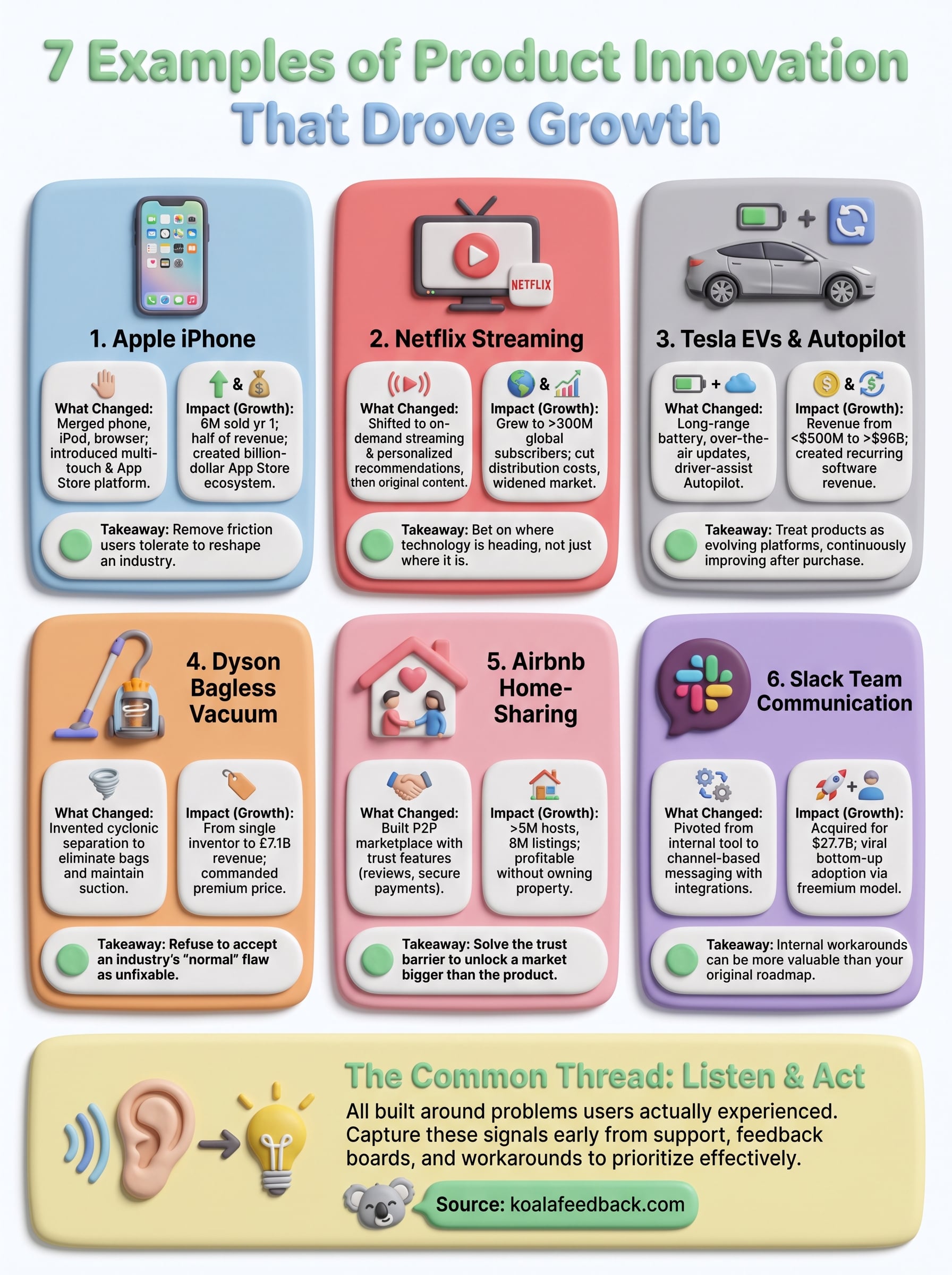
Notice what these seven companies have in common: none of them guessed. Apple, Netflix, Tesla, Dyson, Airbnb, Slack, and Spotify all built around a problem users actually experienced, whether that problem was clunky phones, buffering DVDs, or a catalog that felt anonymous. Every product innovation example in this article started with someone paying close attention to what people struggled with, then acting on it before competitors did.
Your next big feature probably won't come from a boardroom brainstorm. It'll come from the requests piling up in your support inbox, the comments on your feedback board, and the workarounds your users have quietly accepted as normal. The companies above just had systems for catching those signals early and prioritizing them fast.
If you want that same visibility into what your users actually need, see how to use customer feedback to shape your product roadmap with Koala Feedback.

Start today and have your feedback portal up and running in minutes.