Product innovation means creating new products or improving existing ones to better serve your customers. It's not just about flashy new features. It's about solving real problems and staying relevant when customer needs change.
Companies that ignore innovation eventually lose ground to competitors who don't. Your customers evolve. Technology shifts. Market conditions change. If your product stays the same, you fall behind.
But here's what matters most: innovation done right drives measurable business growth. You gain competitive advantages. You attract new customers. You keep existing ones engaged. You open up new revenue streams and improve efficiency along the way.
This article breaks down the specific benefits of product innovation and why they matter for your business. You'll learn how to approach innovation strategically, use customer feedback to guide your decisions, and measure the real impact on your bottom line. Whether you're building your first product feature or planning your next big release, understanding these benefits helps you make smarter choices about where to invest your resources.
Your business lives or dies based on how well you adapt to changing markets. Product innovation drives growth because it directly addresses the gap between what you currently offer and what your customers actually need. When you innovate, you create tangible value that customers will pay for, which translates into revenue growth and market expansion.
You face competitors who target the same customers you do. Product innovation gives you clear differentiation that makes choosing your solution obvious. When you develop features or improvements that competitors don't have, you build a moat around your business that protects your market position. Apple demonstrates this perfectly with its iPhone ecosystem, where continuous innovation in hardware and software integration keeps customers locked in and competitors struggling to catch up.
Product innovation isn't just about being different. It's about being better at solving specific problems your customers face.
Companies that innovate consistently grow faster than those that don't. Research shows businesses in the top quartile of product innovation generate median returns over three times higher than companies in the bottom quartile. Your innovation efforts directly impact your bottom-line performance because new or improved products open revenue streams you couldn't access before.
Customers stick with companies that prove they're listening and evolving. Product innovation signals that you're committed to improving their experience, which builds loyalty and reduces churn. You attract new customers because innovation creates talking points and generates word-of-mouth marketing that money can't buy.
Tesla exemplifies this benefit through its over-the-air software updates. The company continuously improves existing vehicles long after purchase, which keeps customers engaged and turns them into advocates. This approach has helped Tesla maintain strong customer retention rates while attracting buyers who value ongoing product enhancement.
The benefits of product innovation extend beyond customer-facing improvements. Internal innovations streamline your operations and reduce costs over time. When you improve manufacturing processes, optimize workflows, or automate repetitive tasks through product development, you increase profit margins without raising prices.
Your team also benefits from innovation culture. Employees who work on innovative projects report higher engagement and satisfaction. You create an environment where talented people want to stay and contribute, which reduces turnover costs and strengthens your organization's capabilities. This internal benefit compounds over time as you build institutional knowledge and innovation expertise that competitors can't easily replicate.
You need a structured approach to turn innovation ideas into real products that customers want. Random experimentation wastes resources and rarely produces meaningful results. The companies that successfully realize the benefits of product innovation follow systematic processes that balance creativity with practical execution.
Your innovation efforts must begin with understanding actual customer problems, not assumptions. Collect feedback through multiple channels to build a complete picture of what your users need. Talk to customers directly through interviews, analyze support tickets for recurring issues, and track feature requests in your feedback portal. This research reveals gaps between what you offer and what customers actually want.
Survey data alone won't give you the full story. Observe how people use your product in real situations to spot friction points they might not articulate in surveys. Netflix built its streaming empire by studying viewing patterns and user behavior, which informed product decisions that competitors missed. You gain similar insights when you combine quantitative data with qualitative feedback from actual usage.
Customer research transforms innovation from guesswork into strategic decision-making based on real needs.
Innovation requires testing ideas quickly before you invest significant resources. Develop minimum viable products (MVPs) that let you validate concepts with real users at low cost. Your MVP should solve one core problem well rather than attempting multiple features poorly. This approach helps you learn fast and fail cheap when ideas don't work.
Create feedback loops that inform your next iteration. Test your prototypes with a representative sample of your target customers and measure their responses objectively. Ask specific questions about usability, value, and willingness to pay rather than general opinions. Dropbox famously validated demand for its product with a simple explainer video before building the full platform, which saved months of development time on an unproven concept.
Product innovation fails when teams work in silos. Break down barriers between product, engineering, marketing, and customer support to ensure everyone contributes their expertise. Your developers understand technical constraints, your support team knows customer pain points, and your marketing team recognizes market opportunities. Combining these perspectives produces stronger innovation outcomes.
Set up regular collaboration sessions where different teams share insights and challenge assumptions. Establish clear decision-making processes that keep projects moving without bottlenecks. Google's famous 20% time policy lets employees collaborate across teams on innovative projects, which has generated products like Gmail and Google News. You don't need to copy Google's exact approach, but you do need to create space for cross-functional innovation to happen.
Your innovation process should include stage gates where you evaluate progress and decide whether to continue, pivot, or stop. Define clear criteria for moving forward at each stage so decisions stay objective rather than emotional. This disciplined approach protects you from pursuing bad ideas too long while giving good ideas enough runway to succeed.
The benefits of product innovation extend far beyond launching new features. Strategic innovation transforms every aspect of your business, from revenue generation to operational performance. Understanding these specific benefits helps you prioritize innovation investments and measure their impact on your organization's growth trajectory.
You unlock new revenue streams when you develop products that solve problems your current offerings don't address. Product innovation opens doors to customer segments you couldn't serve before, which directly expands your addressable market. Amazon demonstrated this when it evolved from an online bookstore into a marketplace, cloud computing provider, and entertainment platform. Each innovation created billions in new revenue that the original business model couldn't capture.
Market expansion through innovation reduces your dependence on single revenue sources. When you diversify your product portfolio, you protect your business from market shifts that might damage companies with narrower offerings. Tesla's expansion from electric cars into energy storage and solar products shows how innovation creates multiple growth paths within related markets. Your business gains similar resilience when you pursue strategic product innovation that complements your core offerings.
Innovation creates defensible advantages that competitors struggle to replicate. You build differentiation through unique features or superior performance that gives customers clear reasons to choose your product over alternatives. This competitive separation translates into pricing power because customers will pay premium prices for solutions that deliver exceptional value.
Your market position strengthens when innovation becomes part of your company identity. Customers perceive innovative companies as industry leaders, which builds brand equity that supports all your marketing efforts. Google maintains its search dominance partly through continuous algorithm innovations that competitors can't match. This leadership position attracts both customers and top talent who want to work with cutting-edge technology.
Innovation isn't a one-time event. It's a sustained commitment that compounds competitive advantages over time.
Internal innovations reduce costs and improve margins without sacrificing quality. Process improvements through product development often reveal opportunities to automate manual tasks, eliminate waste, or optimize resource allocation. Toyota's manufacturing innovations reduced production costs while improving vehicle quality, which created lasting competitive advantages that rivals spent decades trying to match.
Efficiency gains from innovation free up resources for additional growth investments. When you streamline operations, you reduce the capital required to scale, which improves your unit economics and profitability. Your team can serve more customers without proportional increases in overhead costs.
Product innovation directly impacts how long customers stay with your business. Regular improvements show customers you're invested in their success, which builds loyalty that protects against competitor poaching. Adobe's transition from boxed software to Creative Cloud with continuous updates transformed customer relationships and dramatically improved retention rates.
You reduce churn when customers see consistent value additions that justify their ongoing investment. Innovation creates positive momentum that keeps your product feeling fresh and relevant even years after initial purchase. Customers who experience regular improvements become advocates who promote your product through word-of-mouth recommendations.
Better products also reduce support costs because well-designed innovations eliminate friction points that generate customer service inquiries. Your support team spends less time troubleshooting problems and more time helping customers achieve their goals, which further improves satisfaction scores and retention metrics.
Customer feedback transforms abstract innovation ideas into products that solve real problems. Your customers tell you exactly what they need when you create structured channels to collect their input. This direct connection between feedback and development ensures you invest resources in innovations that drive actual value rather than features that sound good but don't get used.
You need consistent methods to gather customer insights from every interaction point. Set up dedicated feedback portals where users submit feature requests, report issues, and vote on priorities. These portals create visibility into what your entire customer base values most, not just the loudest voices. Supplement portal data with support ticket analysis, user interviews, and in-app surveys to capture feedback from customers who don't proactively share opinions.
Track patterns in feedback over time to identify emerging needs before they become critical problems. When multiple customers independently request similar capabilities, you've found a strong signal for innovation priorities. Your feedback system should automatically categorize and deduplicate submissions so you can spot these patterns quickly without manual sorting.
Raw feedback doesn't automatically translate into development plans. You must analyze and prioritize requests based on strategic fit, technical feasibility, and business impact. Weight feedback from different customer segments according to their value to your business, since not all requests deserve equal attention. Enterprise customers might need different capabilities than small business users.
Prioritization frameworks that combine customer demand with business strategy produce innovations that satisfy users while driving growth.
Create transparent roadmaps that show customers how their feedback influences your product direction. This transparency reinforces that you're listening and builds trust that encourages more participation. Customers who see their suggestions implemented become vocal advocates who amplify the benefits of product innovation to their networks. Your feedback loop becomes a growth engine when users know their voices shape your product's future.
You need concrete metrics to prove that innovation investments deliver returns. Tracking specific indicators shows whether your innovation efforts actually move the business forward or just consume resources. The benefits of product innovation only materialize when you measure what changes after you launch new products or features. Without measurement, you're flying blind and can't make informed decisions about future innovation priorities.
Monitor revenue growth directly attributable to new product launches or feature releases. Compare sales velocity before and after innovation rollouts to isolate their specific impact. You should track customer lifetime value increases among users who adopt new features versus those who don't, which reveals whether innovations actually strengthen customer relationships. Calculate your return on innovation investment by dividing additional revenue generated by the costs spent developing and launching new capabilities.

Measuring innovation success through revenue metrics connects product decisions directly to business outcomes that executives care about.
Analyze market share changes following major innovation releases to understand competitive impact. Your innovation should either help you gain share from competitors or defend against their advances. Price premium metrics also matter because successful innovations let you charge more without losing customers.
Track adoption rates for new features to see whether customers find your innovations valuable enough to actually use them. High adoption signals market fit while low rates suggest you missed customer needs. Measure time-to-adoption to understand how quickly customers embrace changes, which indicates both value and usability quality.
Customer satisfaction scores and Net Promoter Score should improve after successful innovation launches. Survey customers specifically about new features to gather targeted feedback. Retention rates tell you whether innovations keep customers engaged long-term or just create temporary interest.
Internal metrics reveal operational benefits that don't show up in customer-facing data. Track cost reductions from process innovations, measuring savings per transaction or per customer served. Your support ticket volume should decrease when product improvements eliminate friction points that generated complaints.
Team productivity metrics show whether innovation streamlines workflows for both employees and customers. Measure time savings on routine tasks that new features automate or simplify. These efficiency gains compound over time as you scale.
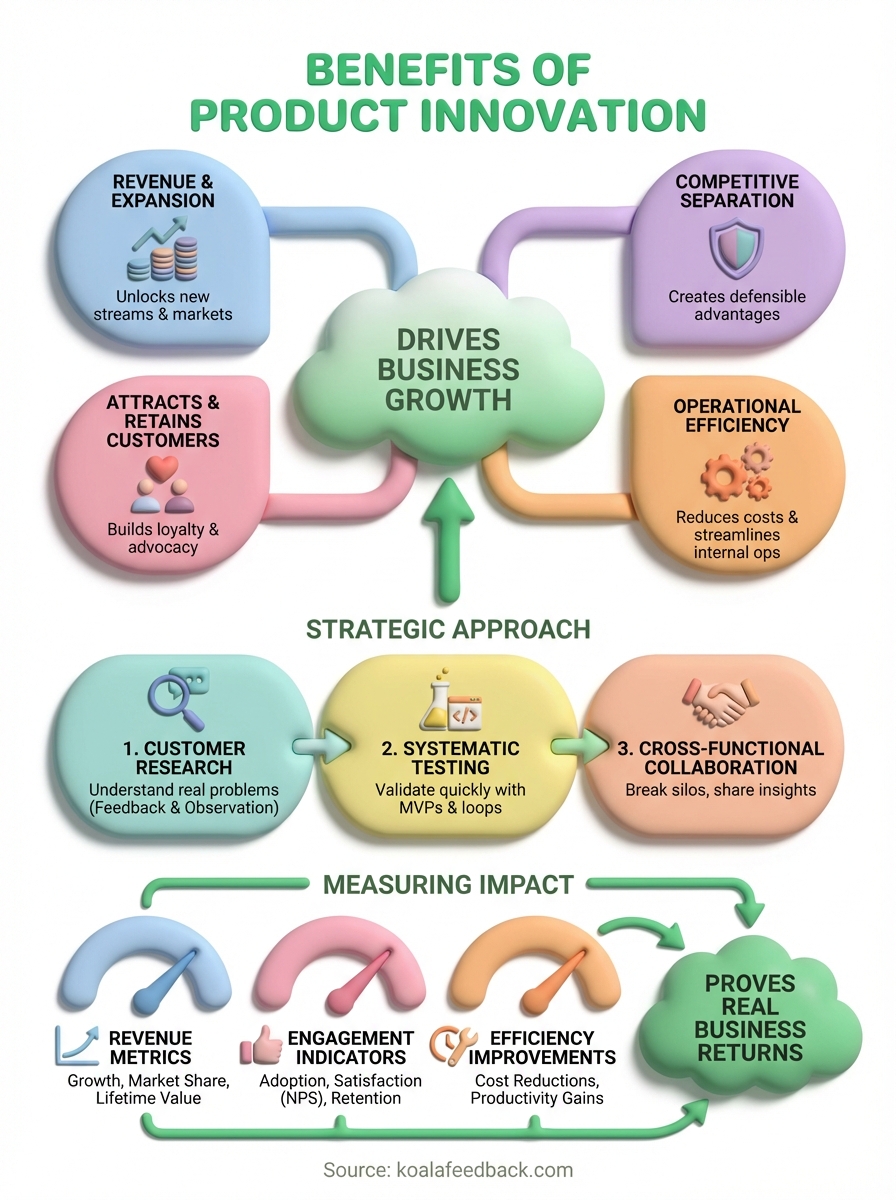
The benefits of product innovation directly determine whether your business grows or stagnates. You gain competitive advantages through differentiation, attract and retain customers through continuous improvement, and unlock new revenue streams by solving problems your competitors ignore. Innovation also improves your operational efficiency, which protects margins while you scale.
Success requires a systematic approach grounded in customer feedback rather than guesswork. Your customers tell you exactly what they need when you create structured channels to capture their input. Measure the real impact of your innovation efforts through revenue metrics, adoption rates, and efficiency gains that prove returns on your investments.
Your innovation strategy strengthens when you centralize feedback collection and prioritization in one place where your entire team can see what customers actually want. Capture feedback systematically with Koala Feedback to ensure you build what matters most to your users while keeping them informed about your product roadmap.

Start today and have your feedback portal up and running in minutes.