A product growth strategy is your plan to increase revenue and expand your user base through deliberate product improvements and market positioning. It combines customer acquisition, retention tactics, and product development to create sustainable business growth. Without a clear strategy, you're basically guessing which features to build and which users to target.
This guide breaks down four main types of growth strategies you can use, shows you how to build an actionable framework, and reveals the metrics that actually matter. You'll see real examples from companies that scaled successfully and learn exactly which tactics drove their growth. By the end, you'll know how to choose and implement a growth strategy that fits your product and market.
You can't build a successful product by randomly adding features and hoping users stick around. A solid product growth strategy gives you a clear direction for every decision, from which features to prioritize to how you allocate your development resources. Without one, you'll waste months building things nobody wants while your competitors capture the market share you should have owned.
Most product teams that skip strategic planning end up in a cycle of reactive development that drains resources and delivers minimal results. You build features based on whoever shouts loudest, chase every new trend, and watch your user churn rate climb because you never addressed the real problems. This approach burns through your runway faster than you realize and leaves you with a bloated product that doesn't excel at anything specific.
Companies without a strategy also struggle to align their teams around shared goals. Your engineering team builds one thing, marketing promotes another, and sales promises features that don't exist yet. The disconnect creates friction that slows down your entire organization and confuses your users about what your product actually does.
A clear growth strategy transforms your product team from order-takers into strategic builders who understand exactly how their work drives business results.
When you know what is product growth strategy and actually implement one, you gain the ability to predict and influence your business outcomes. You can forecast revenue based on specific product improvements, allocate budget to initiatives that move the needle, and make data-driven decisions about where to invest your time. This predictability becomes crucial when you're raising funding or planning your next quarter.
Your strategy also helps you identify the highest-leverage opportunities in your market. Instead of competing on every front, you focus on specific user segments and use cases where you can win. This focused approach lets you build deeper features that truly solve problems rather than surface-level functionality that barely helps anyone.
Products with clear growth strategies move faster than their competitors because every team member understands the priorities and trade-offs. You ship features that compound on each other rather than disconnected improvements that don't add up to meaningful progress. Your users notice this coherence and start trusting your product to evolve in ways that benefit them.
Strategic products also create stronger network effects and defensibility. When you deliberately design features that increase value as more users join, you build moats that competitors can't easily replicate. This intentional approach to growth separates products that scale from those that plateau after initial traction.
Understanding what is product growth strategy means knowing which approach fits your current market position and business goals. The four core strategies each serve different scenarios, from expanding within your existing market to launching completely new products for new audiences. You'll typically use one as your primary driver while incorporating elements from others to support your overall growth.
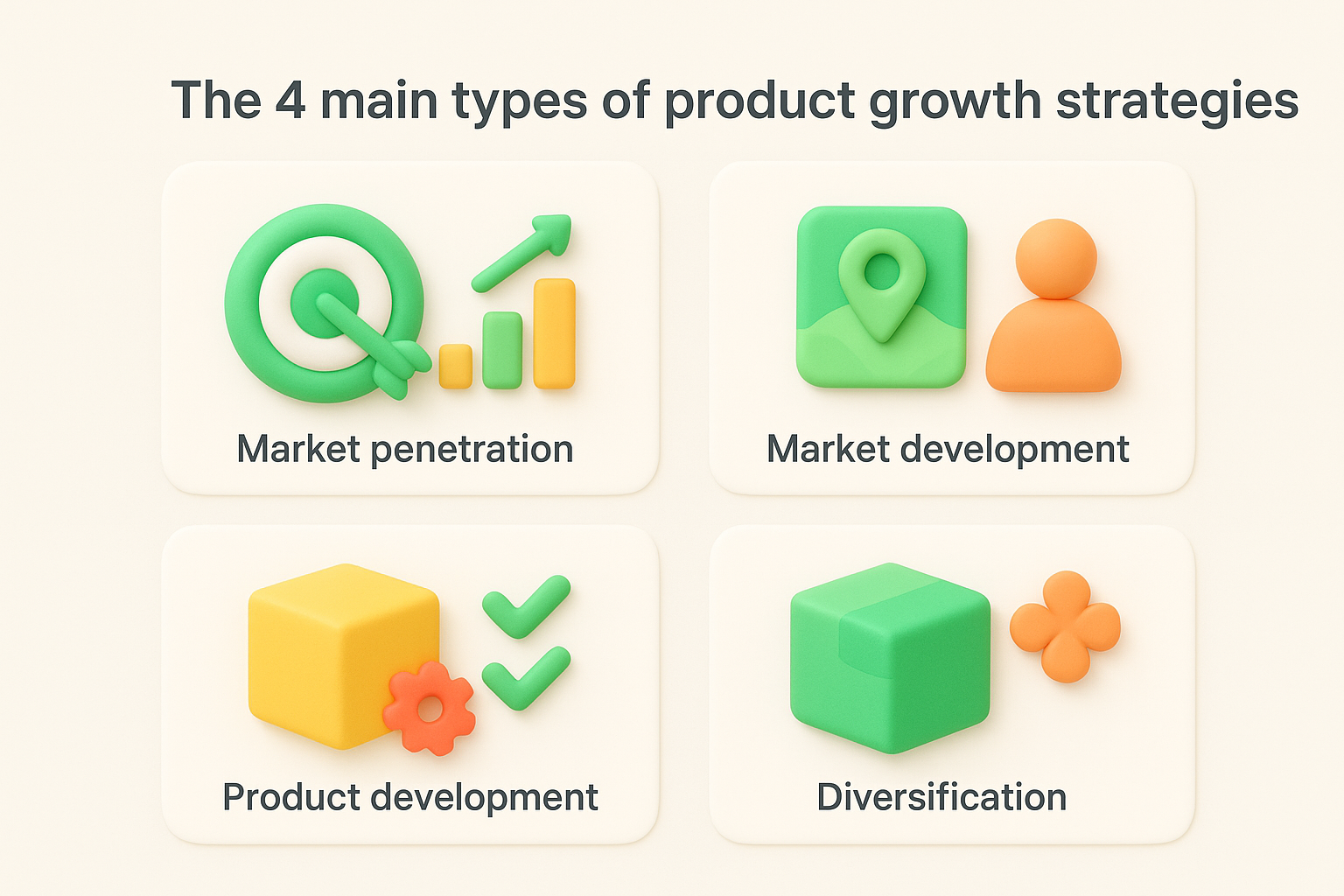
This strategy focuses on increasing your share of customers in your existing market with your current product. You achieve growth by converting more users, reducing churn, or getting existing customers to pay more through upgraded plans or add-ons. Netflix used this approach by improving recommendations and adding more content to keep subscribers engaged longer, which directly reduced cancellations and increased lifetime value.
You take your existing product into new geographic regions, customer segments, or use cases that you haven't targeted before. Slack grew rapidly by expanding from tech startups into enterprise companies and traditional industries that needed better team communication. This strategy works when your product solves a universal problem but you've only penetrated a fraction of the total addressable market.
Market development lets you leverage your existing product strength while accessing completely new revenue streams.
Your strategy centers on building new features or products for your current customer base. You already understand their needs and have established distribution channels, so you create additional solutions they'll buy. Adobe shifted from selling individual software licenses to a subscription suite that bundled multiple creative tools, increasing revenue per customer significantly.
This highest-risk approach involves creating new products for new markets simultaneously. Amazon started with books, then diversified into cloud computing with AWS, targeting a completely different audience with different technology. Most startups should avoid this strategy until they've dominated their initial market, since it spreads resources thin and reduces your focus on core growth drivers.
Building a framework that actually drives results requires you to define clear metrics, identify specific growth levers, and create systems that let you test and iterate quickly. Most frameworks fail because they're too abstract or disconnected from day-to-day product decisions. Your framework should tell your team exactly what to build next and why it matters for growth.
Your north star metric represents the single number that best captures the value your product delivers to customers. For Airbnb, it's nights booked. For Slack, it's messages sent by teams. This metric should directly correlate with revenue and customer satisfaction, while being something your team can influence through product improvements. Once you identify it, every feature and experiment gets evaluated on whether it moves this number up.
Your north star metric aligns your entire organization around one measurable outcome that proves you're delivering value.
Break down the path from first visit to active user into distinct stages where you can measure conversion and identify friction points. A typical SaaS journey includes awareness, signup, activation, engagement, and retention. Understanding what is product growth strategy means knowing exactly where users drop off and which product changes will improve those transitions. Document the key actions users must complete at each stage to progress to the next.
Growth levers are the specific mechanisms you can pull to accelerate user acquisition, activation, or retention. For a marketplace, levers might include supply-side onboarding speed, search relevance, or transaction completion rates. List every lever you could theoretically improve, then prioritize based on impact and effort required. Your framework should map which levers affect your north star metric most directly, creating a clear hierarchy for what to tackle first.
Tracking the right metrics lets you measure whether your growth strategy actually works or just looks good on paper. You need quantitative indicators that show real user behavior and business impact, not vanity metrics that make you feel productive without driving results. Understanding what is product growth strategy means knowing exactly which numbers to watch and how they connect to your revenue goals.
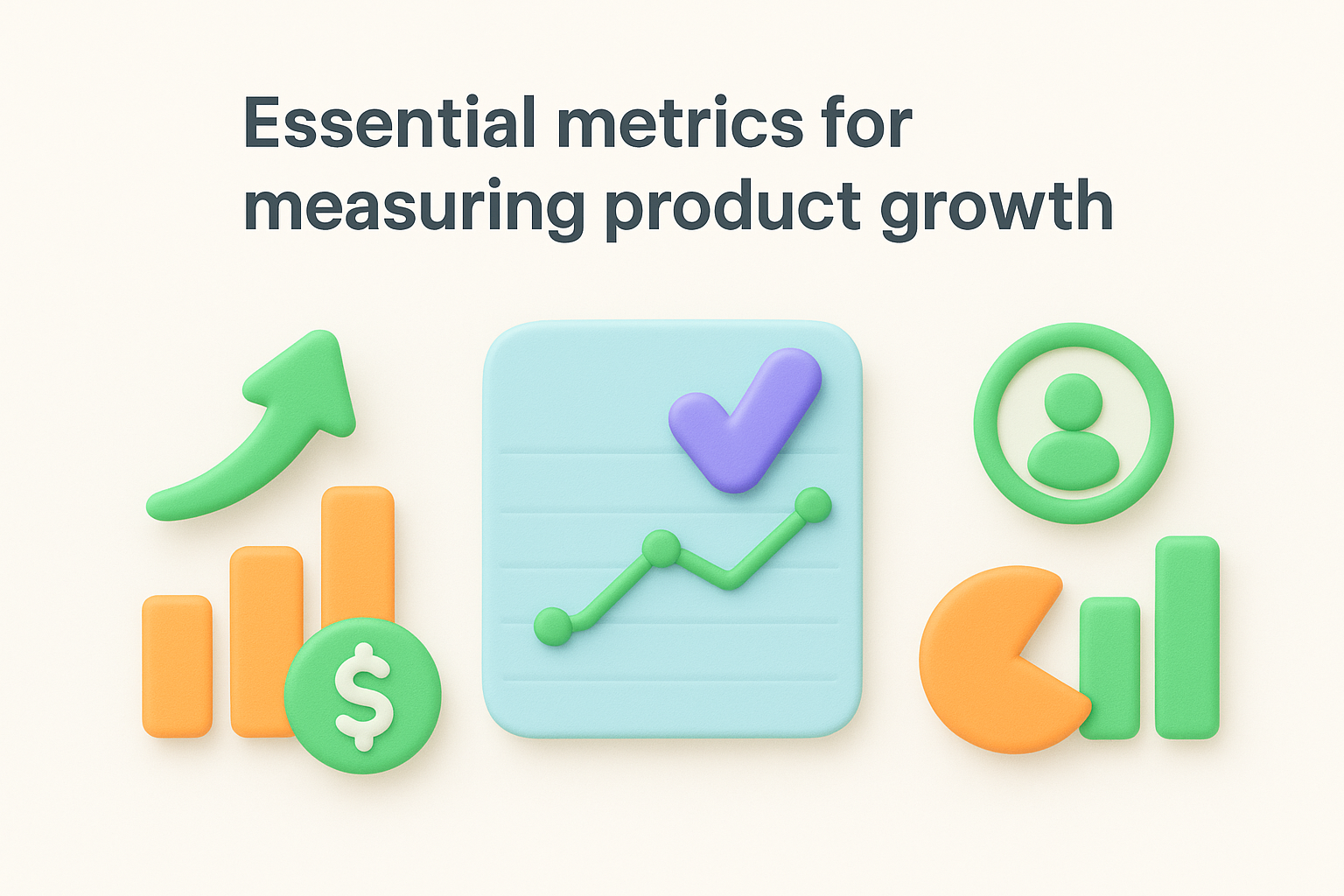
Your acquisition metrics tell you how efficiently you're bringing new users into your product funnel. Track your customer acquisition cost (CAC) against lifetime value (LTV) to ensure you're spending sustainably on growth. A healthy ratio sits around 3:1 LTV to CAC, meaning each customer generates three times what you spent to acquire them. Monitor where your users come from by measuring conversion rates across channels, which helps you double down on what works and cut what doesn't.
Activation measures how many new users complete the critical actions that demonstrate they've experienced your product's core value. For a project management tool, this might be creating their first project and inviting a team member. Your activation rate directly predicts long-term retention, so improving this metric often delivers the highest impact on overall growth. Track engagement through daily active users (DAU), weekly active users (WAU), and feature adoption rates to identify which capabilities keep users coming back.
Activation metrics reveal whether your onboarding actually delivers the value that convinced users to sign up in the first place.
Retention cohorts show you what percentage of users from each signup period continue using your product over time. Strong products retain at least 40% of users after three months, while exceptional ones keep over 60%. Monitor your churn rate monthly and investigate why users leave through exit surveys and usage pattern analysis. Revenue metrics include monthly recurring revenue (MRR), expansion revenue from upgrades, and net revenue retention, which captures both churn and expansion to show if you're growing value from existing customers.
Seeing how successful companies applied growth strategies helps you understand what is product growth strategy in practice. These examples show specific tactics that drove measurable results, from viral loops to strategic bundling. Each company chose an approach that matched their product strengths and market position, proving there's no single formula for growth.
Dropbox faced expensive acquisition costs in a crowded storage market, so they built a referral system that offered free storage to both referrers and new users. This product-led approach increased signups by 60% permanently and reduced their customer acquisition cost by over half. The strategy worked because it solved a real problem (users needed more storage) while naturally encouraging viral sharing that brought in qualified users who already understood the product's value.
Dropbox turned their users into their most effective marketing channel by making referrals mutually beneficial.
Spotify invested heavily in recommendation algorithms that created personalized playlists like Discover Weekly, which sent over 5 billion tracks to users in its first year. This product development strategy increased user engagement by 24% and retention by nearly 30% because it continuously delivered fresh value that kept subscribers active. Their focus on personalization created a network effect where more listening data improved recommendations for everyone, making the product harder to leave as users invested time.
Amazon combined fast shipping with video streaming, music, and other perks into Prime membership, transforming one-time buyers into loyal subscribers. Members spend an average of $1,400 annually compared to $600 for non-members, demonstrating how bundling multiple value propositions drives both retention and revenue expansion. This diversification strategy let Amazon capture more wallet share from existing customers while making the subscription cost feel negligible compared to the total value delivered.
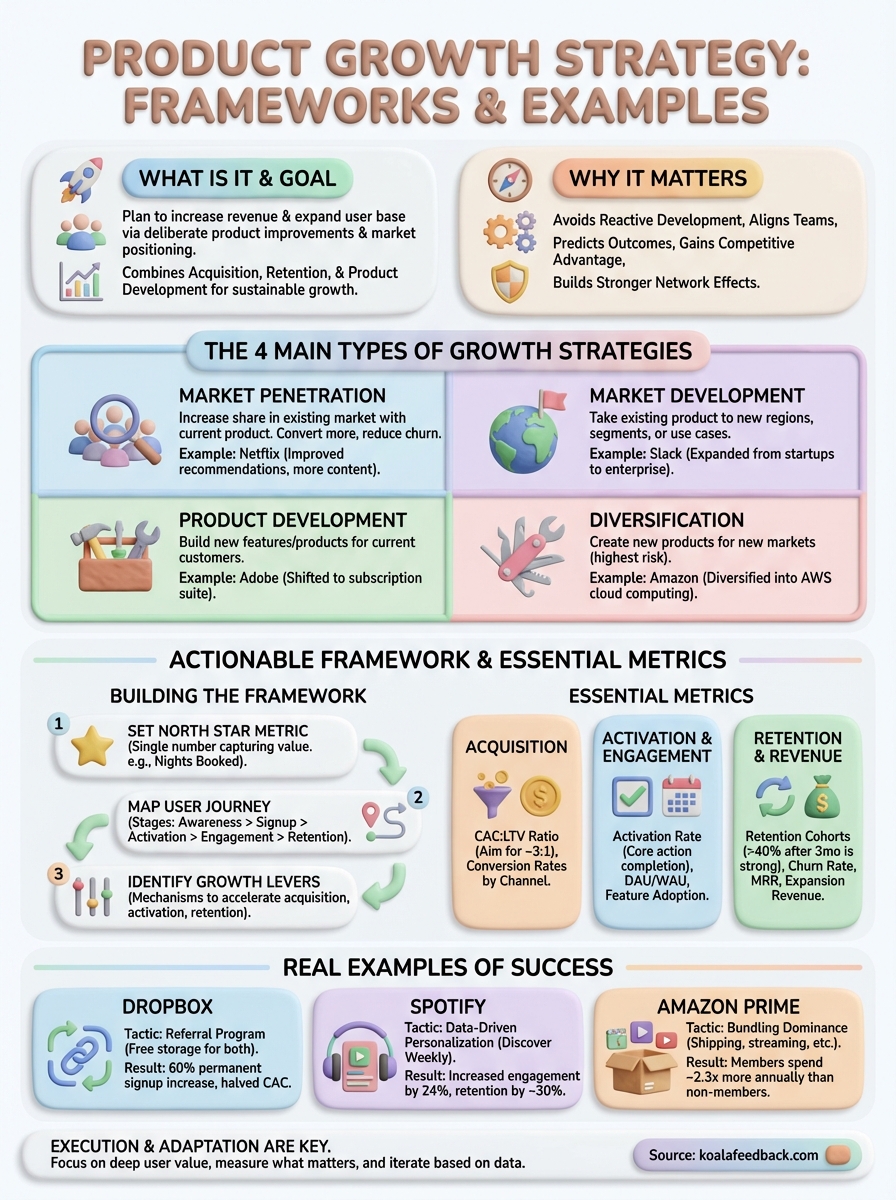
Understanding what is product growth strategy gives you the foundation, but execution determines whether your product actually scales. You need to pick one primary strategy that matches your market position, measure the metrics that predict long-term success, and iterate based on real data instead of assumptions. The companies that win don't just follow frameworks, they adapt strategies to their unique product strengths and user needs while maintaining laser focus on their core value proposition.
Your growth strategy should evolve as your product matures and market conditions shift beneath you. What works during early traction won't necessarily drive expansion at scale, so stay flexible and willing to pivot when the data tells you to. Building sustainable growth means creating deep value for users first, then capturing that value through smart monetization and retention tactics that compound over time.
Capture user feedback to continuously validate whether your growth strategy aligns with what your customers actually need and want from your product.

Start today and have your feedback portal up and running in minutes.