You built something people want. Users sign up. They try your product. Then most of them disappear. You pump more money into ads and marketing campaigns. You get more signups. The cycle repeats. You know there has to be a better way to grow without burning cash on acquisition costs that never seem to drop.
Product growth frameworks flip this script. Instead of forcing growth through your funnel, you design your product to drive its own expansion. Users experience value quickly, stick around longer, and bring others with them. These self-sustaining loops compound over time, reducing your reliance on paid channels while improving unit economics.
This guide walks you through building a product growth framework from scratch. You'll learn how to diagnose your current growth stage, choose between freemium and trial models, design loops that actually work, wire in the right metrics, and make growth part of your team's daily routine. No theory. Just practical steps you can implement this week.
A product growth framework is a structured system that turns your product into the primary driver of customer acquisition, activation, and retention. Instead of relying on expensive sales teams or endless marketing campaigns, you build growth mechanisms directly into your product experience. Users discover value quickly, share the product naturally, and upgrade when they need more.
Every effective product growth framework contains four essential elements. You need a clear acquisition model (freemium or trial) that removes barriers to entry. You build activation sequences that get users to their first meaningful outcome fast. You design retention mechanics that create habits and increase engagement over time. Finally, you establish expansion loops where existing users naturally bring in new ones through invitations, sharing, or collaboration features.
The best product growth frameworks create compounding returns where each user action generates more value for both the user and your business.
Traditional growth strategies put marketing and sales at the center. You generate leads through ads, nurture them with email campaigns, demo the product to prospects, negotiate contracts, and then finally let them use what they bought. This linear funnel burns cash and creates friction at every step.
Product-led frameworks invert this sequence entirely. Users experience your product first, then decide to buy based on actual usage and value received. Dropbox grew to 500 million users largely through a referral program that gave both parties extra storage. Calendly expanded by having every meeting invite expose new people to the product. Slack spread within companies as teams invited colleagues to channels. These companies built growth into their core product experience rather than bolting it on through external campaigns.
Your framework determines which levers you pull to accelerate growth. Pick the wrong model and you waste resources on tactics that don't compound. Choose wisely and every product improvement amplifies your growth rate.
Your product growth framework must match your current reality, not your aspirations. You can't build viral loops if users abandon your product after one session. You can't optimize expansion revenue if nobody converts from free to paid. Start by assessing where you actually stand right now.
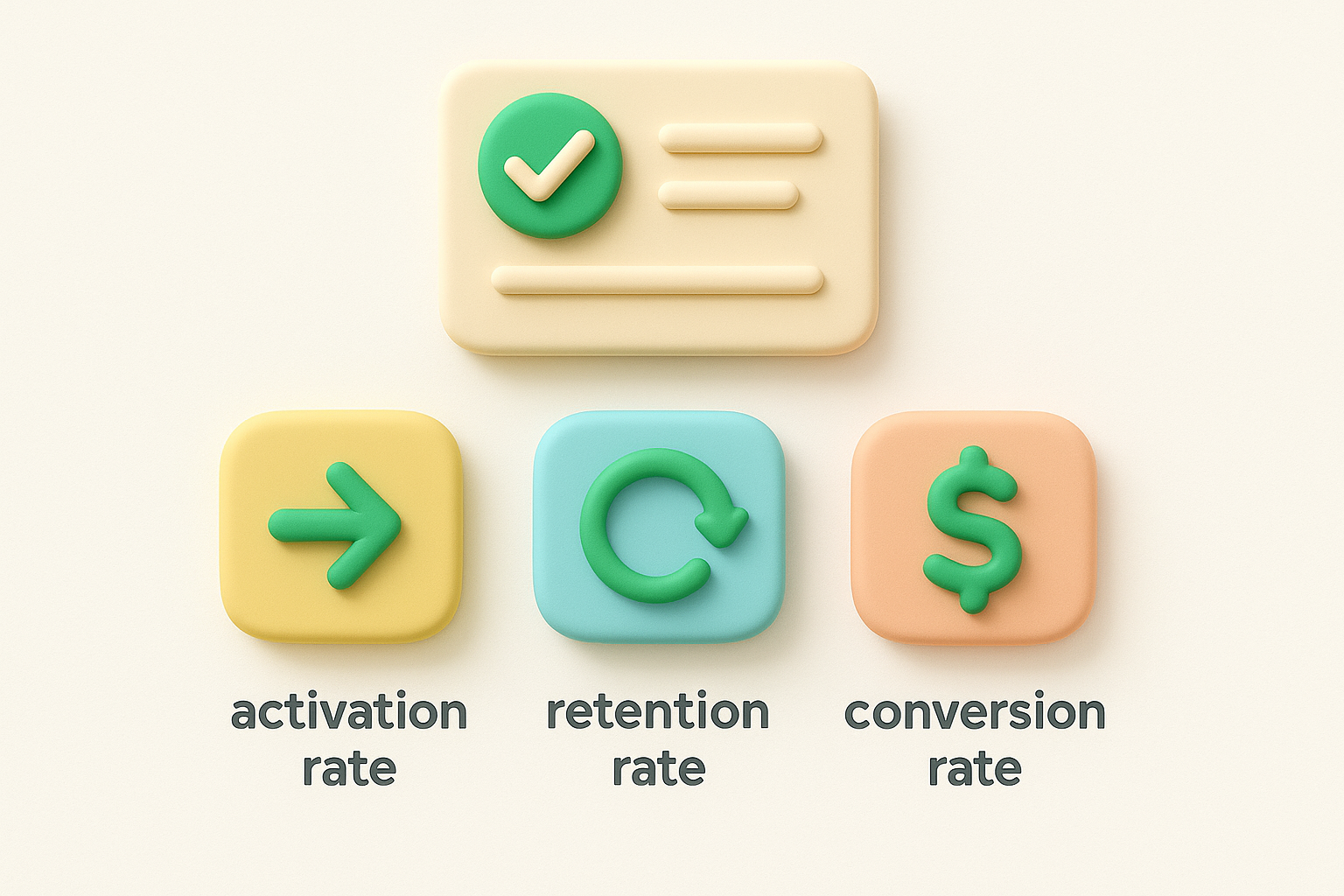
Pull three numbers from your analytics: activation rate (percentage of signups who complete a key action within their first session), retention rate (percentage of users who return within 7 days), and conversion rate (percentage of free users who upgrade to paid). These metrics reveal whether you have a leaky bucket or a solid foundation to build on.
Calculate your time to value by tracking how long it takes new users to experience their first meaningful outcome. If this number exceeds 10 minutes for most products (or 24 hours for complex B2B tools), you have an activation problem that will sabotage any growth loop you attempt to build. Fix activation before investing in acquisition channels.
Products typically fall into one of four growth stages, and each requires a different framework focus. Early stage products (less than 30% activation rate) need to nail the core value proposition before pursuing growth. Growth stage products (30-50% activation, 20-40% retention) should build their first growth loops. Scale stage products (50%+ activation, 40%+ retention) can layer multiple loops and optimize aggressively. Mature products focus on retention and expansion rather than new acquisition.
Your growth stage determines which metrics matter most and which tactics will actually move the needle.
Answer these questions honestly to pinpoint your exact starting point. Do users complete onboarding in one sitting or drop off halfway? Do they return within a week without prompts? Can they explain your core value in one sentence? Do they invite teammates or share results without incentives? If you answered no to most questions, you sit in the early stage. Two or three yes answers put you in growth stage. Four yes answers mean you're ready to scale.
Track how users discover value patterns by reviewing session recordings and talking to your most engaged customers. Look for the specific actions that predict long-term retention. Notion found that users who created five pages in their first week became lifetime customers. Slack discovered that teams sending 2,000 messages rarely churned. Your activation metric should measure completion of this critical behavior, not vanity metrics like profile completion.
Use this diagnosis to set realistic expectations. If you're early stage, accept that you'll spend 3-6 months improving activation before growth loops work. Growth stage products can implement their first loop within 4-8 weeks. Scale stage products should test multiple loops simultaneously and measure incrementally.
Your acquisition model determines how users first experience your product and sets the foundation for every growth loop you build. The two primary options (freemium and free trial) serve different product types and create distinct growth dynamics. Pick the wrong model and you either leave revenue on the table or create friction that kills adoption before it starts.
Freemium removes all barriers to entry by offering permanent free access to core features. You build a large user base quickly, then convert a small percentage to paid plans when they hit usage limits or need advanced capabilities. This model thrives when your product becomes more valuable as more people use it, like Slack channels or Figma design files that require team collaboration.
Deploy freemium when your product has low marginal cost per user and when free users create value for paid users through network effects. Notion and Airtable grew using this approach because free users generated content and templates that attracted premium customers. Your free tier should deliver real value without cannibalizing paid features that matter to power users.
Free trials give users temporary full access to your complete feature set, typically for 14 to 30 days. This model works best for products with steep learning curves or enterprise features that require evaluation before purchase. You demonstrate value quickly, create urgency through the countdown timer, and convert users who experience the full capabilities.
Choose trials when your product delivers immediate transformative value or when usage costs force you to limit free access. Analytics platforms, development tools, and business intelligence software typically use trials because free tiers would either cost too much to support or fail to showcase the product's real power. Calendly and Loom use hybrid approaches, offering limited free plans with trial access to premium features.
The right model aligns with your product's value delivery speed and your ability to support free users at scale.
Answer these four questions to pick your model. First, can users extract meaningful value in under 10 minutes? If yes, freemium works. If your product requires hours of setup or data integration, use trials. Second, do free users attract paid users through sharing or collaboration? Network effects favor freemium. Third, what are your infrastructure costs per free user? High costs demand trials or restrictive free tiers. Fourth, does your product require ongoing engagement or solve point-in-time problems? Habit-forming products benefit from freemium's unlimited access.
Test your chosen model with a small user cohort before committing your entire product growth framework to it. Track conversion rates, support costs, and user engagement patterns across 90 days. If fewer than 2% of free users convert to paid within six months on freemium, or if trial users don't activate within three days, reconsider your approach.
Your product growth framework needs a self-sustaining loop that converts each user action into inputs for future growth. You're not building a funnel that ends at conversion. You're creating a circular system where satisfied users become acquisition channels themselves. Start by mapping the exact sequence of events that transforms a single user into multiple users.
Define the specific moment when a user needs to take action. This trigger can come from inside your product (a task completion, a milestone reached) or from outside (an email notification, a shared link). Dropbox triggered growth when users ran out of storage space. Calendly triggers happen when someone receives a scheduling link. Your trigger must feel natural and necessary, not forced or manipulative.
Look at your analytics to find moments when users pause or seek help. These friction points often make perfect triggers because users already want to do something but lack the capability. Canva prompts users to invite team members when they create a design meant for collaboration. Notion suggests inviting others when users create a workspace. Document three to five trigger points in your current user journey that could spark sharing, inviting, or upgrading behavior.
Outline the exact steps a user takes from trigger to completed action. Keep this sequence as short as possible. Every additional step cuts your completion rate by 20-30%. Here's a template for mapping your loop:

1. User hits trigger point (example: completes first project)
2. Product presents clear call to action (example: "Invite your team")
3. User takes one-click action (example: enters email addresses)
4. New user receives invitation with context (example: "John invited you to review Project X")
5. New user experiences immediate value (example: sees completed work, not empty state)
6. New user completes their first action (example: leaves feedback)
7. Original user receives notification (example: "Sarah commented on your project")
8. Loop repeats with new user as trigger point
The most effective growth loops require no more than three user actions between trigger and value delivery.
Test your sequence by walking through it yourself with a timer. If you can't complete the entire loop in under two minutes, you need to remove steps or reduce complexity. Loom's growth loop takes 30 seconds: record video, share link, recipient watches and signs up to reply with their own video.
Insert a clear benefit at each loop completion. Users must receive something valuable immediately after they invite someone, share content, or upgrade. This reward can be functional (extra storage, unlocked features), social (recognition, status), or informational (insights, analytics). Grammarly rewards users with weekly writing statistics that users naturally want to share on social media.
Make rewards variable when possible. Fixed rewards lose impact over time, but unpredictable rewards create anticipation. LinkedIn varies the visibility and engagement each post receives. Figma community templates get different levels of adoption and recognition. Random reinforcement keeps users engaging with the loop multiple times.
Require users to put something into the system that increases their commitment and makes switching harder. This investment could be time spent customizing settings, data imported from other tools, or content created within your product. Notion users invest by building elaborate workspace structures. Airtable users invest by connecting databases and creating automations. Each investment raises the cost of leaving while simultaneously making the product more valuable to that specific user.
Your growth loop must connect back to itself. The investment phase should naturally lead to new trigger points that restart the cycle. Track how many times an average user completes your loop in their first 30 days. Successful product growth frameworks generate at least three loop completions per user monthly.
Your product growth framework becomes measurable and improvable when you connect specific metrics to each stage of your growth loop. Without this wiring, you operate blind, guessing which changes move the needle and which waste your time. You need both quantitative tracking to measure what happens and qualitative feedback to understand why it happens.
Start by selecting three to five metrics that directly measure your loop's health. Your activation metric tracks how many users complete the trigger action in their first session. Your loop completion rate measures the percentage of users who finish the entire sequence from trigger to investment. Your viral coefficient calculates how many new users each existing user brings in. Time to first loop completion tells you how quickly users engage with your growth mechanism.
Track these metrics per user cohort rather than as aggregate totals. Users who signed up in January may behave differently than March signups because you changed onboarding or targeting. Cohort analysis reveals whether your improvements actually work or just coincide with seasonal variations.
| Metric | What It Measures | Target Range |
|---|---|---|
| Activation Rate | % completing first key action | 40-60% |
| Loop Completion Rate | % finishing full sequence | 15-30% |
| Viral Coefficient | New users per existing user | 0.5-1.5 |
| Time to First Loop | Hours until first completion | <24 hours |
| Retention After Loop | % active after completing loop | 60-80% |
Measure outcomes, not activities. A high invitation send rate means nothing if recipients don't activate.
Implement event tracking at every step of your growth loop. Tag each trigger point, user action, reward delivery, and investment moment with distinct events that flow into your analytics platform. You need to see exactly where users drop off and which variations perform better.
Build a simple tracking template that your team can reference:
Event: user_invited_teammate
Properties:
  - invitation_method: email|link|in_app
  - invitation_context: onboarding|feature_discovery|prompt
  - user_cohort: signup_date
  - loop_completion_number: 1|2|3+

Event: teammate_accepted_invitation
Properties:
  - time_to_acceptance: minutes
  - signup_completed: true|false
  - inviter_user_id: reference
Configure automated alerts that notify you when critical metrics drop below thresholds. If your loop completion rate falls 10% below the seven-day average, you want to know immediately, not when you review dashboards next week.
Collect qualitative data by asking users specific questions at crucial moments. When someone completes your growth loop successfully, ask what motivated them to invite others or share content. When someone abandons the loop halfway through, trigger a one-question survey asking what stopped them. These responses reveal friction points that metrics alone can't explain.
Interview five power users monthly who complete your loop most frequently. Record these conversations and extract patterns about what drives their behavior. These insights guide your product growth framework improvements more effectively than guessing based on aggregate numbers.
Set up a feedback channel where users can suggest loop improvements directly. Create a board specifically for growth feature requests using a tool that organizes and prioritizes suggestions based on votes and comments. Review this feedback weekly and implement the top-voted changes that align with your growth strategy.
Your product growth framework fails if it lives in a strategy document instead of your team's daily operations. You need systems that embed growth into regular product decisions, sprint planning, and feature prioritization. Build habits and processes that keep growth loops running smoothly without requiring constant manual intervention.
Designate a specific person who owns each metric in your growth loop. Someone must wake up every morning responsible for activation rate. Another person tracks loop completion. A third monitors viral coefficient. Shared ownership means no ownership, and your metrics drift while everyone assumes someone else is watching them.
Create a simple ownership matrix that documents who tracks what:
| Metric | Owner | Review Frequency | Alert Threshold |
| Activation Rate | Product Manager | Daily | <35% |
| Loop Completion | Growth PM | Daily | <20% |
| Viral Coefficient | Marketing Lead | Weekly | <0.4 |
| Retention After Loop | Customer Success | Weekly | <55% |
Hold these owners accountable in weekly standups where they report current numbers, trends, and actions taken. If a metric drops, the owner must present a hypothesis and test plan within 48 hours.
Schedule a 30-minute session every week where your team reviews growth loop performance together. Start by examining the previous week's metrics compared to targets. Identify which stage of the loop shows the biggest opportunity or problem. Discuss one specific experiment you'll run to improve that stage.
Weekly reviews keep growth loops visible and prevent you from abandoning them when other priorities compete for attention.
Document decisions in a shared workspace using this template:
Growth Review - [Date]
Current Metrics: [numbers]
Biggest Opportunity: [specific stage]
Hypothesis: [what we believe will improve it]
Test Plan: [specific changes we'll make]
Success Criteria: [how we'll measure impact]
Owner: [who implements this]
Review Date: [when we check results]
Set up automated reports that land in your team's communication channel every morning. These reports should highlight yesterday's key metrics, flag anything that dropped significantly, and link directly to dashboards for investigation. You want the team to see growth data without hunting for it.
Configure notifications that trigger when users complete specific milestones or when metrics hit concerning levels. If your loop completion rate falls 15% below average, everyone should know immediately through an alert in your team's main channel.
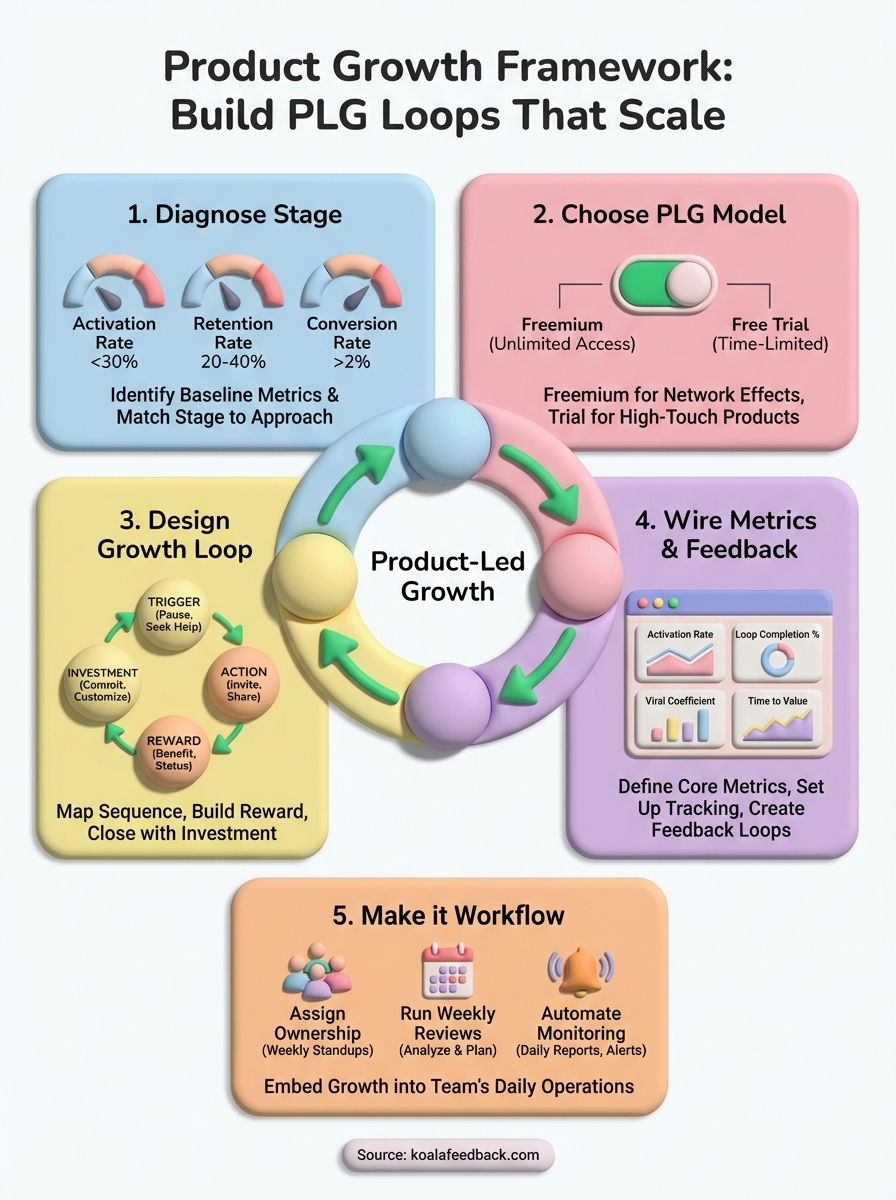
Your product growth framework doesn't require perfect planning or massive resources to launch. Start by diagnosing your current growth stage using the metrics and checklist from step one. This baseline tells you whether to fix activation first or build your first loop immediately.
Pick one growth loop to implement over the next four weeks. Choose freemium or trial based on your product's complexity and cost structure. Map your trigger points, design the action sequence, and wire in tracking before you launch. Test with a small user cohort first to identify friction points you missed.
Track your core metrics daily for the first 30 days. Review performance weekly with your team and adjust based on real user behavior. Organize user feedback and feature requests so you can prioritize improvements that strengthen your growth loops. Collect both numbers and qualitative feedback to understand what drives completions and what causes drop-offs.

Start today and have your feedback portal up and running in minutes.