Your product team ships features every sprint. But ask three people where the product is heading and you'll get three different answers. Engineering builds what seems urgent. Sales promises features to close deals. Users submit requests that pull you in every direction. Without a clear product vision, you're reacting instead of leading.
A product vision framework gives you structure to define where your product needs to go and why it matters. It transforms vague aspirations into concrete direction that your whole team can rally behind. You don't need inspirational speeches or corporate buzzwords. You need a clear statement that answers what you're building, who it serves, and how it improves their lives.
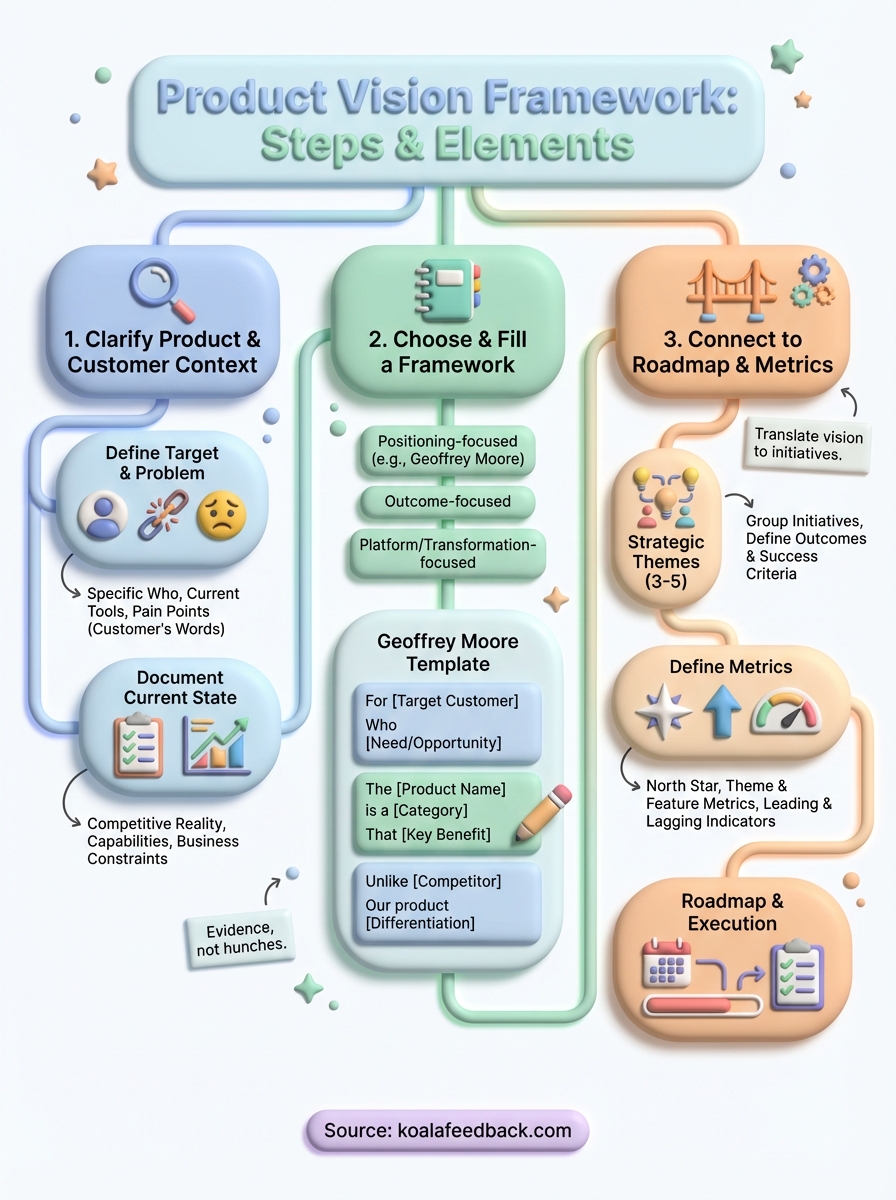
This guide walks you through creating a product vision that actually works. You'll learn what makes a framework effective, how to choose the right template for your situation, and how to connect your vision to roadmaps and metrics. We'll cover proven frameworks with real examples and show you how to keep your vision relevant as your product evolves. By the end, you'll have everything you need to build a vision that guides decisions and aligns your team.
A product vision framework is a structured template that helps you define and document what your product will become in the next 2-5 years. Unlike a freeform vision statement, a framework provides specific prompts and sections that force you to think through the critical elements of your product's future. It answers who your product serves, what problems it solves, how it differs from alternatives, and why it matters to your business and customers.
The framework acts as a shared reference point for your entire organization. When product managers debate prioritization, when engineers question feature requests, or when executives review strategy, they all turn to the same vision document. This consistency prevents the confusion that derails product development and keeps everyone working toward the same destination.
A well-structured framework transforms abstract ideas into concrete direction that guides daily decisions.
Most effective product vision frameworks contain four core components that work together to create complete clarity. You need to define your target customer with specific characteristics, not vague descriptions. You must articulate the problem you're solving and why current solutions fall short. Your framework should specify how your product creates value and what makes it different from competitors. Finally, you need to connect your vision to measurable business outcomes.
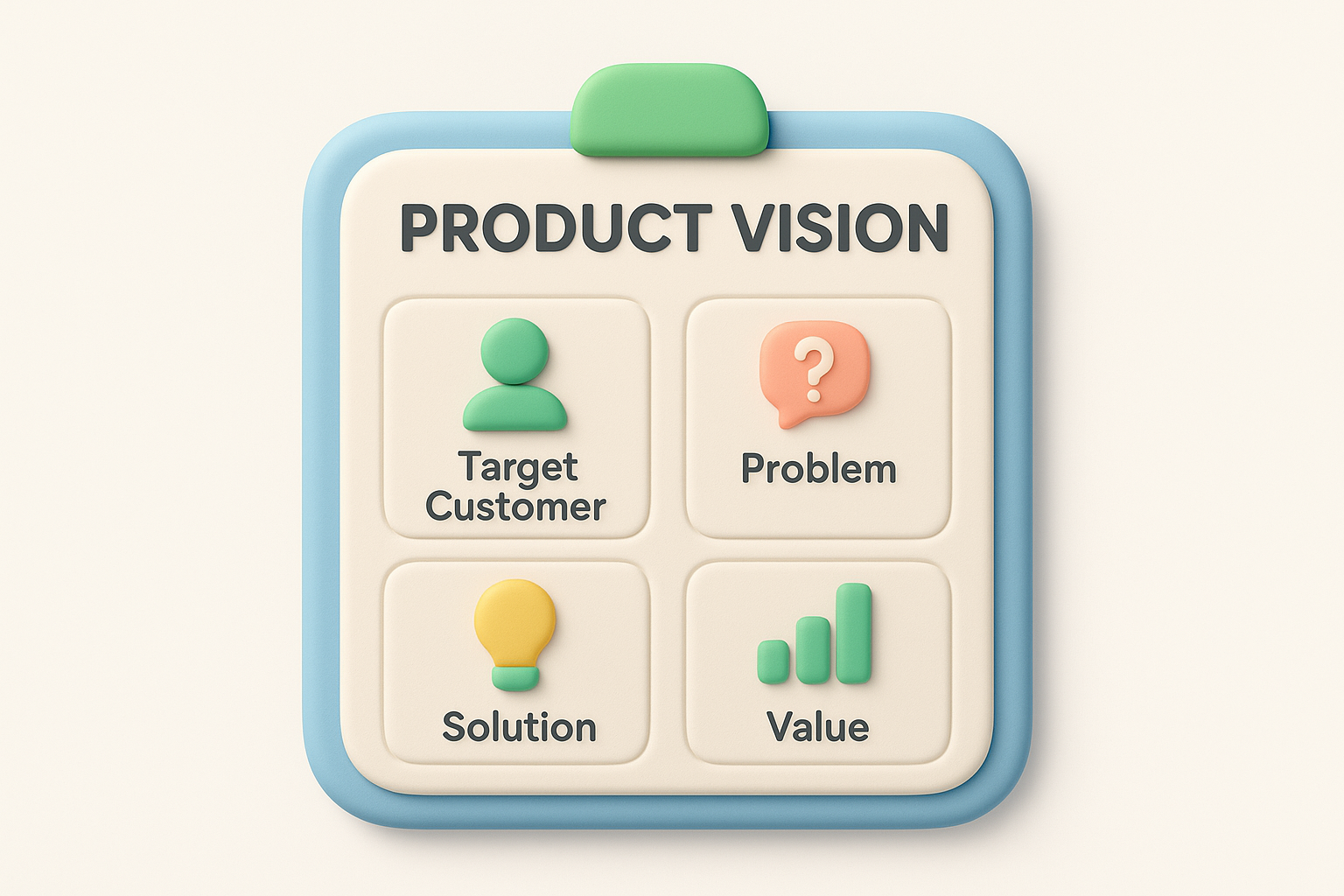
These elements appear in different formats across frameworks. Some use fill-in-the-blank templates, others use visual boards with sections, and some rely on narrative structures. The format matters less than covering all essential components. Your framework should answer every question a team member might ask about your product's direction without requiring interpretation or guesswork.
Before you choose a product vision framework, you need to gather the foundational information that will fill it. Many teams rush to templates and end up with generic statements that don't reflect reality. You must understand your current market position, your customers' actual problems, and how competitors address those needs. This clarity transforms your vision from aspirational fluff into strategic direction.
Start by collecting data from customer conversations, support tickets, and usage analytics. Schedule interviews with at least five current customers and five potential customers who chose competitors. Ask them to describe their workflow without your product and what happens when they try to accomplish their goals. These conversations reveal friction points you might miss from internal discussions alone.
You need to narrow your target audience to specific characteristics that matter for your product strategy. Instead of "small business owners," specify "bootstrapped SaaS founders with 1-10 employees who handle customer support themselves." Document these details in a simple profile:
Target Customer Profile:
Write down the specific problem your product solves using your customer's own words, not marketing language. If a customer says "I waste three hours every week copying feedback from Slack into spreadsheets," use that exact phrasing. This specificity keeps your vision grounded in real needs rather than assumptions about what matters.
The most effective visions start with documented evidence of customer problems, not hunches about market opportunities.
Create a competitive landscape document that lists alternatives your customers consider, including doing nothing or using spreadsheets. For each alternative, note its strengths, weaknesses, and the types of customers who choose it. This analysis helps you identify where your product vision framework should emphasize differentiation.
Map out your product's current capabilities and how customers actually use them versus how you intended them to be used. Usage analytics often reveal surprising patterns. Customers might ignore your flagship feature while building workflows around something you consider secondary. These insights inform which direction your vision should take because they show what resonates with real users.
Document your business constraints and goals in plain terms. List your revenue targets, team size, runway, and strategic priorities from leadership. Your product vision framework needs to align with these realities, not ignore them. A vision that requires ten engineers when you have three won't guide useful decisions.
Now that you understand your customer context, you need to select a framework structure that fits your product stage and communication needs. Different frameworks emphasize different aspects of vision. Some focus heavily on customer problems and solutions, others prioritize market positioning, and some highlight the transformation you want to create. You'll pick one based on what your stakeholders need to understand most clearly about your product's direction.
The framework you choose becomes your working document for the next 2-5 years. It should feel substantial enough to guide major decisions but flexible enough to refine as you learn. Most teams benefit from starting with a proven template rather than creating something from scratch. You can always customize it after you complete your first version.
Your product maturity determines which framework works best. Early-stage products need frameworks that clearly differentiate from existing solutions and explain why customers should switch. Established products benefit from frameworks that articulate market expansion or platform evolution. Choose based on what questions your team asks most often.
Consider these framework types:
The Geoffrey Moore positioning template remains the most widely used product vision framework because it forces clarity on every essential element. You fill in seven specific blanks with concrete information from your customer research. This template works exceptionally well for SaaS products and any situation where you need to explain how you differ from alternatives.
Geoffrey Moore Product Vision Template:
For [target customer]
Who [statement of need or opportunity]
The [product name] is a [product category]
That [key benefit, compelling reason to buy]
Unlike [primary competitive alternative]
Our product [statement of primary differentiation]
Here's a completed example for a feedback management tool:
For SaaS product managers
Who waste hours consolidating user feedback from multiple channels
Koala Feedback is a feedback centralization platform
That automatically captures, categorizes, and prioritizes user requests
Unlike spreadsheets or generic project management tools
Our product connects feedback directly to your public roadmap
Write your first draft in under 15 minutes using information you already gathered. Don't obsess over perfect wording yet. The goal is to get your thinking on paper so you can refine it with stakeholders. Most teams go through three to five revisions before settling on final language that resonates internally.
A completed framework template forces you to make specific choices about who you serve and how you compete.
Some products need different structure than the Moore template provides. If your product creates a new category rather than competing in an existing one, consider the vision narrative format. This approach tells a story about the future state you're creating without emphasizing competitive alternatives. You describe the world after your product succeeds and work backward to explain the path.
The Product Vision Board offers a visual alternative that works well for collaborative workshops. It divides your vision into five sections: target group, needs, product, and business goals. You fill each section with sticky notes during team sessions, making it easier to involve multiple stakeholders in vision creation. This format excels when you need buy-in from cross-functional teams who prefer visual thinking over text-heavy documents.
Your product vision framework becomes useless if it sits in a document while your team ships features that don't support it. You need to translate your vision into concrete initiatives that appear on your product roadmap and define metrics that prove you're making progress toward that future state. This connection transforms vision from inspiration into execution. Without it, your roadmap becomes a collection of disconnected features that please individual stakeholders but don't build toward anything meaningful.
You convert your vision into 3-5 strategic themes that group related initiatives together. Each theme represents a major capability or customer outcome your vision requires. Look at your completed product vision framework and identify the distinct elements that need development. If your vision promises to "automatically capture and prioritize user feedback," you might create themes like "Multi-channel feedback capture" and "Intelligent prioritization engine."
Document each theme with specific outcomes you need to achieve:
Strategic Theme Template:
These themes become the organizing structure for your product roadmap. Every feature request and initiative you consider should map to at least one theme. When something doesn't fit any theme, you either create a new theme (and update your vision) or decline the request because it doesn't support your strategic direction.
Themes create the bridge between your long-term vision and the quarterly initiatives that appear on your roadmap.
Your product vision framework needs quantifiable indicators that prove you're moving in the right direction. Choose metrics that reflect the customer outcomes your vision promises, not just product usage. If your vision emphasizes reducing time waste, track time saved per customer rather than feature adoption rates. Pick 2-3 primary metrics that directly measure whether you're delivering your core promise.
Structure your metrics in three levels:
Vision Metrics Framework:
| Metric Level | Purpose | Example |
|---|---|---|
| North Star | Overall vision success | Monthly active users completing core workflow |
| Theme Metrics | Progress on strategic themes | Feedback items automatically categorized |
| Feature Metrics | Initiative effectiveness | Adoption rate of new capture method |
Review these metrics quarterly alongside your roadmap planning. If your metrics show strong growth but don't reflect progress toward your vision, you're tracking the wrong things. Adjust either your metrics or your initiatives to ensure alignment. Share vision progress updates with your entire team using these metrics so everyone sees how daily work connects to long-term direction.
Track both leading and lagging indicators for each theme. Leading indicators predict future success and help you course-correct early. Lagging indicators confirm results but come too late for adjustment. For a feedback centralization vision, a leading indicator might be "percentage of support channels integrated" while a lagging indicator tracks "hours saved consolidating feedback."
You don't need to limit yourself to a single product vision framework structure. Different situations call for different approaches, and some teams find that combining elements from multiple templates creates the clearest direction. The frameworks below offer alternatives when the Geoffrey Moore template feels too rigid or doesn't capture the transformation you want to create. You can also study real-world examples from successful products to see how companies articulate their vision in practice.
The Product Vision Board organizes your vision into five distinct sections that work together as a visual reference. This framework excels when you need to involve multiple stakeholders in collaborative workshops or when your team prefers visual thinking over text-heavy documents. You fill each section during team sessions, making it easier to build shared understanding across product, engineering, and business teams.
Product Vision Board Template:
| Section | Questions to Answer |
|---|---|
| Vision | What is the overarching goal? What positive change do you want to create? |
| Target Group | Which market or user segment will you serve? |
| Needs | What problem does the product solve? What benefit does it provide? |
| Product | What is the product? What makes it stand out? |
| Business Goals | How will the product benefit the company? What are the revenue targets? |
You start by defining your overarching goal in the Vision section, then work through each section to add specificity. This format forces you to think about business goals alongside customer needs, preventing visions that satisfy users but don't support company objectives.
Studying how established companies express their product vision framework helps you understand what works in practice. These examples show different approaches that all accomplish the same goal: clear direction that guides decisions. Notice how each vision specifies the target customer, the problem being solved, and the unique approach.
Slack's original vision: "Make business communications simpler, more pleasant, and more productive for teams who need to coordinate work across multiple channels and timezones."
Airbnb's vision: "Create a world where anyone can belong anywhere, providing healthy travel that is local, authentic, diverse, inclusive and sustainable."
Zoom's vision: "Deliver limitless human connection through video communications that work reliably for every user, regardless of their location or technical expertise."
Each example uses plain language without buzzwords and describes a clear outcome rather than listing features. Your vision should follow this pattern: specific enough to guide decisions but broad enough to accommodate multiple product initiatives over several years.
The best product visions describe the customer outcome you're creating, not the technology you're building.
Your product vision framework becomes outdated the moment you stop referring to it. You need to review and update your vision at least annually, bringing in fresh customer research and market data to validate your direction. Schedule quarterly check-ins where your leadership team examines whether your roadmap still aligns with your vision statements. These reviews catch drift early before you've invested months building features that don't support your strategic direction.
Share your vision with every new team member during onboarding and reference it in planning meetings, prioritization discussions, and feature reviews. When stakeholders request changes that conflict with your vision, use the framework to explain why certain paths don't make sense. Your vision only guides decisions when people actually use it to make choices. Tools like Koala Feedback help you maintain alignment by connecting user requests directly to your public roadmap, ensuring every feature you build serves your larger vision and keeps customers informed about your strategic direction.

Start today and have your feedback portal up and running in minutes.