Customer insights professionals sit at the intersection of user feedback and product decisions. They're the ones turning raw opinions into actionable direction, figuring out what users actually need, not just what they say they want. Whether you're preparing to land one of these roles or you're hiring someone to fill it, having a solid list of customer insights interview questions ready makes a real difference in how the conversation goes.
At Koala Feedback, we build tools that help teams collect, organize, and prioritize user feedback, so we understand firsthand how critical it is to have the right people interpreting that data. A great customer insights hire can transform scattered feedback into a clear product roadmap. A bad one lets valuable signals slip through the cracks.
This article covers 10 interview questions commonly used for customer insights positions, along with sample answers you can adapt. Each question targets a specific skill, from research methodology to stakeholder communication, so you'll know exactly what's being evaluated and how to respond with substance.
This is one of the most common customer insights interview questions you'll encounter, and it tests more than just your research knowledge. A voice of customer (VoC) system is the backbone of any insights function, and how you describe building one reveals your strategic thinking and your ability to connect feedback to real business decisions.
Interviewers want to know whether you can build structured feedback infrastructure, not just analyze data handed to you. They're checking if you understand the full pipeline: where feedback comes from, how it gets captured, and how it reaches decision-makers. A vague answer signals reactive thinking, while a methodical response shows you can own a program end to end.
A strong answer walks through the core components of a VoC system in a logical sequence. You should cover how you identify the right feedback channels, how you standardize collection, and how you route insights to the right teams. Interviewers also want to confirm that you close the feedback loop, meaning you communicate back to customers what happened with their input.
Candidates who skip the "closing the loop" step often miss the most important part of a VoC system: building the trust that keeps customers giving honest feedback over time.
A solid answer typically touches on:
"I start by mapping every touchpoint where customers interact with the product, then I match the right collection method to each one. For in-app actions, I use short contextual surveys. For high-value accounts, I schedule quarterly interviews. Everything flows into a central repository where feedback gets tagged by theme and segment. From there, I set a weekly sync with the product team and a monthly summary for leadership. The step I never skip is closing the loop with customers, whether that's a status update on a feature or a clear explanation of a decision we made."
Expect the interviewer to push on specifics once you finish your answer. Be ready to explain how you handle low response rates or what you do when feedback conflicts across customer segments.
Raw feedback rarely arrives organized. You get support tickets overlapping with survey comments, one-off emails, and sales call notes all pointing in different directions. This question tests whether you can cut through the noise and build a reliable process for finding patterns in unstructured data.
Interviewers use this question to separate candidates who react to feedback from those who systematically process it. They want to see that you have a repeatable method, not just good instincts. A strong answer signals that you can handle high feedback volume without losing signal quality.
Your answer should walk through a clear sequence: grouping raw inputs by theme, filtering by frequency and business impact, then translating findings into a format that drives decisions. Mention how you handle one-off feedback versus recurring patterns, since that distinction matters when prioritizing what to act on.
Treating every piece of feedback equally is one of the fastest ways to slow down a product team.
Walk into this type of customer insights interview questions scenario with a concrete process ready to describe.
"I start by tagging every piece of feedback with a consistent set of labels: theme, product area, and customer type. Once I have enough volume, I look for patterns across tags. From there, I score each theme by frequency and revenue impact, then write a one-page summary that ties findings to a specific product decision."
Expect follow-up questions that test your process under pressure in real-world scenarios.
Bad data leads to bad decisions. This question shows up in most customer insights interview questions lists because acting on flawed data is one of the most expensive mistakes an insights team can make. Interviewers want to know that you treat data validation as a standard step, not an afterthought.
Interviewers ask this to confirm you understand that insights are only as good as the data behind them. A candidate who skips validation often delivers findings that unravel under scrutiny, which damages credibility with the product and leadership teams who rely on that work.
Your answer should show that you actively check for common data quality problems before drawing conclusions. Cover how you handle sample bias, response rate issues, and data collection errors. Strong candidates also explain how they cross-reference multiple sources to confirm a finding rather than relying on a single channel.
Skipping a validation step might save time upfront, but it costs far more when a flawed insight shapes a roadmap decision.
"Before I report any findings, I run a quick audit of the data set: response rate, sample size, and whether the respondents match the customer segment I intended to reach. If something looks off, I dig into the collection method first, then cross-check the pattern against support tickets or usage data to confirm it holds."
Expect the interviewer to test how you handle real gaps in your data under practical constraints.
Choosing the wrong research method wastes time and produces misleading results. This question shows up across customer insights interview questions lists because the ability to match method to question is a core competency for any insights role. Interviewers want to confirm that you select tools deliberately, not by habit.
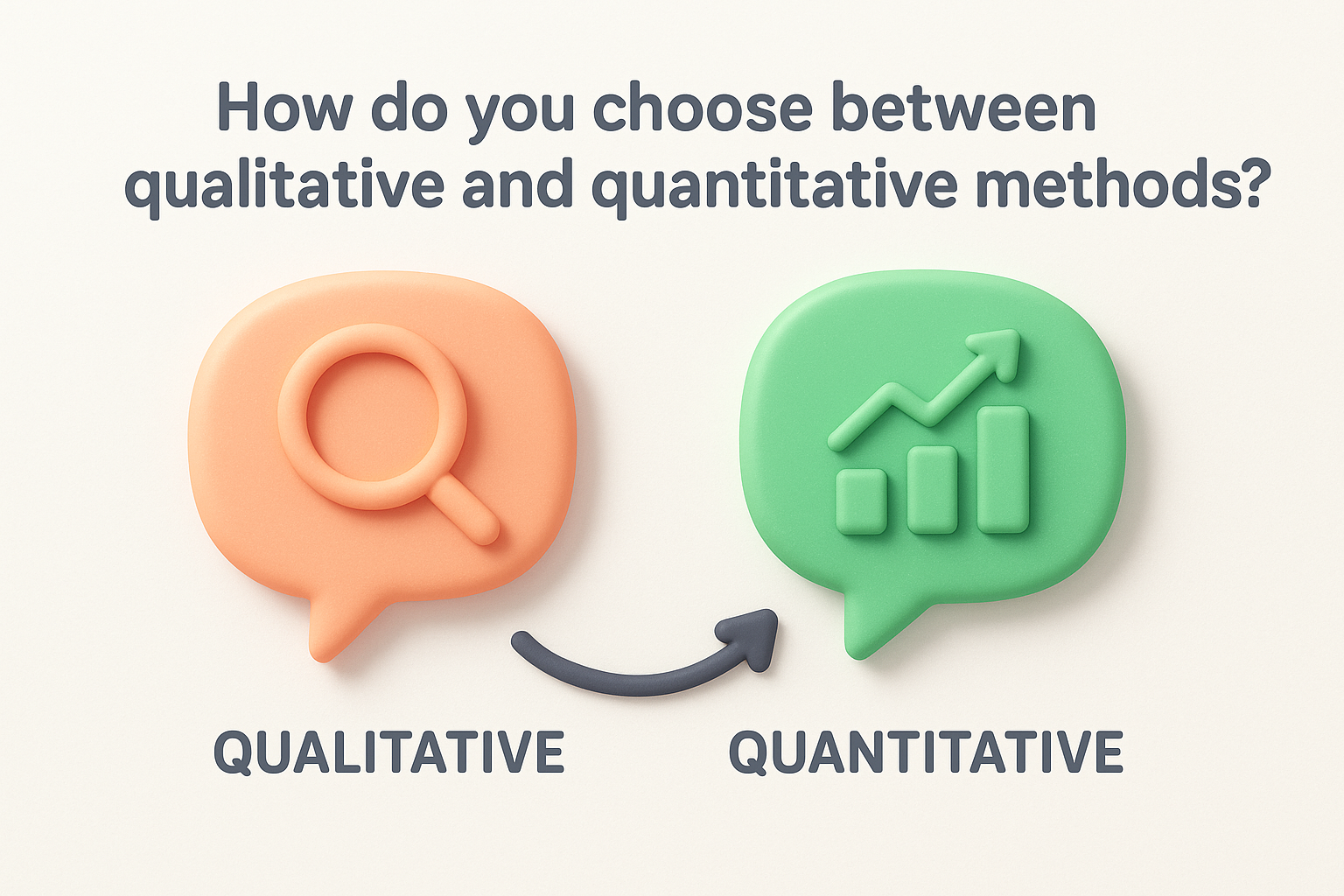
Interviewers ask this to test your research judgment, not just your technical knowledge. Candidates who default to one method regardless of context raise a red flag. The question reveals whether you understand that each method answers a different type of question and that mixing them strategically produces stronger findings.
Your answer should clearly state the conditions under which you reach for each method. Qualitative research, such as interviews or open-ended surveys, works best when you need to understand why something is happening. Quantitative methods work best when you need to measure how often or how many. Strong candidates explain how they combine both to validate findings.
The best insights work often starts qualitative to surface the "why," then uses quantitative data to confirm scale.
"My starting point is always the question I need to answer. If I need to understand what's driving churn, I start with interviews to hear the reasoning directly from customers. Then I use survey data or usage metrics to confirm how widespread that pattern is across the broader base."
Expect the interviewer to pressure-test your reasoning with specific trade-off scenarios.
A poorly designed survey produces data no one acts on. This question tests whether you treat survey design as a deliberate skill and whether you tie every question back to a specific business decision rather than collecting data out of general curiosity.
Survey design is central to most insights programs, and interviewers use this question to see if you connect research to outcomes. They want to confirm that you understand a survey's value comes from answering a defined question, not from maximizing response volume.
Your answer should show that you start with the decision first, then build the survey around it. Strong candidates cover question neutrality and sequencing, completion rates, and pilot-testing before a full send.
A survey that tries to answer everything ends up answering nothing useful.
"I start by writing down the decision the survey needs to support. Then I draft only questions tied directly to that decision, keep it under ten minutes, and pilot-test before sending broadly. After launch, I track drop-off points to flag questions that need to be reworded."
Expect pressure on how you handle stakeholder requests to add more questions, which is a common scenario in customer insights interview questions for this topic.
Customer interviews are one of the most direct ways to understand user behavior, but they only work when you run them well. A poorly structured interview leads customers to confirm your assumptions instead of revealing what they actually experience. This question appears in most customer insights interview questions lists because the skill gap between a mediocre and a strong interviewer is significant.
Interviewers want to confirm that you know how to surface genuine user needs rather than leading customers toward a predetermined answer. Many candidates can schedule an interview, but fewer can structure one that produces findings the product team trusts enough to act on.
Your answer should cover your preparation process, your approach to keeping questions open-ended, and how you handle moments when a customer goes off-script. Strong candidates also explain how they document and synthesize findings after the session.
The best interviews feel like conversations, not questionnaires, and that balance takes deliberate preparation to achieve.
"I build a discussion guide with three to five open questions and let the customer drive the detail. I avoid yes or no questions entirely and instead ask things like 'walk me through the last time you dealt with this.' After each session, I write a summary within an hour while the context is fresh."
Expect the interviewer to test how you handle challenging interview dynamics that come up in real sessions.
Customer segmentation separates insights work that drives decisions from insights work that collects dust. This question comes up in most customer insights interview questions conversations because bad segments are one of the most common reasons research outputs never get used. Interviewers want to know that you can build segments with a clear purpose and maintain them as the customer base evolves.
Segmentation is a foundational skill, and interviewers use this question to see whether you build segments around business questions or just copy a framework you've seen before. They want to confirm that your segments actually change how the product team thinks and acts, not just how data gets labeled.
Your answer should cover how you define segmentation criteria, how you validate that segments are meaningfully different from each other, and how you keep them current. Strong candidates also explain how they retire or adjust segments when customer behavior shifts.
A segment that no longer reflects real customer behavior is worse than no segment at all, because it creates a false sense of understanding.
"I define segments based on how customers actually use the product, not just who they are on paper. Every quarter I check whether the segments still hold by comparing behavioral data across groups and adjusting the criteria if the patterns have shifted."
Expect the interviewer to probe how you handle edge cases and internal disagreement about which segments matter most.
Churn analysis is where insights work has direct revenue consequences, which is why it shows up in most customer insights interview questions lists. Interviewers want to see that you can go beyond labeling a problem and actually propose a fix with supporting evidence.
This question tests whether you can connect customer behavior data to business outcomes and then move from diagnosis to recommendation. Candidates who only describe why customers leave without proposing concrete next steps signal that they stop short of the most valuable part of the work.
Your answer should cover how you combine multiple data sources to identify churn signals, not just rely on exit surveys alone. Strong candidates show they triangulate behavioral data, support ticket themes, and direct customer feedback to build a credible picture. You should also explain how you frame a recommendation so the product or success team can act on it quickly.
The most useful churn analysis ties a specific behavior pattern to a concrete intervention, not just a general observation.
"I start by pulling usage data for accounts that churned in the last 90 days and comparing it against retained accounts. Then I cross-reference those patterns with support history and any exit survey responses I have. I package findings as a one-page brief with a root cause, a proposed fix, and a metric to track whether it worked."
Expect the interviewer to test how you handle incomplete data and internal resistance to your findings.
Translating data into language that drives decisions is one of the most practical skills in any insights role. Stakeholders in product, marketing, or leadership often lack a research background, so your job is to make the finding clear enough that no one needs a clarifying question before acting on it.
This question appears across most customer insights interview questions lists because communication is where insights either land or get ignored. Interviewers want to confirm that you can bridge the gap between data and decisions without oversimplifying your findings or burying them in technical detail.
Your answer should show that you lead with the business implication first, then support it with the data. Strong candidates explain how they adapt their format to the audience, using visuals for executives and more detail for product teams. Mention how you handle questions you cannot immediately answer.
The moment you lead with methodology instead of the finding, you lose the room.
"I structure every stakeholder presentation around one sentence: here is what we found and here is what it means for the business. The supporting data and methodology go in an appendix for anyone who wants to dig deeper."
Expect the interviewer to probe how you handle pushback or skepticism from stakeholders who challenge your findings in the moment.
This question is a practical skills check that shows up in most customer insights interview questions conversations. Interviewers want to know whether you can operate independently with data, not just interpret reports someone else built for you.
Interviewers ask this to confirm you can pull and manipulate data without waiting on an analyst or engineer. They are also checking whether your tool fluency matches the stack their team actually uses. A generic answer that lists every tool you have ever heard of raises doubts about real working knowledge.
Your answer should name specific tools you have used recently and explain what you used them for, not just that you know them. On SQL, be honest about your level. Strong candidates describe the types of queries they write independently and where they rely on others.
Admitting the limits of your SQL skills is far more credible than overstating them and getting caught in a technical screen.
"My daily stack includes a survey platform for structured feedback collection and an analytics tool for behavioral data. In SQL, I write joins and aggregations on my own to pull cohort data or segment usage patterns. For anything more complex, I collaborate with a data analyst and come prepared with a clear question so we get to the output faster."
Expect the interviewer to test specific technical scenarios rather than accepting a general answer at face value.
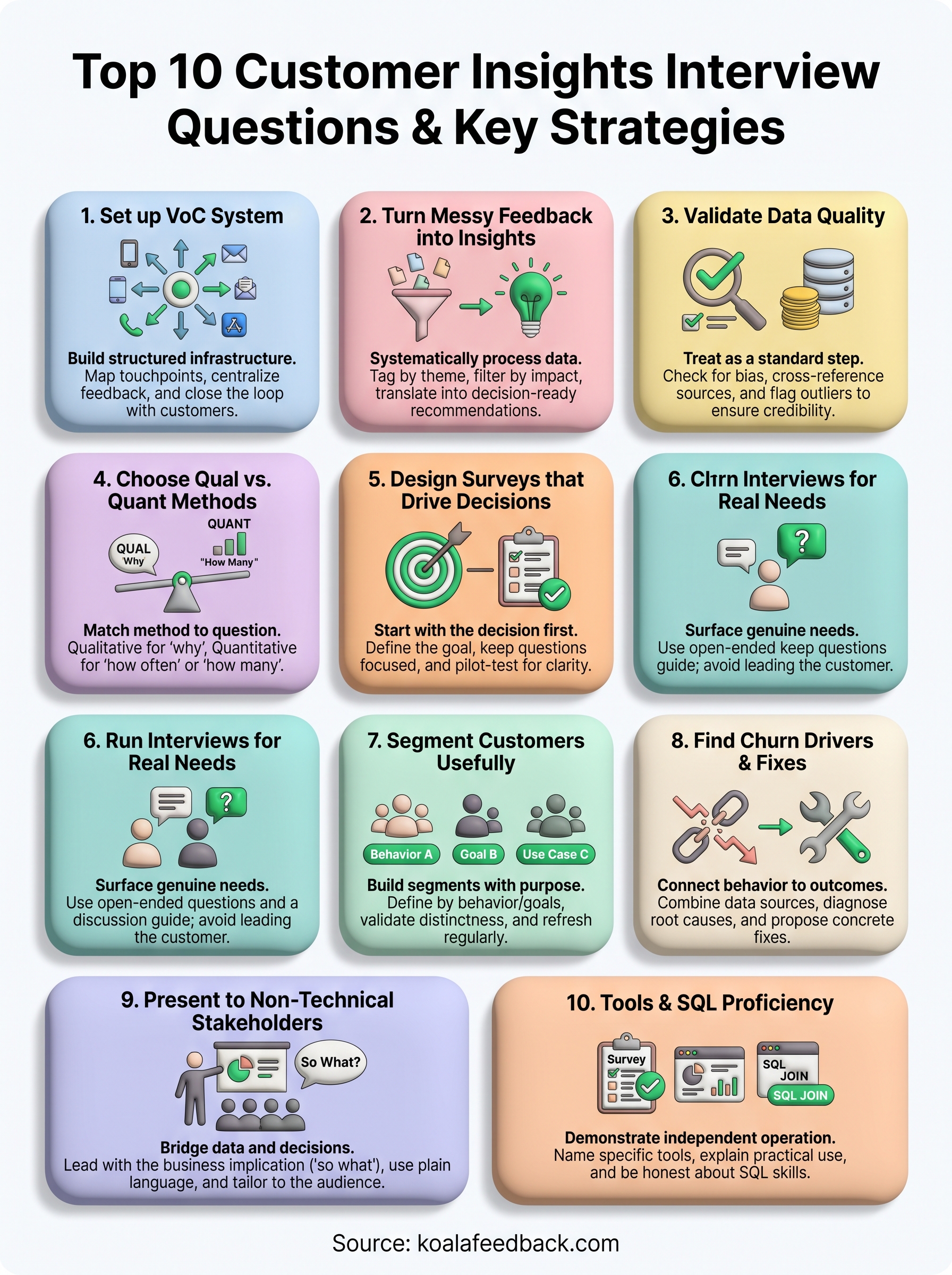
Preparing for customer insights interview questions takes more than memorizing answers. You need to connect each response to a real process you can defend when the interviewer pushes back. Use the sample answers in this article as a starting point, then adapt them to reflect your own experience, tools, and specific outcomes you have driven.
The strongest candidates walk into these interviews with concrete examples and a clear sense of how insights connect to product decisions. If you work in a product or SaaS environment, that means knowing how feedback gets collected, prioritized, and acted on. Platforms like Koala Feedback give you hands-on exposure to that full cycle, from capturing user input to surfacing patterns that shape a roadmap. Understanding that workflow from the inside makes your interview answers sharper and more credible to anyone evaluating whether you can do this work.

Start today and have your feedback portal up and running in minutes.