Every product decision you make is a bet. You're betting that what you build is what your customers actually want. A customer needs analysis gives you the data to make that bet with confidence, it's a structured process for identifying what your users expect, what frustrates them, and what drives their purchasing decisions. Without it, you're guessing. And guessing gets expensive.
The challenge most teams face isn't a lack of feedback, it's scattered feedback. Requests buried in emails, support tickets, Slack messages, and spreadsheets. That's exactly the problem we built Koala Feedback to solve: a single place to collect, organize, and prioritize what your users are telling you. But collecting feedback is just one piece of the puzzle. You also need a clear framework for analyzing it.
This guide breaks down the methods, questions, and concrete steps behind an effective customer needs analysis, so you can stop building on assumptions and start building on evidence.
A customer needs analysis is a structured process for discovering what your customers actually need from your product, service, or experience, as opposed to what you assume they need. It goes beyond surface-level requests to uncover the underlying motivations, pain points, and desired outcomes that drive behavior. Think of it as a translation layer between raw customer input and actionable product decisions.
A needs analysis doesn't just capture what customers say they want. It reveals why they want it, and that "why" is where your best product decisions live.
This process typically examines three layers of customer need: functional needs (what a product must do), emotional needs (how it should make users feel), and social needs (how it affects the way users are perceived). Each layer gives you a different angle on the problem your product is solving. Ignoring any one of them leads to gaps in your solution that users feel but struggle to articulate.
A solid analysis pulls signals from multiple data sources: surveys, interviews, support tickets, usage data, and sales calls. No single source tells the full story. Combining them gives you a more accurate picture of what your customers actually need versus what a vocal minority is loudly requesting.
When you skip this step, you default to building features based on whoever spoke to you last or shouted loudest. A rigorous customer needs analysis gives your team a shared, evidence-based foundation for deciding what to build, what to cut, and what to delay. It removes the politics from prioritization.
Teams that run this process consistently ship features their users actually adopt. They waste less time on low-impact work and build stronger relationships with users because those users feel heard. That trust compounds over time.
Before you collect a single data point, you need to know what you're trying to learn and who you're trying to learn it from. Teams that skip this step end up with a pile of feedback that points in every direction. A clear goal keeps your analysis focused and your findings usable.
If you can't write your analysis goal in one sentence, your scope is too broad.
Your goal should define the decision you're trying to make. Are you evaluating a new feature? Figuring out why churn is rising? Each goal demands a different set of questions. Use this format to write yours before anything else:
Goal template: "We need to understand [specific gap] so we can [specific decision]."
Example: "We need to understand why free trial users do not convert so we can redesign the onboarding flow."
Not all customers share the same needs. A power user and a first-time user will give you completely different signals. Pick the segment most relevant to your goal before you start collecting anything. Use criteria like plan tier, company size, or time as a customer to narrow it down. Running a customer needs analysis on too broad a group mixes conflicting signals and makes your findings harder to act on.
Once your goal and audience are locked in, you need to collect actual data. The method you choose shapes what you learn, so picking the right one for your specific goal is not optional. Each source in a customer needs analysis reveals a different layer of what users actually want.
Different situations call for different collection tools. Use this table to match your goal to the right method:
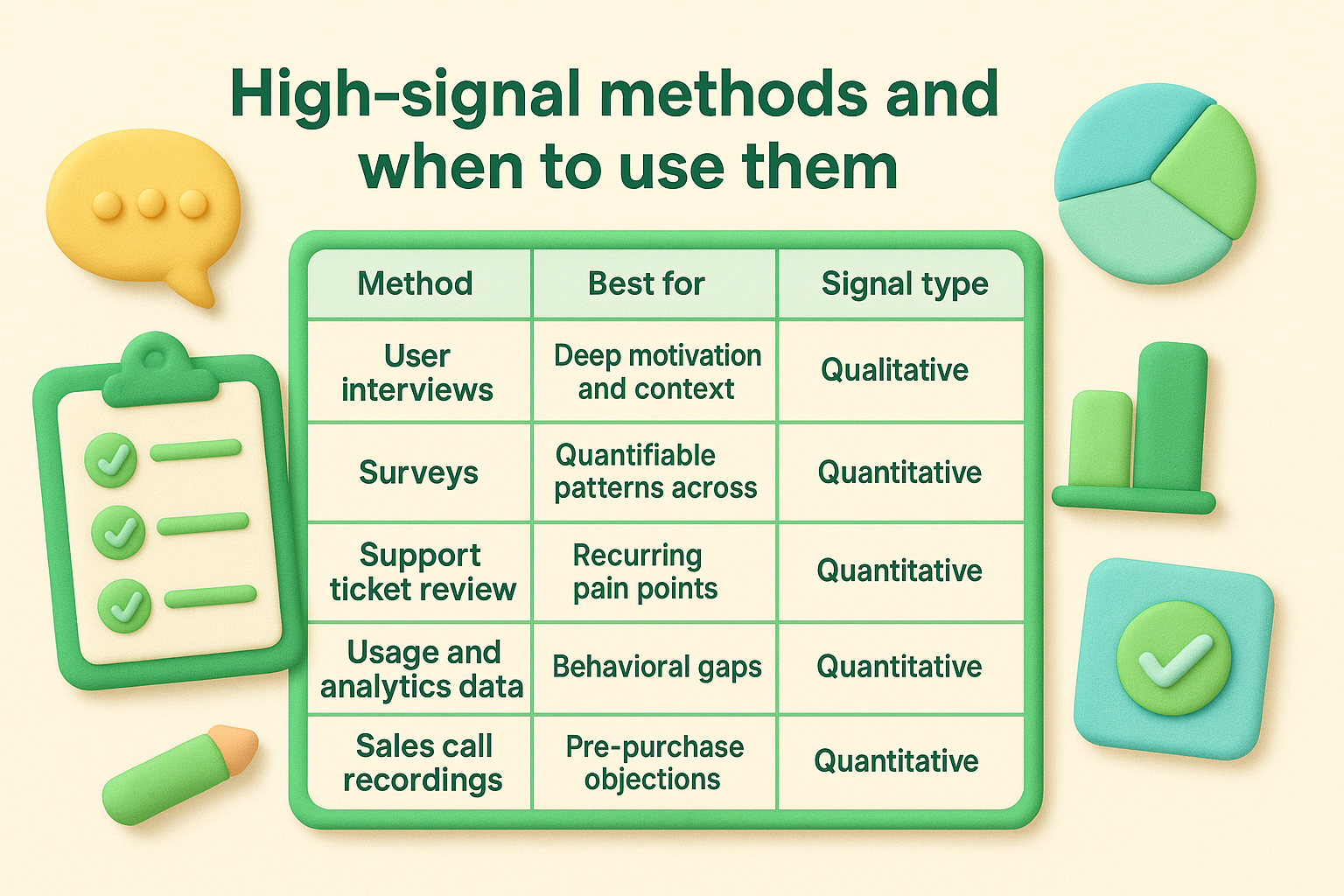
| Method | Best for | Signal type |
|---|---|---|
| User interviews | Deep motivation and context | Qualitative |
| Surveys | Quantifiable patterns across segments | Quantitative |
| Support ticket review | Recurring pain points | Qualitative |
| Usage and analytics data | Behavioral gaps | Quantitative |
| Sales call recordings | Pre-purchase objections | Qualitative |
User interviews give you the richest signal but take the most time. Surveys scale well but tend to surface only what users can easily articulate, not what they struggle to name.
Your questions determine the quality of your data. Avoid leading or yes/no questions and focus on behavioral prompts that push users to describe real past situations rather than hypothetical preferences.
The best interview questions start with "Tell me about a time when..." not "Would you like a feature that..."
Try these openers: "Walk me through...", "What happens next when...", "How do you currently handle..."
Collecting signals is only useful if you can turn them into clear, actionable need statements. This step is where your customer needs analysis moves from raw input to something your team can actually build against. Ambiguous needs produce ambiguous solutions, so precision here saves you time later.
A need statement is not a feature request. It describes a user's problem, not your proposed solution.
A strong need statement follows a consistent structure that keeps the focus on the user, not on your product. Use this template for every need you identify:
Template: "[User segment] needs to [accomplish goal] so they can [achieve outcome], but currently [barrier or pain point]."
Example: "Free trial users need to see value in the product within the first session so they can justify upgrading, but currently the onboarding flow skips their primary use case."
Once you have your need statements written, connect each one to a measurable outcome your team already tracks. This makes prioritization straightforward and keeps your findings tied to business impact.
Use this mapping format to link each need to a metric:
| Need statement summary | Linked metric | Current baseline |
|---|---|---|
| Faster onboarding for trial users | Trial-to-paid conversion rate | 12% |
| Clearer error messages in checkout | Support ticket volume | 340/month |
You have need statements, you have data, and now you need to make a call. Prioritization is where your customer needs analysis pays off because you stop reacting to whoever asked last and start making decisions based on evidence and business impact.
The goal is not to build everything users ask for. It's to build the right things in the right order.
Run each need statement through a simple scoring matrix before you commit to anything. Impact measures how directly the need connects to a business metric you already track. Effort measures your team's cost to address it. High-impact, low-effort needs ship first. Everything else gets ranked below them.
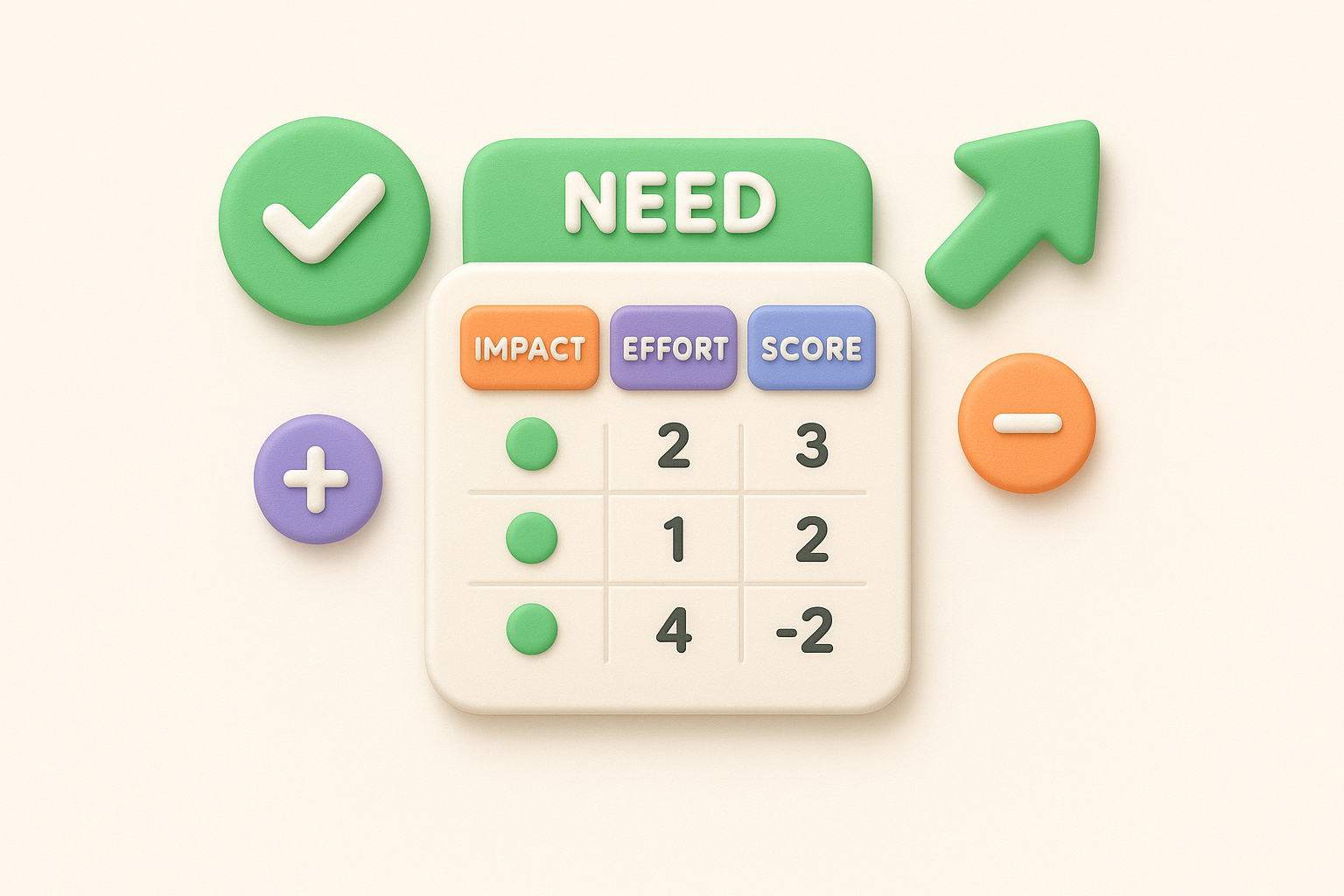
| Need summary | Impact (1-5) | Effort (1-5) | Priority score (Impact minus Effort) |
|---|---|---|---|
| Faster onboarding | 5 | 2 | 3 |
| Clearer error messages | 3 | 1 | 2 |
| Advanced export options | 2 | 4 | -2 |
Scoring gives you a ranked list, but it does not replace direct validation. Before you move the top-ranked need into your roadmap, confirm it with at least five to eight users from the exact segment you analyzed. A quick interview or a targeted survey is enough to verify that your interpretation of the need matches what users actually experience.
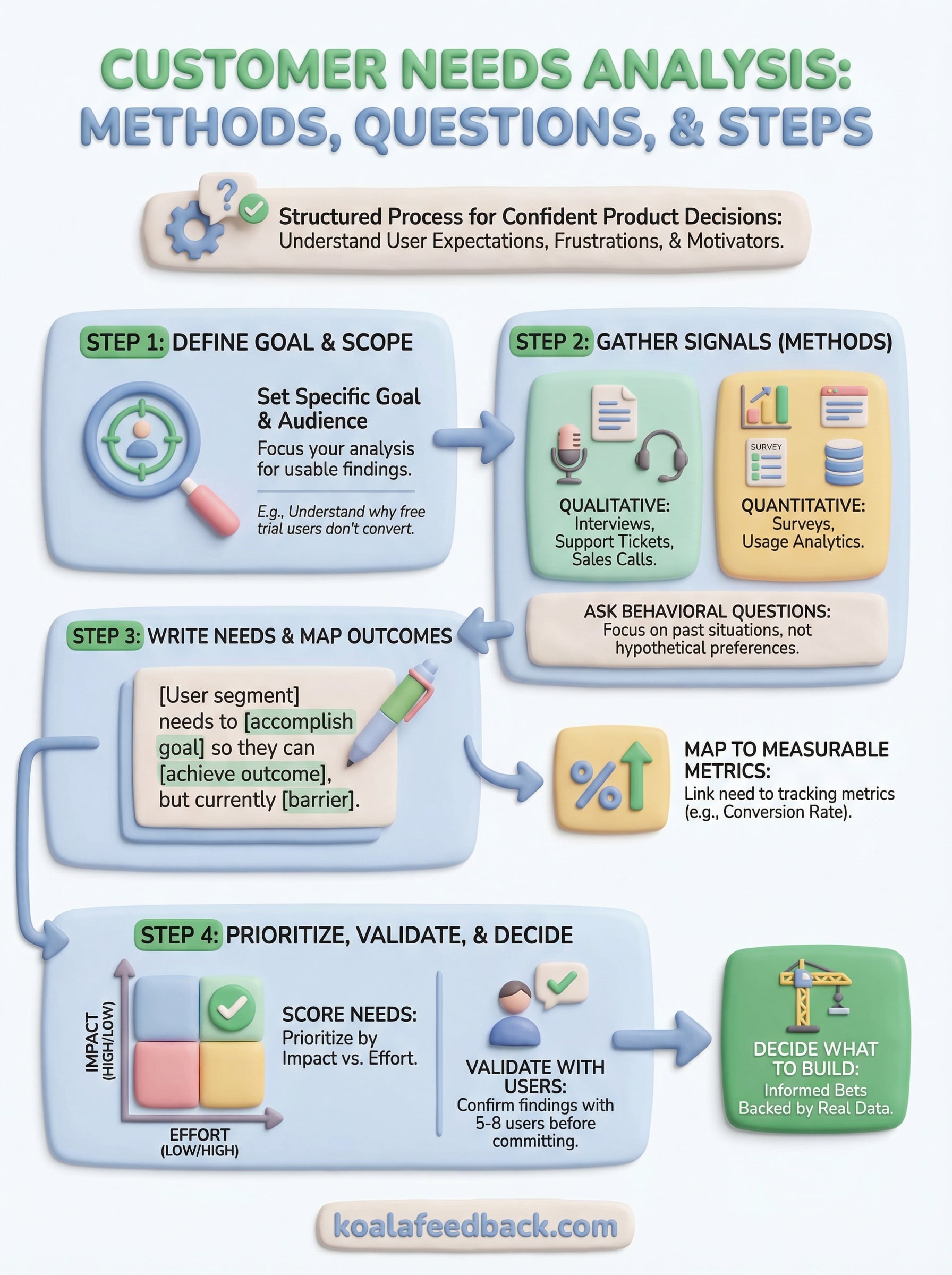
Running a customer needs analysis is not a one-time event. You define your goal, gather signals, write clear need statements, and then prioritize based on evidence. Repeat that cycle regularly and your product decisions stop being guesses. They become informed bets backed by real user data.
The biggest obstacle most teams hit is fragmented feedback. Users send requests through email, chat, and support tickets, and none of it connects. That's what makes the whole process harder than it needs to be. Centralizing your feedback before you analyze it saves you hours and produces cleaner, more reliable findings.
Koala Feedback gives you a single place to collect, organize, and prioritize what your users are telling you, so your next analysis starts with structured data instead of a messy inbox. If you're ready to bring your feedback process together, start collecting user feedback with Koala Feedback and build from there.

Start today and have your feedback portal up and running in minutes.