Most product teams still spend hours manually tagging feedback, hunting for patterns across support tickets, and guessing which feature request actually matters to revenue. AI product discovery changes that math by letting you process thousands of customer signals in minutes instead of weeks, surfacing themes you'd otherwise miss buried in spreadsheets and Slack threads.
This guide gives you a practical framework for weaving AI into your existing discovery workflow, not a pitch for replacing your judgment with an algorithm. You'll see exactly where AI tools fit into research, synthesis, and prioritization, and just as importantly, where human context still has to lead the decision.
We'll walk through how to use AI to automatically categorize feedback, cluster similar requests, spot sentiment shifts before they show up in churn numbers, and turn raw customer input into prioritized themes your team can act on. Along the way, you'll get concrete steps for connecting these techniques to a tool like Koala Feedback, so centralizing feedback and running it through AI-assisted analysis becomes part of your regular product cadence rather than a one-off experiment.
The traditional discovery process breaks down the moment your feedback volume outpaces your team's capacity to read it. A product manager juggling five channels, support tickets, sales notes, app store reviews, in-app surveys, can maybe process a few hundred data points a week before burnout sets in. AI product discovery flips that constraint. Natural language models can read thousands of comments in the time it takes you to finish your coffee, tagging sentiment, extracting themes, and flagging outliers that would otherwise sit unread in a spreadsheet tab nobody opens again.
Speed isn't the only benefit. Pattern recognition across large datasets is something humans are genuinely bad at, especially when the data lives in disconnected tools. AI models don't get fatigued or biased toward the last five tickets they read; they weigh the whole dataset consistently. That consistency matters when you're deciding whether a request came from three loud users or three hundred quiet ones.
The real value of AI in discovery isn't speed alone, it's catching patterns no single person could hold in their head.
AI is excellent at surfacing what's happening, but it doesn't know your business context, your margins, or your roadmap commitments. A model can tell you that "onboarding friction" appears in 40% of churn-related comments; it can't tell you whether fixing that is worth delaying your enterprise SSO launch. That judgment call stays with your team. Treat AI as a research assistant that does the heavy lifting on volume, not a decision-maker that replaces product strategy.
Here's a quick comparison of what shifts once AI enters the workflow:
| Task | Manual process | AI-assisted process |
|---|---|---|
| Tagging feedback | Hours per week, inconsistent labels | Minutes, consistent categorization |
| Finding themes | Relies on memory and spot-checking | Surfaces clusters across full dataset |
| Sentiment tracking | Reactive, noticed after churn spikes | Detects shifts as they happen |
| Prioritization input | Gut feel plus a few loud customers | Volume and sentiment-weighted signals |
Once you see the gap in that table, the case for AI-driven feedback analysis becomes less about chasing a trend and more about closing an obvious efficiency hole in how product teams already work, which is exactly how customer insights AI works in practice. The next four steps show you exactly how to build that into a workflow you can run every week, not just once as an experiment.
Before any AI model can find patterns, it needs a single dataset to work with. Scattered feedback across email threads, support tickets, app store reviews, and sales call notes is the biggest reason discovery stalls, not a lack of good tools. Centralizing feedback into one system is the unglamorous first step that makes every AI-assisted step after it actually work.
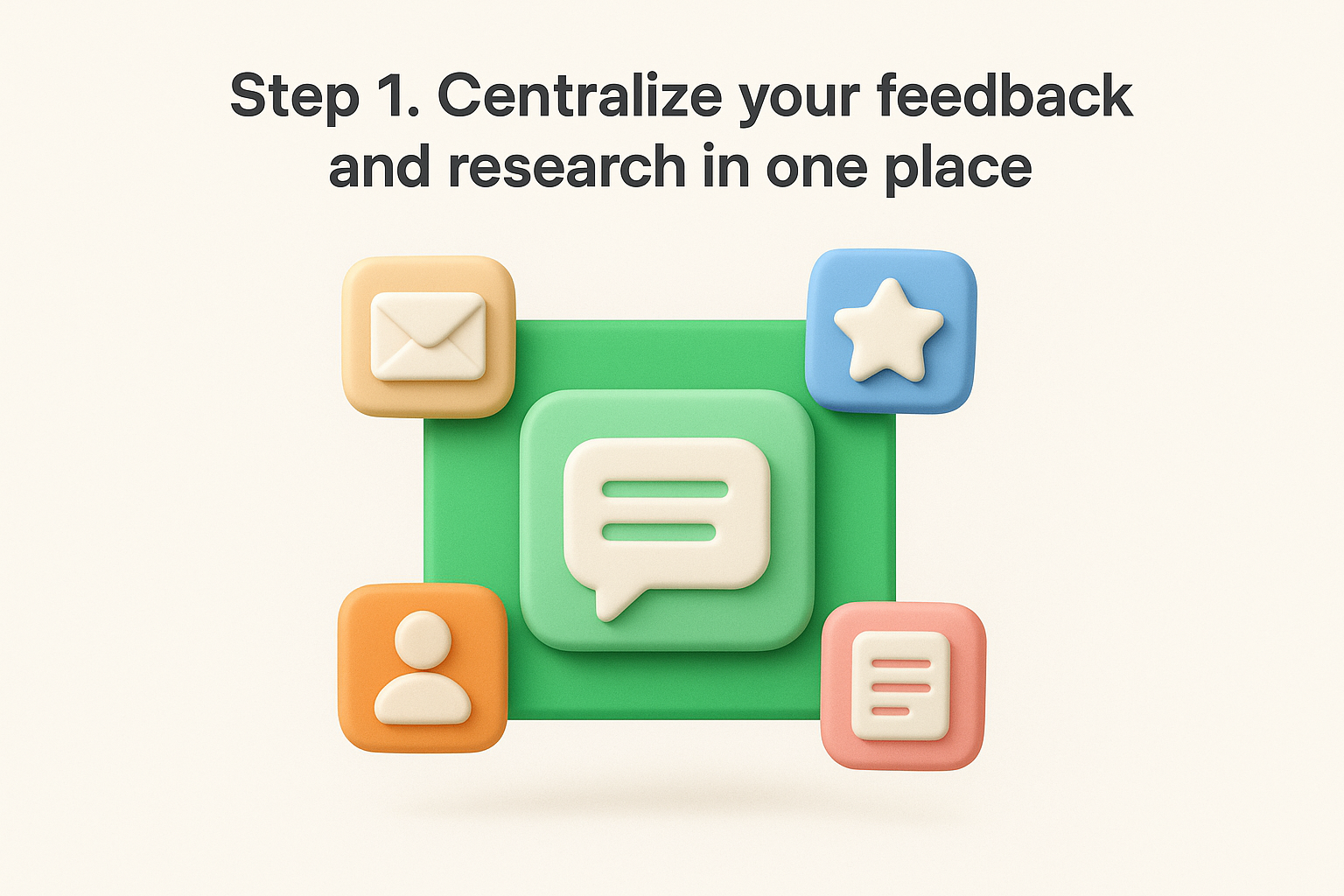
Start by mapping where customer input actually lives, then route it into a shared repository instead of leaving it siloed by department. A feedback portal like Koala Feedback gives you a home for this, letting customers submit requests directly while your team imports feedback from other channels into the same board.
AI can only find patterns in feedback it can actually see, so fragmented data means fragmented insight.
Raw text dumped into a spreadsheet gives an AI model less to work with than structured, timestamped entries with source tags. Tag each piece of feedback with its origin, date, and customer segment before you run any AI-powered tools for analyzing feedback on top of it. This structure lets you later filter results by plan tier or account size, which turns a generic theme like
Once your feedback lives in one place, the next job is turning that raw pile into themes you can act on. This is where AI-powered synthesis earns its keep: instead of you manually re-reading hundreds of tickets, a language model can group similar requests, label sentiment, and flag the outliers worth a closer look. Koala Feedback's feedback categorization tools handle this automatically, deduplicating similar submissions and organizing them into boards so patterns show up without you tagging every entry by hand.
Give the model your structured dataset and ask it to group entries into themes by underlying need rather than surface wording. "Can't find the export button" and "exporting is confusing" are the same problem described two ways, and clustering catches that overlap a keyword search would miss. Run this weekly instead of quarterly, and tracking customer sentiment with NLP will catch shifts before they show up as churn.
A pattern buried in five hundred comments is invisible to a person and obvious to a model built to read all five hundred.
Vague prompts return vague summaries. Instead, structure your requests so the output maps directly to decisions your team needs to make:
Each question produces a specific, comparable answer instead of a generic theme list. Treat this synthesis step as pattern discovery, not final judgment. The output tells you what's happening across your customer base; deciding what it means for your roadmap is still your call, and it feeds directly into scoring the opportunities you'll prioritize next.
Synthesis tells you what customers are asking for. Scoring tells you what to build first, and this is where AI-assisted prioritization turns opinion into something closer to a repeatable formula. Feed the model your clustered themes alongside a scoring framework, and it can rank opportunities by volume, sentiment intensity, and account value in seconds instead of a full afternoon in a spreadsheet.
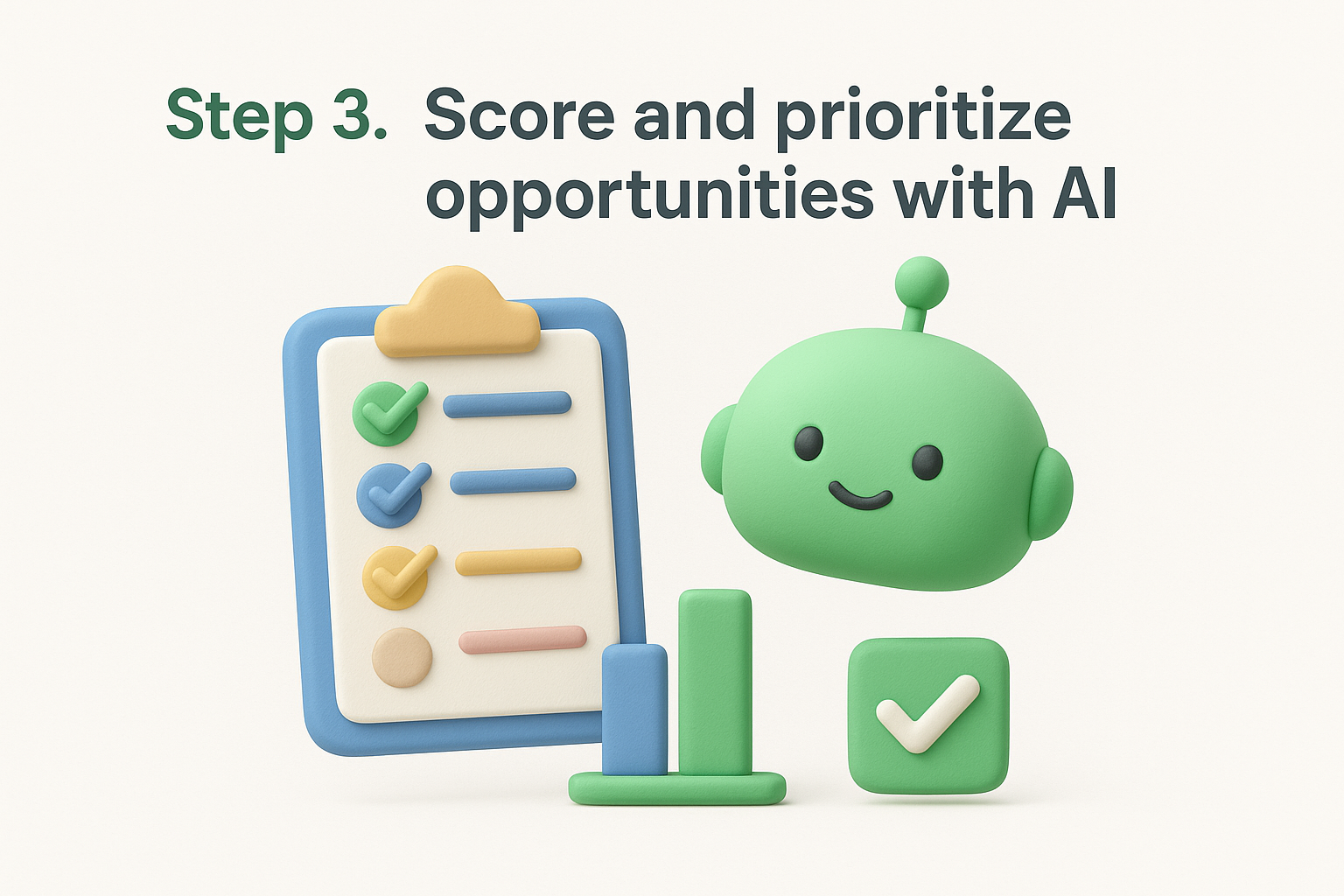
Don't ask an AI to "prioritize this list." Give it explicit weights, the same way you'd build a scoring rubric for feature requests, so the output reflects your business rather than a generic default. A RICE-style input works well:
A prioritization score is only as trustworthy as the criteria you feed into it, so define your weights before you ask AI to rank anything.
Once you have ranked opportunities, push them straight into your prioritization boards so the score isn't stuck in a report nobody revisits. Koala Feedback lets you organize scored requests by product area, which keeps the ranking visible to your whole team instead of buried in a one-time export.
Running this scoring pass monthly, rather than only at planning time, means your backlog reflects current customer signal instead of last quarter's guesswork. Treat the AI-generated ranking as a strong first draft: adjust for roadmap dependencies, technical debt, or strategic bets the model has no visibility into. Structured scoring narrows the debate to a handful of top contenders, which is exactly what you need before you validate them with the people who'll actually build and buy them.
Landing on a shortlist of prioritized ideas doesn't mean you're ready to build. Validation confirms the problem is real and the solution direction makes sense before engineering time gets spent chasing a theme that sounded stronger in a spreadsheet than it does in a customer's actual workflow, which is where lean research tactics for validating product ideas pay off. AI speeds up this step too, drafting interview scripts, summarizing call recordings, and flagging contradictions between what customers say and what they do. Use it to prepare for the conversation, not to skip it.
Validation exists to catch the gap between what a spreadsheet says and what a real customer means.
Give the model your top-scored theme and ask it to draft a validation script, including the kind of open-ended user interview questions that don't lead the customer toward the answer you're hoping to hear. Feed it raw call transcripts afterward, and it can pull recurring quotes, flag emotional language, and highlight where customers actually disagree with each other, so you're not just validating the loudest opinion in the room.
Stakeholder debates usually stall because sales, support, and leadership have each seen a different slice of feedback. Sharing the same synthesized dataset and AI-generated summary before a roadmap review means the discussion starts from shared evidence instead of competing anecdotes. Stakeholder alignment gets easier once everyone is arguing over the same numbers instead of their own inbox. Publish the validated theme on your public roadmap so customers and internal teams see the same status, whether it's planned, in progress, or shipped, closing the loop between discovery and delivery.
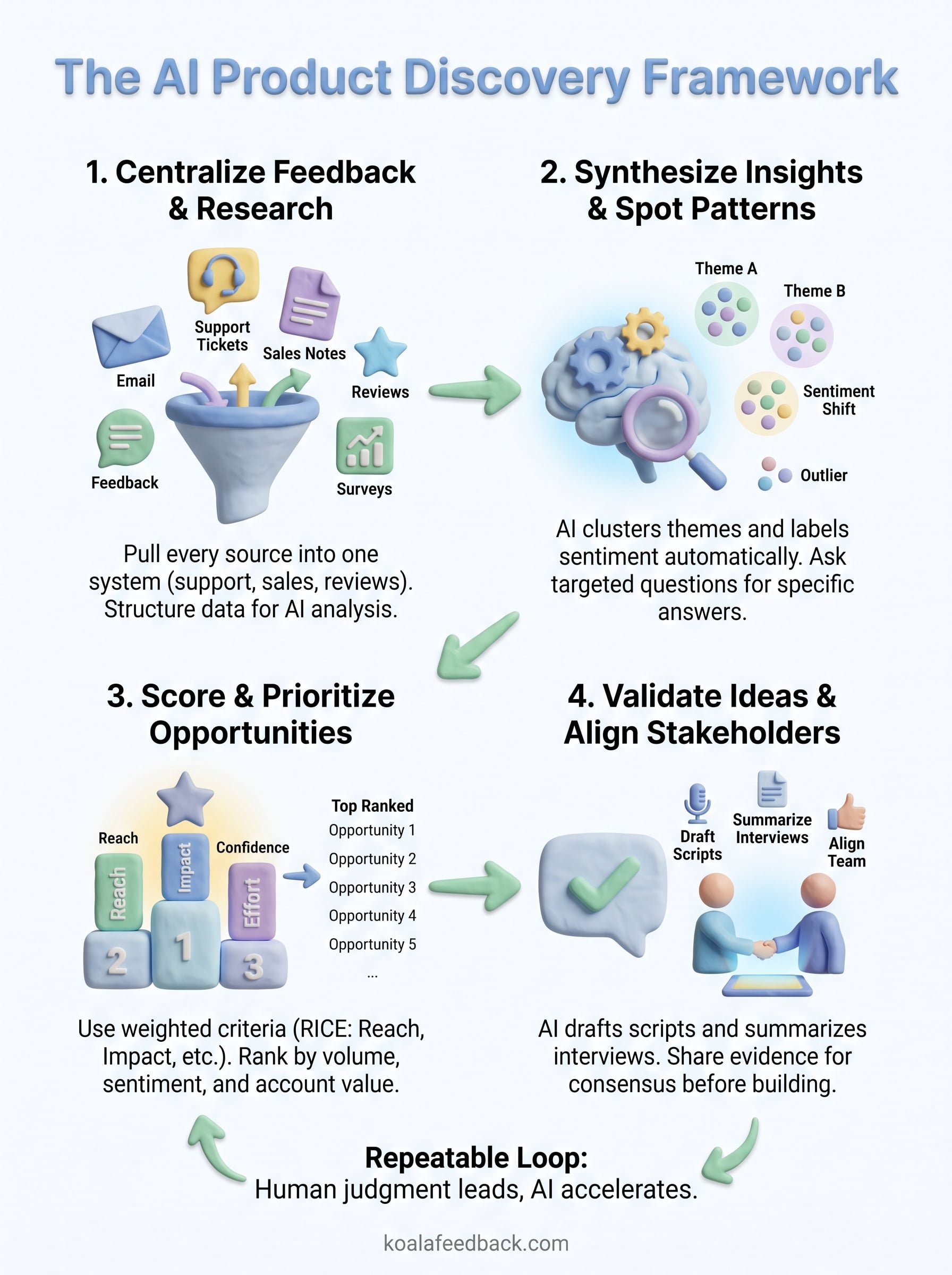
None of these four steps work as one-off experiments. AI product discovery earns its keep when you run it as a repeatable loop: centralize feedback, let AI synthesize the patterns, score opportunities against your own weighted criteria, then validate before you commit engineering time. Skip the centralizing step and the rest falls apart, because AI can only find patterns in data it can actually see.
Quality still depends on your judgment at every stage. The model surfaces themes and rankings fast, but you decide what those numbers mean for your roadmap, your margins, and your customers. That balance, speed from AI paired with context from your team, is what separates a genuinely useful process from a flashy dashboard nobody trusts.
If you want a system built for exactly this workflow, from prioritization boards through public roadmaps, start by centralizing every request in one feedback portal with Koala Feedback and see how much of this loop you can automate this week.

Start today and have your feedback portal up and running in minutes.