Every product update, delayed feature, or scope change forces the same question: who needs to know, and how do you tell them without spamming everyone. A solid stakeholder communication plan solves that by mapping out exactly which updates go to which stakeholders, through which channel, and on what schedule. Skip this step and you end up with confused executives, frustrated customers, and a support team fielding the same "what happened to my request" questions every week.
If you're wondering what a stakeholder communication plan actually looks like in practice, it's simpler than most templates make it seem. It's a working document that pairs your stakeholder analysis with a clear cadence for updates, tailored to what each group actually cares about: executives want progress against goals, users want to know when their requests ship.
This guide walks through building one from scratch, step by step, whether you're managing a software project or running product feedback for a growing SaaS team. You'll get a practical framework for stakeholder mapping, real examples of a stakeholder communication plan, and tips for keeping communication consistent without adding hours of manual work to your week.
A stakeholder communication plan is a written strategy for stakeholder communication that spells out who needs project updates, what information they need, how often they get it, and through which channel. Think of it as the operating manual for every conversation you have about your product's progress. Instead of improvising a Slack message here and an email there, you follow a plan that already answers the who, what, when, and how for each group tied to your project.
Most teams first encounter this idea inside stakeholder communication plan project management frameworks like PMBOK, where it sits alongside the project charter and risk register as a core deliverable. But you don't need a certification to use one. A three-person SaaS team shipping a new feature benefits from the same structure as a 200-person enterprise rollout, just at a smaller scale. The plan scales down to a single spreadsheet or up to a full communication management system, depending on how many stakeholders you're juggling.
Without a plan, communication defaults to whoever shouts loudest or whichever channel is open at the moment. That's how executives end up blindsided by a delay they should have heard about weeks earlier, and how customers stop trusting your roadmap because updates feel random. A documented plan forces you to decide, in advance, that engineering leads get weekly technical syncs while customers get a public status change on your feedback portal when their request moves to "in progress."
A stakeholder communication plan turns communication from a reaction into a routine.
People often use stakeholder management and communication plan interchangeably, but they're not quite the same thing. A stakeholder management plan is the broader strategy: it covers how you'll engage, influence, and manage expectations across every stakeholder group over the life of a project. The communication plan is the execution layer underneath it, the actual schedule of messages, formats, and channels that brings that strategy to life. You need both, but the communication plan is what you'll actually follow day to day.
Every solid plan, regardless of industry, answers the same handful of questions for each stakeholder group. Skipping any one of these columns is usually where plans fall apart, because someone assumes a default that nobody agreed on.
| Component | What it answers |
|---|---|
| Stakeholder group | Who is receiving this communication? |
| Interest and influence | Why do they care, and how much power do they have over the project? |
| Key message | What information matters most to them? |
| Channel | Email, Slack, meeting, public roadmap, or portal update? |
| Frequency | Weekly, biweekly, monthly, or triggered by specific milestones? |
| Owner | Who is responsible for sending it? |
Once you fill in this table for every group, you have the backbone of the plan. The next sections walk through how to build each column properly, starting with the part most teams rush through: figuring out who your stakeholders actually are and how much attention each one deserves.
Before you write a single message, you need a full list of everyone touched by the project. This is where stakeholder analysis communication plan work starts, and most teams stop too early. They list the obvious names (the CEO, the lead developer) and skip the support rep who fields customer complaints or the sales team who promises features to prospects. Pull from every corner: internal teams, external customers, vendors, and anyone whose work depends on your product decisions.
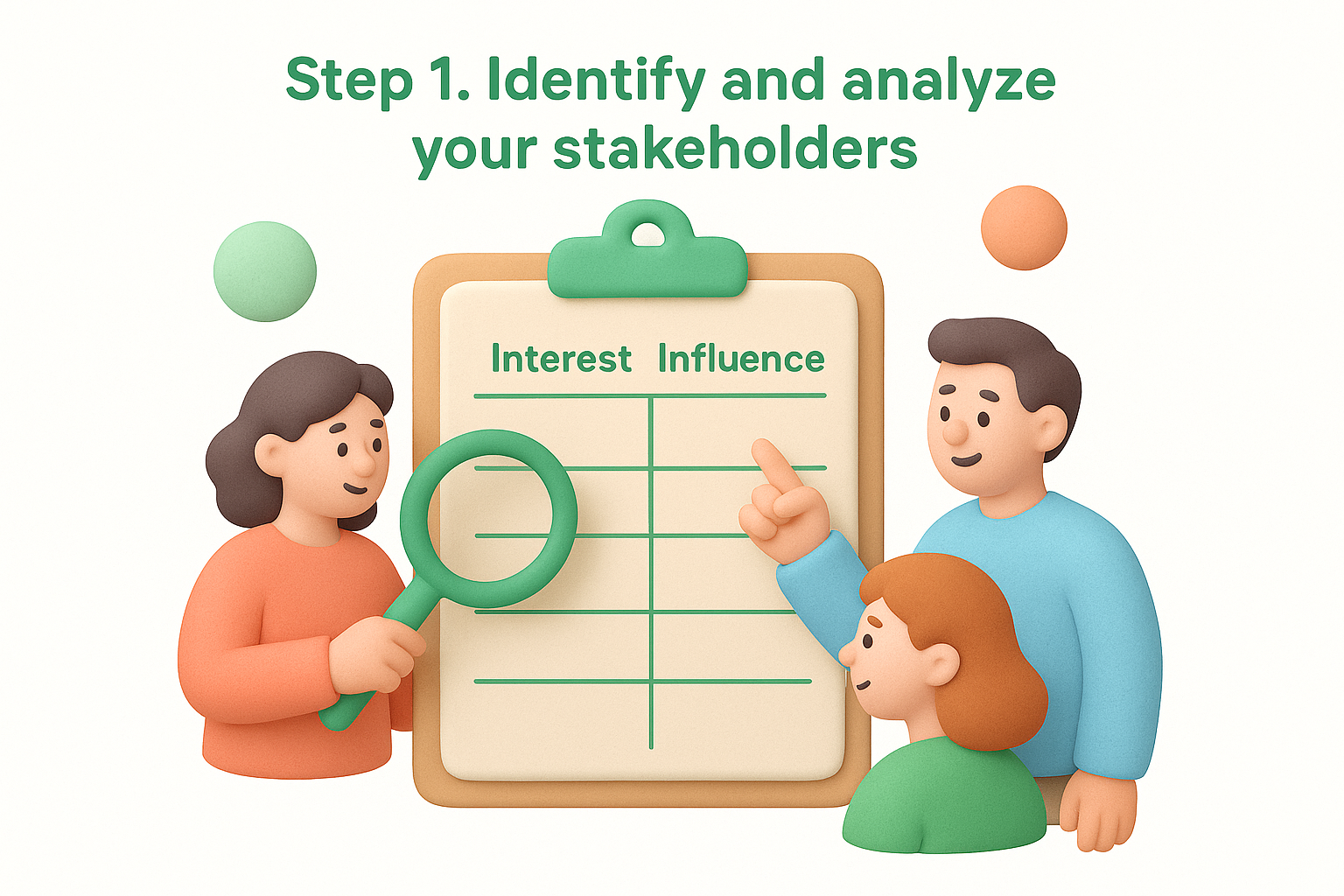
Once you have names and groups on paper, sort them by two factors: how much interest they have in the project and how much influence they hold over its direction or funding. This is the classic power-interest grid used in stakeholder mapping communication plan exercises, and it works because it forces you to stop treating every stakeholder the same way.
| Group | Interest | Influence | Priority |
|---|---|---|---|
| Executive sponsor | High | High | Manage closely |
| Engineering lead | High | Medium | Keep informed |
| Power users on portal | High | Low | Keep satisfied |
| Occasional customers | Low | Low | Monitor lightly |
Not every stakeholder needs the same attention, and treating them equally wastes time on the ones who don't need it.
Spreadsheets only get you so far. Grab 15 minutes with your engineering lead, your head of support, and one or two vocal customers to ask what they actually want to know and how often. This step turns a guess into real stakeholder engagement and communication plan input, and it usually surfaces gaps your internal assumptions missed, like a compliance officer who needs sign-off before any public roadmap change.
Keep this list in a shared doc or spreadsheet, not buried in someone's notebook. Update it whenever a new stakeholder joins, a role changes, or a project shifts scope, because a stale list is worse than no list at all. If you're already running a feedback portal for customer requests, cross-reference your most active voters and commenters. They're often your highest-interest external stakeholders, and they deserve a spot on this list even if they have zero formal influence over the roadmap.
With your stakeholder list mapped, the next job is deciding why you're communicating with each group in the first place. Every message should tie back to a purpose, whether that's building trust, securing budget approval, or simply keeping users from filing duplicate support tickets. Vague goals like "keep everyone updated" lead to vague communication that nobody reads. Instead, write down what action or feeling you want each update to produce.
Goals shift depending on who's on the receiving end. Executives usually need reassurance that the project supports business goals and stays on budget. Engineering teams need clarity on priorities so they're not guessing what to build next. Customers want to feel heard and want proof their feedback led somewhere, which is exactly what good customer communication delivers. Writing these objectives out loud, even in a rough bullet list, keeps your later messaging from drifting into generic status updates that serve no one.
A communication plan without clear objectives is just a mailing list with extra steps.
It's tempting to jump straight to "we'll send a monthly newsletter" without deciding what that newsletter needs to accomplish. Resist that urge. A stakeholder communication management plan works best when objectives come first and channel choice follows. If your goal for power users is retention and trust, communicating your product roadmap with an update showing their request moved to "in progress" does more than a generic email blast ever could.
Where possible, attach a number or a signal to each objective so you can tell if it's working, the same way you would with product strategy objectives. That might mean tracking how many stakeholders open your monthly update email, how many comments show up on a roadmap item after a status change, or how often support tickets reference outdated information. This is the piece most stakeholder engagement communication plan efforts skip, and it's the reason plans quietly go stale. Objectives without a way to check progress just become assumptions you never revisit, and assumptions are exactly what got you into a communication mess in the first place.
Now you turn all that analysis into one document you can actually reference during a busy week. The stakeholder communication matrix is the table version of everything you've decided so far: who gets what message, through which channel, and how often. This is the artifact people mean when they ask for an example of a stakeholder communication plan, because it's the single page that answers every question before it gets asked.
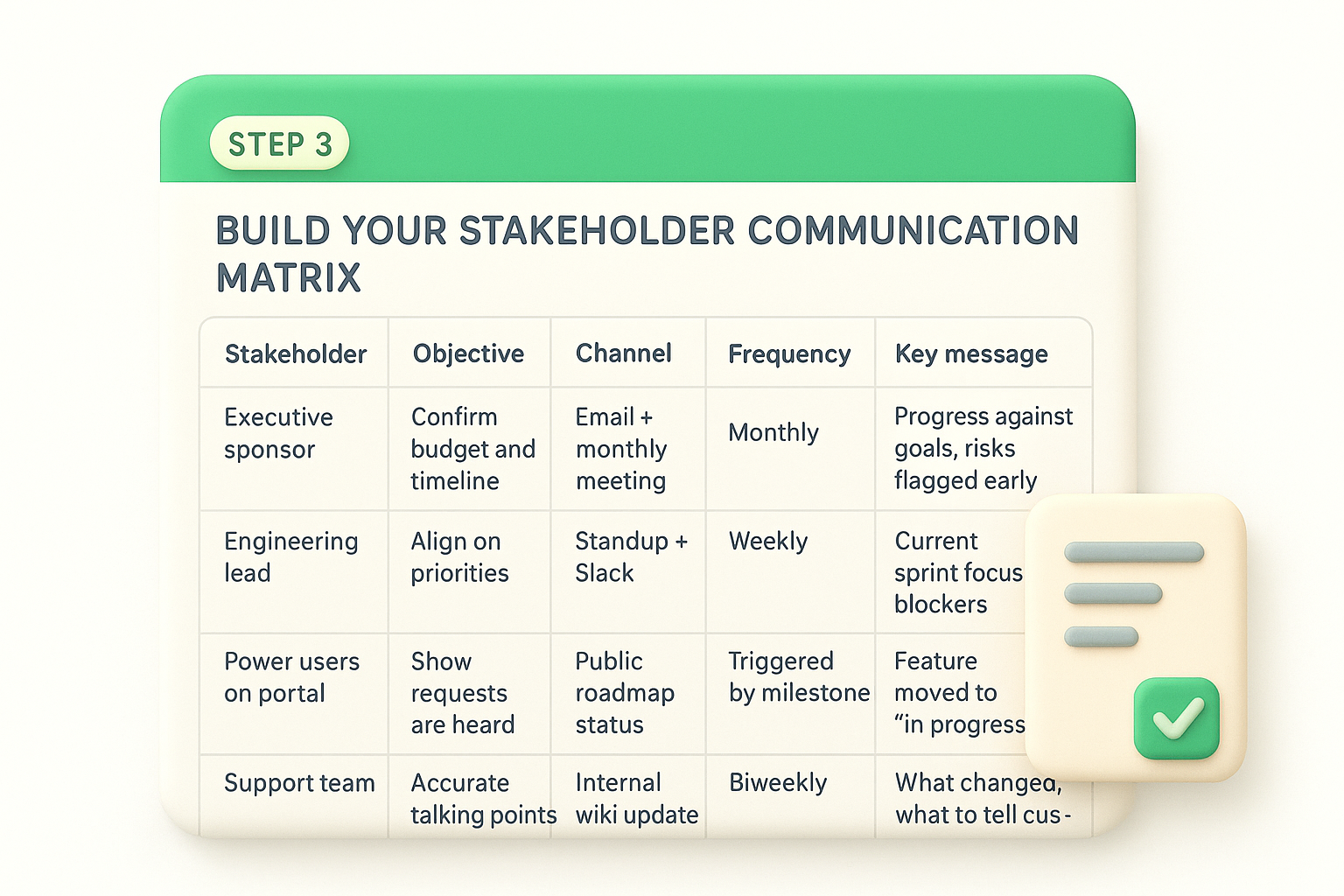
Pull together the stakeholder groups from Step 1 and the objectives from Step 2, then add channel and frequency, much like a customer communication plan template does for user segments. Here's a working example you can adapt directly:
| Stakeholder | Objective | Channel | Frequency | Key message |
|---|---|---|---|---|
| Executive sponsor | Confirm budget and timeline health | Email + monthly meeting | Monthly | Progress against goals, risks flagged early |
| Engineering lead | Align on priorities | Standup + Slack | Weekly | Current sprint focus, blockers |
| Power users on portal | Show requests are heard | Public roadmap status change | Triggered by milestone | Feature moved to "in progress" or "shipped" |
| Support team | Accurate talking points | Internal wiki update | Biweekly | What changed, what to tell customers |
| Vendors | Confirm dependencies | As needed | Deadline changes, deliverable confirmations |
If a stakeholder isn't in your matrix, they're not in your plan, no matter how important they seem in the moment.
Don't build this in a tool nobody opens. A shared spreadsheet works fine for most teams, and it beats a polished slide deck that goes stale after one meeting. The goal of a stakeholder management communication plan matrix isn't to impress anyone, it's to give you a fast reference when you're deciding whether a delay needs an email or just a portal status update.
Some rows in your matrix don't need a human writing a fresh message every time. Status changes on a public roadmap, for instance, can update automatically the moment a feature moves stage, which is exactly what a tool like Koala Feedback's public roadmap feature handles for you. That frees up your energy for the rows that actually need judgment, like explaining a delay to an executive sponsor or a vendor whose deadline just shifted.
A matrix full of channels and frequencies means nothing if nobody knows who actually hits send. This step assigns a real name, not a job title, to every row in your communication matrix. Ownership is what separates a plan that survives a busy sprint from one that quietly falls apart the first time your product manager takes a vacation. In most stakeholder communication plan project management setups, this is the step teams skip, and it's exactly why updates stop going out the moment the original owner gets pulled onto something else.
"Marketing will handle it" isn't an assignment, it's a guess about who has time later. Go back through your matrix and write an actual name next to each communication task. If your engineering lead is responsible for the weekly standup update, put their name there, not "engineering." This small change turns a vague intention into an accountable task, and it's the same logic behind a good RACI breakdown:
If a task doesn't have a name attached, assume it won't get done during a busy week.
Every owner needs a backup, especially for time-sensitive updates like a roadmap status change or an executive briefing before a board meeting. Write the backup's name right next to the primary owner in your matrix so there's no scramble when someone's out sick or swamped with another launch. This is a small addition, but it's the difference between a plan that holds up under real conditions and one that only works when everyone's schedule cooperates.
Teams reorganize, people leave, and responsibilities shift more often than most plans account for. Set a reminder to review your owner column every quarter, or whenever there's a team change, so the plan doesn't quietly point to someone who left the company two months ago. A stale owner list is one of the fastest ways a solid stakeholder communication management plan turns into shelfware nobody trusts.
Ownership only works if it runs on a schedule people can actually keep. This step turns your matrix's frequency column into calendar events, recurring tasks, or triggers inside whatever tool you already use, so updates go out on autopilot instead of depending on someone remembering. A solid communication and stakeholder engagement plan treats scheduling as infrastructure, not a to-do list item you hope survives a busy sprint.
Pick a rhythm for each stakeholder group and put it somewhere that enforces itself: a recurring calendar invite for the monthly executive email, a Slack reminder for the weekly engineering sync, an automated trigger for portal status changes. Recurring reminders beat good intentions every time, because intentions disappear the moment a launch goes sideways. If a cadence keeps slipping past its date, that's a signal the frequency is wrong, not that your team is failing. Adjust it rather than letting it quietly die.
A schedule you have to remember isn't a schedule, it's a hope.
A communication plan that only pushes information out misses half the job. Stakeholders need a place to respond, ask questions, or flag concerns before they escalate into a support ticket or a tense executive meeting. This is where a feedback portal earns its keep as a two-way customer feedback loop: customers vote, comment, and get notified automatically when their request changes status, without anyone manually chasing them down. For internal stakeholders, an open Slack channel or a standing five-minute slot at the end of a weekly sync works just as well. The format matters less than making sure the door is genuinely open, not just theoretically available.
Consistency matters more than polish. A simple template keeps every update from starting at zero:
Subject: [Project/Feature] Update - [Date]

What happened: one or two lines on progress or change
Why it matters to you: tie it to their objective from Step 2
What's next: the next milestone or expected date
Where to respond: link to portal, reply-all, or meeting slot
Drop this into your matrix as the default format for recurring updates, and swap details for each stakeholder group rather than rewriting the structure every time.
A plan is never finished the day you publish it. Treat your stakeholder communication plan in project management work as a living document, not a deliverable you file away after the kickoff meeting. Projects shift scope, new stakeholders show up mid-launch, and channels that worked in month one go quiet by month three. Building in a review habit from the start is what keeps the plan useful instead of becoming another dusty doc nobody opens.
Watch a handful of concrete signals instead of guessing whether communication is landing. Open rates on your monthly executive email, comment activity on roadmap items right after a status change, and a drop in "what happened to my request" support tickets all tell you something real. If engagement on a channel flatlines, that's your cue to swap the format before stakeholders tune out entirely.
If nobody reacts to an update, the problem is the plan, not the audience.
Quarterly reviews work well for most teams, though a fast-moving startup might need a monthly check instead. Sit down with your matrix from Step 3 and ask whether the stakeholder list still matches reality, whether frequencies still make sense, and whether any owner from Step 4 has moved on to a different role. Skipping this review is how plans quietly rot, one outdated row at a time.
Asking directly beats guessing every time. A quick survey or even a casual Slack poll asking stakeholders whether they're getting the right amount of detail, at the right frequency, through the right channel, surfaces friction long before it shows up as complaints. Executives might tell you the monthly meeting could be a five-minute email instead. Power users might ask for more detail on why a request got deprioritized. Feed every answer back into the matrix, because a plan that only moves forward on assumptions eventually stops matching what your stakeholders need.
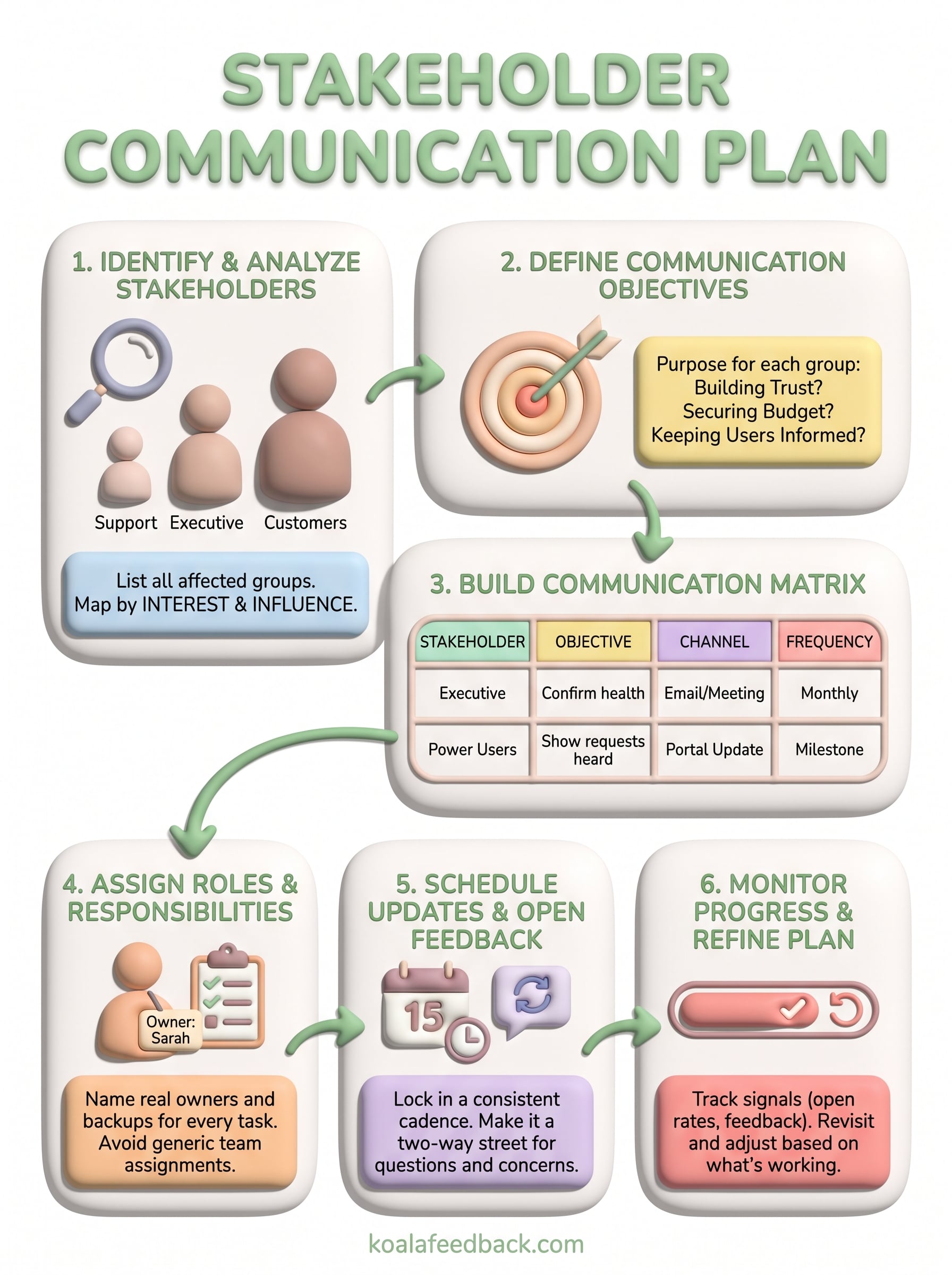
A stakeholder communication plan only earns its keep once you actually run it week after week. You've now got the full sequence: map your stakeholders, define objectives, build the matrix, assign owners, schedule updates, and review what's working. None of that requires fancy software, but it does require a place where updates and feedback live side by side instead of scattered across inboxes and chat threads.
Start small if you need to. Pick your highest-priority stakeholder group from Step 1, build one row of the matrix, and get that cadence running before you tackle the rest. Momentum matters more than a perfect first draft.
If customer-facing updates are the piece you keep putting off, don't handle it manually forever. Try Koala Feedback to automate status changes and centralize user feedback, so your users stay informed without adding another recurring task to your week.

Start today and have your feedback portal up and running in minutes.