You deliver the project on time and within budget. Your team executes perfectly. Yet somehow stakeholders are disappointed. This scenario plays out daily in product teams because nobody took the time to define what success actually meant. Misaligned expectations kill more projects than technical failures ever will.
This guide walks you through 10 practical steps to manage stakeholder expectations from project kickoff through delivery. You'll learn how to identify stakeholders and map their influence, define success metrics everyone agrees on, and build communication plans that prevent surprises. Each step includes templates you can adapt for your team, from stakeholder registers and roadmap frameworks to risk logs and status report formats. We'll also show you how centralized feedback tools like Koala Feedback help align stakeholders around a shared view of priorities and progress. By the end you'll have a repeatable process to set clear expectations, keep stakeholders informed, and deliver projects that genuinely satisfy the people who matter most.
Scattered feedback creates scattered expectations. When stakeholders submit requests through email threads, Slack messages, and random meetings, nobody knows what's actually planned or why. You end up managing stakeholder expectations one conversation at a time, which doesn't scale and guarantees misalignment. A centralized feedback hub gives everyone the same view of what users want, what you're building, and what tradeoffs you're making.
Koala Feedback creates a single source of truth for all product feedback and feature requests. Stakeholders see what other users have requested, how many people want each feature, and where each request sits in your priority queue. This transparency shifts conversations from "when will you build my feature" to "I see 50 other users want this, how do we prioritize it." The voting and commenting system shows stakeholders they're heard without promising delivery dates you can't keep.
A shared feedback portal transforms expectations from personal demands into collaborative prioritization.
Connect your feedback portal to your website and internal tools so requests flow into one organized system. Set up boards that match your product areas so stakeholders can browse feedback by category. Use the automatic deduplication to show stakeholders when their idea already exists, which prevents duplicate work and inflated expectations. Enable voting so stakeholders understand demand relative to other requests, making your prioritization decisions easier to defend.
Organize your Koala boards by product area, customer segment, or development phase depending on how your team works. Create custom statuses like "Evaluating," "Planned," "In Progress," and "Shipped" to show movement without committing to timelines. Share your public roadmap with stakeholders so they can see your current priorities and completed features. This visual representation of your product direction reduces status update requests and keeps everyone aligned on what's next.
You can't manage expectations you haven't identified. Before you write a single status update or schedule a kickoff meeting, you need to know exactly who has a stake in your project and what they expect from it. Stakeholder mapping creates a shared reference that prevents you from accidentally ignoring someone important or over-communicating with someone who just needs occasional updates. This exercise takes an hour but saves weeks of confusion later.
Start by listing every person and group affected by your project or able to influence its outcome. Look beyond the obvious names on your project charter to find hidden stakeholders like support teams who will field user questions, legal reviewers who might delay launches, or executive sponsors who rarely attend meetings but control budget decisions. Ask your team and recent project leads who surprised them with late-stage demands or blockers. Document each stakeholder's role, department, and relationship to the project so you can track them throughout delivery.
Plot each stakeholder on a simple grid with influence on one axis and interest on the other. High influence, high interest stakeholders need your constant attention and involvement in major decisions. High influence, low interest stakeholders need just enough information to prevent them from blocking you. Low influence, high interest people want detailed updates but shouldn't drive your communication strategy. This analysis reveals who actually matters for managing stakeholder expectations and helps you allocate your limited time appropriately.

Understanding stakeholder power and interest patterns prevents you from treating all requests as equally urgent.
Build a stakeholder register as a spreadsheet with columns for name, role, influence level, interest level, key expectations, preferred communication method, and update frequency. Add a notes column to track concerns, hot buttons, and past friction points. Create a visual stakeholder map using a 2x2 grid to show influence versus interest at a glance. Update both documents as you discover new stakeholders or as influence patterns shift during the project lifecycle.
Vague goals produce vague results and endless debates about whether you succeeded. When stakeholders say they want a "better user experience" or "improved efficiency," they're setting you up for disappointment because those phrases mean different things to different people. Concrete metrics transform subjective wishes into measurable outcomes everyone can track. Defining these numbers early prevents the situation where you declare victory and stakeholders claim failure because you were measuring different things all along.
Translate every fuzzy goal into specific numbers with clear measurement methods. Instead of "improve customer satisfaction," commit to "increase NPS from 42 to 55 within 3 months of launch." Replace "faster performance" with "reduce page load time from 4.2 seconds to under 2 seconds for 95% of users." Ask stakeholders to define what "success" looks like in quantifiable terms and capture those definitions in your project documentation. Push back when someone refuses to commit to numbers because managing stakeholder expectations becomes impossible without agreed benchmarks.
Concrete metrics eliminate the guessing game about whether your project actually succeeded.
Connect your project metrics to broader business outcomes stakeholders care about. Show how your technical improvements will drive revenue, reduce costs, or improve customer retention by specific amounts. Link feature adoption targets to strategic priorities like entering new markets or reducing support volume. This alignment helps stakeholders understand your choices and prevents scope creep disguised as "strategic pivots." Document the relationship between your metrics and company goals so everyone sees how success cascades from project delivery to business impact.
Create a simple metrics template with columns for metric name, current baseline, target value, measurement method, tracking frequency, and owner responsible for reporting. Add a "why this matters" column that connects each metric to a business goal. Build a KPI dashboard format that shows progress toward each target using simple visuals like progress bars or trend lines. Include a section for leading indicators that predict final outcomes so you can course-correct before missing targets.
Documented scope prevents expectation drift. When you skip the work of translating stakeholder expectations into written deliverables and explicit boundaries, you create space for everyone to assume different things about what you're building. Managing stakeholder expectations requires a scope statement that clearly defines what's included, what's explicitly excluded, and what assumptions you're making. This document becomes your reference point when stakeholders ask for changes or claim you missed something they expected.
Gather requirements through structured interviews and workshops rather than casual conversations where you might accidentally nod along to unrealistic demands. Document what stakeholders request but resist the urge to immediately commit to delivering everything. Separate must-haves from nice-to-haves using MoSCoW prioritization or similar frameworks that force stakeholders to make tradeoffs. Write requirements as specific user stories or acceptance criteria rather than vague feature descriptions so everyone understands exactly what you're building. Push back when stakeholders describe requirements in solution terms instead of problems that need solving, which gives you flexibility in how you deliver value.
Clear requirements documentation prevents stakeholders from claiming you promised features you never agreed to build.
Your scope statement should list all major deliverables, project objectives, acceptance criteria, and assumptions in plain language stakeholders can review and approve. Include an explicit out-of-scope section that names features, integrations, or capabilities you will not deliver in this project phase. Document constraints like budget limits, technology choices, and timeline dependencies that might limit what's possible. Get stakeholders to formally approve the scope statement through signatures or documented sign-off so you have leverage when someone later claims you should have included something you explicitly excluded.
Create a scope statement template with sections for project objectives, in-scope deliverables, out-of-scope items, assumptions, constraints, and acceptance criteria. Build a product backlog template that captures user stories with priority rankings, effort estimates, and dependencies. Add a requirements traceability matrix if you need to track how requirements connect to business goals and test cases. Include a simple change request template that forces stakeholders to document what they want to add, what they're willing to remove or delay, and what business justification supports the change.
Ad-hoc updates create chaos and erode trust. When you send project information randomly based on who emails you or who catches you in the hallway, stakeholders develop different understandings of progress and priorities. A communication plan documents exactly what information each stakeholder receives, when they receive it, and through which channels. This structure eliminates surprises, reduces your inbox load, and ensures consistent messaging across your entire stakeholder group.
Different stakeholders need different information at different levels of detail. Your executive sponsor wants high-level status and risk alerts, not technical implementation details. Development teams need specifics about requirements and dependencies, not business justification for every decision. Map each stakeholder to the information they actually need to make decisions or do their work. Document whether they need strategic updates, tactical progress reports, or operational details like deployment schedules. This filtering prevents information overload while ensuring nobody misses critical updates that affect their work.
Tailoring information to stakeholder roles prevents both overload and dangerous knowledge gaps.
Select communication channels that match your stakeholders' preferences and the information's urgency. Use email for regular status updates, meetings for collaborative decisions, and your Koala Feedback roadmap for self-service progress tracking. Define update frequency based on project pace and stakeholder needs, whether that's daily standups, weekly reports, or monthly steering committee meetings. Assign an owner responsible for each communication so nothing falls through cracks when you're busy. Build this schedule into your project calendar so communication becomes routine rather than reactive.
Create a communication matrix with columns for stakeholder name, information needed, delivery method, frequency, and responsible person. Add a RACI chart (Responsible, Accountable, Consulted, Informed) that maps stakeholders to key decisions and deliverables. Include template formats for your recurring communications like status reports and steering committee slide decks. Document escalation paths so stakeholders know who to contact when managing stakeholder expectations requires quick decisions or intervention. Update these templates based on what works and what stakeholders actually read.
Static documents hide in folders and get forgotten. Visual roadmaps show your product direction and current priorities in a format stakeholders can scan in seconds without digging through project plans or status reports. When everyone can see what you're building, when features are scheduled, and what tradeoffs you're making, managing stakeholder expectations becomes a shared exercise rather than constant individual explanations. Your roadmap becomes the conversation starter that prevents misalignment before it happens.
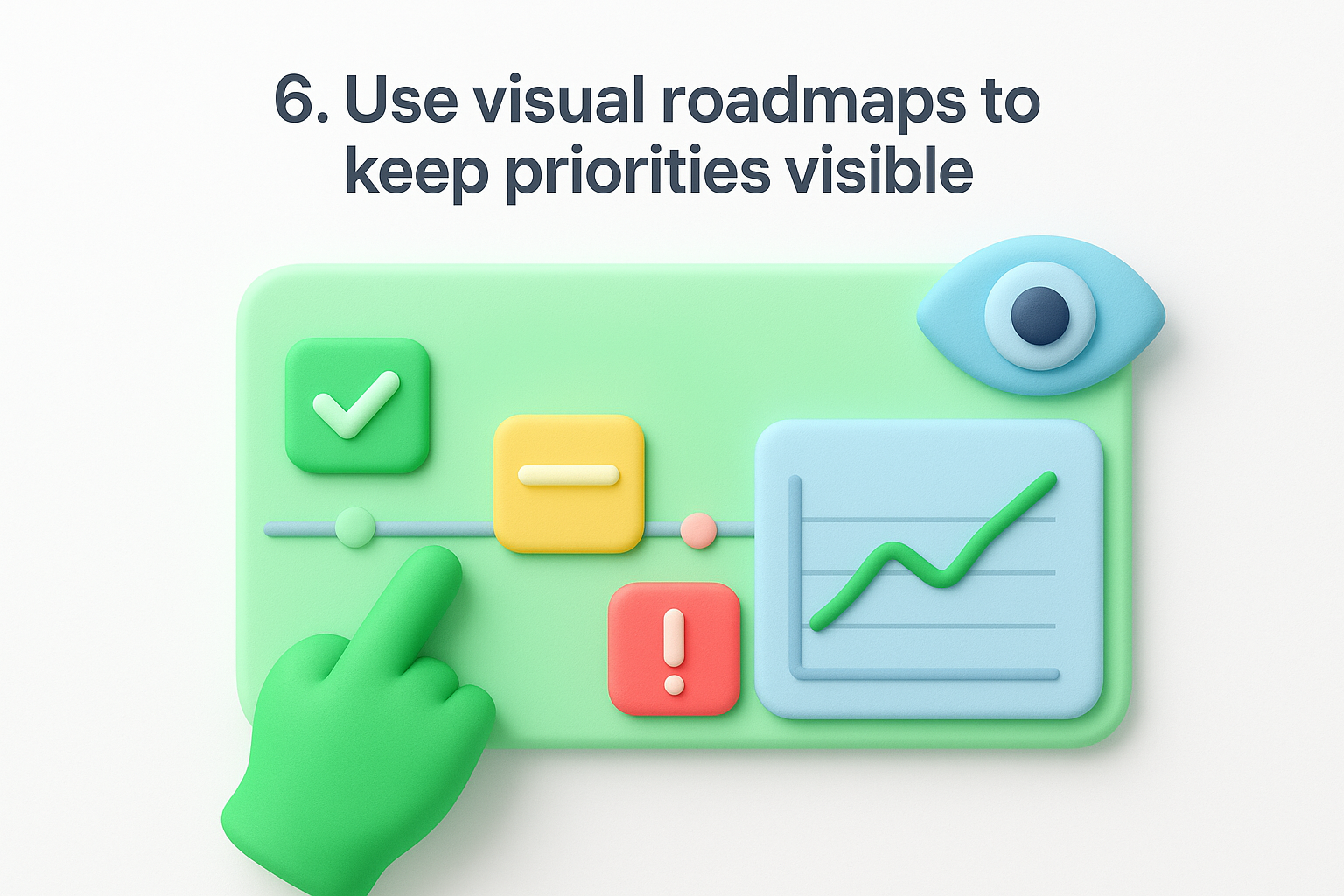
Build roadmaps that display planned features, in-progress work, and completed deliverables on a simple timeline that stakeholders can understand without training. Use color coding or status labels to show confidence levels and risk areas so stakeholders see both the plan and the uncertainty. Include capacity constraints and dependencies that explain why certain features are scheduled later than stakeholders might want, which makes your prioritization decisions transparent and defensible.
Visual roadmaps transform abstract plans into concrete commitments stakeholders can track and discuss.
Share your draft roadmap with stakeholders before you finalize it so they can challenge priorities and suggest alternatives while you still have flexibility. Use roadmap review sessions to walk through your prioritization logic and discuss tradeoffs between competing requests. Link roadmap items back to your Koala Feedback portal so stakeholders can see the user demand and voting data that informed your choices, which reduces arguments about whether you're building the right things.
Create a quarterly roadmap template that shows themes, major features, and dependencies across a three to six month horizon. Build a release planning template that breaks features into specific delivery milestones with dates and success criteria. Use your Koala Feedback roadmap to publish status updates automatically as features move from planned to in progress to completed, which keeps stakeholders informed without manual update work.
Consistent communication beats comprehensive updates every time. When you wait to share information until something significant happens, stakeholders fill the silence with worry or unrealistic assumptions about progress. Regular check-ins create a predictable rhythm that keeps everyone informed and aligned without requiring stakeholders to chase you for updates. This steady flow of information makes managing stakeholder expectations easier because you're addressing concerns before they escalate into problems.
Schedule recurring touchpoints at intervals that match your project pace, whether that's daily standups, weekly status calls, or bi-weekly steering meetings. Stick to this schedule even when you have limited progress to report because consistency builds trust and prevents stakeholders from wondering why they haven't heard from you. Use your Koala Feedback updates to automate feature status changes so stakeholders can check progress between formal meetings without interrupting your team.
Predictable communication rhythms eliminate the anxiety that comes from information gaps.
Design your meetings with clear agendas that cover progress since last check-in, upcoming milestones, blockers requiring decisions, and risks needing attention. Time-box each section so meetings stay focused and respect everyone's calendars. Send meeting materials 24 hours in advance so stakeholders come prepared to make decisions rather than hearing information for the first time.
Build a status report template with sections for accomplishments, next steps, issues, and decisions needed. Create a meeting agenda template that includes progress updates, risk review, upcoming deliverables, and action items with owners. Share these templates with stakeholders so they know what to expect and can prepare relevant questions.
Problems hidden early become crises later. When you avoid discussing technical limitations, budget constraints, or competing priorities with stakeholders upfront, you guarantee conflict when reality forces those conversations later in the project. Managing stakeholder expectations means surfacing bad news and hard choices early when you still have options to adjust plans or reset expectations. Your job is to create space for these difficult conversations before they become project-killing emergencies.
Identify your project's critical assumptions and key risks during planning and share them with stakeholders immediately. Document what could go wrong, what dependencies exist outside your control, and what constraints limit your options. Schedule risk review sessions with stakeholders quarterly or whenever new threats emerge so everyone understands the challenges you face. This transparency prevents stakeholders from feeling blindsided when risks materialize and gives them time to prepare backup plans or accept modified outcomes.
Early risk transparency converts surprise failures into managed course corrections.
Force every change request through a formal evaluation process that documents what stakeholders want to add, what they're willing to delay or remove, and what business value justifies disrupting your plan. Use your Koala Feedback portal to show stakeholders how proposed changes affect other priorities users voted for, which makes tradeoffs visible and defensible. Require stakeholders to acknowledge that adding features means extending timelines, increasing budgets, or cutting other scope rather than absorbing changes invisibly.
Build a risk register template with columns for risk description, probability, impact, owner, mitigation plan, and current status. Create a change request template that captures requested change, business justification, impact on scope and timeline, and approval status. Maintain a decision log that records what you decided, who decided it, when, and why so stakeholders can reference your reasoning later when questioning choices.
Numbers tell the story words obscure. When you report project progress through narrative updates alone, stakeholders filter information through their biases and anxieties about whether you're meeting their expectations. Data-driven reporting removes ambiguity by showing exactly where you stand against the metrics everyone agreed to during planning. Simple reports that track the right numbers make managing stakeholder expectations straightforward because everyone sees the same objective reality instead of competing interpretations of your written updates.
Select measurement indicators that directly connect to the success criteria you documented with stakeholders at project start. Track adoption rates if stakeholders expect user engagement, monitor response times if they care about performance, or measure error reduction if quality was the primary concern. Avoid vanity metrics that make you look busy without proving you're delivering value stakeholders actually wanted. Focus on the three to five numbers that best represent progress toward outcomes stakeholders said mattered most, which keeps reports scannable and prevents information overload that obscures what's actually happening.
Metrics that match stakeholder priorities eliminate debates about whether you're succeeding.
Design visual dashboards that show metric trends over time rather than point-in-time snapshots that hide whether you're improving or declining. Use color coding sparingly to highlight metrics that need attention without creating alarm fatigue when everything shows red. Include brief context notes that explain significant changes or anomalies so stakeholders understand what drove unexpected numbers. Share dashboard access so stakeholders can check progress whenever they want instead of waiting for formal reports, which reduces status check interruptions while maintaining transparency.
Create a metrics dashboard template with sections for each key metric, current value, target value, trend indicator, and brief commentary. Build a progress report format that shows metric performance, milestone completion status, upcoming deliverables, and risks requiring attention. Add a variance explanation section that addresses any metrics significantly off target so stakeholders understand what you're doing to course-correct.
Every project teaches you something about managing stakeholder expectations if you take time to extract the lessons. When you skip the retrospective process, you repeat the same mistakes on your next project and lose the institutional knowledge your team just gained. Documentation of what worked and what failed transforms project experience into organizational capability that improves how you handle stakeholders going forward.
Schedule a retrospective session with your team and key stakeholders within two weeks of project completion while memories remain fresh. Ask specific questions about which stakeholders surprised you with late demands, which communication methods failed, and which metrics didn't actually reflect what stakeholders cared about. Document the gaps between planned and actual expectations so you understand where your initial stakeholder analysis missed important details or where you failed to reset expectations when project conditions changed.
Documented lessons from expectation failures prevent you from repeating the same stakeholder management mistakes.
Revise your stakeholder register template to capture information types you wish you had documented from the start. Add questions to your communication plan template that address issues you encountered this project. Build new status report formats that better match what stakeholders actually read and responded to rather than what you thought they wanted.
Create a lessons learned template with sections for what worked well, what failed, root causes, and specific improvements to implement. Build a retrospective format that asks what to start doing, stop doing, and continue doing in stakeholder management.
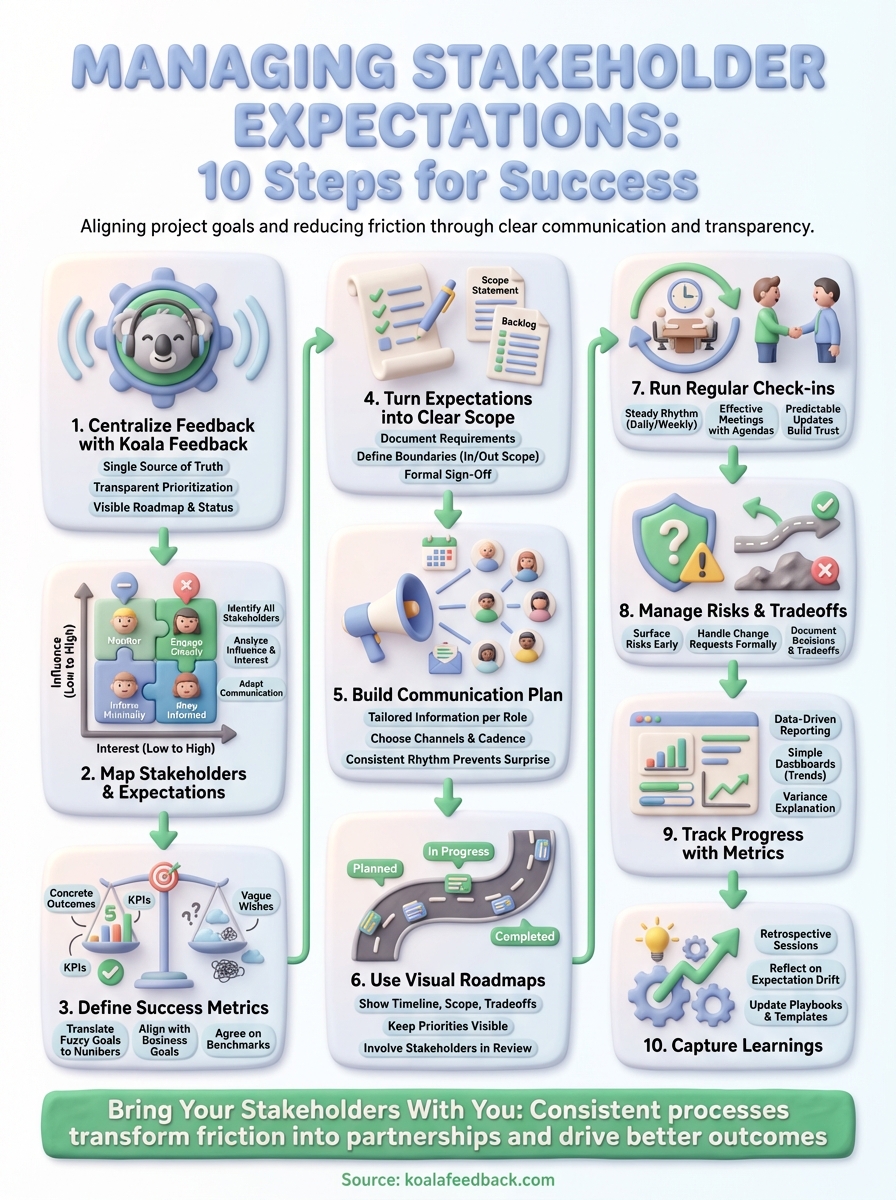
Managing stakeholder expectations doesn't require perfect planning or flawless execution. It requires consistent processes that keep everyone informed and aligned from project start to finish. The ten steps in this guide give you a repeatable framework to identify stakeholders, define success metrics, communicate progress, and handle the changes every project faces. When you implement these practices, you transform stakeholder relationships from sources of friction into partnerships that drive better outcomes.
Start with the foundation that makes everything else work. Koala Feedback centralizes your product feedback so stakeholders see what users actually want, how requests are prioritized, and where features sit on your roadmap. This transparency eliminates expectation mismatches before they start. You'll spend less time explaining decisions and more time building products that satisfy both users and stakeholders. Your feedback portal becomes the single source of truth that keeps everyone aligned without constant status updates or emergency meetings.

Start today and have your feedback portal up and running in minutes.