Every product team eventually hits the same wall: you have a backlog full of ideas, users asking for different things, and no clear filter for deciding what actually matters. That's the exact problem Roman Pichler product strategy frameworks are designed to solve. Pichler, one of the most respected voices in product management, has spent years developing practical models that connect product vision to concrete execution, giving teams a structured way to make better decisions about what to build and why.
His approach covers everything from defining your target users and identifying their core needs to choosing the right business model and setting measurable goals. Rather than treating strategy as a one-time planning exercise, Pichler frames it as a living process, one that evolves based on real feedback and validated learning. It's a methodology built for teams who want to stop guessing and start building with purpose.
At Koala Feedback, we help product teams collect, organize, and prioritize user feedback, which sits right at the heart of executing a strong product strategy. Understanding Pichler's framework gives you the strategic lens; tools like a feedback portal and public roadmap give you the operational layer to act on it. This article breaks down Pichler's product strategy model step by step, with practical examples and actionable guidance you can apply to your own product.
Most product teams don't fail because they lack ideas. They fail because they have too many ideas and no systematic way to choose between them. Roman Pichler's work addresses this directly. His frameworks give product managers a structured decision-making process rather than a collection of opinions and gut feelings. When you apply his approach, strategy becomes something concrete that your entire team can reference, debate, and improve over time.
When teams skip formal strategy, they default to the loudest voice in the room or the most recently submitted feature request. Development cycles get consumed by work that feels urgent but isn't important. Over time, your product loses coherence, and users start to notice that features don't connect to each other or solve a consistent problem.
A product without a strategy is just a list of features waiting for a reason to exist.
Pichler identifies this pattern and offers a concrete alternative: a written strategy artifact that defines who the product is for, what problem it solves, what makes it stand out, and what business goals it serves. That artifact becomes the filter your team uses every time a new idea or request comes in. Instead of asking "is this a good idea?" you ask "does this fit the strategy?"
What separates Pichler's methodology from generic product strategy advice is that it connects directly to the tools product teams already use. He doesn't ask you to produce a lengthy strategy document that sits in a folder and gets ignored. Instead, the roman pichler product strategy framework produces compact, visual tools like the Product Vision Board, which fits on a single page and forces your team to make explicit choices rather than vague statements.
That simplicity matters more than it might seem. A strategy that takes three meetings to explain will never actually guide daily decisions. Pichler's model is built for real teams working under time pressure, which is why product managers across industries have adopted it. Brevity enforces clarity: when you only have a few fields to fill in, you have to commit to specific, defensible answers rather than comfortable generalities.
One of the most practical benefits of Pichler's framework is what it does for user feedback management. Without a strategy, every piece of feedback carries equal weight, which means nothing gets prioritized effectively. With a clear strategy in place, you can immediately evaluate incoming feedback against your target user definition, your differentiation focus, and your business goals.
Your team stops drowning in requests and starts making evidence-based decisions about which feedback actually matters. That's the shift Pichler's work enables: from reactive to intentional. It's the foundation every strong product team needs before they can turn raw user input into meaningful product progress.
Before you can apply the roman pichler product strategy framework, you need to understand the specific questions it forces you to answer. Pichler argues that most teams treat strategy as a broad directional statement when it actually needs to be a set of concrete, specific commitments. Vague answers like "we serve small businesses" or "our goal is growth" don't give your team anything to work with when a difficult prioritization call comes up.
A strategy that doesn't make choices isn't a strategy at all; it's just a wish list with better formatting.
Pichler structures product strategy around four fundamental questions, each one building on the last. Skipping or glossing over any one of them weakens the entire framework.
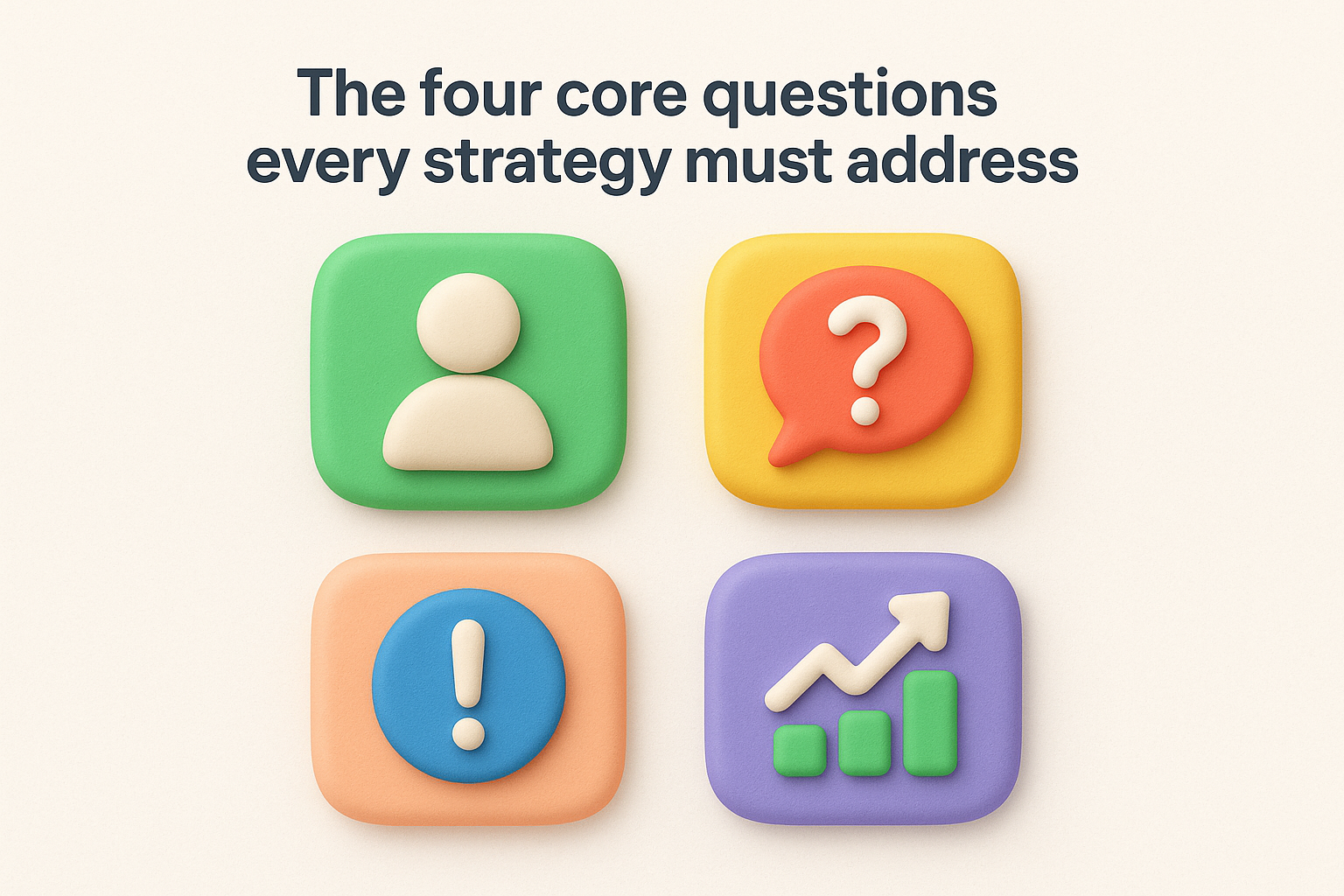
| Question | What it forces you to decide |
|---|---|
| Who is the target user? | A specific segment, not a broad category |
| What problem do you solve? | A concrete need, not a general pain point |
| What makes you different? | A defensible differentiator, not a feature list |
| What are your business goals? | Measurable outcomes, not vague intentions |
Working through this table as a team exposes disagreements early, which is exactly the point. If two people on your team give different answers to the same question, that gap will surface later as conflicting priorities in your backlog.
The more specific your answers, the more useful your strategy becomes as a day-to-day decision tool. If your target user definition is "anyone who needs project management," you can justify building almost any feature. If it's "remote-first engineering teams at companies with 50 to 200 employees," you immediately rule out dozens of requests that don't fit.
That same logic applies to your differentiation answer. Saying "we're easier to use" is a claim almost every product makes. Committing to a specific capability or approach that others don't offer gives your team a real filter. Specificity doesn't limit your strategy; it makes it usable.
One of the most common breakdowns in product development happens in the gap between a high-level product vision and the actual items teams pick up to build. Pichler solves this with a layered model that creates a clear, traceable path from your big-picture direction down to your day-to-day prioritization decisions. Without that path, even a well-written vision statement becomes wallpaper.
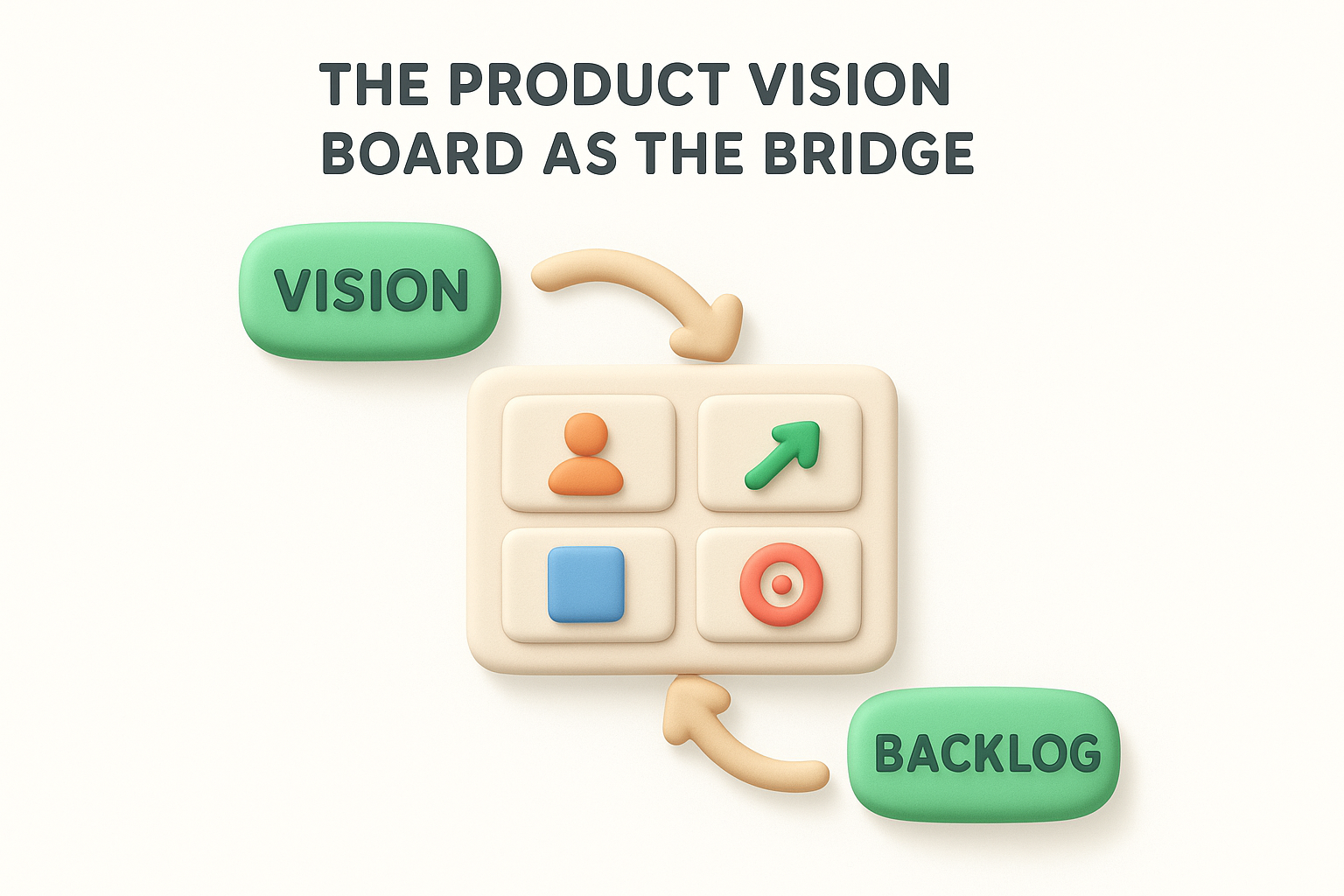
The Product Vision Board is the central artifact in the roman pichler product strategy framework. It sits between your vision and your strategy, holding your answers to the four core questions (target user, need, product, and business goal) in one compact, visual format. When your team disagrees about what to build next, this board is what you point to.
A shared artifact that your whole team can read in two minutes is worth more than a strategy document that nobody opens.
The board works because it forces explicit commitments rather than implied ones. Teams that fill it out together surface disagreements early, before those disagreements turn into wasted sprints. Once completed, it becomes the reference point every prioritization conversation starts from.
With your board in place, evaluating what belongs in your backlog becomes a structured process rather than a debate. Every new feature request or user feedback item gets measured against your defined target user and the need your product is built to solve. If an item doesn't serve both, it either goes into a later category or gets dropped entirely.
Pichler recommends that product goals act as the direct link between your strategy and your roadmap. Each quarter or planning cycle, you set goals that flow from the strategy, and your backlog items then map to those goals. That chain, vision to strategy to goal to backlog item, means nothing in your pipeline exists without a clear strategic reason. Your team spends less time debating individual requests and more time building toward a coherent outcome.
Knowing the theory behind the roman pichler product strategy framework only gets you so far. At some point, you have to sit down and build the actual strategy. The steps below follow Pichler's model closely, and each one builds directly on the previous, so skipping ahead creates gaps you'll feel when prioritization decisions get hard.
Start by writing down a specific description of your primary user, not a persona packed with demographic trivia, but a clear statement of who they are in context of the problem your product solves. Include their role, the situation they're in when they need your product, and what they're trying to accomplish. This description should be narrow enough that someone on your team could spot a target user at a conference.
The moment your target user definition becomes too broad to rule anything out, it stops working as a filter.
Once you have that definition, share it with your whole team and ask whether it matches how they've been thinking about users. Misalignment at this step is extremely common, and uncovering it now prevents conflicting prioritization decisions later.
With your target user defined, write down the specific problem they need solved and what outcome they're trying to reach. Avoid describing features here. Focus entirely on the user's situation and what would make their work or life meaningfully better. Then write a single sentence describing what makes your product the right solution compared to alternatives, including doing nothing or using a competitor.
These two answers together form the core of your strategic argument. If you can't articulate the need and the differentiation in plain language, your team won't be able to use the strategy to make real decisions.
Finally, add two or three measurable business goals that your product is meant to support over the next six to twelve months. Frame them as outcomes, not activities. Then transfer all four answers into a Product Vision Board so your entire team references the same document whenever a new idea or request needs to be evaluated.
A strategy you write once and never revisit will drift out of sync with reality faster than you expect. The roman pichler product strategy framework treats strategy as a living artifact, not a finished document. That means building regular checkpoints into your process where you test your assumptions and update your answers based on what you've actually learned from users and the market.
Your strategy contains assumptions, and the only way to know whether those assumptions hold is to test them against real user behavior. Pichler recommends treating your strategy choices, particularly your target user definition and the need you've identified, as hypotheses that require evidence. You should actively collect feedback from your actual users and compare what they tell you against what your strategy predicts they need.
If users consistently request things your strategy says shouldn't matter to them, that's a signal to investigate, not ignore.
A practical way to structure this validation is to map incoming feedback to each of your strategy's four core answers. If you notice a pattern of requests that falls outside your current user definition, that's worth examining. Either those users aren't actually your target and you should deprioritize their feedback, or your target definition is too narrow and needs adjustment. Both conclusions are valuable.
Pichler suggests reviewing your product strategy at a cadence tied to your product goals, typically every three to six months. A review doesn't mean rewriting everything from scratch. It means asking whether your core assumptions still hold based on what you've learned since the last review.
There are also specific triggers that should prompt an earlier review: a significant shift in competitor positioning, new data showing your target users are behaving differently than expected, or a business goal that has changed at the company level. Treating these triggers as scheduled review prompts rather than emergencies keeps your strategy from becoming either stale or reactive. When you update the strategy, communicate the changes to your team so everyone continues to make decisions from the same foundation.
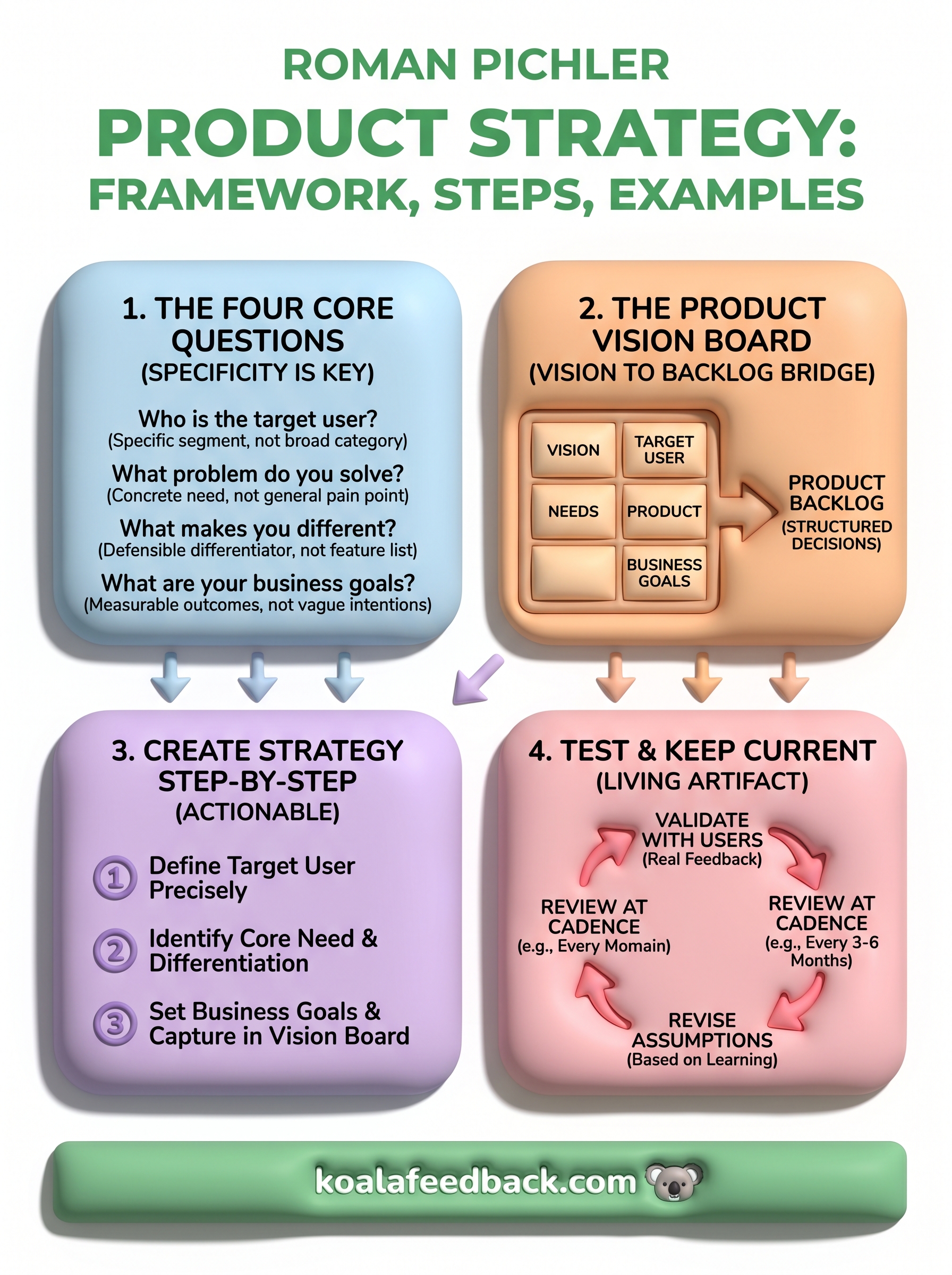
The roman pichler product strategy framework works because it forces your team to make explicit, specific commitments rather than comfortable generalizations. By answering the four core questions, defining your target user, naming the need, stating your differentiation, and setting measurable business goals, you build a shared decision-making filter that every prioritization conversation can reference.
Strategy without execution is just documentation. Executing well means collecting real user feedback, testing your assumptions against what users actually say, and revising your answers when the evidence points in a new direction. That cycle of validation and revision is what keeps your strategy useful over time rather than stale.
If you want a practical way to put this into motion, capturing and organizing user feedback is the operational layer that makes Pichler's framework work in practice. Start collecting structured feedback with Koala Feedback and give your product strategy the real-world input it needs to stay accurate.

Start today and have your feedback portal up and running in minutes.