Most startups don't fail because they built the wrong product. They fail because they built the right product for the wrong reasons, at the wrong time, without a clear plan for who it serves and why. A solid product strategy for startups isn't a luxury reserved for companies with large product teams, it's the difference between shipping features that drive growth and burning through runway on guesses.
The challenge is that strategy can feel abstract, especially when you're under pressure to ship fast. You know you need direction, but frameworks often feel disconnected from the messy reality of early-stage product development. What actually works is grounding your strategy in real user signals, not assumptions, not competitor copycat moves, but direct input from the people you're building for.
That's exactly what we focus on at Koala Feedback: giving product teams the tools to collect, organize, and prioritize user feedback so every strategic decision has evidence behind it. In this guide, we'll walk you through a step-by-step framework for building a product strategy that keeps your startup focused, user-driven, and positioned for product-market fit.
A product strategy is the plan that defines what you're building, who you're building it for, and why it will win in the market. It's not a feature backlog or a sprint schedule. It's the decision-making framework that guides every choice your team makes, from which users to prioritize to which problems are worth solving first. For startups, this matters more than it does for large companies because you have limited time, capital, and people, so every decision needs to connect back to a clear direction.
For a startup, this framework sits at the intersection of user needs, business goals, and market opportunity. When those three things align, you stop reacting to every request and start building with intention. Without that alignment, you end up shipping features nobody asked for while the problems your users actually care about go unsolved.
Many founders confuse a product strategy with a product roadmap, and that confusion causes real problems. A roadmap is a tactical output, a prioritized list of what you plan to build and when. A strategy is the reasoning behind that list. The strategy answers "why are we building this?" while the roadmap answers "what are we building next?"
Your roadmap should always be a reflection of your strategy, not the other way around.
If you update your roadmap without revisiting your strategy, you're making short-term decisions that gradually pull you away from your original direction. Your strategy should stay relatively stable across quarters, while your roadmap evolves as you gather more user feedback and learn more about the market.
A practical product strategy for startups doesn't need to be a lengthy document. It needs to cover a handful of key components clearly enough that every person on your team can recall and act on them. Here's what a startup strategy should define:
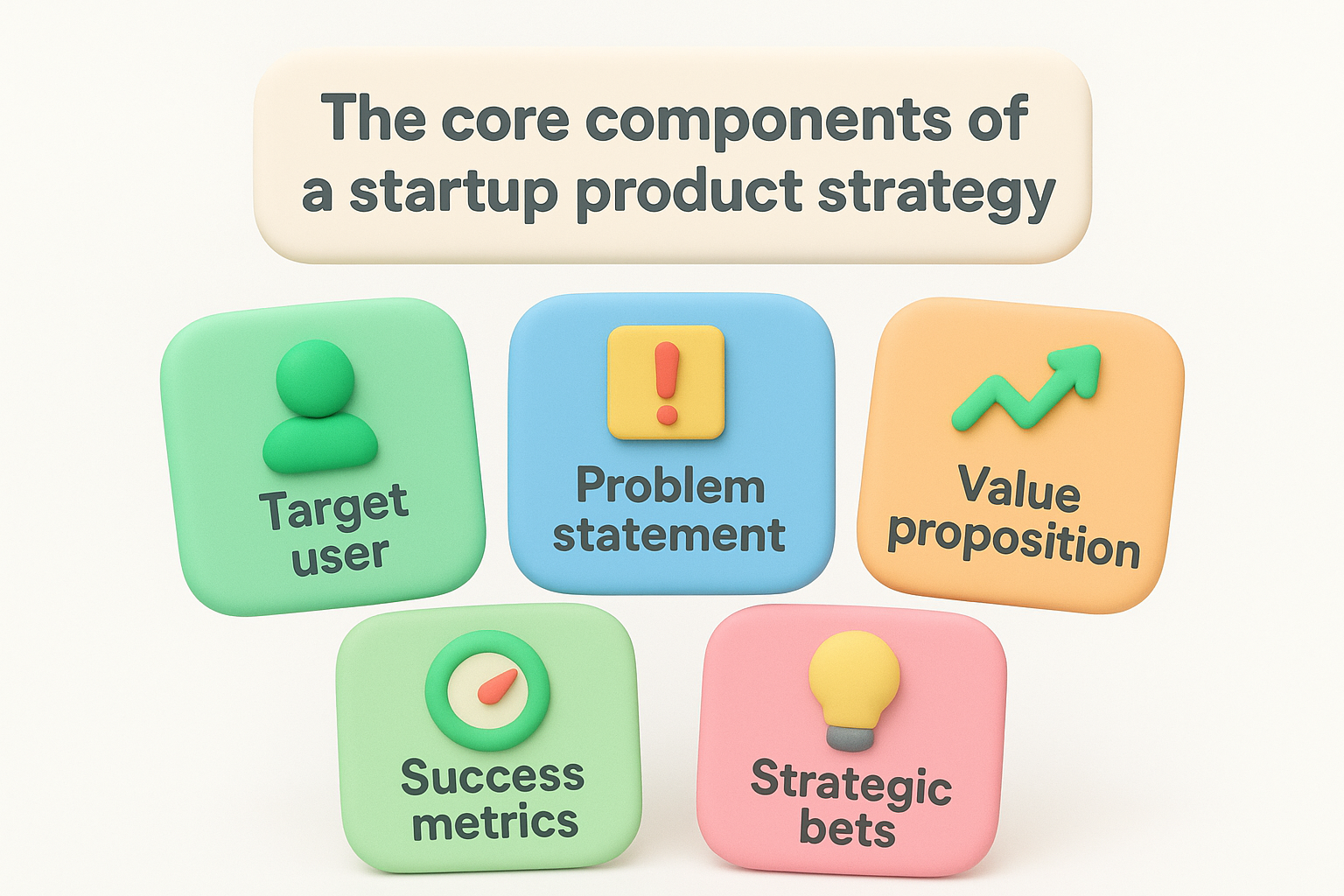
| Component | What it defines |
|---|---|
| Target user | Who you're building for and their core problems |
| Problem statement | The specific pain you're solving and why it matters |
| Value proposition | Why your solution beats the alternatives |
| Success metrics | How you'll measure meaningful progress |
| Strategic bets | The key hypotheses you're actively testing |
Each of these components forces you to make explicit choices rather than leave things open to interpretation. When your whole team understands these five elements, you spend less time debating priorities in meetings and more time building what actually moves the needle for your users.
Before you write a single line of code or plan a single sprint, you need two things locked in: a north star metric and a clearly defined target user. Without both, every decision becomes a debate with no anchor, and your team will pull in different directions every time a new user request lands in your inbox.
Your north star metric is the single number that best captures the core value your product delivers to users. For a messaging tool, it might be "messages sent per week." For a feedback platform, it might be "active feedback boards per account." The exact metric matters less than choosing one and committing to it as your primary signal of progress.
Your north star keeps your team aligned on what growth actually means for your specific product, not just vanity numbers like signups or page views.
Use this template to define yours:
Most early-stage teams target "everyone who could benefit" rather than the one user type who will get the most value fastest. That broad thinking produces a scattered product strategy for startups that tries to solve too many problems at once, which means you end up solving none of them well.
Pick one primary user persona and capture it in a single sentence: who they are, what they do, and what specific problem they need solved. For example: "A SaaS product manager at a 10-to-50-person company who needs to prioritize feature requests without drowning in support tickets." That level of specificity gives your team a real person to design and build for, which makes every product decision faster and sharper.
Most early-stage product strategy for startups falls apart here. You've defined your north star and target user, but now you need to confirm that the problem you identified is real and that your proposed solution actually solves it better than what users already do. Skipping this step means you'll spend months building something that solves a problem users can live with, not one they urgently need fixed.
Discovery interviews are the fastest way to test your assumptions before you commit engineering time to them. Your goal isn't to pitch your idea; it's to understand how the user currently handles the problem and what that friction costs them in time, money, or frustration. Aim for five to ten interviews with people who match your target user persona before you draw any conclusions.
Use this interview template to stay focused:
If multiple users describe the same pain in nearly identical words, you've found a problem worth solving.
Once you've confirmed the problem is real, you need to pressure-test your solution's core claim before you build. Write down exactly what your product does and why it beats the alternative in one sentence, then read it back to three to five of your interview participants. Watch their reaction closely.
If they immediately understand the benefit and ask how to sign up, your value proposition is clear. If they look confused or ask follow-up questions, revise the statement and test it again until the value lands without any explanation from you.
Once you've validated the problem and confirmed your value proposition lands, your next move is to define the smallest version of your product that delivers real value to your target user. This is your minimum viable product (MVP), and picking it correctly is one of the most critical decisions in your product strategy for startups. Most teams over-build their MVPs because they're afraid users won't be satisfied with a limited feature set. That fear leads to wasted months and delayed learning.
Your MVP's job isn't to impress users; its job is to test whether your core value proposition solves a real problem for real people.
Start by listing every feature you originally planned to build, then cut everything that isn't required to deliver the core value you tested in your discovery interviews. What remains is your MVP. If users said they needed a way to centralize feedback from multiple channels, you don't need advanced analytics on day one. You need one reliable way to collect and view that feedback, nothing more.
Use this framework to evaluate each feature before including it in your MVP:
With your MVP scope set, you need to define two or three metrics that tell you whether it's working. These should connect directly back to your north star metric from Step 1. For example, if your north star is "active feedback boards per account," your MVP metrics might track new boards created in the first week and the percentage of invited users who submit at least one piece of feedback.
Track your MVP metrics in a simple table like this:
| Metric | What it measures | Target |
|---|---|---|
| Boards created (week 1) | Core activation | 3+ per account |
| Feedback submissions | User engagement | 5+ per board |
| Return visits (week 2) | Retention signal | 40%+ of users |
With your MVP metrics defined, you now need to translate your product strategy for startups into a visible roadmap and a structured process for collecting ongoing user feedback. A roadmap without a feedback loop becomes stale the moment your users start using the product. You need both working together so your strategy stays grounded in real signals rather than internal assumptions.
Your roadmap doesn't need to span twelve months with detailed timelines. For early-stage startups, a three-column roadmap organized by status gives your team and your users enough clarity without locking you into plans that will change. Structure it around three buckets: what you're working on now, what you've committed to next, and what you're considering later.
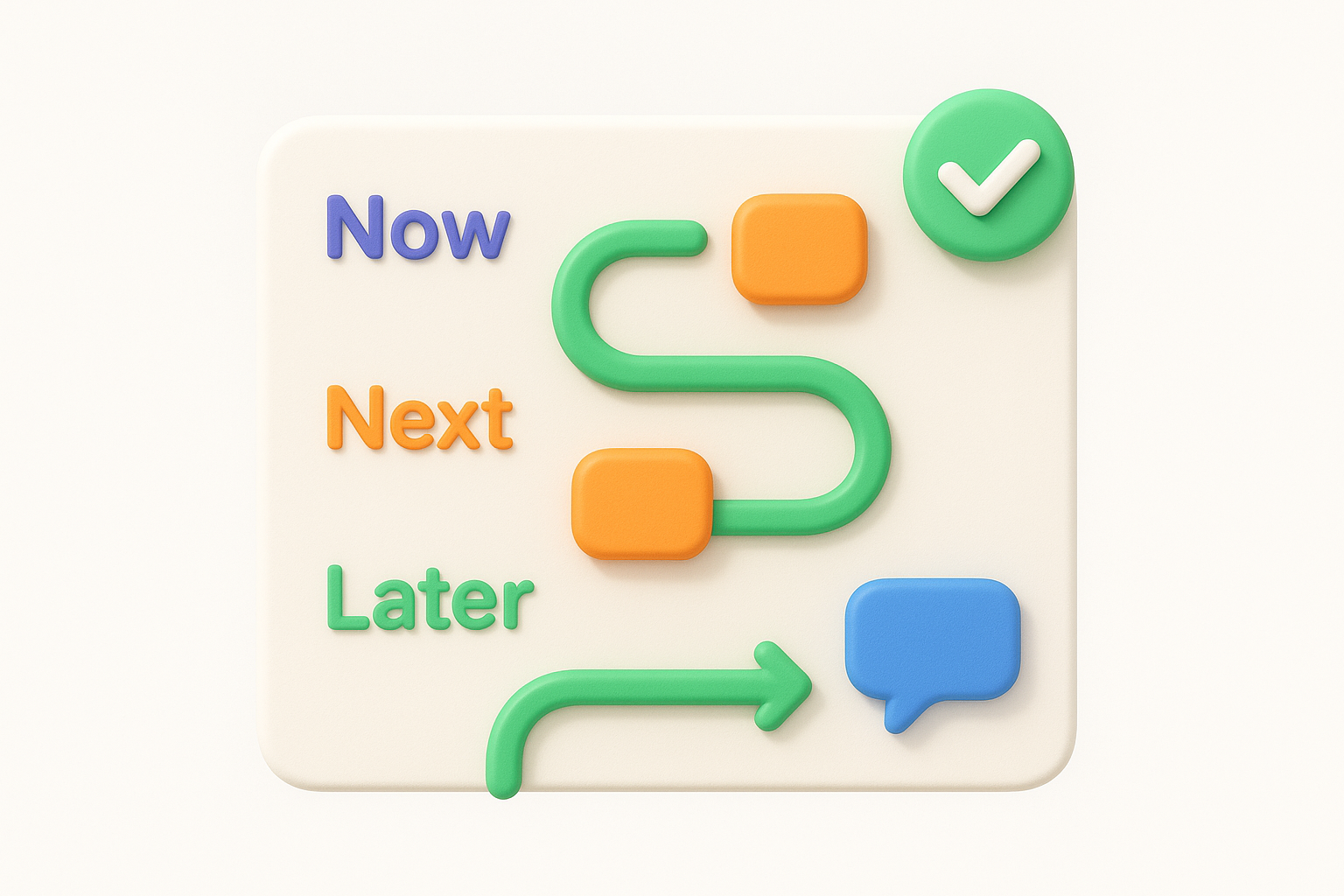
Use this simple roadmap template to get started:
| Status | Items | Owner |
|---|---|---|
| Now (current sprint) | Core feedback collection flow | Product |
| Next (committed) | Voting and comment threading | Engineering |
| Later (considering) | Analytics dashboard, integrations | TBD |
Share your roadmap publicly with users. Transparency builds trust and generates better feedback because users understand what context their input fits into.
Once your roadmap is live, you need a repeatable system for collecting and acting on user input at every stage. The most common mistake at this point is treating feedback as a one-time exercise rather than an ongoing process. Set a fixed rhythm, such as reviewing new feedback every two weeks, and use it to update your roadmap priorities rather than waiting for a major strategy review.
Map each piece of incoming feedback against your current roadmap columns. If a request fits your "Now" column, it validates your current direction. If multiple users push for something in "Later," that's your signal to move it up before your next planning cycle.
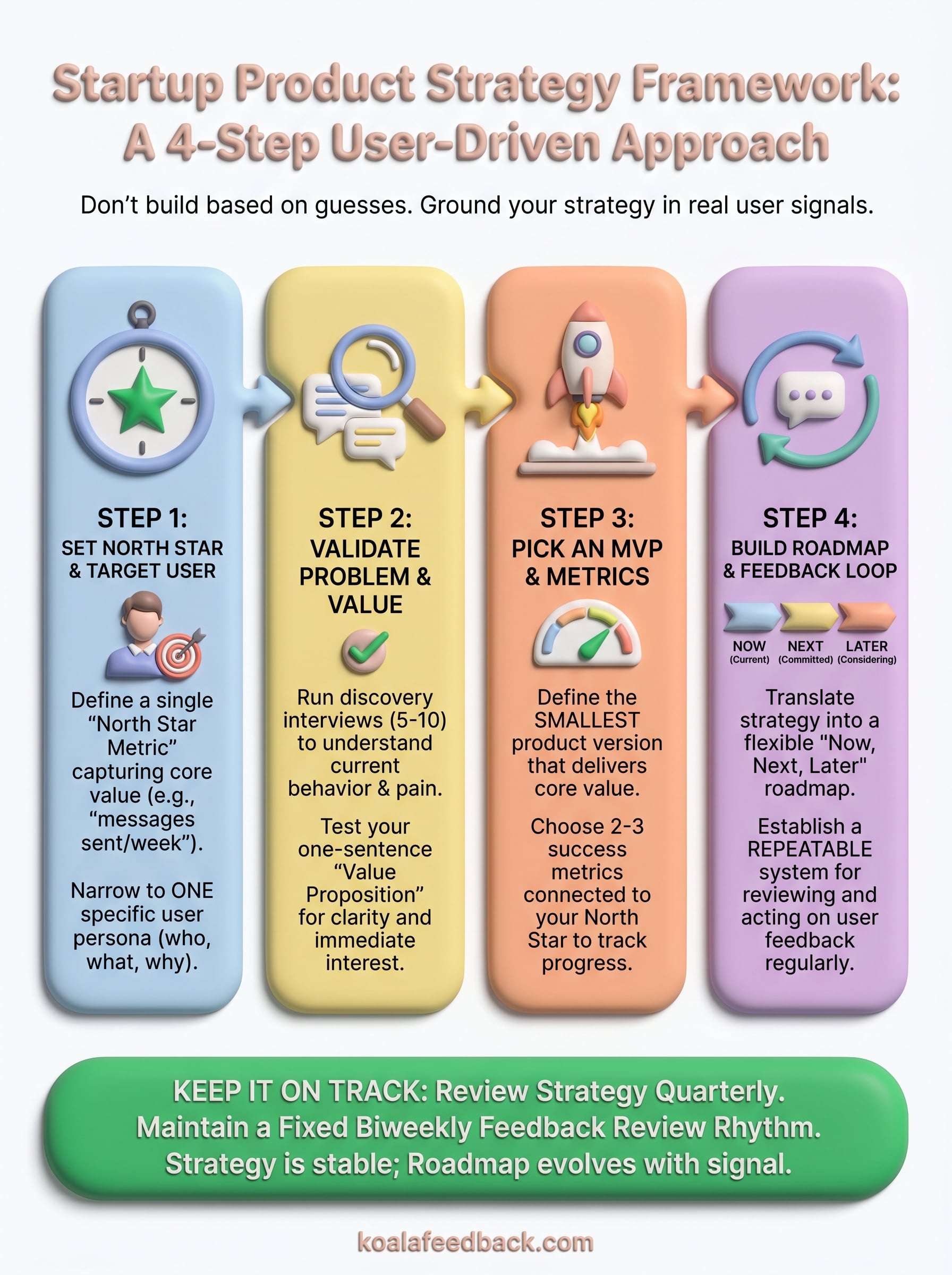
You now have a complete product strategy for startups framework, from setting your north star to closing the feedback loop with real users. The next step is to put it into action before it gets pushed aside by daily priorities. Review your strategy every quarter, and treat it as a living document that evolves as your users give you more signal.
The biggest risk at this stage is losing your feedback rhythm. Schedule a fixed biweekly review where you read incoming requests, map them against your roadmap, and make small prioritization adjustments before they pile up. That consistent cadence keeps your team aligned and your users engaged in the product direction you're setting.
If you want a structured way to collect, organize, and act on user feedback in one place, try Koala Feedback and build the feedback loop your product needs to stay on track.

Start today and have your feedback portal up and running in minutes.