Building a product without a clear strategy is like navigating without a map, you might move forward, but you'll waste time and resources on features nobody asked for. Product strategy tools help product managers and teams cut through the noise, align on priorities, and create roadmaps that actually drive results.
The challenge? There are dozens of options available, each with different strengths. Some excel at visualization and planning. Others focus on collecting user input to inform decisions. A few do both. Finding the right combination depends on your team's workflow, your users' needs, and how you communicate progress to stakeholders.
At Koala Feedback, we help teams capture and prioritize user feedback to guide their product decisions, because the best roadmaps are built on real user demand, not guesswork. But feedback collection is just one piece of the strategy puzzle. In this guide, we've rounded up nine tools that can help you build winning roadmaps in 2026, from prioritization frameworks to collaborative planning platforms.
Koala Feedback centralizes user feedback collection and feature prioritization into a single platform. You can capture ideas from your users, organize requests into logical boards, and share a public roadmap that keeps everyone aligned on what's coming next. The platform removes the guesswork from product decisions by giving you direct access to what your users actually want, rather than relying on internal assumptions or scattered feedback across email, support tickets, and Slack threads.
You use Koala Feedback to decide which features to build based on real user demand. The voting system lets your users signal what matters most to them, while the automatic deduplication ensures you're not counting the same request multiple times. This data-driven approach replaces gut feelings with concrete numbers, so you can defend your roadmap priorities to stakeholders with quantifiable user interest. The categorization tools help you spot patterns across different user segments, revealing which features will have the broadest impact on your product's value proposition.
Koala Feedback sits at the discovery and prioritization stages of your strategy process. You start by collecting continuous feedback through the portal, then use the voting data and comment threads to identify which requests align with your strategic goals. The public roadmap becomes your communication tool, showing users and stakeholders exactly what you're planning, building, and shipping. This transparency reduces the number of "when will you build X?" questions while building trust with your user base.
"The best product strategy tools turn user feedback into actionable roadmap decisions without requiring manual data wrangling."
Product managers at SaaS companies get the most value from Koala Feedback, especially those managing products with active user communities. Development teams that need to justify feature decisions to executives or investors benefit from the clear voting metrics. Startups building their first roadmap find the platform accessible, while established companies use it to bring structure to fragmented feedback channels. If you're currently managing feature requests in spreadsheets or losing track of user ideas in your inbox, this tool solves that problem.
Koala Feedback offers transparent pricing that scales with your needs. The platform provides customization options including your own domain, brand colors, and logo to match your product's identity. You can start collecting feedback immediately without complex setup processes, and the pricing structure grows with your usage rather than locking you into enterprise contracts upfront.
Jira Product Discovery extends Atlassian's project management ecosystem into the product strategy space. You can capture ideas from multiple sources, prioritize features using customizable frameworks, and connect strategic decisions directly to development work in Jira Software. The platform consolidates scattered product ideas into one workspace where you can evaluate, compare, and rank initiatives based on your chosen criteria. Teams already using Jira benefit from the seamless integration that eliminates context switching between strategy planning and execution tracking.
Jira Product Discovery helps you decide which ideas deserve development resources through customizable scoring models. You can apply frameworks like RICE, weighted scoring, or custom formulas that reflect your strategic priorities. The tool lets you compare opportunities side by side using your defined criteria, making it easier to defend your choices when stakeholders question why one feature made the roadmap over another. You surface patterns across different idea sources by tagging and filtering requests based on customer segment, strategic theme, or business objective.
This tool bridges the gap between product strategy tools and execution. You start by collecting ideas in a centralized view, then move them through evaluation stages using your scoring system. The Jira Software integration lets you push approved ideas directly into development sprints without manual data transfer. Your product strategy evolves in one place while engineering teams pull work from the same source, creating alignment between what you plan and what gets built.
"The strongest roadmaps connect strategic intent to execution without forcing teams to maintain duplicate records across multiple systems."
Teams already invested in the Atlassian ecosystem get the most value from Jira Product Discovery. Product managers working closely with engineering teams benefit from the direct connection to development workflows. Organizations that need formal prioritization frameworks to justify roadmap decisions find the scoring features useful. If you're currently juggling product ideas across spreadsheets, documents, and ticketing systems, this tool consolidates that chaos into a structured process.
Jira Product Discovery operates on a per-user pricing model that scales with your team size. Atlassian offers a free tier for small teams to test the platform before committing. The pricing increases as you add more collaborators and integrate with other Atlassian products. Enterprise customers can bundle this with existing Jira licenses for better rates.
ProductPlan specializes in visual roadmap creation that transforms strategic plans into presentations stakeholders can actually understand. You build timelines, swimlane views, and Gantt charts that show how features align with business goals over multiple quarters. The platform prioritizes clarity over complexity, giving you drag-and-drop functionality to adjust plans without rebuilding entire documents. Teams use ProductPlan when they need to communicate strategy across departments, not just track tasks in a development queue.
You use ProductPlan to decide how to sequence initiatives over time and which strategic themes get resource allocation in specific quarters. The visualization tools help you spot conflicts before they happen, like overlapping launches that would strain your team or competing priorities that dilute focus. The platform's scenario planning features let you model different roadmap versions based on varying resource constraints or market conditions, so you can present options to leadership rather than single commitments.
ProductPlan sits at the planning and communication stages of your process. You take prioritized ideas from other product strategy tools and translate them into timeline-based roadmaps that show when and why you're building specific features. The platform integrates with Jira, Azure DevOps, and other development tools to pull in progress data automatically, keeping your strategic view synchronized with actual work. You export roadmaps as presentations or live links to share with executives, sales teams, and customers without manual updates.
"The best roadmaps balance strategic vision with realistic timelines that your team can actually deliver."
Product managers who present roadmaps to non-technical stakeholders benefit most from ProductPlan's visual approach. Teams working across multiple products or platforms use the portfolio views to show cross-functional dependencies. Organizations that need to align product strategy with sales cycles or marketing campaigns find the timeline features essential.
ProductPlan charges per editor rather than viewer, letting you share roadmaps broadly without paying for read-only access. The platform offers tiered pricing based on features like custom integrations and advanced security controls. Enterprise plans include dedicated support and training resources.
Aha! and Productboard represent two comprehensive product strategy tools that tackle the full lifecycle from idea capture to roadmap execution. Both platforms offer end-to-end solutions that combine feedback collection, prioritization frameworks, and visual roadmapping in single environments. Aha! emphasizes structured planning workflows with built-in templates for common strategic frameworks, while Productboard focuses on connecting customer insights directly to product decisions through integrated feedback channels. Teams often evaluate these platforms together because they serve similar use cases at comparable price points.
Both tools help you decide which features align with strategic objectives by scoring initiatives against your chosen criteria. Aha! provides templates for frameworks like value versus effort, business model canvas, and competitive analysis that guide your evaluation process. Productboard excels at surfacing user feedback patterns that reveal which requests come from high-value customers or align with your ideal customer profile. You can assign custom scoring weights to different factors, letting you prioritize based on revenue impact, strategic fit, or technical feasibility rather than just vote counts.
These platforms span the entire strategy process from discovery through communication. You collect ideas from multiple sources, including integrations with support tools, CRM systems, and direct user submissions. The prioritization engines help you rank opportunities using your defined criteria, then visual roadmaps communicate approved plans to stakeholders. Both tools connect to development platforms like Jira to track implementation progress, creating a closed loop from strategy to execution.
"Comprehensive strategy platforms eliminate the need to maintain separate systems for feedback, prioritization, and roadmap communication."
Product teams at mid-sized to enterprise companies get the most value from these platforms. Organizations that need formal prioritization processes to justify roadmap decisions benefit from the structured frameworks. Teams managing multiple products or customer segments use the portfolio features to balance priorities across different initiatives.
Both Aha! and Productboard operate on subscription models with pricing based on user count and feature access. Enterprise tiers include advanced integrations, custom security controls, and dedicated support. The platforms offer free trials but require annual commitments for most production use cases.
Amplitude delivers product analytics that reveal how users interact with your features at a granular level. You track user behavior patterns, conversion funnels, and retention metrics to understand which parts of your product create value and which fall flat. The platform transforms raw usage data into strategic insights that inform roadmap decisions, replacing assumptions about user behavior with concrete evidence of what drives engagement and growth.
You use Amplitude to decide which features to expand, optimize, or deprecate based on actual usage patterns rather than survey responses or internal opinions. The analytics reveal which features drive retention, where users drop off in critical workflows, and how different customer segments interact with your product. This data helps you prioritize roadmap initiatives that will move your core metrics, whether that's activation rate, feature adoption, or long-term retention.
Amplitude plugs into the analysis and validation stages of your strategy process. You review behavioral data before committing to major feature investments, testing whether current functionality meets user needs or requires iteration. The platform integrates with product strategy tools to connect usage metrics with feature requests, helping you validate whether highly requested features actually get used after launch. Teams use these insights to adjust roadmaps based on real outcomes rather than initial hypotheses.
"Data-driven product strategy tools surface patterns that qualitative feedback alone might miss, revealing the gap between what users say and what they do."
Product managers at data-mature organizations benefit most from Amplitude's depth. Teams that make roadmap decisions based on behavioral metrics rather than just feedback volume find the platform essential. Organizations building digital products with measurable user journeys can track how strategic bets perform in production.
Amplitude offers a free starter plan for smaller teams with basic analytics needs. Paid tiers scale with event volume and unlock advanced features like predictive analytics and cohort analysis. Enterprise pricing includes custom data retention and dedicated support.
Pendo combines product analytics with in-app guidance to help you understand and improve user adoption. You track feature usage, identify friction points, and deliver contextual help directly inside your product without requiring engineering resources. The platform bridges the gap between knowing how users behave and actively guiding them toward success, making it valuable for teams focused on user onboarding and feature adoption rates.
You use Pendo to decide which onboarding flows need improvement and which features require better discoverability. The analytics show you where users struggle during initial setup or abandon critical workflows, helping you prioritize guides, tooltips, and walkthroughs that reduce friction. This data reveals whether low feature adoption stems from poor placement, confusing UI, or lack of awareness, letting you address the root cause rather than building redundant features.
Pendo operates at the validation and optimization stages of your product strategy. You review usage analytics after launching features to measure actual adoption against your goals, then use in-app guides to improve performance without rebuilding functionality. The platform connects behavioral data with qualitative feedback through integrated NPS surveys and polls, giving you both the what and the why behind user actions. Unlike other product strategy tools that focus solely on planning, Pendo helps you improve existing features through targeted user interventions.
"Understanding usage patterns helps you distinguish between features that need better marketing and features that need better design."
Product managers focused on user activation and retention benefit most from Pendo. Teams launching complex products that require guided onboarding use the platform to reduce time-to-value. Organizations that need to improve feature adoption across diverse user segments find the targeted messaging capabilities essential.
Pendo operates on annual subscription pricing based on monthly active users and feature access. The platform requires quotes for specific use cases rather than publishing standard rates. Enterprise customers get access to advanced segmentation and white-glove support.
Figma provides collaborative design capabilities that let product teams visualize features before committing development resources. You create interactive prototypes, explore different interface approaches, and gather stakeholder feedback on proposed solutions without writing code. The platform turns abstract roadmap items into tangible mockups that reveal usability issues and design challenges early in the strategy process. Teams use Figma to validate whether planned features solve user problems in ways that actually make sense.
You use Figma to decide which design approaches best serve your users and whether proposed features are feasible from a UX perspective. The prototyping tools let you test multiple interface variations before committing to a final approach, revealing which layouts reduce cognitive load or create confusion. This early validation helps you spot fundamental design problems that would require rework if discovered after development starts, saving time and resources on features that looked good on paper but fail in practice.
Figma operates at the exploration and validation stages of your product strategy. You translate prioritized roadmap items into visual designs that stakeholders can interact with and critique before engineering begins. The collaborative features let designers, product managers, and developers work in the same environment, reducing misalignment about what you're actually building. Unlike other product strategy tools that focus on what to build, Figma helps you define how features should work through rapid prototyping and iteration.
"Visual prototypes communicate feature concepts more effectively than written specifications, exposing gaps in your thinking before code gets written."
Product teams building user-facing features benefit most from Figma's design capabilities. Organizations that need to validate interface decisions with stakeholders or users before development find the prototyping essential. Teams working on complex workflows use the platform to map out user journeys visually.
Figma offers a free tier for individual designers and small teams. Paid plans unlock advanced collaboration features and version history. Enterprise pricing includes enhanced security controls and dedicated support resources.
Miro delivers collaborative whiteboard capabilities that let product teams map out strategy frameworks, run workshops, and visualize complex planning processes together. You build strategy canvases, create affinity diagrams, and facilitate remote brainstorming sessions in a shared workspace that everyone can access simultaneously. The platform transforms abstract strategic discussions into visual artifacts that capture your team's thinking and create alignment on direction. Teams use Miro when they need to work through strategic questions collaboratively rather than reviewing static documents.
You use Miro to decide which strategic frameworks apply to your product challenges and how different initiatives connect to broader business goals. The platform provides templates for common product strategy tools like OKR mapping, impact effort matrices, and customer journey maps that guide your strategic conversations. This visual approach helps you spot relationships between initiatives that spreadsheets hide, revealing dependencies or conflicts in your roadmap. The collaborative features let distributed teams contribute to strategic planning simultaneously, capturing diverse perspectives that improve decision quality.
Miro operates at the planning and alignment stages of your strategy process. You use the boards during kickoff workshops, quarterly planning sessions, and retrospectives where teams need to think through problems together. The platform integrates with product strategy tools like Jira and Productboard to pull in context from your existing workflow, then exports finished frameworks as references. Unlike tools focused on execution tracking, Miro helps you work through the messy strategic thinking that precedes concrete roadmap commitments.
"Visual collaboration platforms reveal connections and conflicts in your strategy that linear documents obscure."
Product managers running remote or distributed teams benefit most from Miro's collaborative features. Organizations that rely on structured frameworks like OKRs or value proposition canvases use the templates to standardize planning. Teams working through complex strategic pivots find the visual approach helps build consensus.
Miro offers a free tier for small teams with basic board functionality. Paid plans unlock advanced integrations and administrative controls. Enterprise pricing includes custom security requirements and dedicated support.
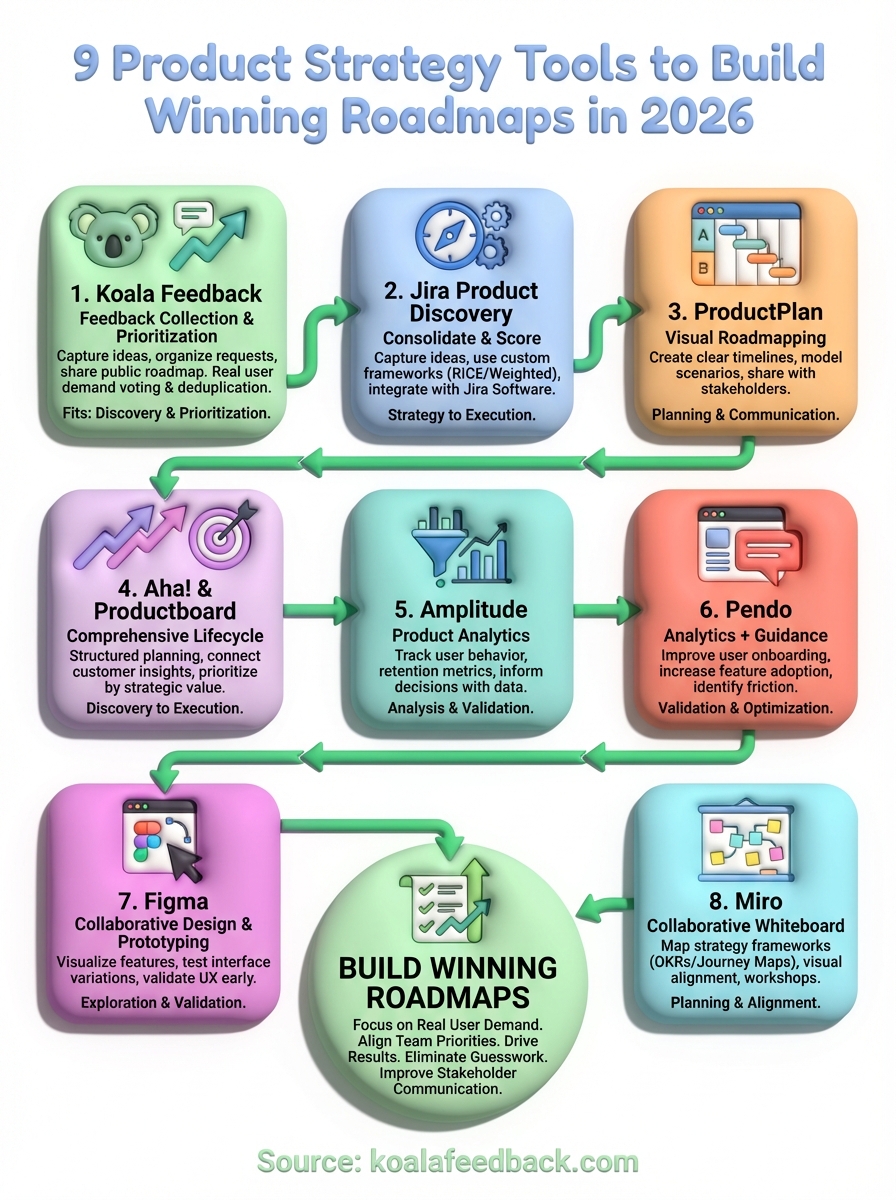
The right product strategy tools depend on your team's current challenges and workflow gaps. You don't need all nine platforms to build effective roadmaps. Start by identifying your biggest pain point: whether that's scattered feedback across channels, unclear prioritization criteria, or poor stakeholder communication. Choose one or two tools that directly address those specific problems, then expand your stack as you prove value and build adoption across your organization.
Building roadmaps based on real user demand separates products that grow from those that stagnate under feature bloat. Koala Feedback helps you capture what your users actually want, prioritize features through transparent voting, and share public roadmaps that keep everyone aligned on your direction. The platform eliminates guesswork by giving you quantifiable data about which features matter most to your customer base. Try Koala Feedback to transform scattered requests into strategic roadmap decisions that drive your product forward.

Start today and have your feedback portal up and running in minutes.