Reforge Product Strategy is one of the most talked-about programs for product managers who want to move beyond gut-feel decision-making. Created by former HubSpot VP of Growth Casey Winters and other seasoned operators, the course promises structured frameworks for identifying where to play, how to win, and what to build next. But with a price tag that gives most individuals and teams pause, the obvious question is: is it actually worth it?
This article breaks down the Reforge Product Strategy curriculum, the specific frameworks it teaches, and honest reviews from people who've completed the program. Whether you're a PM at a startup trying to figure out your next big bet or a product leader at a scaling company looking to sharpen your strategic thinking, you'll get a clear picture of what Reforge delivers, and where it falls short.
One thing Reforge emphasizes throughout its curriculum is that strong product strategy depends on real user signal, not assumptions. That's exactly the problem we built Koala Feedback to solve. Our platform helps product teams collect, organize, and prioritize user feedback so that the strategic frameworks you learn in programs like Reforge actually have solid data behind them. Strategy without feedback is guesswork. Frameworks without user input are just theory. What follows is everything you need to know before deciding if Reforge Product Strategy deserves your time and budget.
Most senior product managers reach a plateau that execution skills alone cannot fix. You ship features, you run reviews, you ship more features, and then you sit across from a VP or a board and get asked something like "what's our strategy for winning in this segment?" and realize that nothing in your day-to-day work actually prepared you to answer that. That gap is exactly why product strategy training has become a serious investment for PMs who want to operate at the next level.
Early in your PM career, shipping well is enough. You learn to write clear specs, work with engineers, and manage backlogs. But as you move into senior, principal, or director-level roles, the job fundamentally changes. You spend less time executing someone else's vision and more time justifying, shaping, and defending your own. That shift requires a completely different mental model, and most PMs are never formally taught how to make it.
The uncomfortable truth is that strategic thinking does not develop automatically with seniority. Many experienced PMs carry the same mental habits they had as associates, just applied to larger problems. Reforge product strategy and programs like it exist precisely because this gap is real and well-documented in the industry. Without deliberate training, you risk staying stuck in feature-level thinking even when your title says otherwise.
Strong strategic instincts are built through structured repetition, not just years of experience.
You might assume that working at a strong product company gives you enough exposure to strategy. In practice, most PMs absorb product strategy by osmosis. You see outputs like a roadmap or a prioritization decision, but you rarely see the reasoning process behind them made explicit. You observe what leaders decide but not the mental models they used to get there.
This creates a specific problem: you end up copying patterns without understanding the principles. When you hit a new context, a new market, or a new business model, the copied patterns break down and you have no framework to replace them with. Formal training forces you to confront the underlying logic instead of just mimicking the output. That distinction matters enormously when you are the one setting direction rather than following it.
When you invest in product strategy training, you are not just acquiring knowledge. You are building a repeatable process for making hard decisions. Frameworks like market segmentation, competitive moats, and growth loops give you a common language to think with and a structure to apply when stakes are high and the answer is not obvious.
Structured training also gives you a shared vocabulary with other senior operators. When your CPO references a concept from a well-known program and you understand the model behind it, you participate in the conversation differently. You can challenge assumptions, adapt the framework to your context, and push back when the logic does not hold. That kind of engagement changes how you are perceived and how much influence you carry.
A practical breakdown of what good product strategy training should deliver:
None of these outcomes happen by default from simply logging more years on the job. They require deliberate learning in a structured environment, which is why programs aimed at senior PMs have grown so significantly in demand over the last several years. Knowing what to build next is only half the challenge; being able to articulate and defend that decision with a clear strategic rationale is what separates good PMs from great ones.
Reforge Product Strategy is a structured online program built for experienced product managers, not beginners. It sits within the broader Reforge membership, a platform that offers multiple programs across growth, retention, monetization, and product. The Product Strategy program specifically focuses on how to define a winning market position, allocate resources to the right bets, and communicate strategic direction in a way that actually influences decisions inside your organization.
Reforge runs its programs in cohorts, which means you move through the material alongside other senior practitioners on a fixed schedule rather than at your own pace. Each cohort lasts several weeks and combines pre-recorded video content, written frameworks, and live sessions. The live components are where most participants say the real value shows up, because you work through case studies with peers who bring context from different companies and industries.
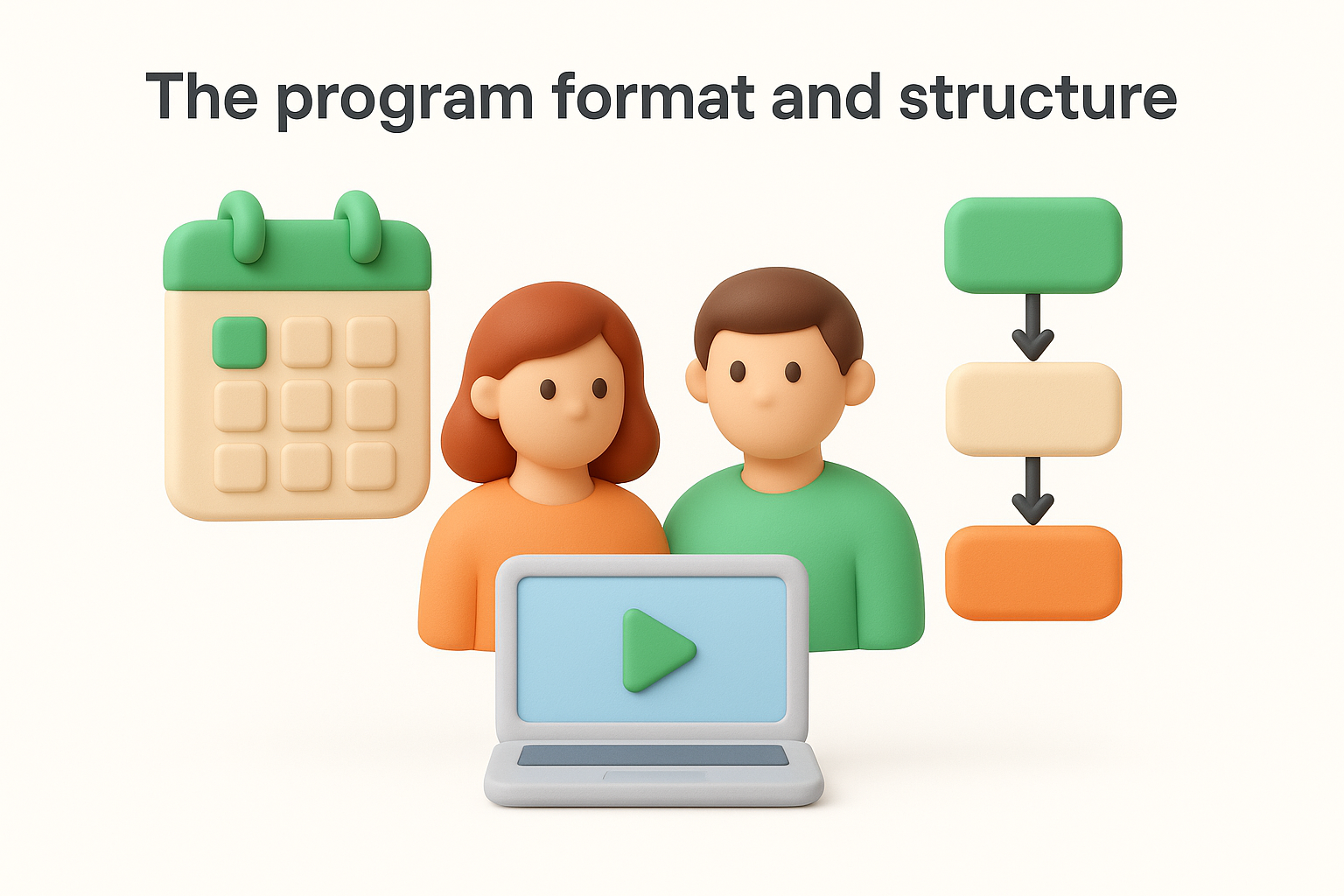
The cohort model separates Reforge from on-demand courses by forcing you to engage with the material in real time alongside people who are wrestling with similar problems.
The curriculum uses a mix of reading assignments, structured exercises, and group discussions to push you past surface-level understanding. You are expected to apply the frameworks to your own product context, not just memorize definitions. That application layer is intentional. Reforge has built its curriculum around the idea that strategic thinking only develops when you practice it against real constraints.
The reforge product strategy program targets senior PMs, directors, and product leads who already understand how products are built but want to sharpen how they decide what to build and why. If you are newer to product management or still building core execution skills, you will likely find the material moves too fast and assumes knowledge you have not developed yet.
Reforge is transparent about this expectation. Most accepted members have between four and ten years of product experience, and the application process filters for that seniority. You will be asked about your current role, the scope of your work, and what specific strategic challenges you are trying to solve. This filtering is not gatekeeping for its own sake; it keeps the cohort conversations substantive because every participant brings comparable depth to the discussion. When your peers have led product teams through real strategic decisions, the live sessions move at a pace and depth that you cannot replicate in a more general audience setting.
The reforge product strategy program runs for approximately six weeks, with each week covering a distinct strategic layer. The structure is intentional: earlier weeks focus on diagnosing your current market position, while later weeks shift toward building and communicating a forward-looking strategy. You do not skip around. Each module builds on the one before it, so the sequence itself is part of the learning design, not just a convenient way to organize content.
The first two weeks ground you in market segmentation and competitive analysis. You learn how to define your addressable market with precision and how to identify where your product holds a structural advantage versus where it is simply competing on features. Week three typically shifts to growth models and resource allocation, asking you to map where you should concentrate bets based on evidence rather than internal politics or instinct.
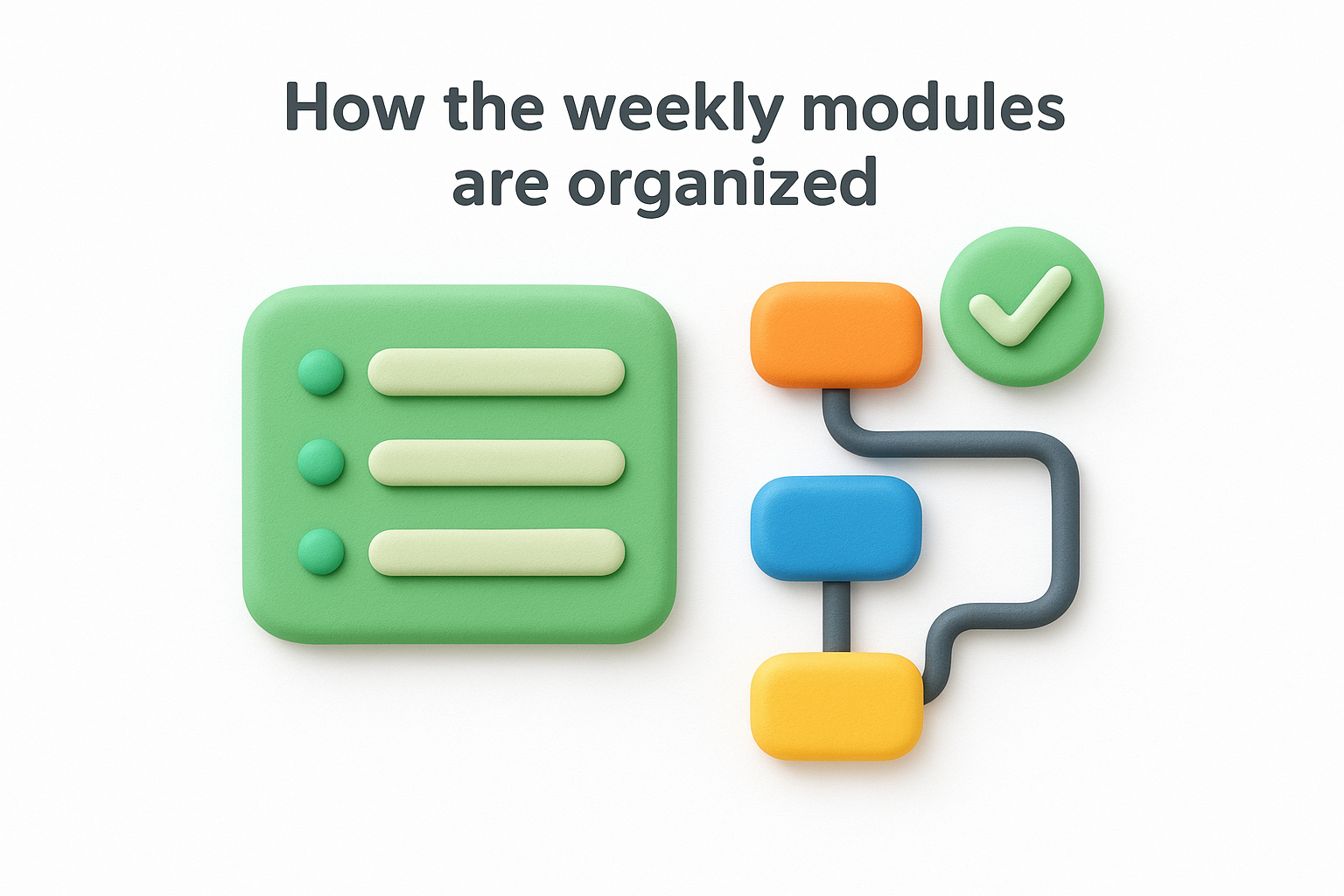
The middle weeks are where most participants say the frameworks start to feel real, because you apply them directly to your own product instead of working through abstract examples.
Weeks four and five move into organizational strategy and roadmap communication. This is where the program closes the gap between having a strategy in your head and getting your team, leadership, and stakeholders to actually act on it. The final week focuses on synthesis and presentation, where you pull your work together into a coherent strategic narrative and receive structured feedback from peers and facilitators before the cohort wraps up.
You should expect to spend roughly four to six hours per week to engage with the program seriously. That breaks down into approximately two hours of async content including video lessons, written frameworks, and exercises, and another two to four hours across live sessions and peer discussions. If you skip the async work and show up to live sessions cold, you will find the conversations move faster than you can follow, because facilitators build on the reading rather than restating it.
Most participants treat this more like a part-time course than a passive subscription. If you are carrying a demanding full-time role, block the time on your calendar before the cohort starts. The program does not accommodate passive consumption. Reforge builds its curriculum around the expectation that you will arrive prepared, and the cohort dynamic holds that standard consistently from week one through the final session.
The reforge product strategy program teaches a specific set of mental models and repeatable tools designed to make strategic decisions more structured and defensible. These are not generic business school concepts repackaged with new names. Each framework connects directly to the decisions you face as a senior PM, including where to compete, how to grow, and how to justify your bets to leadership.
The program starts with how you define your market, because most PMs draw their segment boundaries too broadly or too narrowly. Reforge teaches a structured approach to segmentation that goes beyond demographics. You learn to segment by job-to-be-done, identifying the specific problems your product solves and which customers experience those problems most acutely. Competitive positioning then becomes a function of where your product creates the most asymmetric advantage relative to alternatives, not a vague claim about differentiation.
Key questions this framework pushes you to answer:
Once you understand where you compete, the program turns to how you grow within that space. Reforge is well known for its growth loop frameworks, which map how your product acquires, retains, and expands users through self-reinforcing cycles rather than one-off campaigns. In the product strategy context, growth loops inform where you should concentrate your roadmap investment, because building into a strong loop compounds over time while building outside of it burns resources with diminishing returns.
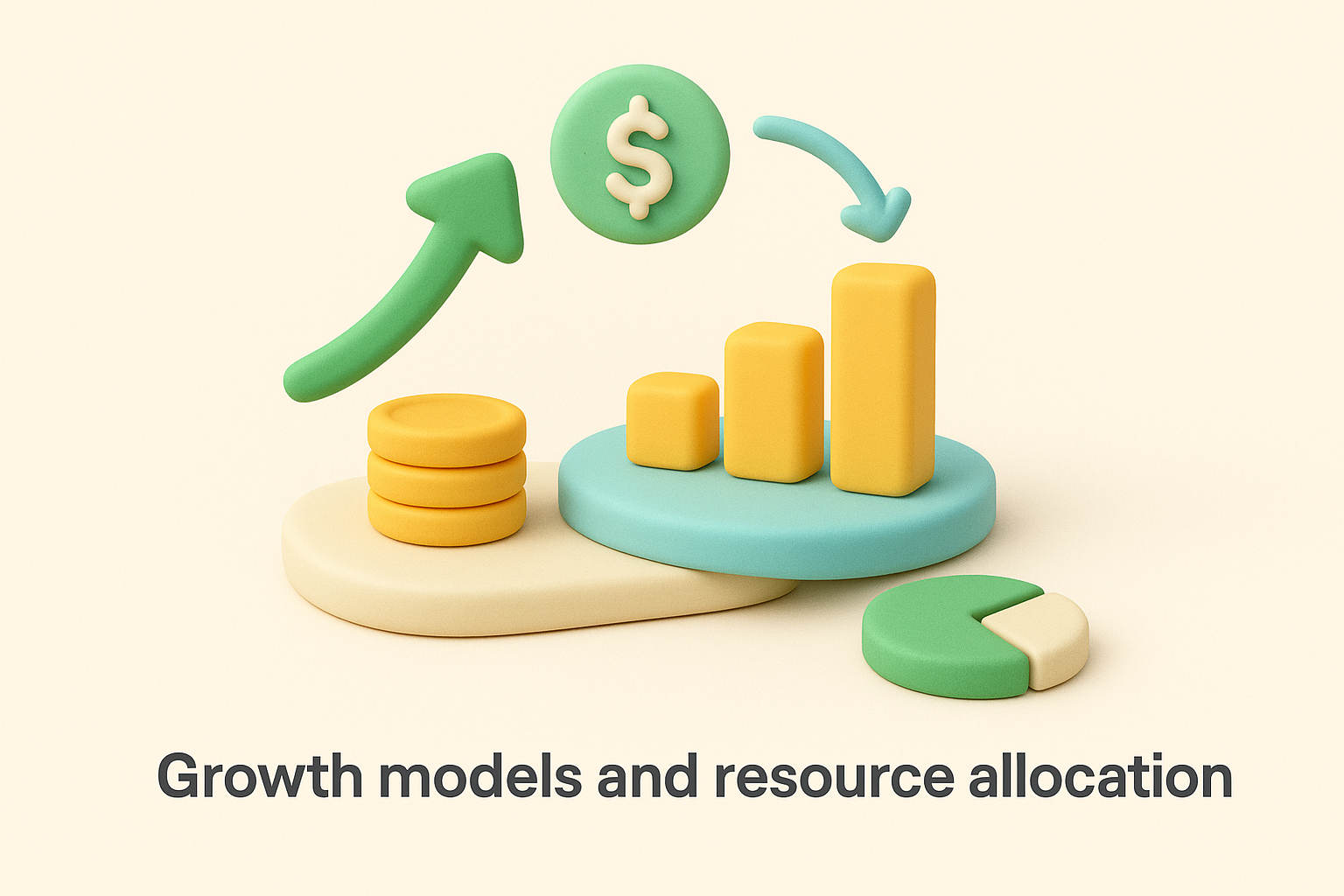
Building into a strong growth loop accelerates returns; building outside of one just adds complexity.
You practice identifying the loops already present in your product and evaluating which ones are worth accelerating based on evidence rather than intuition or organizational pressure.
Knowing your strategy is only half the problem. The other half is communicating it clearly enough that engineers, designers, executives, and stakeholders all pull in the same direction. Reforge teaches a framework for building a strategic narrative that connects your market position to your growth model to your specific roadmap choices.
This narrative structure gives your decisions a visible logic chain rather than presenting them as isolated calls. When you can show the reasoning from first principles, your recommendations carry more weight and your team has a clearer mental model to reference when making day-to-day decisions without you in the room.
Reforge moved away from per-course pricing several years ago. Today, accessing the reforge product strategy program requires an annual membership, which gives you entry to the full Reforge library rather than a single standalone course. This model works differently from most online learning platforms, and understanding exactly what you are paying for before you commit saves you from surprises when the invoice arrives.
Reforge individual membership is priced at roughly $2,000 to $2,500 per year as of 2026, though Reforge adjusts its pricing periodically, so confirm the current rate directly on their site before budgeting. That fee unlocks access to every program in the Reforge catalog, which spans product strategy, growth, retention, monetization, and product management fundamentals. You do not pay separately for each program once you hold an active membership.
One membership gives you access to the full catalog, which changes the math significantly if you plan to complete more than one program during the year.
Here is what the membership typically covers:
Reforge also offers team and company-level memberships for organizations that want to enroll multiple employees at once. These plans carry a higher total cost but reduce the per-seat price compared to buying individual memberships separately. If your company needs to upskill several senior PMs or product directors in the same period, the team plan usually makes more financial sense than processing individual enrollments one by one.
Most companies that sponsor Reforge categorize it as a professional development budget item rather than a standard training expense, which makes internal approval easier. When you build the business case for your employer, anchor it to a specific strategic challenge your team is actively working through rather than framing it as general professional development. The program's applied, framework-driven structure makes that argument concrete, because you can point directly to the decisions you intend to make better as a result of completing it. That specificity tends to move budget conversations forward faster than a vague appeal to career growth.
The membership fee is real, and the time commitment is real. Before you submit an application, run a quick self-assessment against a few concrete criteria rather than relying on general enthusiasm for the program. The decision comes down to two things: where you are in your career right now and what specific strategic problem you are actively trying to solve.
The reforge product strategy program delivers the most value when you are already working at a senior or director level and your daily work requires you to make or defend strategic decisions, not just execute on them. If you regularly sit in rooms where your company debates where to compete, what bets to fund, or how to explain your roadmap to leadership, you will find the curriculum directly applicable to work you are already doing.
The clearest sign that you are ready is when you feel the limits of your current mental models more often than you feel confident in them.
You should also evaluate whether your company gives you the authority to apply what you learn. If you complete the program and return to an environment where strategy is owned entirely above your level, you will absorb frameworks you cannot exercise. The program works best when your role already carries strategic scope, or when your organization is actively expanding yours.
Here are strong indicators the program fits your situation right now:
Waiting makes sense if you are early in your PM career or still building the execution fundamentals that senior roles assume you already have. The cohort conversations move fast and assume significant prior context; without that foundation, you will spend more energy keeping up than applying the material.
Skipping also makes sense if your budget is tight and you cannot absorb the membership cost without a clear return. In that case, spend the next six months building a specific strategic problem you need to solve, then apply when the program maps directly to something urgent. A sharply defined use case for the frameworks is worth more than general curiosity about strategy, both for getting accepted and for getting real value once the cohort begins.
People who complete the reforge product strategy program consistently highlight two things: the quality of the peer network and the applied nature of the frameworks. But the reviews are not uniformly positive. Students who go in with the wrong expectations or insufficient seniority often walk away frustrated, and a few structural limitations come up repeatedly in honest accounts. Here is what the feedback actually shows.
Most graduates name the cohort conversations as the single highest-value component, well above the recorded content or the written materials. When your peers are product directors and VP-level operators working through real strategic dilemmas, the discussions go deeper than any curriculum can script. You hear how different industries apply the same frameworks under very different constraints, and that exposure sharpens your own thinking in ways that solo study simply cannot replicate.

The frameworks give you a vocabulary, but the cohort gives you the judgment to apply them.
Students also consistently credit the strategic narrative module for changing how they communicate with leadership. Learning to build a visible reasoning chain from market position to roadmap choices gives your recommendations a logical spine that is hard to dismiss. Multiple reviewers note that this module alone justified the membership cost when they applied it in their next executive review.
The most common criticism is that the content assumes a relatively stable product context, which means early-stage founders and PMs at companies still searching for product-market fit often find the frameworks too advanced for their current situation. The curriculum is built around optimizing and extending an existing position, not discovering one from scratch. If you are at that earlier stage, several core modules will feel like they solve a problem you have not reached yet.
Async content quality receives mixed marks from reviewers as well. Some participants describe the pre-recorded videos as dense and occasionally dry, and a few note that the written frameworks can feel abstract until the live sessions bring them to life. If you are someone who learns primarily through reading or self-paced study, the async materials alone may not fully land.
The biggest gotcha is how much preparation each session requires. Students who treat Reforge like a passive subscription quickly fall behind, because facilitators build directly on the assigned material rather than recapping it. A second surprise is that the application process itself is selective, and some qualified candidates do not get accepted on the first attempt. If you get deferred, Reforge typically provides feedback, and reapplying with a more specific strategic problem to anchor your application usually improves your odds.
If the reforge product strategy program does not match your current budget, career stage, or learning style, you still have strong options. The goal is structured strategic thinking, and several paths can get you there without the Reforge membership cost or cohort format.
Books remain one of the highest-value investments for senior PMs who want to build strategic frameworks at their own pace. "Good Strategy Bad Strategy" by Richard Rumelt gives you a rigorous framework for understanding what strategy actually is versus what most organizations pretend it is, and it applies directly to product decisions. "Competing Against Luck" by Clayton Christensen covers jobs-to-be-done thinking in depth, which is the same segmentation lens Reforge builds much of its curriculum around. Reading both back to back gives you a strong conceptual foundation before investing in any formal program.
A focused reading list with deliberate application to your current product context can produce more durable learning than a course you rush through.
You can supplement books with practitioner writing published by senior operators at major tech companies. Product leaders at companies like Google, Meta, and Amazon regularly publish detailed strategic frameworks through official channels, conference talks, and academic platforms. This material is free, current, and grounded in real product decisions at scale.
If your company already employs strong product leaders, requesting structured mentorship around a specific strategic decision is often more actionable than any external program. You learn within the exact context where you will apply the frameworks, which removes the translation step that trips up many Reforge graduates when they return to work. Ask a senior PM or VP of Product to walk you through how they structured a recent strategic bet, including the trade-offs they weighed and the alternatives they rejected.
Internal workshops and product reviews also develop strategic thinking when you treat them as practice rather than bureaucratic checkboxes. Before your next roadmap review, write out the explicit reasoning chain connecting your market position to your resource allocation choices. Force yourself to defend every bet with a clear first-principles argument. That kind of deliberate practice compounds quickly over several review cycles.
Structured reflection on real decisions accelerates strategic development faster than passive consumption of external content, and it costs nothing beyond time.
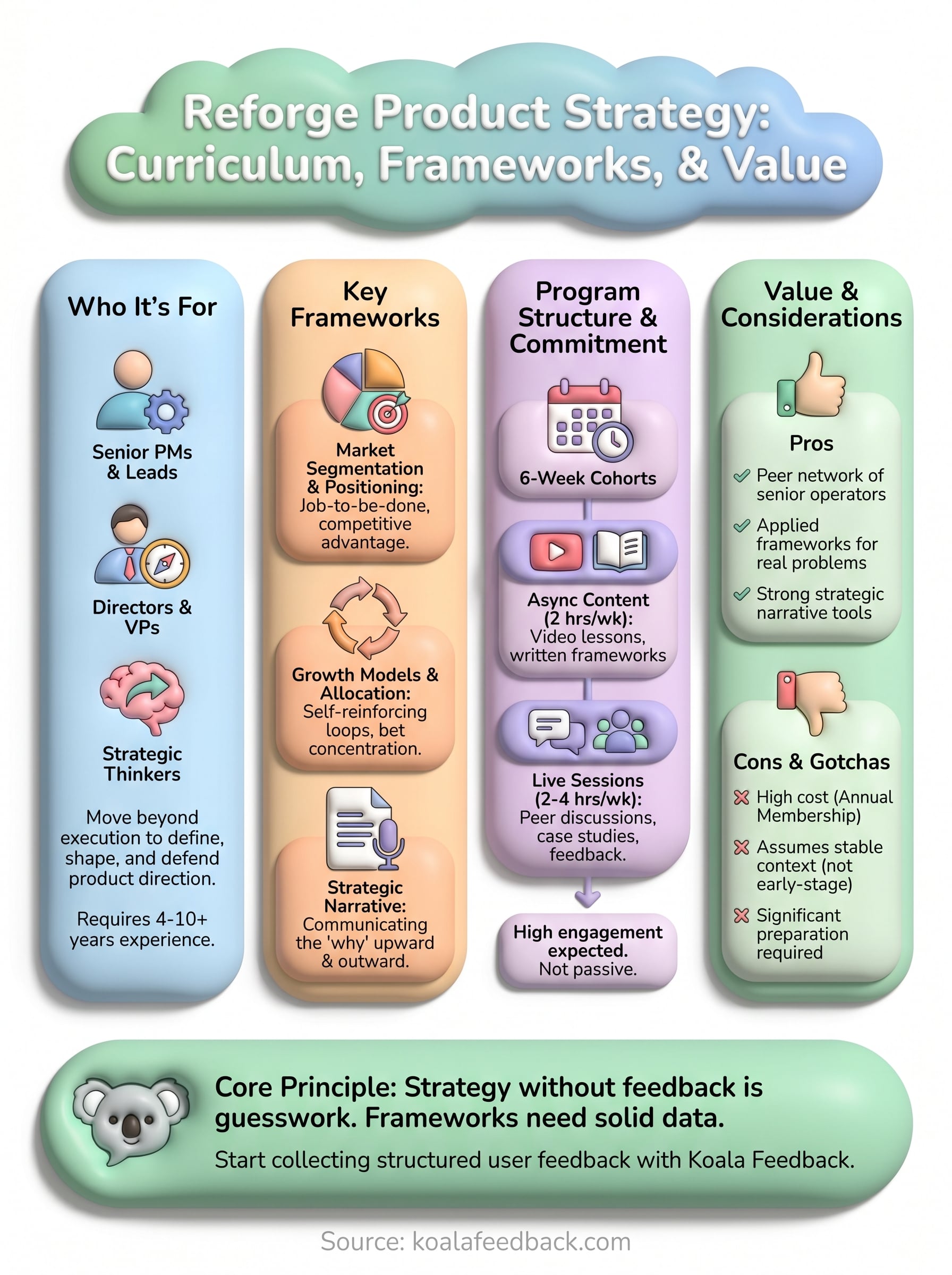
The reforge product strategy program delivers real value for senior PMs who arrive with the right experience, a clear strategic problem to anchor their learning, and the time to engage seriously with each cohort session. The frameworks, peer discussions, and strategic narrative tools are genuinely useful, but only when your role already gives you the authority and scope to apply them. If you are earlier in your career or still building execution fundamentals, the alternatives covered in the previous section will serve you better right now.
One principle the program reinforces throughout is that strategy only holds up when it connects to real user signal. Frameworks built on assumptions erode quickly. If you want your strategic decisions to stand on solid ground, you need a reliable way to capture, organize, and prioritize feedback from the people actually using your product. Start collecting structured user feedback with Koala Feedback and give your strategy the evidence it needs to hold up under pressure.

Start today and have your feedback portal up and running in minutes.