Research and development of a product is the work a business does to find out what customers need, turn that into a design, and test it until it is ready to sell. It covers the market research done before anything is built, the prototypes and tests done while it is built, and the improvements made after launch. R&D rarely pays off right away. Its job is to lower the risk of building the wrong thing.
This article explains why product R&D matters, how to run it in stages, and which types and methods suit which questions. You will see what it looks like in real businesses, how to fund it, and where teams go wrong.
Feedback is the raw material of most software R&D, so we will also point out where it fits. We build Koala Feedback, a platform for collecting user feedback and sharing roadmaps.
Product R&D matters because it replaces guesses with evidence before you commit money to building. Teams that research first waste less on features nobody wants. Teams that keep researching after launch notice declining interest early.
Building is the expensive part of any product. Research is the cheap part, so it belongs first. A handful of customer interviews or a quick concept test can show that the problem is smaller than you assumed, or that people already solve it another way.
Spending more does not guarantee a good result. What decides the outcome is how well you understand customer needs, and those needs shift over time. The research has to be repeated, not done once at the start.
Research is the cheapest part of product development, so do it before the expensive part.
When research and development product work is done well, the returns show up in several places:
Expect the payoff to be long term. Small businesses usually have limited budgets, so they focus on improving what they already sell. That is a sound approach, because a steady stream of small, well-researched improvements often beats one big bet.
Run product R&D in six stages: discover, test concepts, prototype, test the prototype, price and launch, then iterate. Every stage answers one question and produces one output you can act on. The sequence is the same for a mobile app and for a skincare line.
The table below shows what each stage asks and what you should have in hand before moving on.
| Stage | Question it answers | Output |
|---|---|---|
| 1. Discover | Which problem is worth solving? | Problem statement and customer insights |
| 2. Concept test | Which idea do people actually want? | Ranked list of concepts |
| 3. Prototype | Can we build a working version? | Prototype or minimum version |
| 4. Test | Does it work, and do people use it well? | Usability findings and fixes |
| 5. Price and launch | Will people pay, and how do we reach them? | Pricing and launch plan |
| 6. Iterate | What should improve next? | Updated priority list |
Stages overlap in practice. A software team may be prototyping one feature while discovering the next. The order still holds for each individual idea.
Write pass or fail criteria before you test, not after. For example, "at least 6 of 10 interviewees describe this problem unprompted" is a clear gate. Without criteria, teams read ambiguous results as encouragement and keep spending.
Set the pass mark before the test, or every result will look like a pass.
Feedback feeds stages 1, 2, and 6 most directly. For a software product, a public feedback portal lets users submit ideas, vote, and comment, so your discovery data arrives continuously. A public roadmap then closes the loop by showing which ideas are planned, in progress, or done.
Koala Feedback's free Starter plan is enough to try this. It includes 3 boards, unlimited users, and up to 100 active posts. Setting up a portal takes minutes.
R&D falls into three types, basic research, applied research, and development, and each uses different methods. Knowing which type you are doing keeps you from using a slow method on a fast question.
Basic research seeks general understanding with no product in mind yet. A toy company studying how children play is an example. Applied research aims at a specific problem, such as designing a toy that supports a certain kind of play.
Development turns those findings into a product and refines it. Most small teams spend nearly all their time here, borrowing basic research from published studies or industry reports instead of running it themselves.
Pick the method by the question you need answered:
Small, qualitative methods such as interviews work early, when you do not yet know what to measure. Large, quantitative methods such as surveys and A/B tests work later, when you need numbers to choose between options.
Use small qualitative tests to find the question, and large quantitative tests to settle it.
Product R&D looks different in each industry, but the pattern of researching, building a version, testing, and refining is constant. The three examples below are illustrative scenarios, not reports on named companies.
A skincare brand wants an all-natural moisturizer. It tests ingredient combinations, checks how long each formula stays stable on a shelf, and runs a trial with real users. A cookware maker might do the same with handle shapes, asking testers to lift a full pan and rating comfort.
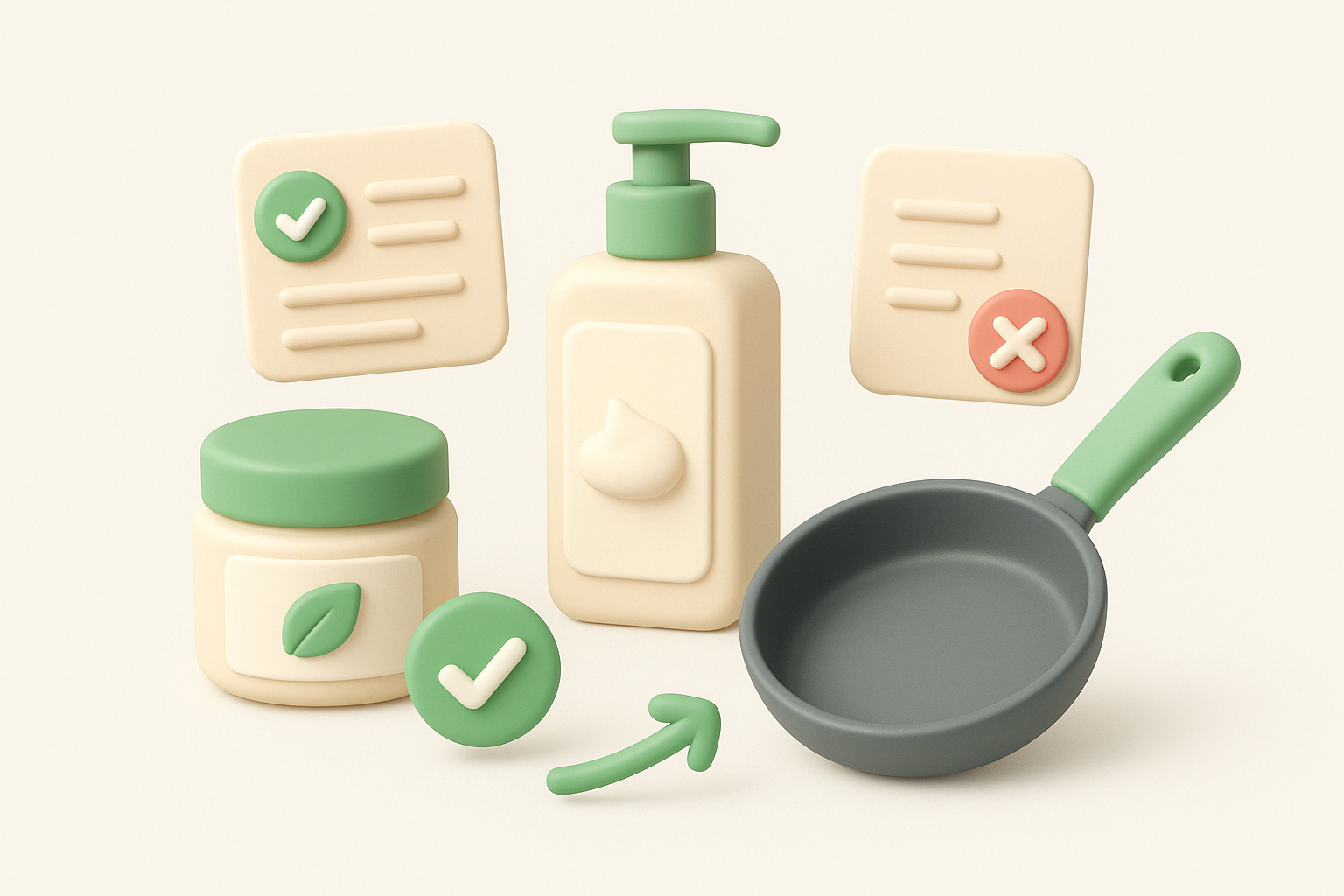
In both cases, testing reveals problems cheaply. Fixing a handle in a prototype costs far less than fixing it after a production run.
A software team gathers feature requests in a feedback portal and lets users vote. The numbers below are made up to show how the process works:
| Request | Votes | Next step |
|---|---|---|
| CSV export | 48 | Build a prototype |
| Dark mode | 31 | Interview voters about use cases |
| Slack alerts | 22 | Keep monitoring |
| Total | 101 |
CSV export holds 48 of 101 votes, just under half, so it earns a prototype first. Votes show demand but not reasons. Interviewing the dark mode voters tells you whether it is a real need or a preference, which is the difference between a vote and a insight.
R&D is not limited to labs. A local plumbing company could develop a diagnostic checklist that cuts the time to find a leak, then time it on 20 real jobs against the old method. A new process that is researched, tested, and measured is still research and development of a product, and here the product is the service.
Fund product R&D from a mix of sources and protect it with clear stop rules and early IP safeguards. Most failures come from skipping research, not from a lack of money.
Common sources include:
In the United States, the federal research credit can reduce taxes for qualifying work. The activity must aim to improve a product, process, or software and involve technical uncertainty and experimentation. A qualified tax adviser can confirm what counts for you.
Four mistakes come up again and again:
Most R&D failures come from skipping research, not from running out of money.
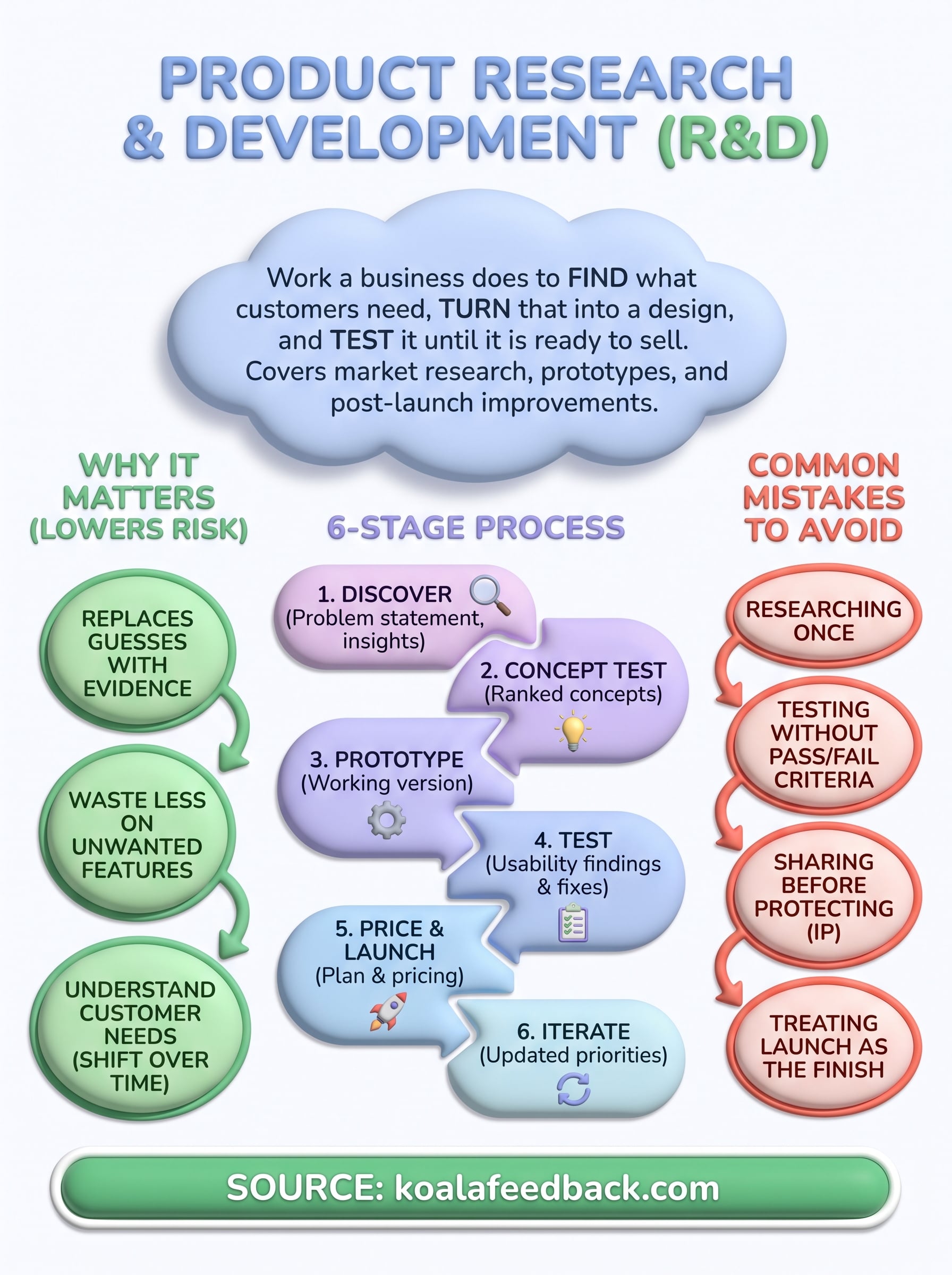
Research and development of a product comes down to one habit: learn what customers need, build a small version, test it against a clear standard, and repeat. The stages give you order, the methods match each question, and funding and IP protection keep the effort sustainable.
You probably already hold useful evidence in support tickets, sales calls, and customer requests. If you build software, you can gather and rank that input in one place with Koala Feedback, and the free plan costs nothing to start.

Start today and have your feedback portal up and running in minutes.