Most users decide whether your product is worth their time in the first ten minutes. If they can't find value fast, they churn, and no amount of feature building will save you. This is the exact problem product-led growth onboarding solves: it's the practice of guiding new users to value inside the product itself, without a sales rep or a lengthy demo call walking them through it.
Done right, product-led onboarding replaces guesswork with a repeatable path to the "aha moment", the point where a user understands why your product matters to them. It relies on in-product prompts, checklists, and contextual guidance rather than static help docs, and it treats user activation as a measurable milestone you design for, not something that just happens.
In this article, you'll get a clear definition of product-led onboarding, the frameworks teams use to structure it, and real examples of onboarding flows that convert trial users into active customers. We'll also cover how tracking feedback and feature requests, something we deal with daily at Koala Feedback, helps you spot exactly where onboarding breaks down and what to fix first.
Growth used to run through sales teams and onboarding specialists who walked every new customer through the product by hand. That model breaks down the moment you have hundreds or thousands of signups a month, because you can't scale a human conversation the way you can scale software. Product-led growth onboarding fixes that by putting the product itself in charge of teaching, guiding, and converting new users, which is why companies like Slack, Dropbox, and Calendly built their entire growth engines around it.
Sales-led onboarding costs money on every single account, whether that account turns into a paying customer or not. Self-serve onboarding spreads that cost across your entire user base instead of concentrating it on a handful of high-touch calls, which means your unit economics improve as you scale rather than degrade.
| Onboarding model | Cost per new user | Scales with signups? | Time to value |
|---|---|---|---|
| Sales-led (demo calls, CSMs) | High, grows linearly | No | Days to weeks |
| Product-led (in-app guidance) | Low, mostly fixed | Yes | Minutes to hours |
That gap widens fast once you're past a few hundred users a month, and it's the main reason venture-backed SaaS companies push so hard to get onboarding right before they scale marketing spend.
Every growth metric you care about, retention, expansion revenue, referrals, sits downstream of one thing: whether a user actually experienced the value your product promised. User activation is the moment that happens, and onboarding is the mechanism that gets users there reliably instead of leaving it to chance.
A product that's hard to start with will always lose to one that's easy to start with, no matter how good the features are underneath.
Teams that treat activation as a design problem, not an accident, consistently see higher trial-to-paid conversion. That's because they've mapped the shortest path to value and removed everything that gets in the way of it.
Weak onboarding doesn't just cost you a few signups, it quietly drains revenue you already paid to acquire through ads, content, or partnerships. Consider what a broken first experience actually does to your funnel:
Understanding this connection between onboarding and revenue is what separates teams that treat it as a cosmetic tour from teams that treat it as the backbone of their growth strategy.
Designing onboarding isn't about adding a welcome screen and calling it done. Product-led growth onboarding starts with a single question: what's the fastest path from signup to the moment a user gets real value? Everything else, the emails, the tooltips, the checklists, exists to support that path, not distract from it.
Begin by listing every step a new user takes between signup and their first genuine "aha" moment, then cut anything that doesn't move them closer to it. Most teams find their signup flow has three or four steps that exist for internal reasons (billing setup, team invites, profile fields) that could easily wait until after activation.
If a step doesn't get the user closer to value, it's a barrier disguised as a feature.
Once you know the path, choose the components that guide users along it without overwhelming them. A short onboarding checklist keeps users oriented, while contextual tooltips explain features exactly when they're needed, not all at once on day one.
Different users want different outcomes from the same product, so a single onboarding flow rarely fits everyone. Segmenting new users by their stated goal, role, or use case during signup lets you route them to the specific flow that gets them to their version of value fastest, rather than a generic tour built for the average user who doesn't exist.
Great onboarding flows share a few habits regardless of industry. Knowing these patterns saves you from reinventing the wheel or copying a flow that worked for a different kind of product.
Users judge your product fast, so the gap between signup and first value has to stay short. Product-led growth onboarding works best when you strip every unnecessary form field, confirmation screen, or setup step that doesn't lead directly toward that first meaningful action. If a task can happen after activation, move it there.
Every extra click between signup and value is a chance for the user to leave and never come back.
Asking one or two questions at signup, like role or primary goal, lets you route users into a flow built for their outcome instead of a generic tour. This small step raises completion rates because the guidance feels relevant instead of generic, and it takes just a few extra seconds to collect.
Don't explain every feature on day one. Reveal capabilities as users need them, which keeps cognitive load low and prevents the abandonment that comes from an overwhelming first session.
Onboarding isn't static. Collecting feedback and feature requests from users who just went through your flow tells you exactly where confusion happens, which is far more reliable than guessing from analytics alone. A feedback portal tied to your product gives users an easy way to flag friction the moment they hit it, and gives your team a prioritized list of what to fix next rather than a pile of anecdotes.
Abstract frameworks only get you so far. Seeing how established companies apply product-led growth onboarding in practice makes the tactics concrete and easier to steal for your own product.
Slack's onboarding skips setup screens almost entirely and drops new users straight into a live channel with a bot ready to answer questions. Activation happens the moment you send your first message, not when you finish configuring notifications or inviting a team. That single focus on one action explains why Slack's early growth numbers became a case study every SaaS founder still references.
Calendly's entire first session revolves around producing one shareable scheduling link, and everything else waits. Users connect a calendar, set availability, and get a link they can send immediately, which means the time-to-value for Calendly is measured in minutes, not days.
The best onboarding flows all share one trait: they get you to one real result before asking for anything else.
Dropbox's classic onboarding rewarded users with extra storage for completing setup tasks like installing the desktop app or inviting a friend. That turned onboarding into a growth loop, since each completed step also brought in new signups.
| Company | Core onboarding action | Activation signal |
|---|---|---|
| Slack | Send a message in a channel | First message sent |
| Calendly | Connect calendar, generate link | Link created and shared |
| Dropbox | Install app, invite a friend | Files synced or referral sent |
Each of these companies built onboarding around one measurable action tied directly to the value their product delivers, which is the pattern worth copying regardless of your industry.
You can't improve what you don't measure, and onboarding is no exception. Product-led growth onboarding needs a small set of metrics that tell you where users drop off and whether the changes you make actually move the needle, rather than relying on gut feel about what "seems" smoother.
Activation rate tracks the percentage of new signups who complete the specific action you've defined as "real value", whether that's sending a message, generating a link, or syncing a file. This single number matters more than any other onboarding metric because it's the clearest proxy for whether users actually got what they came for.
If you only track one onboarding metric, make it activation rate, everything else is a supporting detail.
Time-to-value measures how long it takes a new user to hit that activation moment from the second they sign up. A rising time-to-value number, even with a stable activation rate, usually means friction crept back into your flow and needs a closer look.
Breaking your onboarding flow into steps and tracking completion at each one shows you exactly where users stall. A steep drop between step 2 and step 3 tells you more than any survey ever could.
Numbers tell you where users drop off, but feedback and feature requests tell you why. Pairing quantitative funnel data with direct comments from new users, collected through a feedback portal or in-app prompt, gives you the context to fix the actual cause instead of guessing based on a chart alone.
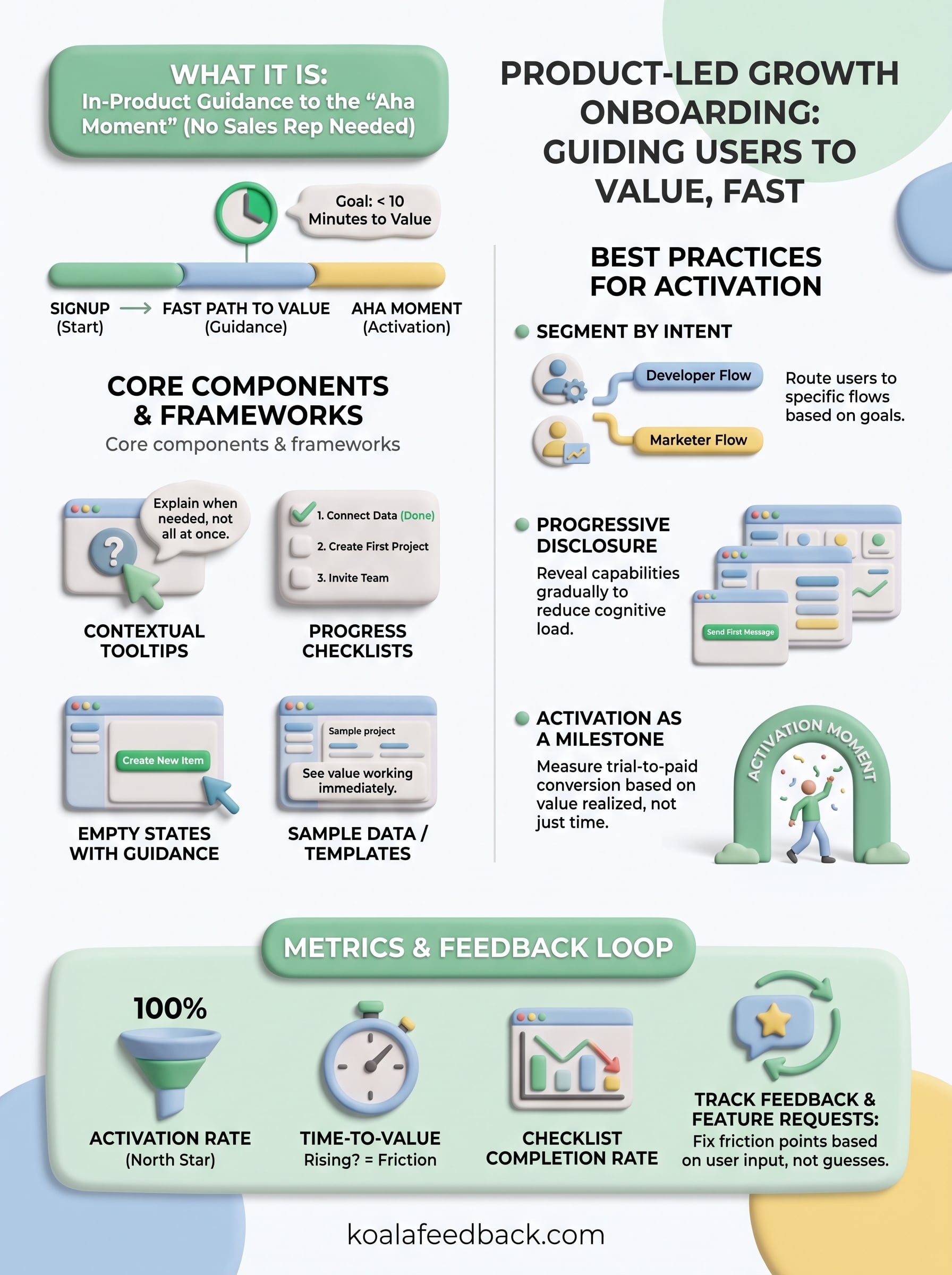
Good product-led growth onboarding isn't a one-time project you ship and forget. It's a loop: map the path to value, strip out friction, watch where users stall, and fix that one spot before moving to the next. The companies you looked at earlier didn't get their flows right on the first try, they kept adjusting based on what actual users told them and showed them through their behavior.
That's the part teams skip most often. Analytics tell you where people drop off, but only direct feedback and feature requests tell you why, and why is what you need to fix the right thing instead of guessing. Build that feedback loop alongside your onboarding flow from day one, not after it breaks.
If you want a simple way to collect that input and turn it into a prioritized list your team can act on, try Koala Feedback and see where your users actually get stuck.

Start today and have your feedback portal up and running in minutes.