Most product teams have been there: weeks of development poured into a feature that users didn't actually want. A product discovery sprint is designed to prevent exactly that, it's a structured, time-boxed process where teams validate assumptions about user problems and potential solutions before writing a single line of code.
Unlike traditional discovery work that can drag on indefinitely, a product discovery sprint compresses research, ideation, and validation into a focused burst of activity, typically one to two weeks. The goal is simple: reduce risk by learning fast. You talk to real users, prototype ideas, and test them quickly so you can move forward with confidence instead of guesswork. It's become a go-to framework for product managers and development teams who want to build things people actually need.
At Koala Feedback, we help teams collect and prioritize user feedback to inform exactly these kinds of decisions. A discovery sprint works best when you're already capturing real input from your users, votes, feature requests, pain points, and using that data as your starting point. This article breaks down what a product discovery sprint is, how it differs from a design sprint, the framework behind it, and the concrete steps to run one with your team.
Building products is expensive. Developer time, design resources, and opportunity cost all add up quickly, and that's before you factor in the cost of shipping something users don't find valuable. Running a product discovery sprint gives your team a structured way to answer the most important question in product development: are you solving the right problem? By front-loading that question into a focused sprint, you protect your team from spending months on work that misses the mark entirely.
Every assumption your team carries into development is a potential liability. If you believe users want a particular feature but haven't validated that belief with real evidence, you're building on a shaky foundation. A product discovery sprint forces your team to surface those assumptions early, when they're still cheap to test. Instead of discovering a flawed premise six months into development, you discover it in week one, before anyone has written a line of production code.
The cost of a wrong assumption caught during discovery is a conversation. The cost of the same assumption caught after launch is months of rework and a frustrated user base.
Finding out an idea doesn't work during a sprint is a win, not a setback. It means you've gathered real information that points you toward something better. Teams that run discovery sprints regularly start to treat each failed test as a learning opportunity rather than a verdict on their instincts, and that mindset shift makes every future sprint more productive.
One of the most overlooked benefits of a product discovery sprint is what it does to team alignment. When engineers, designers, and product managers all participate in discovery together, they develop a shared understanding of the problem they're solving. That shared understanding prevents the kind of miscommunication that leads to features being built in the wrong direction or scope creep that derails your timelines.
Alignment isn't just about agreeing on what to build. It's about agreeing on why it matters to your users. When your whole team hears directly from users during a discovery sprint, everyone internalizes the same feedback. That creates a stronger foundation for every decision that follows, from prioritization to implementation details, because no one is operating from a different version of the problem.
Discovery sprints work best when you already have a steady stream of user feedback to pull from. If you've been collecting feature requests, tracking pain points, or monitoring how users interact with your product, a sprint gives you a dedicated window to dig into that data and turn it into testable hypotheses. You stop guessing and start responding.
Starting from real user signals rather than internal assumptions means your sprint is grounded from day one. You're not brainstorming in a vacuum. You're responding to problems that actual users have already told you about, which dramatically increases the odds that your solution will land. Tools like Koala Feedback help teams centralize that input so when a sprint kicks off, the evidence is already organized and ready to act on. The teams that get the most out of discovery are the ones who treat ongoing feedback collection as the foundation that every sprint builds on.
A product discovery sprint is a time-boxed research and validation process that sits at the front of your product development cycle. Rather than treating discovery as a vague phase that bleeds into planning and build work, a sprint gives it a clear start, end, and a set of deliverables. You enter with a set of assumptions or problems worth exploring, and you exit with validated insights that tell you what to build, or just as importantly, what not to build.
At its core, a discovery sprint involves three overlapping activities: research, ideation, and validation. You start by understanding the problem space through user interviews, existing feedback, and behavioral data. You then generate candidate solutions through structured ideation sessions. Finally, you test those ideas with real users using lightweight prototypes or concept tests. These three activities don't always happen in strict sequence, but all three must occur for the sprint to produce reliable conclusions.
Unlike ad-hoc discovery work, a sprint operates within a defined timeframe, typically five to ten working days. That constraint is intentional. Time pressure forces your team to stay focused on the highest-priority questions instead of spiraling into endless research. It also makes the process repeatable, something you can schedule before any major feature investment rather than treating discovery as a one-off exercise.
A discovery sprint works best as a cross-functional effort. Product managers lead the process, but designers, engineers, and sometimes customer success or sales representatives all contribute. Each role brings a different lens to the problem, and those perspectives help you spot blind spots that a single discipline would miss. When engineers are in the room during discovery, they can flag technical constraints early before you've committed to a solution that isn't feasible to build.
The teams that get the most from a discovery sprint are the ones who treat it as a team sport, not a product manager's solo research project.
In terms of duration, one week is common for focused problems, while two weeks gives you room to run multiple rounds of user testing. The right length depends on how much you already know about the problem. If you're entering the sprint with strong existing user feedback already organized and accessible, you can move faster because you're not starting from zero on understanding what your users actually need.
People often use these two terms interchangeably, but they serve different purposes at different stages of your product development process. Understanding the distinction helps you pick the right tool for the right moment, rather than running the wrong sprint and wondering why you didn't get useful results.
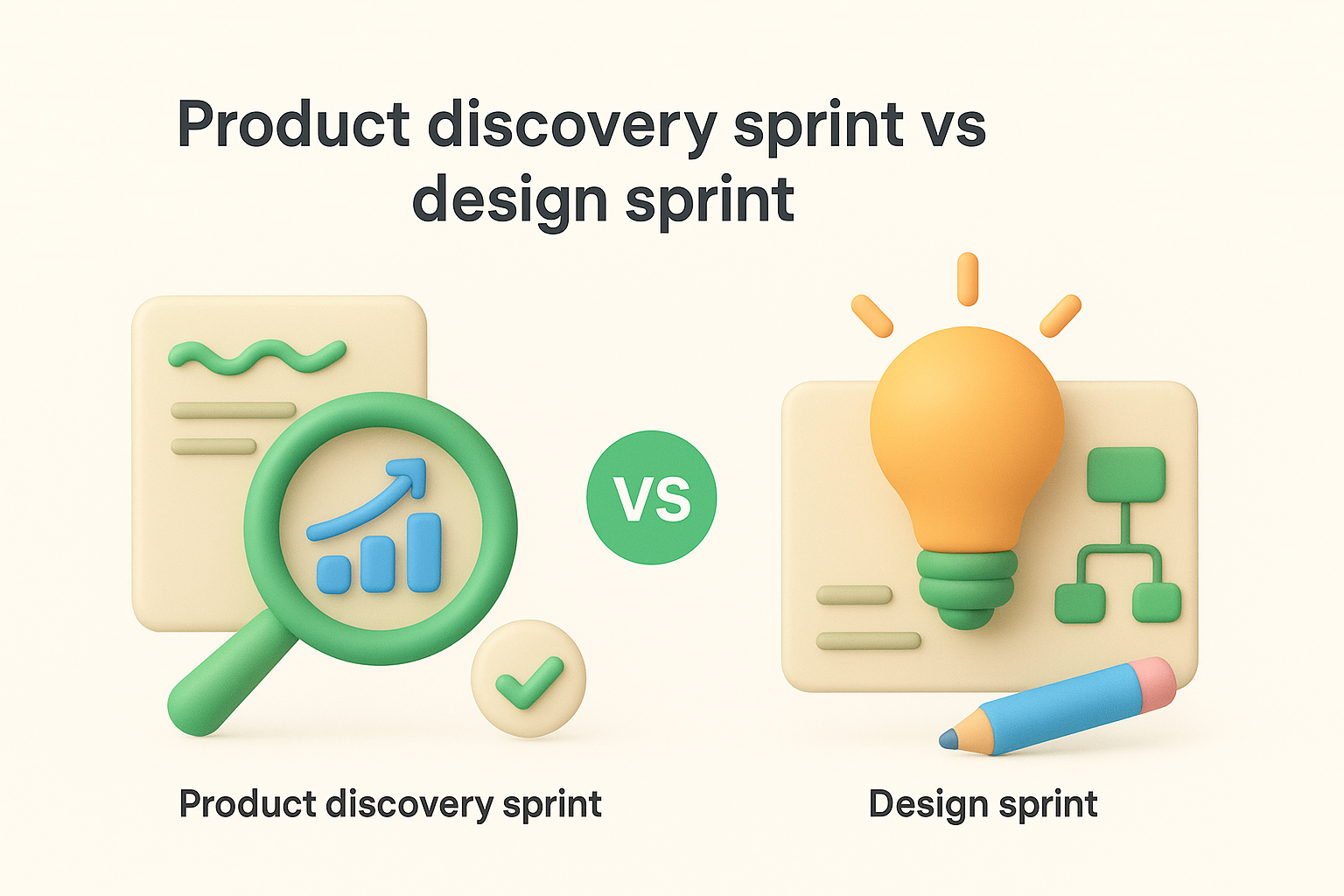
A product discovery sprint focuses on the problem space. Its primary output is validated insight: you're trying to confirm whether a problem is real, who it affects most, and whether your proposed direction is worth pursuing. A design sprint, popularized by Jake Knapp and the team at Google Ventures, focuses on the solution space. It assumes the problem is already understood and moves quickly into sketching, prototyping, and testing a specific solution concept with users. Both are time-boxed, both involve real users, but they answer fundamentally different questions.
Discovery asks "are we solving the right problem?" while a design sprint asks "are we solving it the right way?"
You run a product discovery sprint when you're facing uncertainty about the problem itself. Maybe you're seeing a spike in churn, you're entering a new market segment, or your user feedback is pointing at a pain point you don't fully understand yet. You need to investigate before you build anything. A design sprint, on the other hand, is the right choice when you already have confidence in the problem and want to explore and validate a specific solution rapidly before committing to full development. Running a design sprint too early, before you've validated the problem, is one of the most common ways teams waste a week of effort.
These two processes complement each other more than they compete. Discovery comes first and feeds design. The insights you gather during a product discovery sprint, user interviews, pattern analysis from feedback data, hypothesis testing, become the foundation that makes your design sprint sharper and more focused. When you walk into a design sprint with validated problem statements and clear user evidence, your team spends less time debating what matters and more time generating strong solution ideas. Teams that skip discovery and jump straight to design sprints often find themselves iterating on the wrong solution, no matter how well-executed the sprint itself was.
Most discovery work fails not because teams ask the wrong questions, but because they have no structure holding the process together. A product discovery sprint runs on a repeatable three-phase framework: define, research, and decide. Each phase has a clear purpose and a defined output, which means your team always knows what they're working toward and when they're done. That structure is what separates a productive sprint from an open-ended research project that never reaches a conclusion.
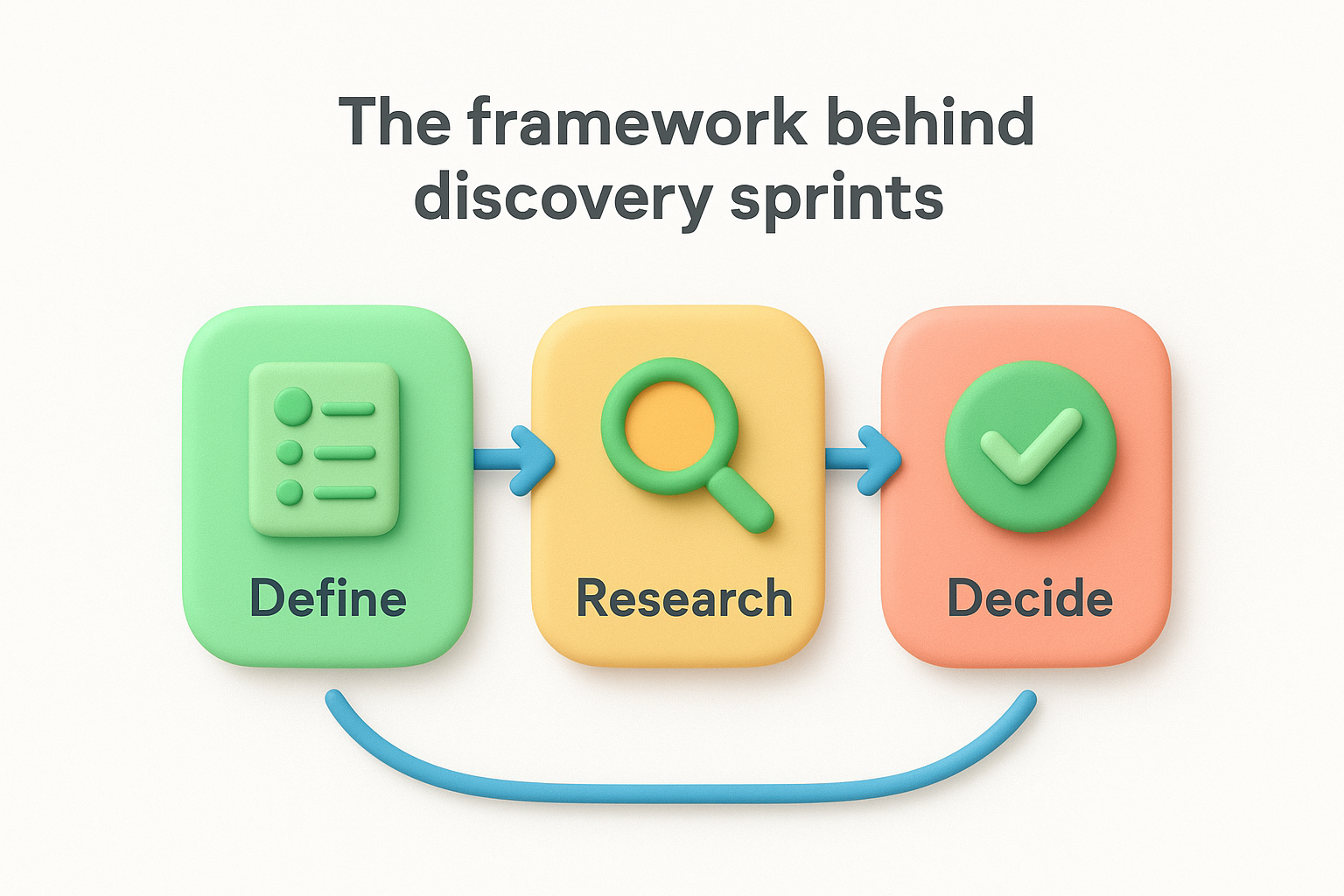
Before you talk to a single user or sketch a single idea, your team needs to align on what problem you're investigating and what assumptions you're carrying into the sprint. This phase is shorter than most teams expect, but it's the most important one. You're identifying the specific gap in your understanding and turning it into a testable question.
Start by listing every assumption your team is making about the problem. Who experiences it, how often, how much it affects them, and what they've already tried. Then rank those assumptions by risk: the ones that would most damage your solution if they turned out to be wrong go to the top of the list. Those high-risk assumptions become the focus of your research phase. This exercise also surfaces disagreements within the team early, before they become expensive mid-sprint conflicts.
The research phase is where you gather direct evidence from real users to test the assumptions you surfaced in phase one. This typically combines user interviews with existing data sources: behavioral analytics, support tickets, and organized feedback from your product portal. You're not looking for a large sample size. You're looking for clear patterns that either confirm or challenge your assumptions.
Five well-structured user interviews will surface more actionable insight than a survey sent to five hundred people who give you one-line answers.
After gathering input, synthesize your findings into clear statements. Group related observations, identify the patterns that appear across multiple users, and connect them back to your original assumption list.
The final phase is a decision point, not another research loop. Your team reviews the synthesized evidence and makes a call: which direction is worth pursuing, which assumptions need more investigation, and which ideas you can safely set aside. This phase produces a prioritized problem statement and a set of validated hypotheses that feed directly into the steps your team takes next.
Running a product discovery sprint effectively comes down to executing a clear sequence of activities without letting scope creep or indecision stall your momentum. Each step feeds into the next, so skipping or shortening one will weaken the reliability of everything that follows. The steps below reflect how high-functioning product teams actually run discovery, not a theoretical ideal that falls apart under real working conditions.
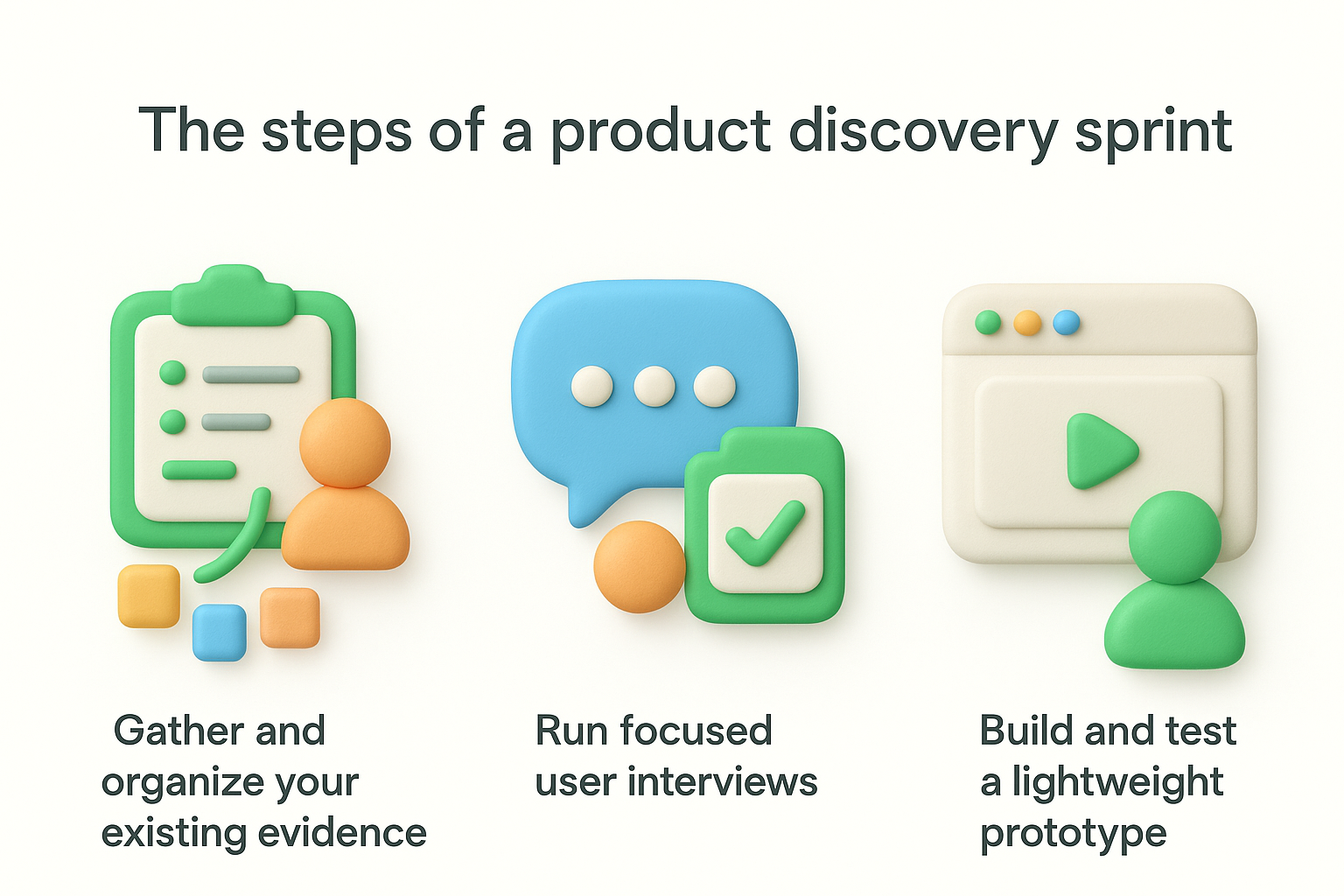
Before you schedule a single user interview, spend time pulling together what you already know. That means reviewing support tickets, analyzing behavioral data, and combing through your feedback portal for votes, comments, and recurring themes. You're looking for patterns that signal a real problem, not just noise. This step prevents you from wasting interview time asking users about issues you already have strong evidence for.
Organize what you find into clusters by problem theme rather than feature request. Users rarely describe solutions accurately, but they describe their frustrations with precision. Let those frustrations, not their proposed fixes, guide where you focus your sprint.
Your interviews should target users who represent the specific problem you're investigating, not a general cross-section of your user base. Prepare a discussion guide with five to eight open-ended questions that probe the problem from different angles. Avoid leading questions that confirm what you already believe.
The goal of each interview is to collect evidence, not to build consensus around your existing hypothesis.
Two to three interviews per day is a sustainable pace that gives your team time to debrief and refine your questions before the next session. Run at least five interviews before drawing conclusions. Patterns that appear across multiple conversations are worth acting on. Isolated complaints, however vivid, rarely justify major product investments.
Once your team has synthesized the interview data and formed a clear hypothesis, create the simplest possible representation of your proposed solution. That might be a clickable wireframe, a static mockup, or even a written concept description. The format matters less than getting it in front of real users quickly.
Put your prototype in front of three to five users and watch how they interact with it. You're not measuring polish or visual design. You're testing whether your proposed solution actually addresses the problem they told you they had. Capture observations in real time and debrief as a team within the same day.
By the time your product discovery sprint wraps up, you should have more than notes and observations. You should have a concrete set of outputs that your team can act on immediately. If you finish a sprint and aren't sure what to do next, that's a sign the sprint lacked enough structure in its final phase. A well-run sprint ends with clarity, not more open questions.
Your most important deliverable is a clear, evidence-backed problem statement that your whole team agrees on. This is not a solution description, and it's not a feature request. It's a precise articulation of who experiences the problem, what triggers it, and why your current product doesn't resolve it. Every word in that statement should be traceable back to something a real user told you or a pattern you observed in your data.
A validated problem statement does more to align a product team than any strategy document you could write.
Write it in plain language that a new team member could read and immediately understand. Avoid technical framing or internal jargon that obscures what you actually learned. The more concrete and specific the statement, the more useful it becomes when you move into solution design.
Beyond the problem statement, you should leave the sprint with two to four testable hypotheses ranked by confidence and potential impact. Each hypothesis should follow a simple structure: if you build or change X, users who experience Y problem will be able to achieve Z outcome. That format keeps your hypotheses actionable and falsifiable, which makes them far easier to carry into a design sprint or development planning session.
Rank your hypotheses honestly. The one with the strongest supporting evidence and the highest user impact goes first. Set aside any hypotheses your research didn't support, but keep a record of why you ruled them out. That reasoning becomes useful context when similar ideas surface in future cycles.
Your sprint output should include an explicit recommendation for what happens after discovery ends. That might mean moving into a design sprint to prototype your top hypothesis, scheduling a second discovery sprint to investigate an area you didn't have time to explore, or deciding that the problem doesn't warrant further investment right now. All three are valid conclusions, but your team needs to leave the sprint having made that call, not carry the ambiguity into your next planning cycle.
Even teams that understand the value of a product discovery sprint fall into predictable traps that undermine the quality of their output. Most of these mistakes don't happen because people are careless. They happen because time pressure and existing assumptions push teams toward shortcuts that feel efficient in the moment but produce unreliable conclusions. Knowing where discovery commonly breaks down is the fastest way to keep your own sprint on track.
The quality of your sprint depends almost entirely on who you talk to during research. Teams frequently interview users who are easiest to reach, loyal customers, internal employees, or people who already love the product, rather than the users who actually experience the problem you're investigating. Convenient sample selection produces biased data that confirms what your team already believes instead of surfacing what you genuinely need to learn.
Fix this by defining your target participant profile before you schedule a single interview. Be specific about which user segment experiences the problem most acutely and recruit from that group deliberately, even if it takes extra time to find them. The extra effort in recruitment pays back immediately in the quality of what you hear.
Many teams collect strong interview data and then fail to extract the signal from it. They move directly from raw notes to feature decisions without taking the time to identify patterns across conversations and connect them back to their original assumptions. That gap between data and insight is where most discovery work breaks down, and it's almost always caused by a compressed timeline and no dedicated synthesis block.
Synthesis is not optional. It is the step where your data becomes a decision.
Block time for synthesis explicitly before your team makes any calls about direction. Group observations by theme, map them to your assumption list, and agree on what the evidence actually supports before anyone pitches a solution. Treating synthesis as its own protected activity rather than something you do informally during a debrief produces far sharper outputs.
Some teams run a single discovery session and then operate on those findings for the next year. Markets shift, user needs evolve, and the assumptions that were valid six months ago may no longer hold. Treating discovery as something you do once per product cycle means you're building on outdated evidence without realizing it.
Build regular discovery rhythms into your team's calendar, even short ones. Combining brief quarterly check-ins with ongoing feedback collection through your product portal keeps your understanding current and ensures your next sprint always starts from fresh, reliable ground.
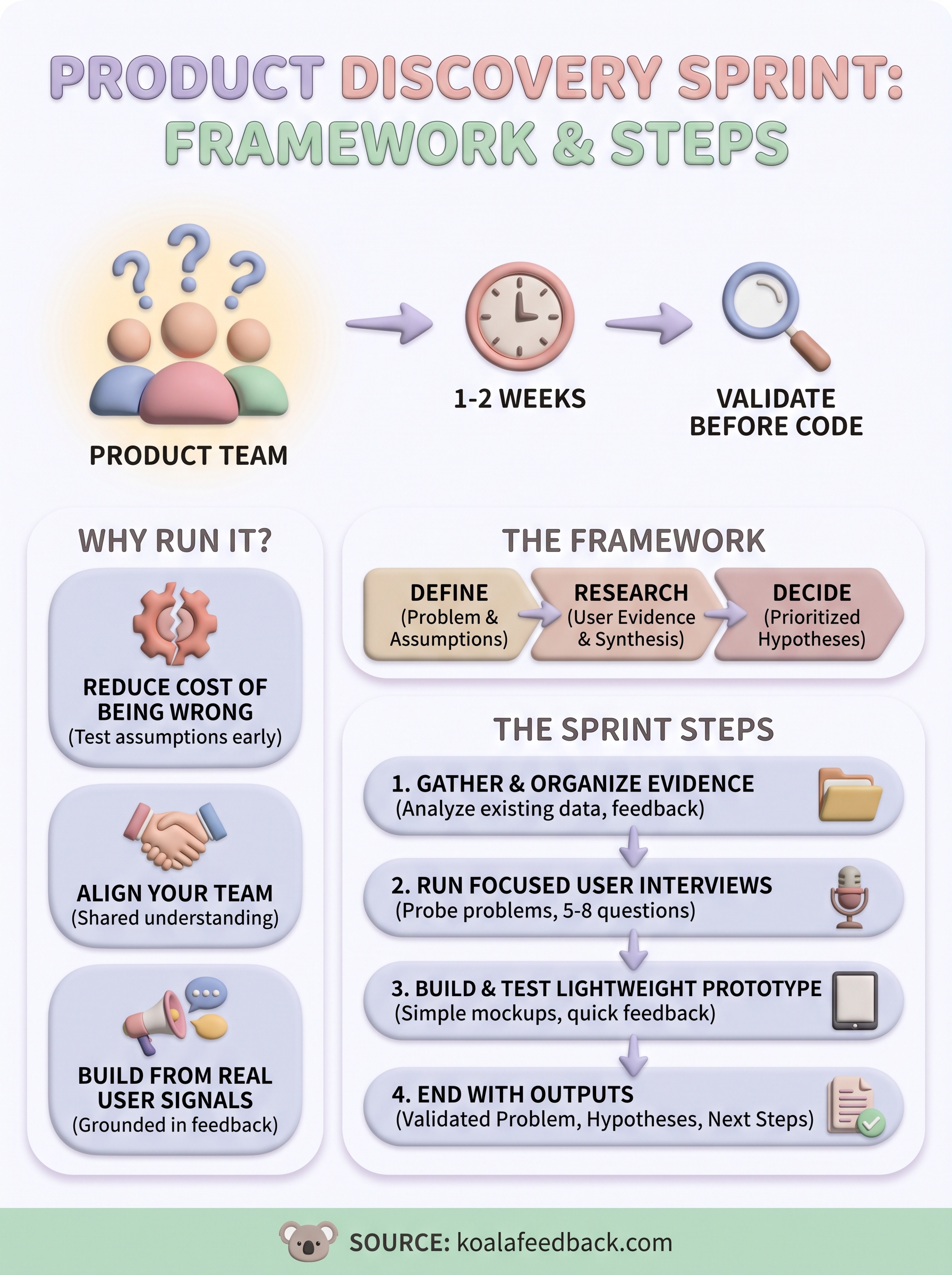
A product discovery sprint gives your team a repeatable way to learn fast, reduce risk, and build from real user evidence instead of internal assumptions. You now have the framework, the step-by-step process, and a clear picture of what strong output looks like when a sprint is done well. The most important move now is to run one, not to refine the process endlessly before you start.
Start by auditing the user feedback you already have. Look for recurring themes, high-vote feature requests, and unresolved pain points that signal a problem worth investigating. That existing evidence is your sprint's starting point. If your feedback is scattered across emails, spreadsheets, and support threads, centralizing it first will save you significant time when your sprint kicks off. Koala Feedback helps you collect, organize, and prioritize exactly that kind of input so your next discovery sprint starts from a solid foundation.

Start today and have your feedback portal up and running in minutes.