Every product team faces the same tension: figuring out what to build versus actually building it. That tension sits at the heart of product discovery vs product delivery, two distinct phases that serve different purposes but need to work together. When teams blur the line between them, or skip one entirely, they end up shipping features nobody asked for or endlessly researching without releasing anything.
Discovery answers the question "Are we building the right thing?" Delivery answers "Are we building it right?" Both matter. But the goals, outputs, and risks look completely different for each. Understanding those differences is what separates teams that build products users love from teams that just stay busy. This is also where tools like Koala Feedback fit in, collecting and prioritizing real user feedback gives your discovery process actual signal instead of guesswork.
This article breaks down what product discovery and product delivery each involve, where they overlap, where they diverge, and how to balance both phases so your team ships work that actually moves the needle. We'll cover goals, key outputs, common risks, and practical ways to keep both sides aligned.
Most product failures don't happen because teams build things poorly. They happen because teams build the wrong things entirely. The product discovery vs product delivery distinction exists to protect you from that outcome. When you understand what each phase is trying to accomplish, you can direct your team's energy at the right problem at the right time instead of bouncing between them without intention.
Treating these two phases as interchangeable creates confusion at every level. Developers get pulled into research meetings that belong to strategists, and product managers start making shipping commitments before validating whether a feature solves a real problem. Each phase has its own success criteria, tools, and risk profile, and mixing them up means neither gets done well.
Skipping discovery feels fast. Your team has a feature idea, stakeholders are excited, and starting to build feels like progress. But shipping a feature users don't want isn't progress; it's wasted capacity. Teams that skip discovery consistently end up building a product shaped by internal assumptions, not actual user behavior. You see this pattern in SaaS products where a team ships a complex settings panel that 90% of users never open. A proper discovery phase would have surfaced that misalignment before a single line of code was written, saving weeks of engineering time.
The output of skipping discovery isn't speed - it's a growing backlog of features nobody uses.
The opposite failure is equally damaging. Some teams stay in discovery mode indefinitely, conducting user interviews, running surveys, and refining problem statements without ever committing to building anything. This creates a different kind of waste: research becomes stale, user needs shift, and competitors ship while you're still validating.
Delivery discipline forces your team to make real decisions. It requires you to scope, prioritize, and commit, which is uncomfortable but necessary. Without a clear boundary between exploring problems and solving them, discovery becomes a way to avoid accountability rather than reduce risk. Your insights only create value when they connect to something your team actually ships.
Both failure modes carry measurable business costs. Skipping discovery inflates your engineering spend on low-impact work and erodes user trust when the product repeatedly misses what people actually need. Skipping delivery turns your product team into a research unit that never produces outcomes. Neither is sustainable. The tension between these two phases isn't something to eliminate; it's something to manage deliberately, and that starts with understanding what each phase is genuinely responsible for producing.
Product discovery is the phase where your team validates problems before committing resources to solutions. Its core purpose is to reduce risk by confirming that a real problem exists, that users care about solving it, and that your proposed solution is worth building. Discovery is not about generating ideas; it is about testing assumptions so that the work you hand off to delivery is grounded in evidence, not hope.
Discovery produces decisions, not features. The tangible outputs include validated problem statements, user research findings, prioritized opportunity areas, and go or no-go decisions on potential solutions. These outputs give your delivery team a clear brief: a defined problem, a targeted user segment, and evidence that building a solution will create real value. Without these outputs, delivery starts on shaky ground and usually has to backtrack.
Discovery doesn't slow down delivery. It removes the work that was never worth doing in the first place.
The inputs that feed discovery come directly from user behavior and feedback. In the context of product discovery vs product delivery, tools that centralize user feedback, like voting boards and feature request portals, give your team concrete signal about where users feel friction. That signal replaces guesswork with observable patterns you can validate through interviews or usability tests before any build begins.
Building without discovery exposes your team to two major risks. The first is solution bias, where teams fall in love with an idea before confirming it solves a real problem. The second is misaligned prioritization, where the loudest internal voice decides what gets built rather than actual user demand. Discovery creates a structured gate that forces your team to answer the hard questions before engineering time is on the line.
Product delivery is where your team converts validated decisions into working software. While discovery focuses on reducing risk through research and testing, delivery focuses on executing with speed, quality, and predictability. Its purpose is to ship a defined solution reliably, on a timeline your stakeholders and users can count on.
Delivery produces working software and measurable outcomes. The outputs include shipped features, resolved bugs, completed integrations, and performance improvements that users can see and use. In the context of product discovery vs product delivery, this is where your team's decisions become real. Every sprint, release, and deployment is a concrete artifact that moves your product forward. Delivery teams measure success through release cadence, bug rates, and whether shipped features actually get used once they land in production.
Delivery without discovery produces activity. Delivery after discovery produces outcomes.
Your delivery team faces its own distinct risks that are entirely separate from anything discovery handles. Scope creep is the most common, where requirements expand mid-sprint because stakeholders add requests that were never validated. This fragments your team's focus and stretches timelines without proportional gains in value. A second risk is shipping work that technically meets the spec but misses the user experience entirely, which happens when delivery teams receive vague briefs from a weak discovery phase.
Managing these risks requires clear scope documentation, defined acceptance criteria, and a direct feedback loop back to your product team once something ships. You need to know whether what you built actually solves the problem discovery identified. Without that loop, delivery becomes a one-way street where features go out the door and no one measures whether they actually landed.
Many teams assume discovery must be complete before delivery begins, but that's rarely how it works in practice. In mature product teams, discovery and delivery run as parallel tracks, where one team validates tomorrow's work while another ships today's. This structure keeps your pipeline moving without forcing you to choose between learning and building.
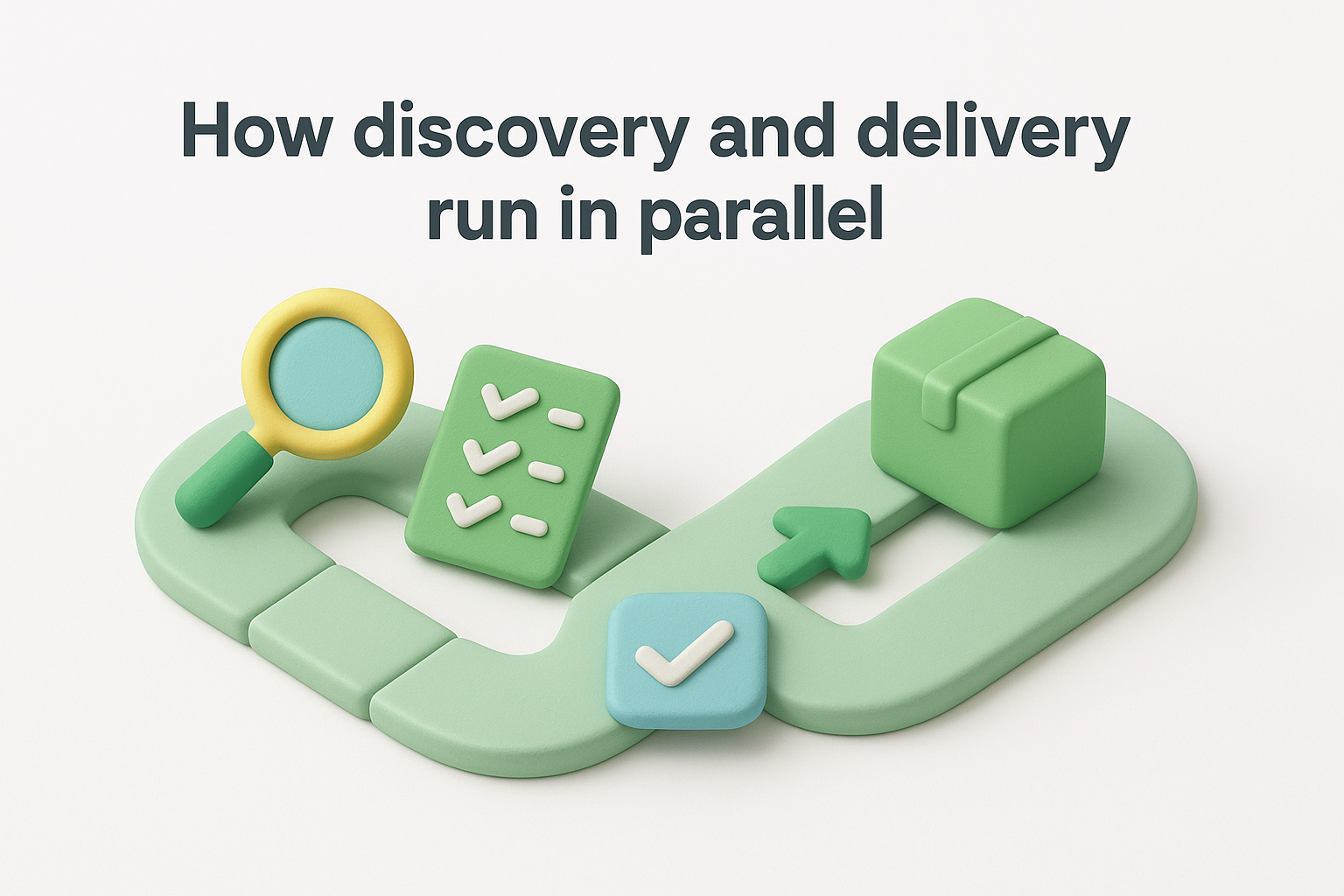
The parallel model separates your team's attention by time horizon. Delivery focuses on the current sprint, executing against a brief that discovery already validated. Meanwhile, discovery looks ahead several weeks, researching the problems that will feed the next round of development. You're never waiting on research to start building, and you're never building before you've validated the next set of decisions.
When discovery and delivery run in parallel, your team is always learning and always shipping at the same time.
The handoff between tracks is the most critical point in the product discovery vs product delivery relationship. Discovery outputs a validated problem brief and hands it to delivery before a sprint begins. Delivery then ships the solution and passes real usage data back to discovery, which uses that data to inform its next round of validation. This creates a feedback loop that tightens with every release cycle.
Your roadmap is where both tracks stay visible to the rest of your organization. Planned items represent validated discovery outputs, while in-progress items show what delivery is actively building. Keeping both visible in one place prevents stakeholders from pushing unvalidated work into active development and gives your team a shared reference point for what has been validated, what is being built, and what is still being explored.
Balancing product discovery vs product delivery comes down to giving each phase the right inputs at the right time. Feedback and roadmaps are the two tools that make this work in practice. Feedback fuels discovery with real signal, while your roadmap keeps delivery aligned with what has already been validated and what stakeholders can expect.
Centralized user feedback gives your discovery process a starting point grounded in actual user behavior. When users submit feature requests, vote on ideas, or flag friction points, those signals tell your team where real problems exist before anyone writes a spec. This removes the guesswork that makes discovery slow and unreliable. Instead of scheduling interviews to find problems, you already know where users struggle, and your discovery work can focus on validating solutions rather than searching for questions.
Feedback is only useful in discovery if it's organized well enough to reveal patterns, not just noise.
Collecting feedback in a structured way also prevents the loudest stakeholder from driving your roadmap. When you can point to fifty users requesting the same capability, the prioritization conversation shifts from opinion to evidence.
Your roadmap communicates what discovery has validated and what delivery is committed to building. It creates a shared reference point that keeps both tracks honest. Items that land on your roadmap should have passed through discovery, which means your delivery team starts each sprint with a clear problem brief instead of an ambiguous request. Publishing your roadmap to users also closes the loop, showing them that their feedback influenced real decisions and that something is actively being built. That transparency builds trust and encourages continued input, which feeds your next discovery cycle.
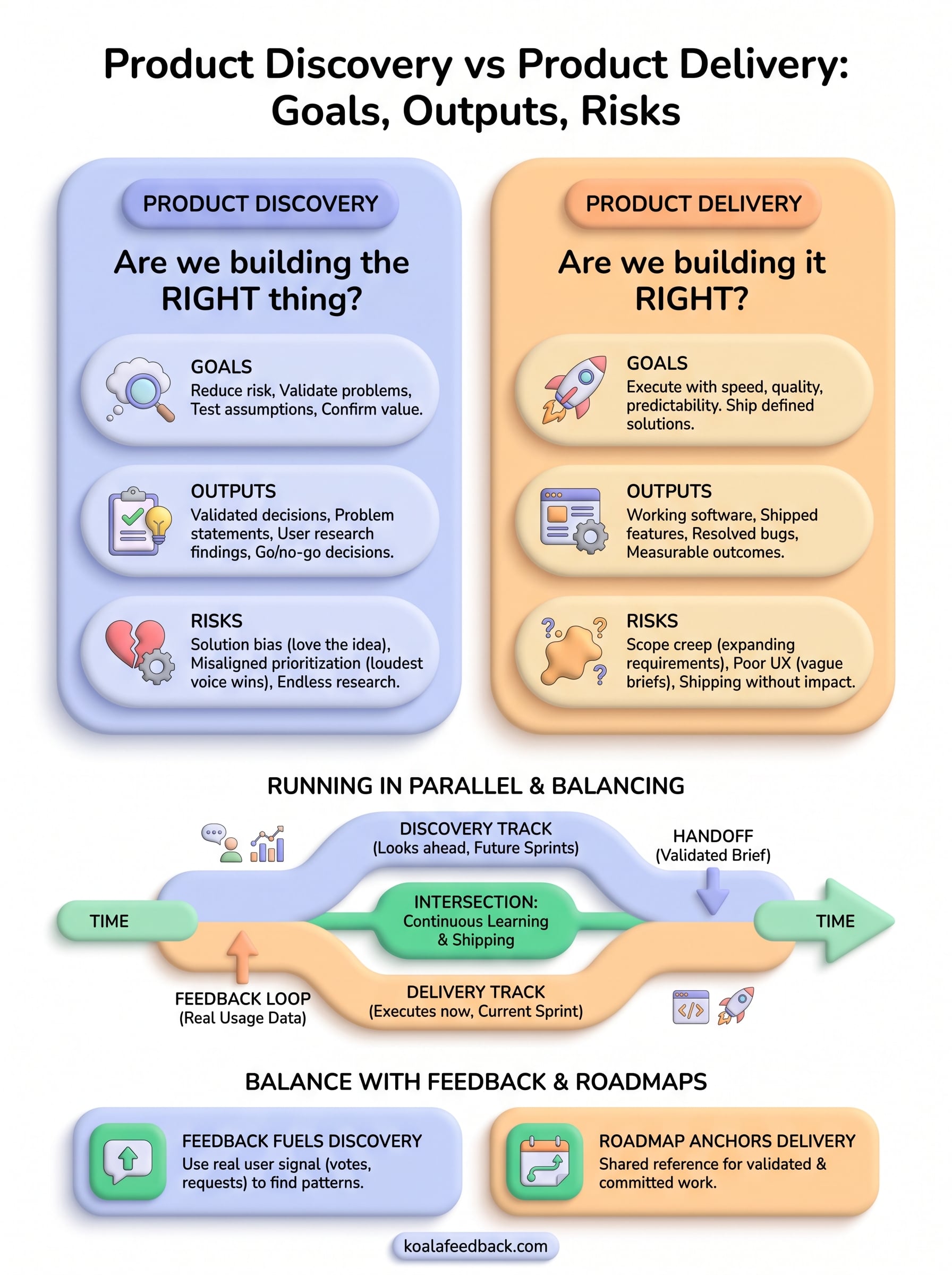
The core insight behind product discovery vs product delivery is simple: two phases, two jobs, one shared goal. Discovery finds the right problems. Delivery builds the right solutions. When each phase has clear inputs, defined outputs, and a feedback loop connecting them, your team stops wasting cycles on work that never moves the needle.
Start by auditing where your current process breaks down. If your team ships features that don't get used, your discovery phase needs stronger signal. If your backlog is full of unvalidated ideas, your delivery track lacks a proper brief. Either way, centralized feedback and a transparent roadmap are the two levers that bring both phases into alignment.
If you want to give your discovery process a foundation built on real user input rather than assumptions, start collecting and prioritizing user feedback with Koala Feedback. Your next roadmap decision should come from your users, not a gut feeling.

Start today and have your feedback portal up and running in minutes.