Most product teams don't fail because they can't build things. They fail because they build the wrong things. That gap between what you assume users want and what they actually need is exactly where product discovery meaning becomes critical to understand.
Product discovery is the practice of figuring out what to build before you commit resources to building it. It sits at the front end of the product management lifecycle, and when done well, it eliminates wasted sprints, misaligned roadmaps, and features nobody asked for. When skipped or rushed, it's the root cause of products that launch to silence.
At Koala Feedback, we build tools that help teams collect and prioritize real user feedback, which is one of the core inputs that makes product discovery actually work. We see firsthand how teams that ground their discovery process in user evidence ship better products, faster.
This article breaks down what product discovery really means, walks through the process step by step, and covers the frameworks and techniques you can use to validate ideas before a single line of code gets written. Whether you're a product manager at a startup or leading development at a growing SaaS company, you'll walk away with a clear, practical understanding of how discovery fits into your workflow.
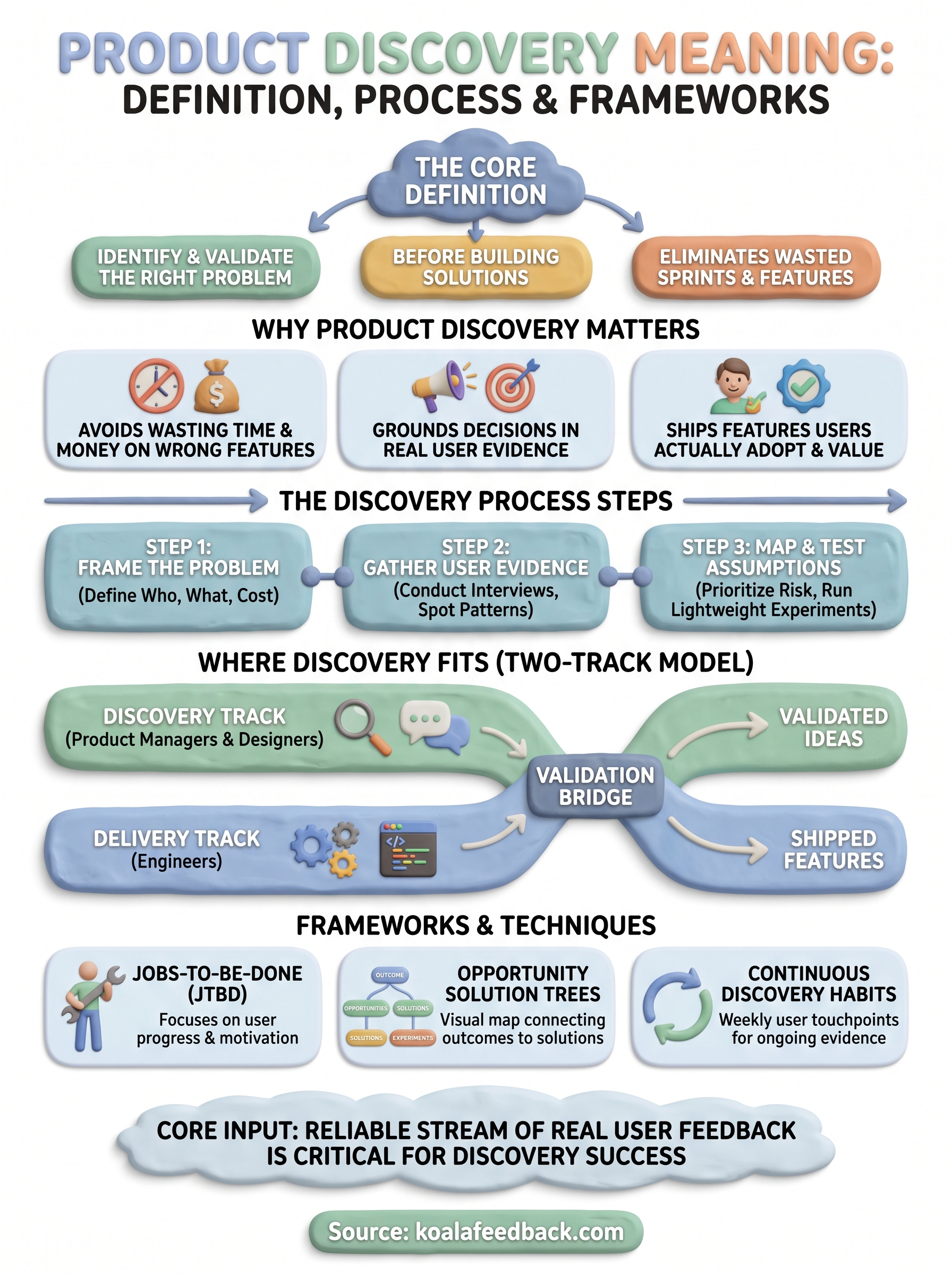
At its core, product discovery is the structured process of identifying and validating the right problem to solve before your team spends any time or money on a solution. It answers three fundamental questions: Is this problem real? Do enough people have it? And will the solution you are considering actually fix it? Getting clear, evidence-backed answers to those questions is what the product discovery meaning is really about in practice.
Product discovery is not about generating ideas. It is about testing assumptions until you have enough evidence to act confidently.
Product discovery sits in the front end of the product development lifecycle, before the design phase and well before any engineering work begins. Think of it as the research and validation stage where your team collects evidence, talks to users, maps out pain points, and stress-tests assumptions. The output is not a finished feature. It is a well-supported decision about whether a problem is worth solving and which direction your solution should take.
A practical example: a SaaS team notices users are churning after 30 days. The initial assumption might be that the onboarding flow is confusing. Before rebuilding onboarding from scratch, discovery work would involve user interviews, session recordings, and support ticket analysis to confirm whether onboarding is actually the driver of churn or whether something else is responsible. That validation process is discovery, and it determines whether the team builds the right fix or wastes a sprint on the wrong one.
Discovery is not a single meeting or a one-time brainstorm. It is an ongoing, repeatable set of activities that your team runs at the beginning of any significant initiative, and sometimes throughout one. These activities typically fall into five categories:
Each of these activities builds on the last. You frame the problem, research it, surface your assumptions, explore solutions, and then validate before you commit resources.
Running discovery as a one-time kickoff event at the start of a project puts you in the same trap as teams that skip it entirely: building based on assumptions that were never properly tested. Markets shift, user needs evolve, and feedback you collected six months ago may not reflect what users need today. The better model is to treat discovery as a continuous track that runs alongside delivery, where product managers and designers validate the next set of features while engineers build the ones already confirmed.
This two-track approach keeps your development pipeline moving without letting delivery outpace validation. While your engineering team ships a validated feature, your product team is doing discovery work on what comes next. That separation of concerns is what prevents reactive roadmaps and ensures every item your team picks up has already cleared a basic evidence threshold. Teams that maintain this discipline consistently ship features that users actually adopt, rather than features that looked reasonable on a whiteboard but missed the mark entirely.
Understanding the product discovery meaning goes beyond a textbook definition. The practical reason discovery matters is straightforward: building software is expensive, and building the wrong software costs more than not building at all. Every sprint your team spends on a feature users won't adopt is time, money, and momentum you cannot recover.
When teams skip discovery, they default to building based on internal assumptions rather than user evidence. Stakeholders push for features that feel important, engineers solve for problems they personally encounter, and product managers guess at what the market wants. The result is a roadmap full of features that made sense in a planning meeting but land flat in production.
Research consistently shows that a significant portion of features shipped by software teams go largely unused. That is not a build quality problem. It is a discovery problem. Teams that validate before they build avoid this trap because they only commit to work that has confirmed demand from real users.
Skipping discovery does not save time. It moves the wasted effort from the research phase to the build phase, where mistakes cost far more to fix.
Discovery gives your team a shared, evidence-based foundation for every decision you make. Instead of arguing about which feature to prioritize in a planning session, you bring data: user interview themes, feedback vote counts, and validated assumptions. That evidence replaces opinion with facts your whole team can align around, which speeds up decisions and reduces internal friction.
Your roadmap also becomes more defensible to stakeholders when it is grounded in discovery. You can explain why a particular feature is prioritized by pointing to specific user pain points and supporting evidence rather than gut instinct. That transparency builds trust with leadership and with users, especially when you communicate your roadmap publicly and invite users to see how their feedback shaped your decisions.
Catching a wrong assumption during a 30-minute user interview costs nothing. Catching it after a two-week sprint means writing off the entire effort and starting over. Discovery compresses that feedback loop so your team identifies misalignments while changes are still cheap, not after engineering has already committed hours to building the wrong solution. That is the concrete business case for investing in discovery before a single line of code gets written.
Three terms get mixed up constantly in product conversations: discovery, delivery, and research. Understanding where each one starts and stops helps you apply the right activity at the right time. If you blur the lines between them, you either skip validation entirely or you stall a project with endless research that never converts into a decision.
Discovery is about figuring out what to build. Delivery is about building it. Those two activities require different mindsets, different tools, and different success metrics. Discovery is exploratory by design. You are testing assumptions, talking to users, and narrowing down options. Delivery is execution-focused. Your team is writing code, running quality checks, and shipping increments against a confirmed plan.
The key distinction is that discovery carries intentional uncertainty. You start without knowing the right answer, and the goal is to reduce that uncertainty enough to justify committing engineering resources. Delivery, by contrast, operates on confirmed direction. When something moves from discovery into your delivery pipeline, it should already have a validated problem statement and enough evidence that the proposed solution is worth building.
Running discovery and delivery as a two-track model keeps your pipeline healthy: engineers build what is already validated while product teams validate what comes next.
Discovery and research overlap, but they are not the same thing. User research is one of the inputs that feeds discovery. It includes activities like interviews, surveys, usability tests, and behavioral analysis. Discovery is the broader process that uses those research outputs to form decisions.
You can run a round of user interviews and still have no clear discovery outcome if you never translate those findings into a validated direction. Research gives you raw evidence. Discovery turns that evidence into a specific, defensible choice about what problem to solve and which solution direction to pursue. That translation step is where most of the product discovery meaning lives in practice.
Think of research as the data-gathering layer and discovery as the decision-making layer built on top of it. Both matter, but confusing them leads to teams that conduct thorough research and still end up building the wrong thing because they never closed the loop with validation. Your discovery process should have a clear end state: a confirmed problem, a tested solution concept, and a justified go or no-go decision your team can move on.
Running discovery is not a vague, open-ended exercise. It follows a repeatable sequence that moves your team from a fuzzy problem area to a justified build decision, and each step builds directly on the one before it. Understanding this sequence is where the product discovery meaning stops being theoretical and starts becoming something you can apply to your next initiative right now.
Every discovery effort starts with a written problem statement, not a feature idea. Define who is experiencing the issue, in what context, and what the consequence is when it goes unresolved. A precise problem statement keeps your research focused and prevents your team from jumping into solution mode before you have gathered any evidence.
A strong problem statement answers three specific questions:
Once you have a problem statement, conduct user interviews with five to ten people who represent the affected segment. Ask about their current behavior, what they already do to work around the problem, and how frequently it comes up. Your goal at this stage is not to confirm your assumptions. Your goal is to collect unfiltered evidence about how users actually experience the situation before you form any conclusions about the fix.
The most common discovery mistake is interviewing users with leading questions that confirm what your team already believes rather than challenging it.
After your interviews, analyze the responses for recurring themes and patterns. Look for problems that multiple users describe in similar terms, workarounds that signal a real unmet need, and friction points that users mention without prompting. Those unprompted moments are your most reliable signal.
List every assumption your proposed solution depends on, then rank each one by how likely it is to be wrong and how costly it would be if it were. Design lightweight experiments to test the highest-risk items before writing any production code. This might mean a clickable prototype, a short survey, or a structured concept walkthrough with real users. When your riskiest assumptions clear that validation threshold, you have enough evidence to move the initiative into your delivery pipeline with confidence.
Knowing the product discovery meaning is one thing. Applying it consistently is another. The right framework gives your team a repeatable structure so discovery does not collapse into ad-hoc conversations or gut-feel decisions. These three frameworks are widely used by product teams, and each one addresses a different layer of the discovery problem.
Jobs-to-be-Done (JTBD) is a framework built around one core idea: users hire products to accomplish a specific job, not just to use a feature set. Instead of asking what users want, you ask what progress they are trying to make in a given situation. This shift in framing produces sharper problem statements because it grounds your discovery work in user motivation rather than surface-level behavior.
When you apply JTBD in interviews, you ask users to walk you through the moment they decided to look for a solution, what they tried before, and what prompted the switch. Those stories reveal the real underlying job your product needs to do, which is often different from what your team originally assumed.
An Opportunity Solution Tree helps you see the full landscape of possible solutions before you commit to any single one.
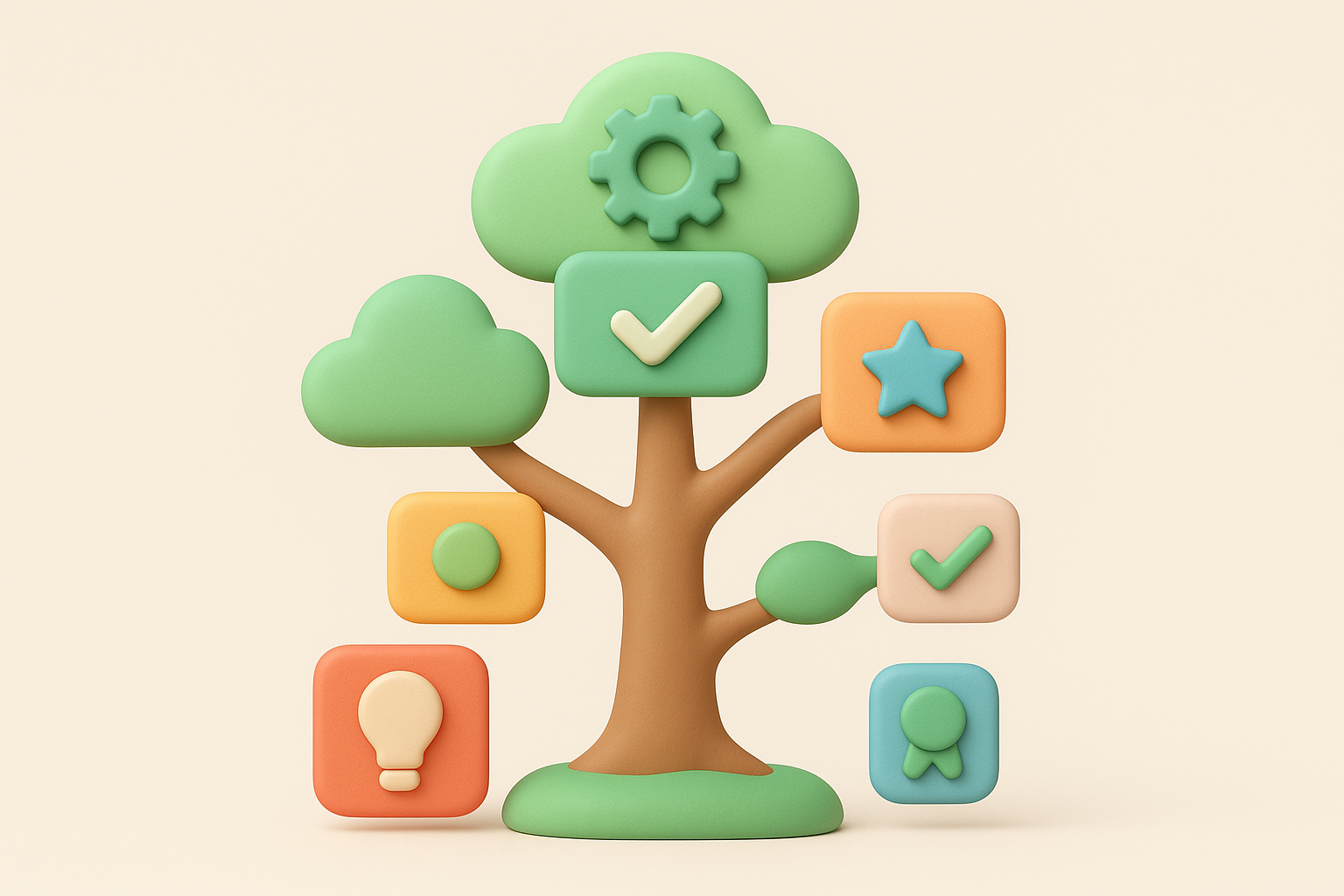
Opportunity Solution Trees give your team a visual map that connects a desired outcome to specific user pain points, solution ideas, and experiments. You start with a measurable outcome at the top, identify the obstacles standing between users and that outcome, branch out into potential solutions, and then attach lightweight validation experiments to your riskiest solution ideas.
The structure forces your team to separate problems from solutions and prevents you from anchoring too early on a single approach. It also makes your discovery thinking visible to stakeholders, which builds alignment before any engineering work begins.
Rather than treating discovery as a one-time project phase, Continuous Discovery turns weekly user touchpoints into a core team habit. Your product trio, typically a product manager, designer, and tech lead, conducts at least one short user interview per week, synthesizes findings in real time, and feeds insights directly into your current Opportunity Solution Tree.
This cadence keeps your evidence current and actionable rather than stale. You build a living picture of user needs instead of relying on a research report that loses relevance within months, and your delivery pipeline stays grounded in validated decisions rather than assumptions that drifted out of date before anyone noticed.
Now that you understand the product discovery meaning in full, the next move is putting it into practice. Start small: pick one active initiative on your roadmap and run the three steps covered in this article. Frame the problem, interview five users, and map your riskiest assumptions before writing a single line of code. You do not need a formal program in place before you begin. A single well-run discovery cycle builds the habit and shows your team the concrete value of validating before building.
Building that habit requires one critical input above all else: a reliable, ongoing stream of user feedback flowing into your process. Without it, your discovery work stalls at assumption mapping and never reaches genuine validation. Koala Feedback gives your team a centralized place to collect, organize, and prioritize real user input so your discovery efforts always start with evidence from the people who actually use your product, not internal guesswork.

Start today and have your feedback portal up and running in minutes.