Running product discovery without a structured approach is like trying to organize user feedback in a spreadsheet, it technically works, but you'll waste hours and miss critical patterns. Product discovery templates solve this by giving you a repeatable framework to define problems, validate assumptions, and decide what to build next. Instead of reinventing the process every time, you start with a proven structure and adapt it to your team's context.
The challenge most product managers and founders face isn't a lack of ideas, it's figuring out which ideas actually matter to users. That's where templates become practical tools rather than busywork. They help you move from scattered conversations and gut feelings to a clear, evidence-based process. And when you pair them with a tool like Koala Feedback to capture and prioritize real user input, discovery becomes less about guessing and more about listening.
This article covers 10 ready-to-use frameworks for every stage of product discovery, from problem definition to idea validation. Each template is designed to be grabbed, filled in, and put to work, whether you're a solo PM at a startup or part of a larger product team. Pick the ones that fit your workflow, skip the ones that don't, and start building what your users actually need.
Starting discovery from scratch every sprint forces your team to solve two problems at once: the structure of the process AND the substance of the problem. Product discovery templates eliminate the first problem entirely. Instead of debating which questions to ask or how to format findings, your team can put all its energy into the actual work of understanding users and validating ideas. That shift alone saves hours per discovery cycle.
When you open a blank document, every decision requires mental effort: what to include, how to structure it, what matters most. Templates pre-answer those questions. A well-designed template acts as a checklist and a thinking tool simultaneously, guiding you through the right questions in the right order without requiring you to remember them from scratch.
The best templates don't constrain your thinking; they focus it so you stop second-guessing the process and start learning from users.
Teams that skip structured frameworks often end up circling the same assumptions without realizing it. A template surfaces blind spots you didn't know you had by asking questions you might otherwise skip. Over time, using consistent frameworks also builds a library of past discovery work that's actually searchable and comparable, instead of a graveyard of inconsistent notes.
One of the most underrated benefits of using structured discovery frameworks is that they give your whole team the same vocabulary. When a PM, a designer, and an engineer all work from the same template, they're answering the same questions and organizing information the same way. That alignment reduces misunderstandings in sprint planning, stakeholder reviews, and customer interviews.
Consistency also makes onboarding faster. A new product manager who joins your team can pick up any past discovery doc and immediately understand the format, the logic, and the decisions that shaped it. You build institutional knowledge that transfers, rather than tribal knowledge that walks out the door when someone leaves.
Not every template fits every moment in the product cycle. Picking the wrong one wastes time and produces outputs your team can't act on. The key is to match the product discovery templates you use to the specific question you're trying to answer right now, not the question you'll face next sprint.
Before grabbing a template, identify what you don't know. If you can't clearly define the problem, start with a problem statement or Jobs-to-Be-Done framework. If you've defined the problem but haven't validated your solution approach, jump to an assumptions map or a Value Proposition Canvas. Using the right framework for the right question keeps your discovery work focused and actionable instead of producing documents nobody reads.
The stage you're in should drive the template you pick, not the other way around.
Your choice also depends on how much user data you already have. Early-stage discovery, where you know very little, calls for generative tools like personas and journey maps that help you build understanding from scratch. Later-stage discovery, where you're choosing between defined options, calls for prioritization frameworks like RICE or Kano that help you make trade-offs with confidence. Honest answers about what you know and what you're assuming will point you to the right starting point every time.
These five product discovery templates cover the early phase of discovery, where your goal is to understand users deeply before you consider any solution. Each one builds on the last, moving you from defining the problem clearly to understanding who has it, what drives them, and where they struggle most.
A problem statement template forces you to capture the user, the problem, and the impact in one concise sentence. This discipline catches vague thinking before it wastes sprint cycles. A Jobs-to-Be-Done (JTBD) template goes one layer deeper by asking what outcome the user is actually trying to achieve, shifting your team's focus from feature requests to underlying motivations.
Getting the problem statement right before you start building saves far more time than any speed shortcut later in execution.
A user persona template documents who your target user is, including their core goals, daily frustrations, and surrounding context, so every team member makes decisions with the same real person in mind. A customer journey map then traces that person's full experience across every touchpoint with your product, surfacing exactly where friction accumulates and where your biggest opportunities live. Finally, a "How Might We" (HMW) template takes those identified pain points and reframes them as open questions, creating space for creative, user-centered solutions without pushing your team toward a predetermined answer too early.
These five product discovery templates shift your focus from understanding users to validating ideas and making confident prioritization decisions. Once you know who your user is and what problem they face, these frameworks help you test your thinking against reality before committing development resources.
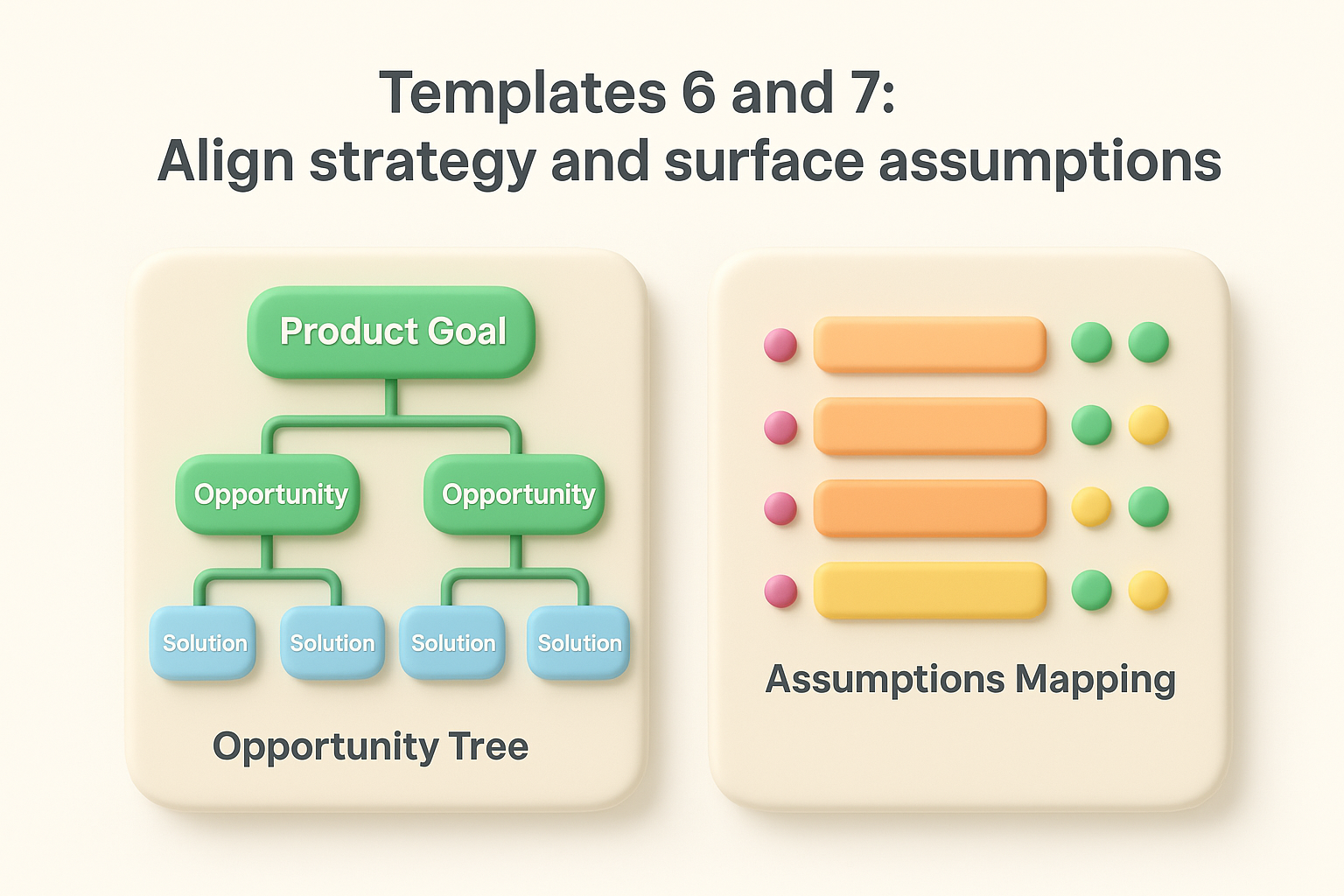
An Opportunity Solution Tree (OST) maps your product goal at the top and branches downward through opportunities, solutions, and experiments, showing exactly how each solution connects to a real user outcome. This visual structure prevents your team from jumping to solutions that don't trace back to a validated opportunity. An assumptions mapping template sits alongside it, listing every belief your team is treating as fact and scoring each one by how risky it is and how little evidence you have to support it.
Surfacing your riskiest assumptions early is the cheapest way to avoid building something users don't want.
A Value Proposition Canvas (VPC) forces a direct comparison between what your solution delivers and what your user actually needs, exposing any gaps between your assumptions and real user jobs, pains, and gains. A Kano model template then helps you categorize features by how much they satisfy users, separating basic expectations from genuine delighters. Finally, a RICE scoring template gives every feature a numeric score based on reach, impact, confidence, and effort, so your team prioritizes with data rather than opinion and can defend those decisions clearly to stakeholders.
Templates give you structure, but they only work when you fill them with real user input rather than internal assumptions. Koala Feedback connects directly to the discovery process by giving you a dedicated space to collect, organize, and analyze what users actually request, so every template you complete reflects genuine evidence instead of guesswork.
When users submit ideas through your Koala Feedback portal, those submissions become raw material for your product discovery templates. A wave of similar requests points directly to a problem worth capturing in your problem statement template. Recurring themes across submissions reveal the jobs users are trying to accomplish, feeding directly into your JTBD framework with language your users chose themselves rather than language your team invented.
The most accurate discovery data comes from users describing their own problems, not from internal teams hypothesizing about user needs.
Koala Feedback's voting and commenting system turns qualitative feedback into quantitative signals you can plug straight into a RICE scoring template. High vote counts indicate reach; comment sentiment reveals impact. You can also use prioritization boards inside Koala Feedback to group requests by product area, which maps naturally onto the opportunity branches in your Opportunity Solution Tree. Running discovery this way closes the loop between your templates and the users whose problems you are actually solving.
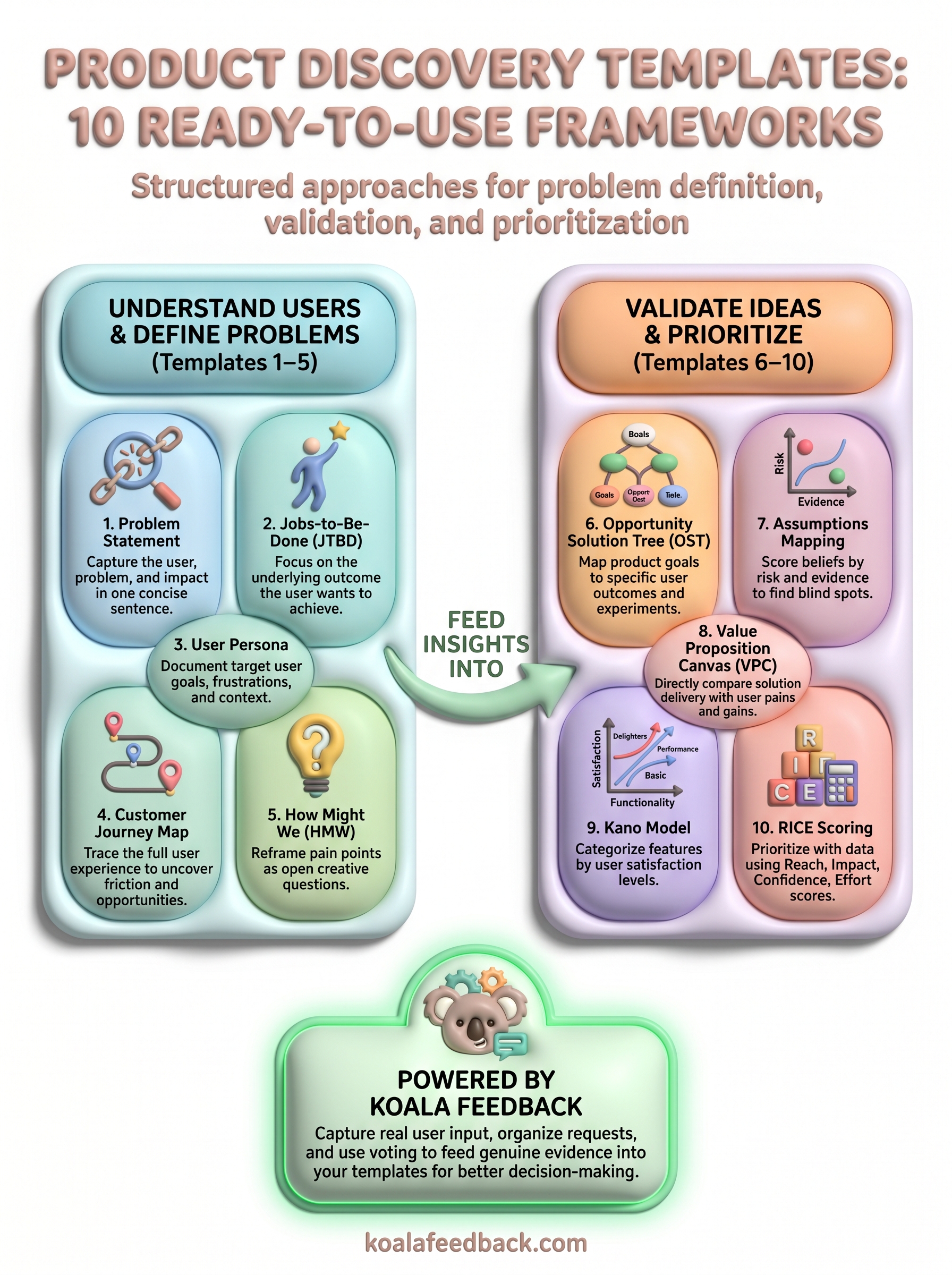
You now have 10 product discovery templates ready to put to work, from problem statements and JTBD frameworks to RICE scoring and Kano models. The most important thing you can do right now is pick one template that matches your current question, fill it out with real data, and share it with your team. One completed framework delivers more value than ten blank ones sitting in a folder.
The templates in this article only get stronger when you ground them in actual user feedback rather than internal assumptions. That means building a consistent habit of collecting what users say, tracking which problems surface repeatedly, and letting that evidence drive what your team builds next. Every vote, comment, and feature request you capture becomes sharper raw material for your next discovery cycle.
Start collecting the real user signals your templates need by setting up your feedback portal with Koala Feedback today.

Start today and have your feedback portal up and running in minutes.