Aha roadmap software is one of the most recognized tools in the product management space, built to help teams set strategy, capture ideas, and visualize their plans on detailed roadmaps. For product managers and SaaS teams evaluating their options, understanding what Aha! actually delivers, and where it falls short, matters before committing to a yearly contract and a learning curve.
Aha! positions itself as a complete product development suite, covering everything from goal-setting to feature prioritization. But its depth can also be its drawback. Many teams find themselves paying for complexity they don't need, especially when their core problem is simpler: collecting user feedback and turning it into a clear, shareable roadmap. That's exactly the problem we solve at Koala Feedback, giving teams a straightforward way to gather input, prioritize what to build, and keep users in the loop.
This article breaks down Aha!'s features, real user reviews, and common use cases so you can decide whether it's the right fit, or whether a lighter, feedback-driven approach makes more sense for your team.
Aha! Roadmaps is a product management platform built around strategic planning. Unlike lightweight tools that focus on simple task tracking, Aha! gives teams a structured environment to define company goals, link those goals to specific features, and then visualize everything on a shareable roadmap. It sits at the enterprise end of the market, designed for organizations that need more than a basic Kanban board.
Aha! Roadmaps is built for teams that need to tie every feature decision back to a strategic goal, not just a backlog item.
Product managers at mid-size to large companies are the primary users of aha roadmap software. These are people managing multiple product lines, coordinating with engineering and executive stakeholders, and reporting progress across departments. If you're running a small SaaS with a single product and a tight team, the platform may feel like bringing a bulldozer to a garden.
Aha! also targets enterprise product teams that need robust access controls, custom fields, and deep integrations with tools like Jira, Salesforce, and Azure DevOps. The platform supports complex workflows where product strategy needs to flow from the executive level down to individual sprint tasks.
The platform is not a lightweight feedback tool aimed at capturing direct customer input. It doesn't make it easy for your actual users to submit ideas, vote on features, or see a simple public roadmap. Aha! is oriented toward internal planning rather than external user engagement. If your core need is capturing real customer feedback and turning it into a visible, transparent roadmap your users can interact with, you'll find it requires significant setup to get even close to that goal.
Without a roadmap, product decisions scatter. Teams end up reacting to the loudest customer complaint or the most recent sales request rather than building toward a defined goal. Roadmap software gives teams a shared place to align priorities, track progress, and make deliberate trade-offs based on data rather than gut feeling.
Every product team collects some form of input, whether from support tickets, sales calls, or user interviews. The challenge is translating that raw input into ranked priorities that engineering can actually execute. Roadmap software creates a direct link between what users ask for and what your team commits to building.
The best roadmap software doesn't just display your plan, it helps you justify every item on it.
Product managers spend a significant amount of time in status update meetings that a well-maintained roadmap could eliminate entirely. When leadership, sales, and customers can see what's planned, in progress, and shipped, the volume of repetitive progress questions drops sharply. Aha roadmap software, like many tools in this space, is built specifically to solve that communication gap between internal teams and the people waiting on results.
Aha roadmap software packs a wide range of features, but most teams end up relying on a core set of tools they use week to week. Knowing which features actually drive value helps you evaluate whether the platform fits your workflow before you commit.
You build a goal hierarchy in Aha! that connects company objectives directly to individual features. Define goals at the top level, then link initiatives and epics beneath them, so every build decision traces back to a strategic priority. This structure suits teams that need to justify product decisions to leadership.
When every feature links back to a goal, prioritization conversations become much easier to have.
The platform includes a built-in scoring model that lets you rank features by factors like customer impact, effort, and strategic fit. You assign weights to each factor, and Aha! calculates a priority score for each item automatically. This removes a lot of the guesswork from deciding what to build next and gives you a defensible, data-backed ranking to share with stakeholders.
Most teams using aha roadmap software follow a repeatable cycle: capture ideas, score and rank them, assign them to releases, and then track progress as engineering picks up the work. Understanding how that cycle looks in practice helps you decide whether the tool fits how your team already operates, and where it might create unnecessary friction.
The clearest sign of a good roadmap workflow is when every stakeholder can answer "what are we building next?" without scheduling a meeting.
You start by logging feature ideas or user requests inside Aha! as ideas or features. Once enough ideas accumulate, you run them through the scoring model to rank them, then promote the top items into epics linked to your active goals. Engineering picks them up from there inside connected sprint tools like Jira, keeping the strategy-to-delivery chain intact and traceable.
Aha! lets you generate a visual timeline roadmap that shows planned releases across weeks or quarters. You share it as a read-only link with executives, customers, or sales teams so everyone sees the same plan without needing access to your internal workspace. That visibility cuts down on repetitive status questions and keeps stakeholders aligned between planning cycles.
Aha roadmap software consistently earns strong ratings from enterprise product teams, but the reviews reveal a clear pattern: power users appreciate the depth, while smaller teams flag the steep learning curve and high cost as real barriers.
If you're paying for features you'll never use, no amount of five-star ratings makes the tool the right fit.
On G2 and Capterra, Aha! scores well for strategic planning capabilities and stakeholder reporting. The most common complaints center on complexity, specifically that onboarding takes weeks and the interface requires significant configuration before it delivers any real value to your team.
Aha! charges per user, per month, with plans starting around $59 per user on the Roadmaps tier. For a team of ten, that's close to $600 per month before any add-ons. Enterprise tiers push that number higher.
Before signing, check whether you actually need strategic goal hierarchies or whether your real problem is capturing and acting on direct user feedback. Tools built specifically around feedback loops often deliver faster results for smaller teams without the overhead that comes with a full enterprise platform.
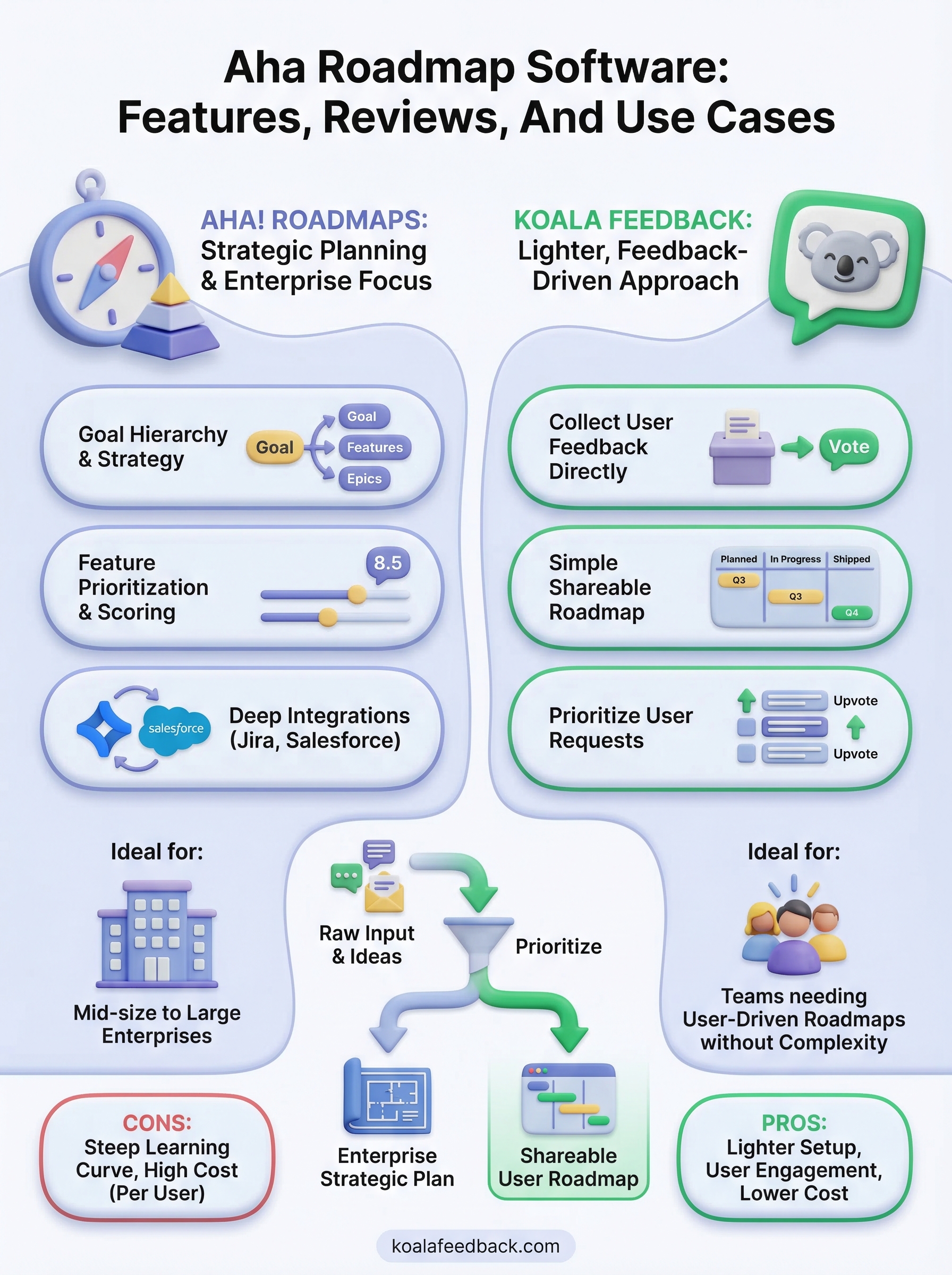
Aha roadmap software works well if your team needs deep strategic planning infrastructure and you have the budget and time to configure it properly. If that matches your situation, the free trial gives you enough time to test the goal hierarchy and scoring features before committing to a paid plan.
If your real priority is collecting direct user feedback, turning those requests into a ranked list, and sharing a simple public roadmap your users can actually interact with, Aha! may be more than you need. The setup cost in both time and money adds up fast for smaller teams.
Koala Feedback takes a lighter approach: you collect ideas from users, let them vote, and share your roadmap without the enterprise overhead. If that sounds closer to what you actually need, start a free trial with Koala Feedback and see how quickly you can go from raw user input to a roadmap your whole team can act on.

Start today and have your feedback portal up and running in minutes.