Every product decision starts with a question: what do your users actually need? What is user research comes down to the systematic process of understanding user behaviors, needs, and motivations through observation and feedback. It's how teams stop guessing and start building products people genuinely want to use.
Without it, you're flying blind. Feature priorities become opinion-driven, roadmaps drift from reality, and development cycles burn through time and money on things nobody asked for. User research closes that gap by putting real evidence behind every decision, from early-stage concepts to post-launch improvements.
At Koala Feedback, we built our platform around this exact principle, giving users a voice and helping teams collect, organize, and prioritize feedback systematically. Research doesn't end after a usability test; it's an ongoing conversation between you and your users.
This guide covers the core methods, real-world examples, and best practices you need to make user research a consistent part of how you build products.
User research sits at the intersection of psychology, design, and strategy. At its core, what is user research comes down to gathering evidence about real people: how they think, what they struggle with, and what they actually do versus what they say they do. It's a discipline with specific methods, clear goals, and repeatable processes, not a vague exercise in "listening to customers." Understanding that distinction is the first step toward using it well.
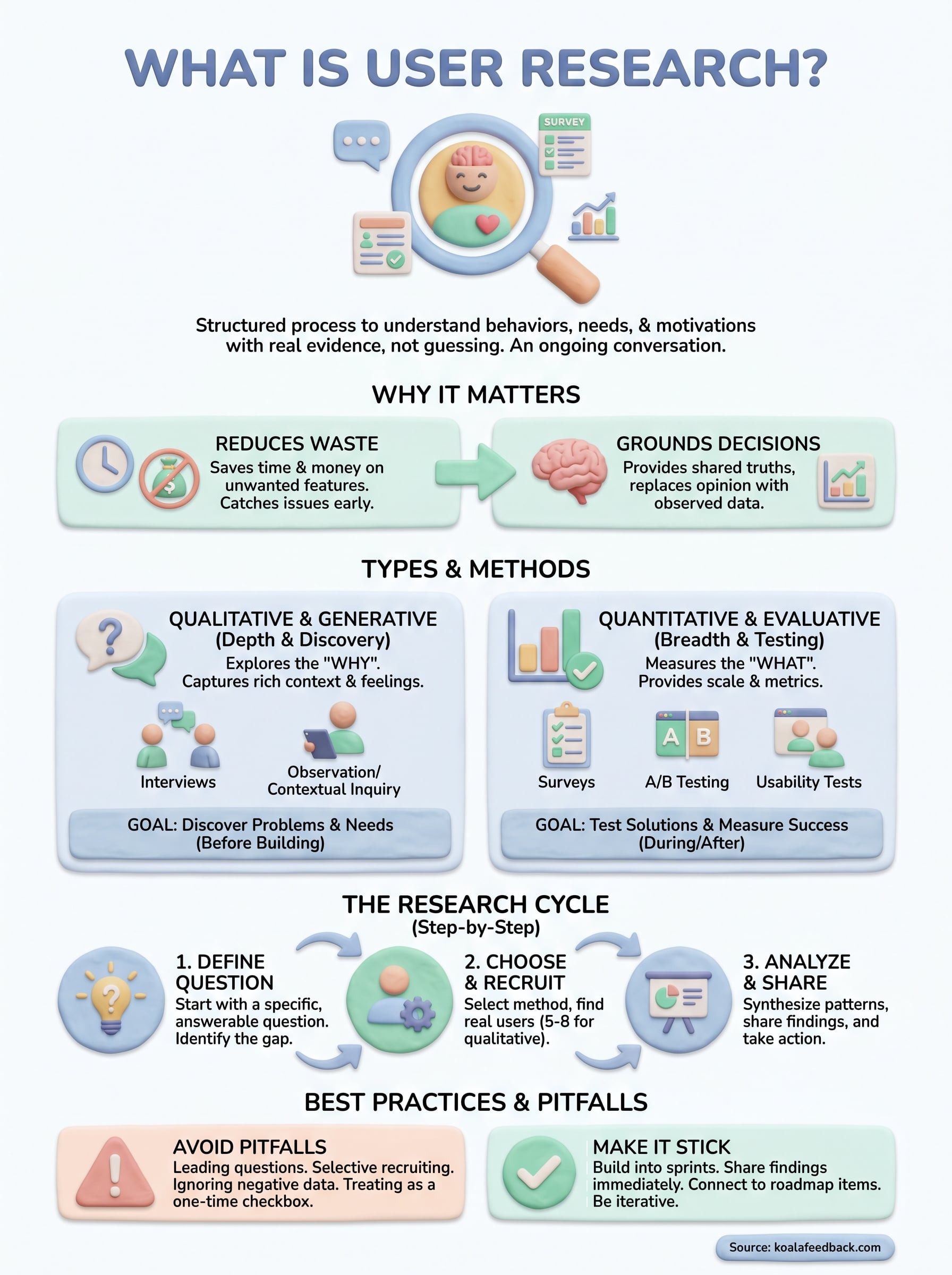
User research is a structured practice of collecting qualitative and quantitative data about your users so you can make better product decisions. That data can come from interviews, surveys, behavioral observation, usability tests, or passive signals like support tickets and feature requests. The key word is structured: you define a question, choose an appropriate method, collect data consistently, and then analyze what you find before drawing any conclusions.
Research is also iterative, meaning it happens throughout the entire product lifecycle, not just once before you start building. Early-stage research helps you validate assumptions and define problems worth solving. Mid-cycle research tests prototypes and surfaces friction before you ship. Post-launch research measures whether the thing you built actually solved the problem you set out to solve. Each phase informs the next, and skipping any one of them leaves a gap in your understanding.
Good user research doesn't just confirm your ideas. It challenges them, often in ways that save you months of wasted development time.
User research is not a synonym for asking your customers what features they want. That kind of direct questioning, while useful in limited contexts, captures stated preferences rather than actual behavior, and the two rarely match. Users describe problems through the lens of solutions they already know, which means their suggestions often point at symptoms rather than root causes.
User research is also not a one-time activity you complete before a product launch. Teams that treat it as a checkbox miss the ongoing signal their users generate every day through support tickets, churn patterns, usage data, and direct feedback submissions. Treating research as a phase rather than a practice is one of the most common and costly mistakes product teams make, because user needs shift as your product and market evolve.
Finally, user research is not the same as market research. Market research focuses on segments, trends, and competitive positioning at a population level. User research zeroes in on individual behavior, mental models, and specific interaction points within your product. Both matter, but they answer different questions, and conflating them produces shallow insights that rarely translate into meaningful product improvements. Your marketing team needs market research; your product team needs user research, and treating them as interchangeable creates blind spots in both directions.
Understanding what is user research helps you see it not just as a methodology but as a business lever. Teams that skip research don't save time; they spend it on features users ignore, interfaces that confuse, and solutions that miss the actual problem. Research upfront costs hours; skipping it costs months of misdirected development effort you can't get back.
Every feature your team builds that nobody uses represents a direct loss: engineering hours, design cycles, and opportunity cost. User research surfaces misaligned assumptions early, before they make it into production. When you interview five users and discover that the workflow you planned to automate is not actually a pain point, you redirect that effort toward something that genuinely matters.
Research doesn't slow down product development. It removes the work you would have had to undo.
The return compounds over time. Teams that build research into their process ship fewer features that require rework, spend less time in reactive support cycles, and accumulate a clearer picture of where their product needs to go next. The cost of fixing a misaligned feature after launch is significantly higher than catching the misalignment before writing a single line of code. According to IBM's Systems Science Institute research, defects found in production cost up to 15 times more to fix than those caught during design, which is exactly where research operates.
Opinions are easy to come by in any product meeting. Everyone has a perspective on what the product should do next, and those perspectives are shaped by individual experience rather than actual user behavior. Research gives you a shared source of truth that shifts conversations from "I think" to "here's what we observed."
Quantitative data tells you what is happening inside your product, while qualitative research tells you why. When you combine both, you build a complete picture of user behavior that no internal debate can replicate. That evidence becomes the foundation for prioritization decisions, roadmap planning, and stakeholder alignment, replacing guesswork with something concrete and defensible.
When you ask what is user research, the answer depends on the question you're trying to answer. Research falls into distinct categories based on what kind of data you need and when in the product cycle you're collecting it. Understanding these categories helps you choose the right approach before you collect a single data point, so you don't end up with findings that don't actually inform a decision.
Qualitative research captures depth over breadth. It surfaces the "why" behind user behavior through interviews, usability tests, and direct observation, giving you rich context that numbers alone can't provide. Quantitative research works in the opposite direction: it measures behavior at scale through surveys, analytics, and A/B tests, producing numbers you can compare across time and user segments. Neither type outperforms the other because they answer fundamentally different questions.
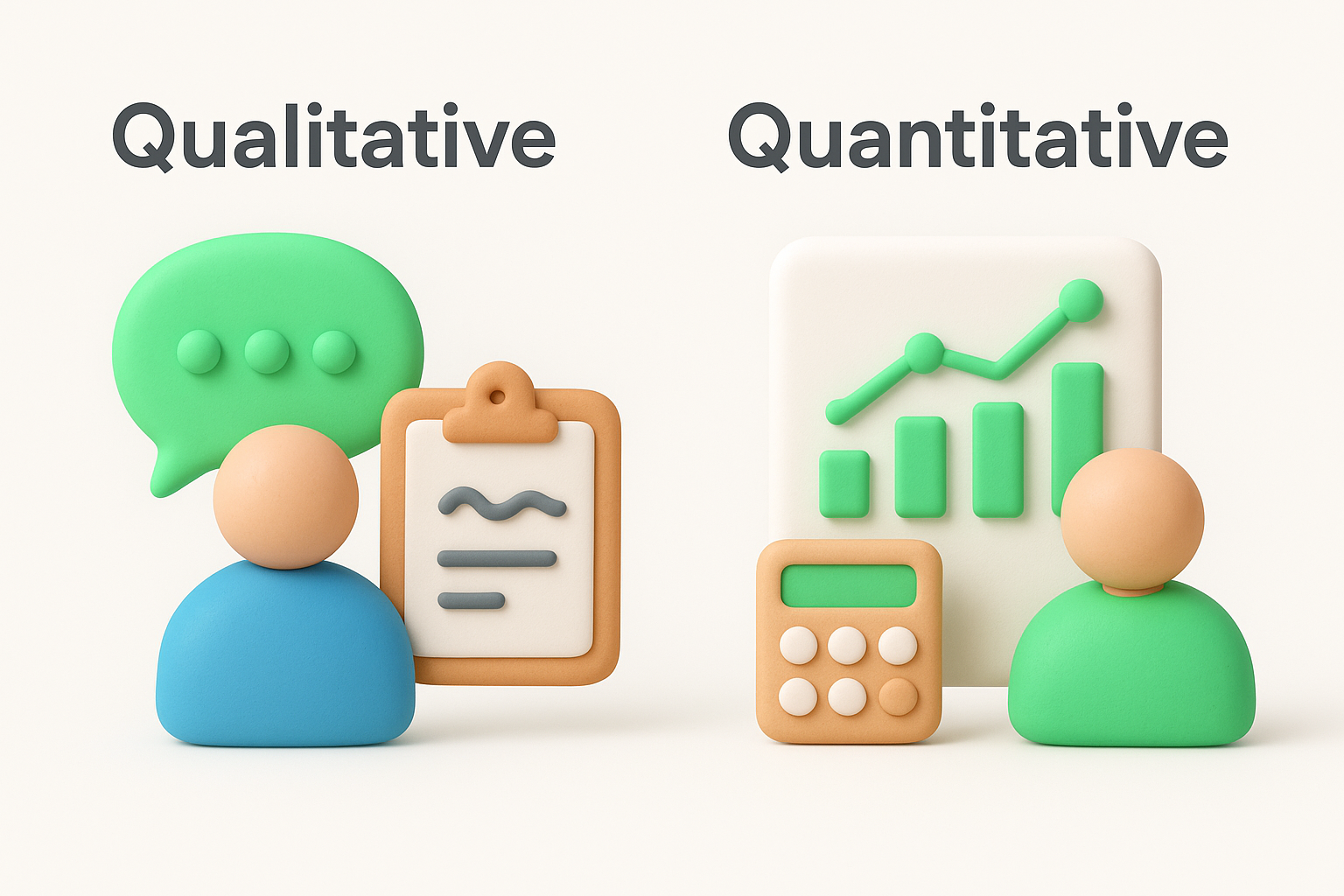
The strongest research programs use qualitative and quantitative methods together, letting each type fill in what the other misses.
Running both types in parallel is the most reliable way to avoid blind spots. Quantitative data tells you that 40% of users drop off at a specific step; qualitative sessions tell you why they leave and what they were trying to accomplish instead. Together, they give you the complete picture you need to make a confident product decision.
Generative research happens before you build. It helps you discover real problems worth solving, map user mental models, and define the right opportunity so you aren't designing a solution for a problem that doesn't actually exist. Evaluative research tests whether what you built actually works: does the prototype make sense, does the new flow reduce friction, did the shipped feature solve the problem you set out to fix?
Timing separates the two: generative research opens up the problem space, while evaluative research narrows it down by testing specific solutions against real user behavior. Running evaluative research without doing generative groundwork first is one of the fastest ways to execute well on entirely the wrong thing, because you're validating answers before you've confirmed the question.
Part of understanding what is user research is knowing which method fits which situation. Choosing the wrong method for the question you're asking produces data that looks useful but doesn't actually inform a decision. The methods below map to distinct phases of your product cycle so you can match the right tool to the right moment.
Contextual inquiry and in-depth interviews are your primary tools for exploration before you commit to a problem definition. Contextual inquiry involves watching users complete tasks in their actual environment, which surfaces friction points they would never mention unprompted. In-depth interviews go deeper into motivations and past behavior, giving you the "why" behind the patterns you observe.
Use discovery methods when you need to:
Usability testing is the most direct way to find out whether your design works. You place a real user in front of a prototype or live product, assign a task, and watch what happens without guiding them. A/B testing operates at the opposite scale: rather than observing one session at a time, it measures behavioral differences across large user segments simultaneously.
Usability testing tells you where users get stuck; A/B testing tells you which version of a solution performs better in production.
Use these methods when you need to:
Surveys and dedicated feedback portals let you collect signal continuously rather than in scheduled research sprints. A well-structured survey quantifies how widespread a problem is across your entire user base. Tracking patterns in submitted feedback, such as recurring themes, vote counts, and comment sentiment, gives you a real-time view of what's gaining urgency before it shows up in churn data.
Use ongoing methods when you need to:
Knowing what is user research is only useful if you can execute it consistently. The process doesn't need to be complex, but it does need to be sequential: each step builds on the last, and skipping one creates gaps that surface later as poor decisions. A clear process keeps your research focused and produces findings your team can actually act on.
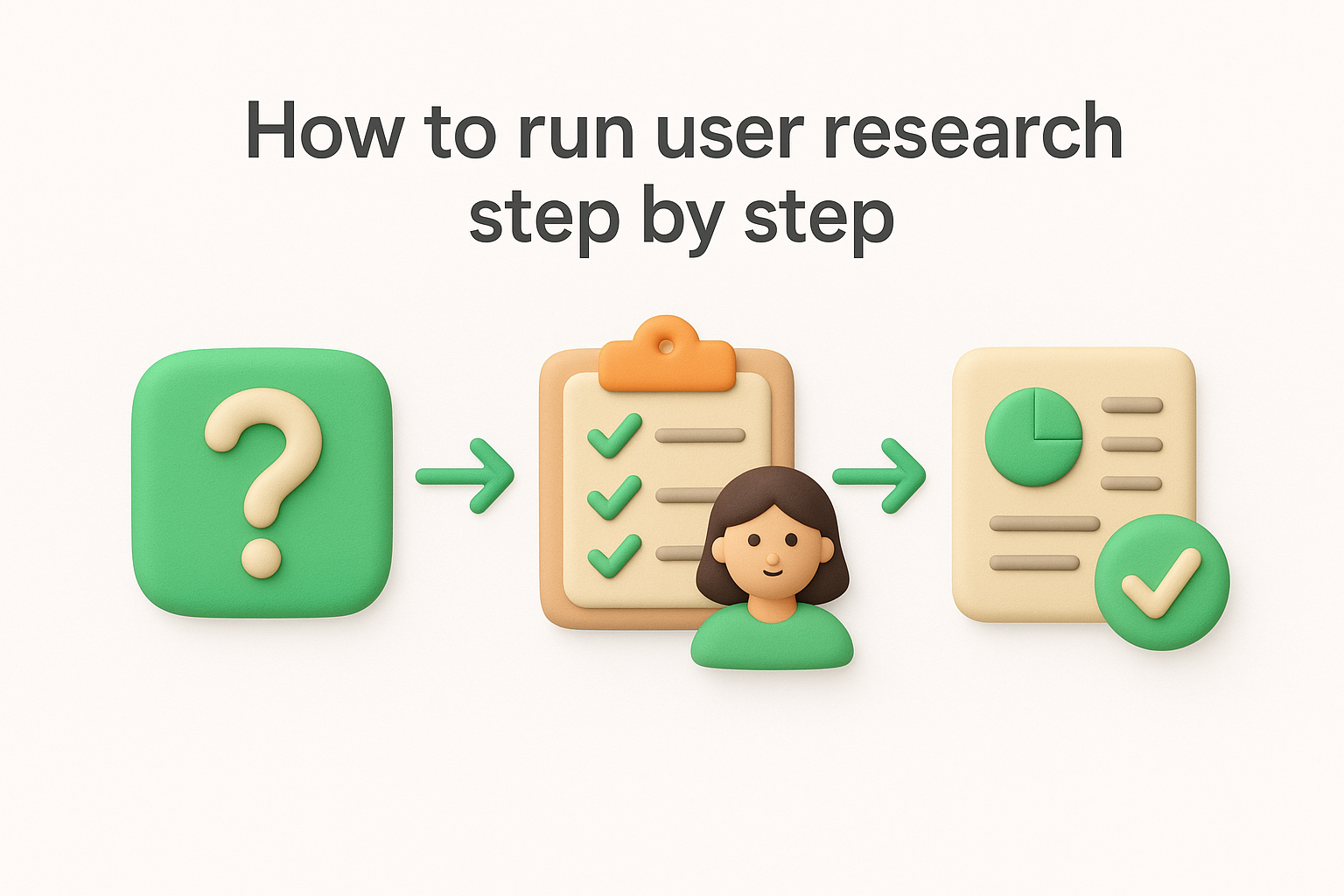
Start with a specific question, not a broad topic. "Why do users abandon setup before completing onboarding?" is a research question. "We want to understand our users better" is not. Your question determines every other decision in the process, including which method you choose and who you recruit.
Before moving forward, confirm your question meets these checks:
Once your question is set, select the method that fits it. Generative questions call for interviews or contextual inquiry; evaluative questions call for usability testing or A/B experiments. Recruit participants who match your real user profile, not coworkers who already know the product. Aim for five to eight participants per qualitative round to surface dominant patterns without generating more data than you can analyze.
Recruiting the wrong participants produces confident findings about the wrong people, which is worse than having no data at all.
During sessions, observe rather than explain. Let users struggle, stay quiet during pauses, and resist correcting misunderstandings in real time. That friction is your data. After sessions wrap, look for recurring themes across multiple participants rather than isolated moments, because patterns drive decisions, not individual anecdotes.
Synthesize findings into a short, readable document:
Findings that stay in a folder change nothing. Share them in a team meeting, tie them to specific backlog items, and make sure the roadmap owner has read them before the next planning cycle.
Understanding what is user research is one thing; executing it without repeating the same mistakes teams make is another. Even well-intentioned research efforts fall apart when they skip critical steps or let confirmation bias shape what gets documented. Recognizing where research goes wrong gives you a clear target for building a practice that actually holds up over time.
Research bias is the most common threat to the quality of your findings. Leading questions, selective recruiting, and documenting only the moments that confirm your existing assumptions all produce data that looks credible but points you in the wrong direction. A question like "How helpful did you find this feature?" pressures users toward a positive response; "Walk me through how you used this feature last week" does not.
The findings you ignore are often more valuable than the ones you highlight, because they reveal the assumptions you were most attached to.
Teams also frequently mistake volume for quality. Running 20 mediocre interviews produces less insight than six focused sessions where you let users drive the conversation, document unexpected behavior, and probe past surface-level answers. More participants rarely fix a flawed methodology.
Build research into your sprint cycle rather than scheduling it as a separate event that competes with delivery timelines. Short, focused sessions run consistently beat long research projects run sporadically, because they keep your understanding of users current as your product changes.
Share findings immediately and connect them directly to backlog items, roadmap decisions, or open product questions your team is already discussing. Research that stays in a slide deck doesn't change decisions; research that maps onto a specific feature request or prioritization debate does. Create a short summary after every research round that includes the question you asked, what you observed, and a concrete recommendation your team can act on before the next planning cycle. Keeping the loop tight between research and action is what separates teams that use research effectively from teams that treat it as a compliance exercise they complete and then file away.
User research isn't a one-time project you complete and shelve. Understanding what is user research means recognizing it as an ongoing practice that shapes every product decision your team makes, from the problems you choose to solve to the features you prioritize on your roadmap.
Start small: pick one open question your team is debating right now and run three to five user interviews against it before your next planning cycle. A single well-executed research session produces more clarity than months of internal discussion, and the habit of running research consistently matters more than any one-time effort.
As your research practice grows, centralizing the feedback your users already send you becomes equally important. Tools like Koala Feedback help you capture, organize, and prioritize user input continuously so that research insights stay connected to real product decisions, not buried in a document no one opens after the meeting ends.

Start today and have your feedback portal up and running in minutes.