Product design and innovation is the discipline of shaping a product around real user needs and finding new ways to meet them better than anything already available. Design decides how a product looks, works, and feels. Innovation decides whether it is new or meaningfully better. Together they turn an idea into something people choose, use, and recommend.
The field sits where engineering, research, and business meet. You will also see it called product innovation and design, and the two phrases describe the same work. Whether you run a SaaS product, build physical goods, or are weighing a degree, the logic is the same: learn what users struggle with, then design something that removes the struggle.
This guide explains why the field matters, how the process works step by step, and the main types of innovation. It also covers which degrees and certificates teach it and what careers it leads to. At Koala Feedback we help product teams collect and prioritize user input, so we focus on the practical side of this work.
Product design and innovation matters because it stops you from building things nobody wants. Most failed products do not fail on engineering. They fail because the team misread the problem or solved one that users did not care about.
Every product is a bet that a specific group of people has a specific problem worth solving. Design practice makes that bet explicit. You observe users, name the problem in one sentence, and judge every later decision against it. Innovation adds the second question: is there a better way than what exists today?
User-centered thinking and a willingness to change the solution are what separate a real product from a copy of someone else's. Without the first, you build in the dark. Without the second, you ship the same thing as everyone else.
Good design finds the right problem, and innovation finds a better answer to it.
Changing a sketch costs minutes. Changing shipped hardware costs a production run, and changing a released software feature costs weeks of engineering plus user trust. The earlier you test an idea, the cheaper a wrong guess becomes.
That is why the field leans so hard on prototypes and early testing. A paper mockup or a clickable wireframe answers real questions before anyone writes production code or orders tooling.
Teams that practice product design and innovation consistently see the same kinds of gains:
None of these gains come from a single workshop. They come from running the process repeatedly, which the next section lays out.
You apply product design and innovation by running a repeatable loop: research, define, ideate, prototype, test, and release, then feed what you learn back into research. The loop matters more than any single step.
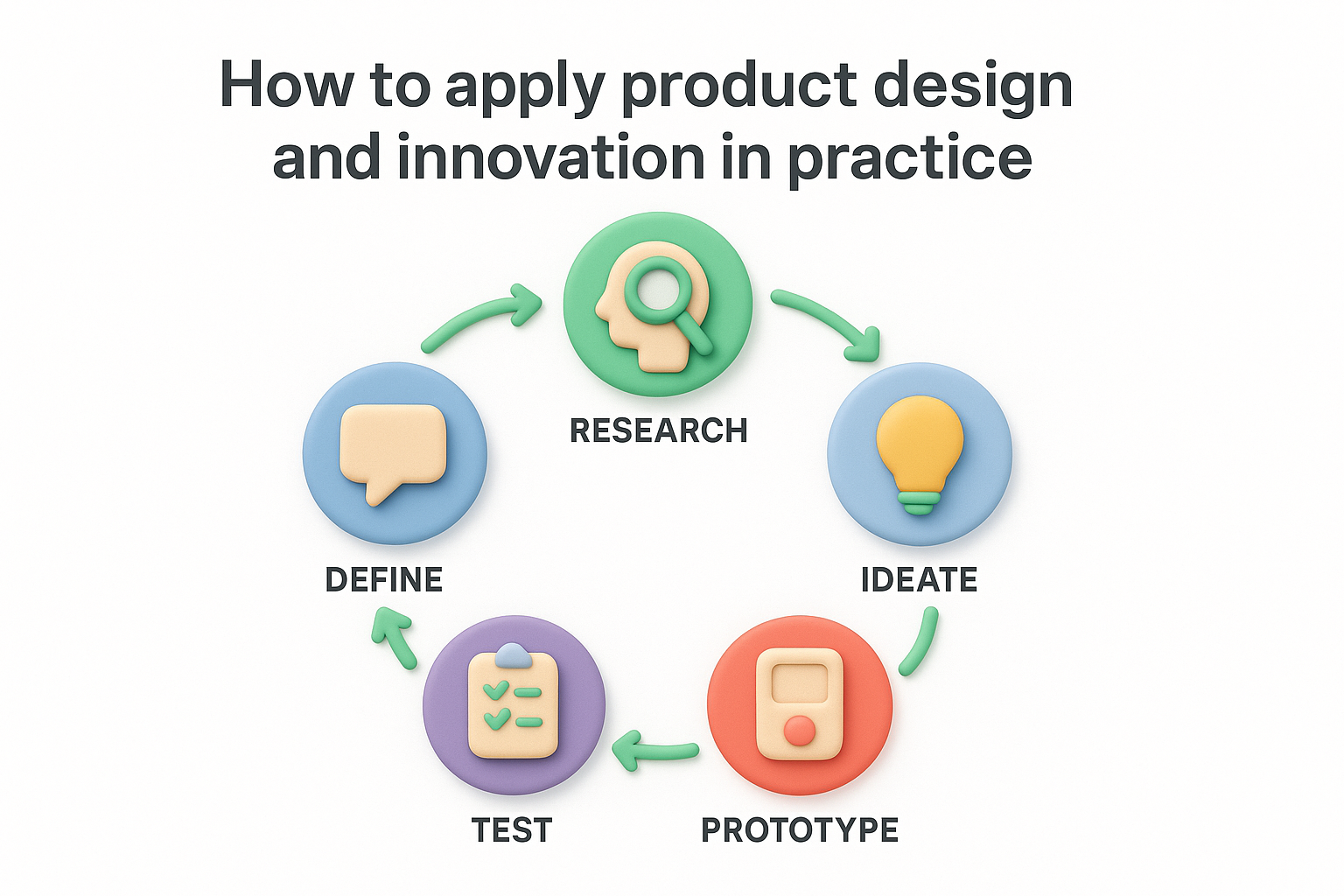
Follow these steps in order the first time, then adapt them to your team:
In practice the steps overlap. A test often sends you back to ideation, and that is the process working, not failing.
Feedback is the fuel for steps one and six. A feedback portal where users submit ideas, vote, and comment gives you a ranked view of demand instead of a pile of scattered emails. Koala Feedback, for example, deduplicates and categorizes incoming requests, so forty phrasings of the same ask show up as one strong signal on a prioritization board.
Then close the loop. A public roadmap with statuses such as planned, in progress, and completed shows users that their input leads somewhere, and engaged users give better feedback. One caution: votes show demand, not solutions. Users tell you what hurts. Designing the cure is still your job.
Users are experts on their problems, and you are the expert on the solutions.
Watch for four common traps:
Product design and innovation work falls into three types: incremental, breakthrough, and disruptive. They differ in how much changes and how much risk you take on.
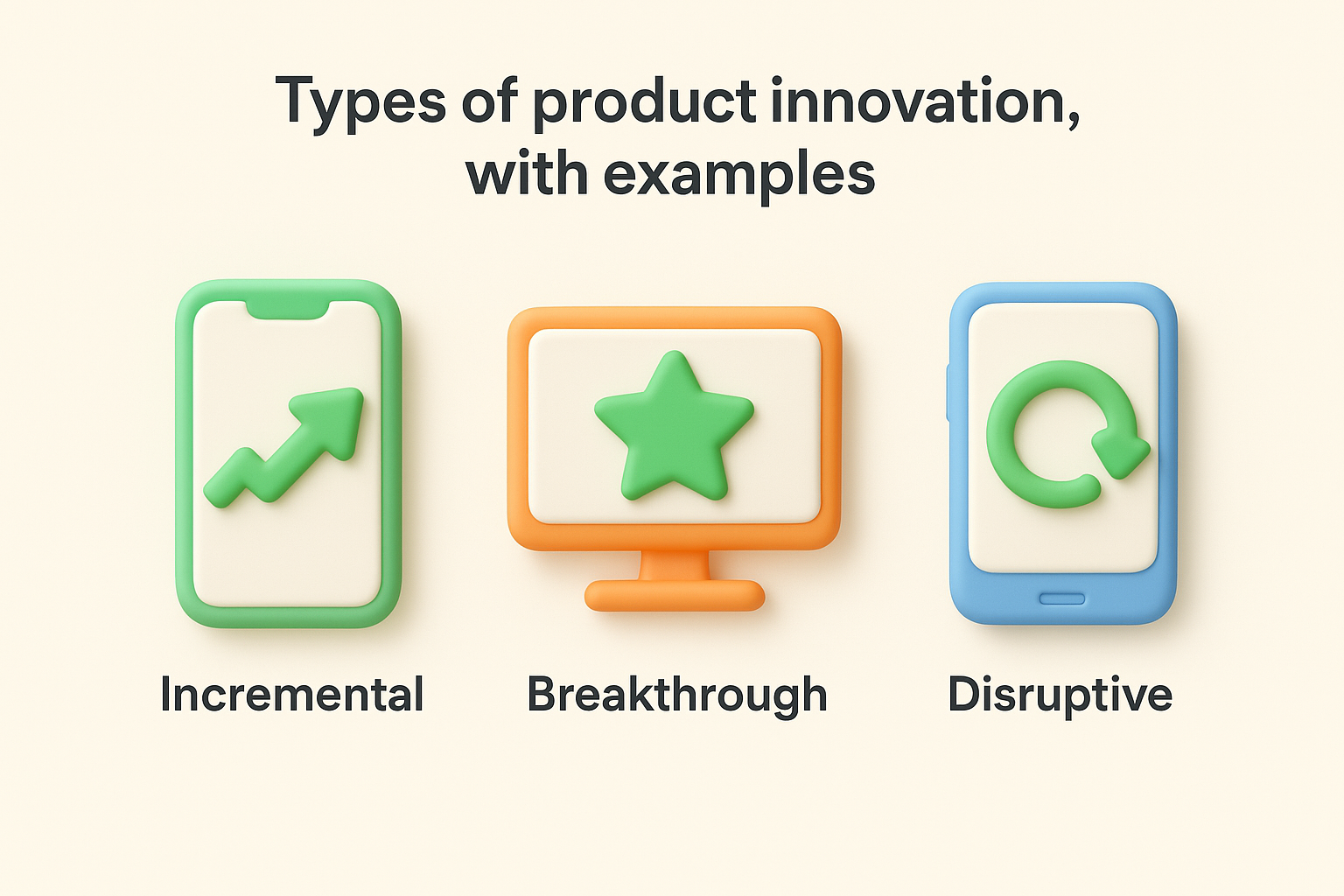
| Type | What changes | Example | Risk level |
|---|---|---|---|
| Incremental | Small, steady improvements to an existing product | A phone camera gaining better low-light performance with each model | Low |
| Breakthrough | A new capability that opens new users or uses | Slim flat-screen TVs replacing bulky tube sets | Medium |
| Disruptive | A simpler or cheaper design that starts at the low end of a market and moves up | Smartphone cameras replacing compact point-and-shoot cameras | High |
Most teams spend most of their time on incremental work, and that is healthy. Steady improvements keep current customers happy. Treat breakthrough and disruptive bets as separate projects with their own budget and their own definition of success, because they will not look like wins on a quarterly roadmap.
Look at the television. Over decades, its internals became far more complex, with higher resolution, connectivity, and built-in apps. Its outward design became simpler, thinner, and cleaner. Hiding complexity behind a simple surface is one of the most reliable patterns in the field. Innovation often means taking things away from the user's experience, not adding to it.
Fitness trackers show another pattern. They combined hardware, software, and a daily habit into one product, and that combination of physical and digital design made them mainstream. Software follows the same logic. A tool that merges duplicate feature requests automatically is an incremental innovation over the old spreadsheet, and it frees a product team to spend its time on decisions instead of sorting.
You can study product design and innovation through a bachelor's degree, a master's degree, or a shorter certificate. The right choice depends on whether you want a full career change or a skill upgrade.
| Option | Typical length | Best for |
|---|---|---|
| Bachelor's degree | About four years in the US | Starting a design career from scratch |
| Master's degree | One to two years | Career changers, specialization, leadership tracks |
| Online certificate | Several months, often part-time | Working professionals adding skills |
| Short course or workshop | Days to weeks | Testing whether the field suits you |
Program names vary. Look for product design and innovation, product design and engineering, product design technology, industrial design, and design innovation. They overlap heavily. Carnegie Mellon University offers an online Product Design Innovation certificate, and several UK universities, including Strathclyde and Portsmouth, run bachelor's programs under the name Product Design and Innovation.
The title matters less than what is inside. Compare programs on these points:
Above all, ask what graduates produce. Portfolio quality drives hiring in design far more than the name of the degree.
Choose the program that gets you the strongest portfolio, not the longest title.
A background in product design and innovation leads to roles in product design, industrial design, UX design, design engineering, and product management. The field is broad, so most people pick a lane after a few years of practice.
Hiring managers want a mix of craft and judgment:
Is it a high-paying field? It depends on the role, industry, and location. The US Bureau of Labor Statistics publishes pay and outlook figures for industrial designers in its Occupational Outlook Handbook. Software-focused and senior roles often pay more than entry-level physical design work, so compare current job listings for the role you want.
Is AI replacing product designers? It is changing the work, not removing the need for it. AI tools speed up drafting, rendering, and summarizing research. They do not decide which problem deserves solving or whether users will trust the answer. Problem framing and judgment about people are the parts of the job that matter more as the production work gets cheaper.
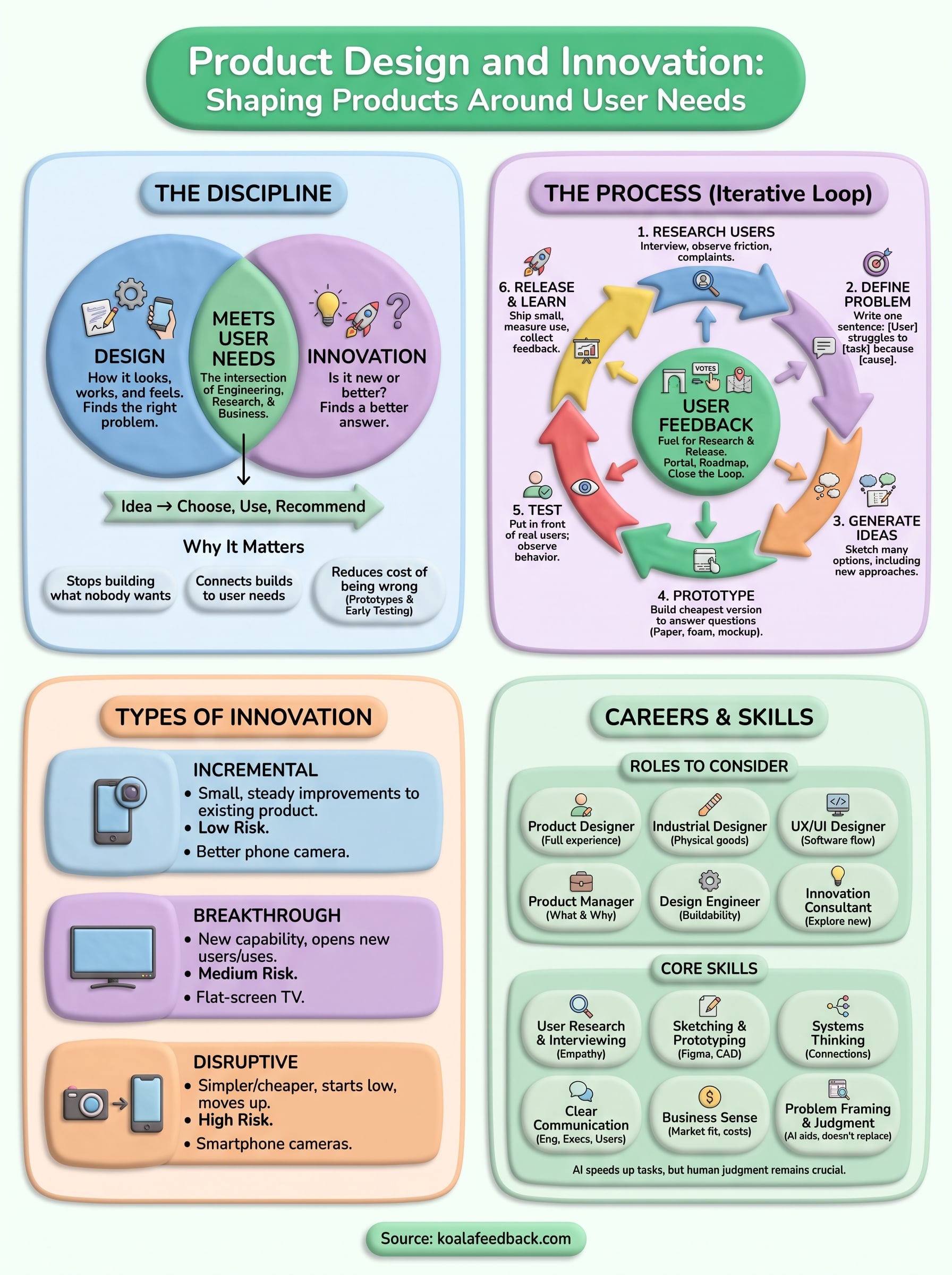
Product design and innovation comes down to one habit: learn what users struggle with, build a better answer, test it cheaply, and keep listening after launch. Whether you study it, hire for it, or practice it on your own product, the loop stays the same.
If you run a software product, the easiest place to start is the feedback you already receive. Gather it in one place, let users vote, and show them what you plan to build. With Koala Feedback you can set up a feedback portal and public roadmap and turn user input into the next round of design decisions.

Start today and have your feedback portal up and running in minutes.