Every product team hits the same wall at some point: you have a backlog full of requests, a roadmap to fill, and no clear sense of what actually counts as innovation versus a minor tweak. Looking at real innovation product examples helps cut through that confusion, because you can see the difference between a feature that shifted an entire market and one that just added noise to a release note.
This article answers that search directly by walking through nine products, spanning decades and industries, that changed how people work, shop, or communicate. You'll see examples of innovation product development from companies big and small, plus the pattern behind each one: a real user problem, a bet on a different approach, and a willingness to ship before competitors did.
We'll also connect these cases to product innovation ideas you can apply now, not just admire from a distance, starting with what product innovation actually means. If you're gathering ideas for product innovation to bring to your next planning session, treat this list as a starting point for spotting where your own roadmap might be playing it too safe.
Blockbuster and other video chains built their business on late fees and limited shelf space, forcing customers to drive to a store and hope the movie they wanted wasn't already rented out. Netflix started as a mail-order DVD service in 1997, cutting out the store entirely, but the bigger problem it eventually tackled was distribution itself: why should watching a movie depend on physical media at all? That question, not the DVD business, is what turned Netflix into one of the clearest innovation product examples in modern business history.
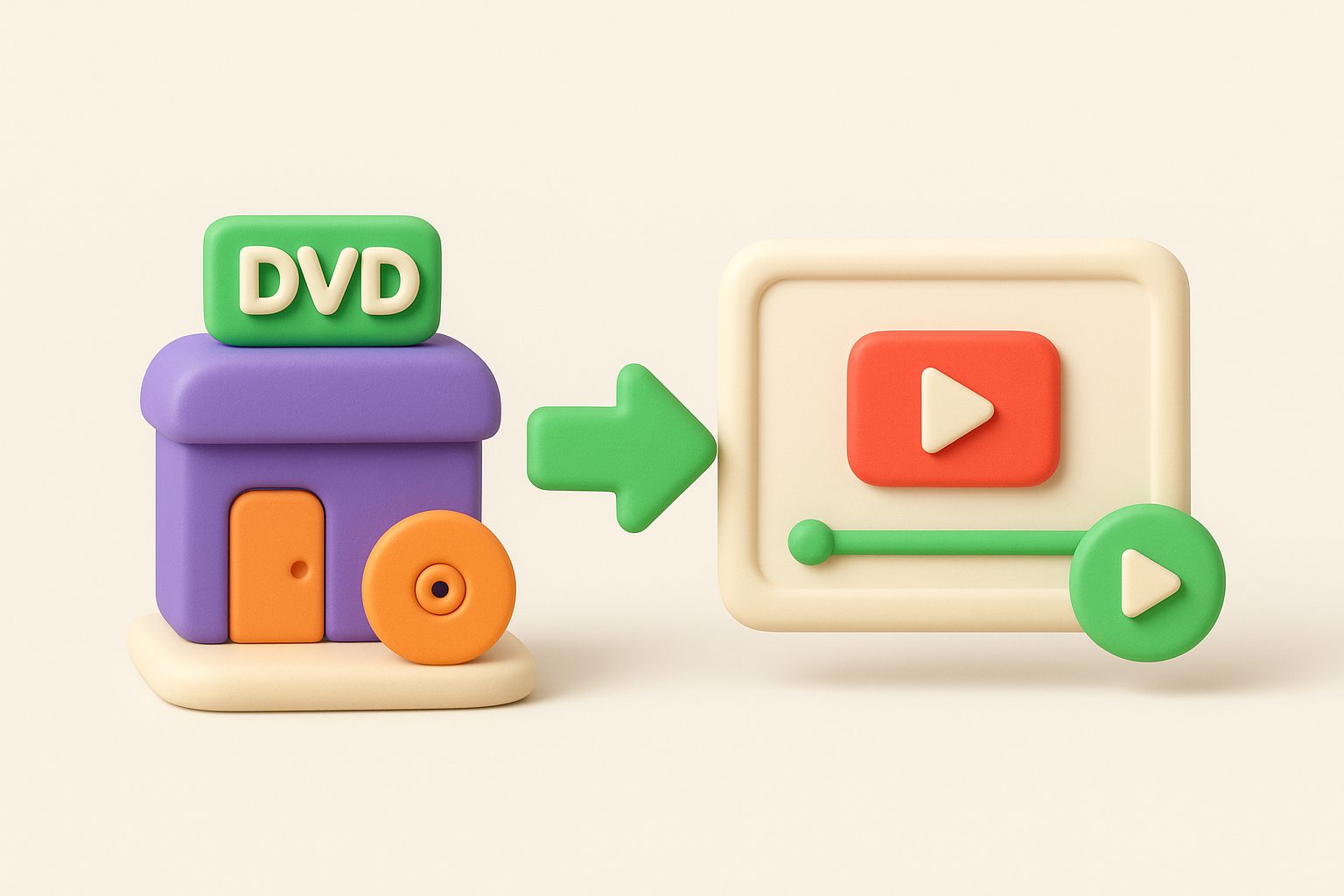
Netflix didn't just digitize what already existed. It rebuilt the entire viewing experience around data and convenience. Streaming removed the wait time of mail delivery, and the recommendation engine used viewing history to surface content people didn't know they wanted. Then came original programming, starting with House of Cards in 2013, which meant Netflix stopped depending on studios for content and started competing with them directly.
Netflix won by repeatedly making its own older business model obsolete before a competitor could do it first.
The shift wasn't a single leap. Netflix moved from DVD-by-mail to streaming in 2007, then invested heavily in licensing deals, then pivoted to original content once it saw how vulnerable licensed catalogs were to studios pulling their shows. Each phase solved a new problem the previous one created:
Netflix shows that innovation rarely happens in one dramatic release. It's a sequence of smaller bets, each addressing a limitation the last version exposed. For your own roadmap, this means treating feedback as an ongoing signal through continuous product discovery rather than a one-time research phase before launch. A tool like Koala Feedback's feedback portal helps you capture that continuous signal from users, so you catch the next shift, whether it's a format change or a business model change, before a competitor does.
Before 2007, phones split into two camps: Blackberrys built for typing emails, and clunky touchscreen devices with styluses that barely worked. Nobody had solved mobile computing as a single, coherent experience. The Apple iPhone launched into that gap, betting that people wanted one device for calls, browsing, and apps, not three separate gadgets stuffed into a pocket.
The iPhone wasn't the first touchscreen phone, but it was the first to make touch feel natural. Apple controlled the hardware, the software, and the App Store ecosystem all at once, which let it ship a product where every piece reinforced the others. This is one of the innovative product development examples teams cite most often because it shows innovation isn't always a new invention. It's often a tighter integration of existing pieces that nobody had bothered to combine well.
The iPhone proves that owning the full experience, not just one clever feature, is what creates lasting differentiation.
Apple didn't stop at the original design. The App Store arrived in 2008, turning the phone into a platform. Retina displays, Touch ID, and the camera system each layer improvements on the core idea rather than replacing it.
When you're weighing product innovation ideas, ask whether you're integrating parts of your product that currently feel disconnected. Sometimes the biggest win isn't a new feature; it's making existing ones work together seamlessly.
Car manufacturers historically treated a vehicle as finished the day it left the factory. Any fix meant a dealership visit, and any upgrade meant waiting years for the next model year. Tesla rejected that model entirely, treating cars more like smartphones than appliances. This is one of the more overlooked innovation product examples because the disruption wasn't the electric motor, it was the idea that a car could keep getting better after purchase.
Over-the-air updates let Tesla push new features, fix bugs, and even improve battery management without a single service appointment. A customer's Autopilot capability, acceleration, or infotainment interface could change overnight. That approach turned hardware into a platform for ongoing product innovation ideas, something the auto industry had never attempted at scale.
Tesla succeeded by refusing to let "the car is built" mean "the car is finished."
Early updates focused on basic fixes. Later ones added Autopilot features, then Full Self-Driving beta access, then games and streaming apps. Each release kept existing owners engaged without requiring a new purchase.
Before assuming a feature needs a full new release, consider whether it can ship as one of the smaller ways to improve a product customers already own. Continuous delivery keeps users invested and gives you more chances to react to feedback. Tracking that feedback across releases is easier with a roadmap you can share publicly that shows customers exactly what's shipping next.
Email buried teams in long threads, and early chat tools like IRC felt too technical for most office workers. Slack started life as an internal tool for a failed video game company, built simply because the team needed a better way to talk to each other while building something else entirely. That accidental origin makes it one of the more unusual innovative product development examples, since the product wasn't even the original goal.
Slack organized conversation into searchable channels, added integrations with tools teams already used, and made the whole experience feel closer to a chat app than corporate software. None of these pieces were new on their own. The innovation was in packaging them for a workplace audience that had never been asked what they actually wanted from internal communication.
Slack turned an internal side project into a category by listening obsessively to how early users actually worked.
Slack's public beta in 2013 grew almost entirely through word of mouth, driven by direct user feedback shaping features like threads, reactions, and shared channels. The company famously read and responded to support tickets from its earliest customers, treating each complaint as a product input rather than a nuisance, much like the other voice of the customer examples that shaped well-known products.
Slack's growth shows what happens when you build a direct pipeline between users and the roadmap. A portal where users vote and comment on requests gives you that same signal, without relying on support tickets alone.
Hotels controlled the entire lodging market for decades, which meant limited inventory in busy cities and prices that spiked whenever demand did. Airbnb started in 2008 when its founders rented air mattresses in their own apartment to cover rent, a scrappy minimum viable product that exposed a bigger gap: millions of spare rooms and empty homes sat unused while travelers overpaid for a bed. That gap is why Airbnb belongs on any list of real example of innovation product thinking, since it turned an overlooked asset into a business.
Airbnb didn't build hotels. It built trust between strangers, using reviews, verified profiles, and payment protection to make peer-to-peer lodging feel safe. That trust layer, more than the listings themselves, is what let the platform scale into a global marketplace.
Airbnb's real innovation wasn't housing supply, it was building enough trust for strangers to hand over their keys.
Early Airbnb was just spare rooms. Over time it expanded into whole homes, then Experiences, then Airbnb Plus for higher-end listings, each addition responding to specific complaints from hosts and guests about safety, quality, or selection.
When you're short on product innovation ideas, look at underused assets your customers already have, whether that's data, time, or spare capacity, a habit you can see across these design-led innovation examples. A feedback portal can surface which of those overlooked resources your own users keep mentioning.
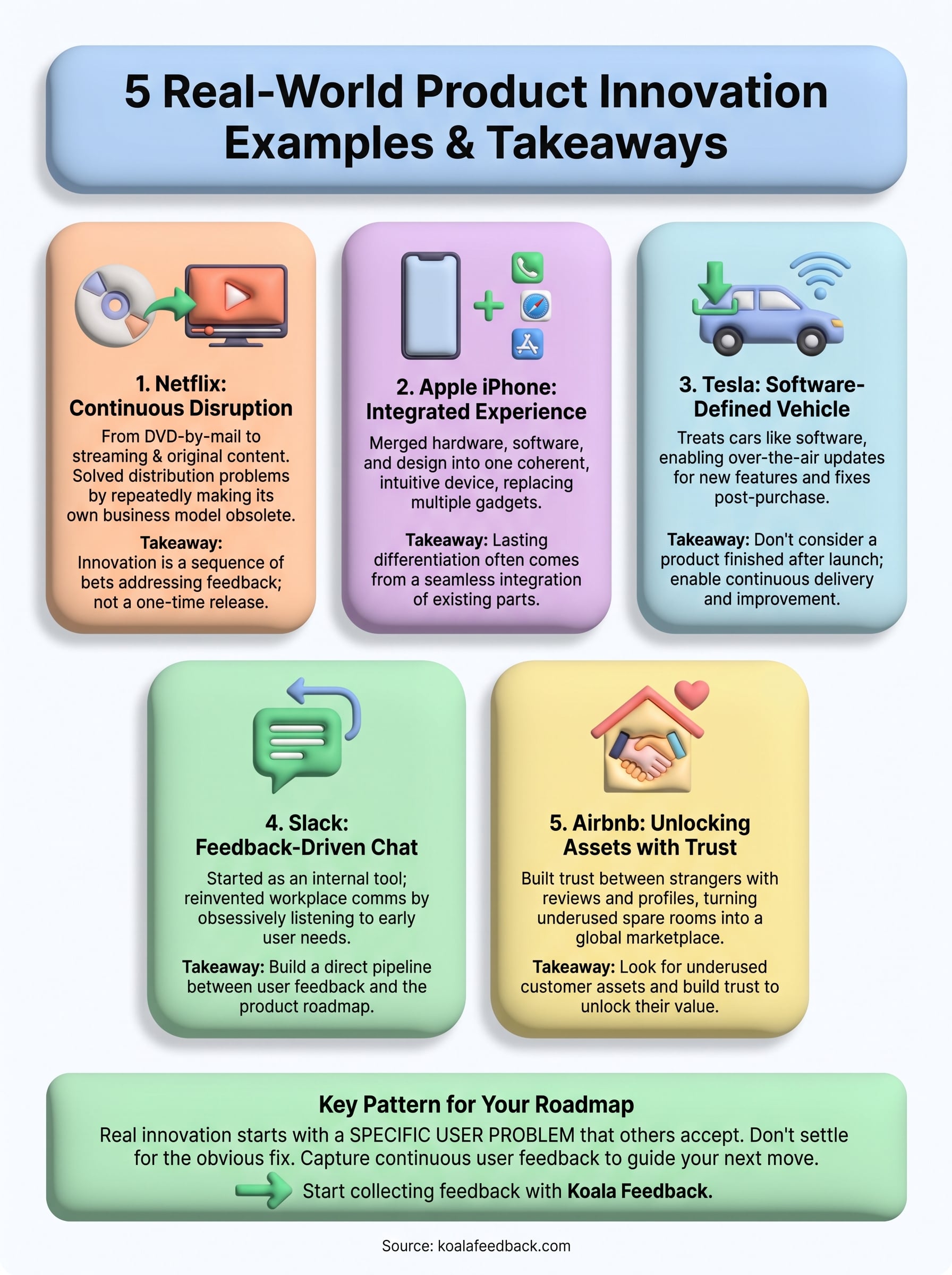
None of these companies started with a fully formed innovation. Netflix, Apple, Tesla, Slack, and Airbnb each began by noticing a specific user problem that everyone else had accepted as normal, then refused to settle for the obvious fix. That pattern matters more than any single product detail: real product innovation ideas come from paying close attention to complaints, workarounds, and small frustrations your users already mention every day.
Your roadmap doesn't need a moonshot to start moving in that direction. It needs a reliable way to hear what users actually want, then a clear place to show them what you're building next. That's the gap Koala Feedback is built to close. Start collecting user feedback in one place with Koala Feedback and turn your next backlog review into the beginning of your own innovation story.

Start today and have your feedback portal up and running in minutes.