Every product team hits the same wall: too many feature requests, too little engineering time, and no clear way to decide what to prioritize and ship next. That's where MoSCoW prioritization comes in, a framework built to cut through the noise and force real decisions instead of endless debate.
MoSCoW stands for Must have, Should have, Could have, and Won't have, four buckets that sort every feature or requirement by how critical it is to your next release. Unlike vague priority labels like "high" or "low," moscow feature prioritization gives your team a shared language for tradeoffs, so a stakeholder pushing for their pet feature has to argue where it fits, not just that it matters.
In this article, you'll get a full breakdown of what MoSCoW means, when it works best, and how to apply it to your own backlog. We'll walk through each category with real examples, common mistakes teams make when they first try moscow product prioritization, and how pairing this method with a centralized feedback tool like Koala Feedback makes the whole process easier to run and easier to explain to your users.
Most product teams don't fail because they lack good ideas. They fail because every idea gets treated as equally urgent, and equally urgent means nothing actually gets done first. MoSCoW prioritization exists to break that stalemate by forcing every feature request into one of four categories before it ever reaches a sprint planning meeting. Instead of a backlog full of "important" items, you end up with a backlog that tells you, at a glance, what ships this release and what waits.
Sales wants the enterprise SSO integration. Support wants better error messages. Your biggest customer wants a custom export format. Left alone, each of these stakeholders will describe their request as critical, because from where they sit, it is. The MoSCoW method doesn't ask people to rank their own request against everyone else's. It asks them to defend which bucket it belongs in, using criteria the whole team agreed on ahead of time. That single shift, from opinion to categorization, removes most of the political friction that stalls roadmap discussions.
MoSCoW works because it replaces "this feels important" with "here's the category, and here's why."
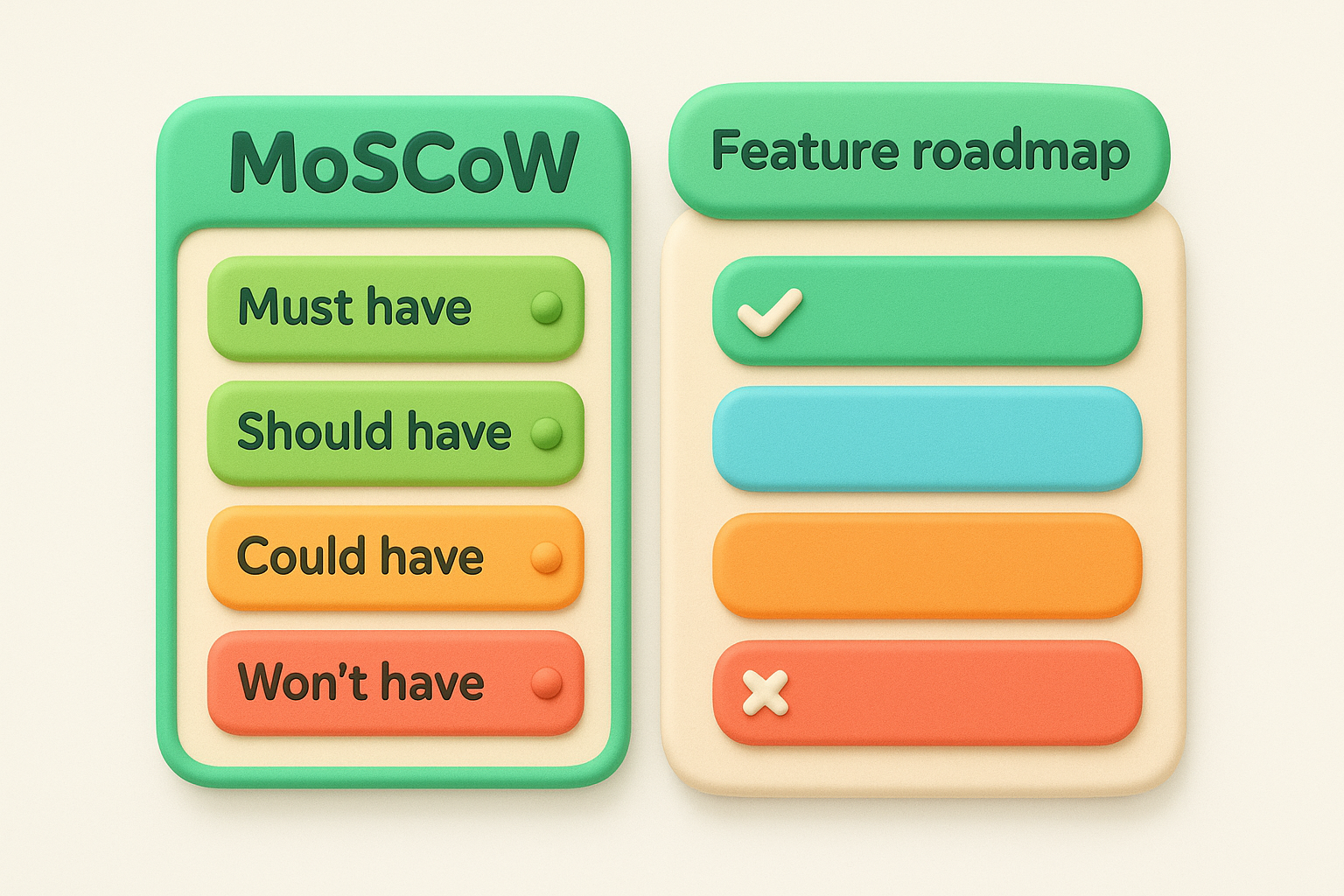
Teams often think their prioritization problem is a tooling problem rather than a missing prioritization framework, so they build an elaborate spreadsheet with weighted scores for impact, effort, and reach. Those scores look precise, but they're usually just gut feelings dressed up in decimal points. MoSCoW skips the false precision and gives you four plain-English labels that anyone on the team, from engineering to customer success, can apply consistently. A must have is something the release fails without. A should have is important but not launch-blocking. A could have adds value if time allows. A won't have is explicitly out of scope for now, not forever.
| Category | What it means | Typical treatment |
|---|---|---|
| Must have | Release fails without it | Scheduled first, non-negotiable |
| Should have | Important, not launch-blocking | Scheduled if capacity allows |
| Could have | Nice-to-have improvement | Backlog, revisit next cycle |
| Won't have | Out of scope for this release | Documented and communicated, not deleted |
Another reason MoSCoW sticks around after twenty-plus years in project management is that it works at multiple altitudes. You can apply it to a single two-week sprint or to an entire quarterly roadmap without changing the framework. Compare that to effort-based frameworks like the RICE scoring model or weighted scoring approaches, which need consistent numeric inputs that small teams rarely have the data to produce reliably. MoSCoW asks for judgment, not spreadsheets full of estimates nobody fully trusts.
Finally, MoSCoW matters because it gives you a vocabulary for talking to users, not just your internal team. When someone submits a feature request through a public feedback board, your process for managing feature requests lets you tell them honestly whether it's a must have for the next release or a won't have for now, rather than leaving them in a vague "under review" limbo indefinitely. That kind of clarity, paired with a public roadmap that shows status changes over time, is a big part of how you communicate roadmap changes and why teams pair MoSCoW with a dedicated tool instead of managing it all in private documents.
Running MoSCoW prioritization well takes more than sorting sticky notes into four columns. The order you do things in matters, because skipping a step usually means you end up with twelve "must haves" and a team that argues about scope right up until launch day. Here's the sequence that actually holds up under pressure.
Before anyone labels a single feature, lock down how much your team can realistically ship this cycle. Skipping this step is the single biggest reason MoSCoW boards turn into wish lists instead of plans. Write the capacity number down and share it with everyone submitting requests, so "must have" means something concrete tied to available engineering hours, not just enthusiasm.
Once capacity is set, run through your backlog and assign each feature to Must, Should, Could, or Won't, the same discipline any other backlog ranking method asks for. No item gets two labels and no item stays unlabeled, that's the whole discipline of the method.
If a feature can't be sorted into one clear bucket, it isn't ready for the roadmap yet.
Moscow product prioritization only works if the "must have" column stays small. Before finalizing that list, test each item against a short checklist:
If an item fails all three questions, move it to Should or Could. Teams that skip this check almost always end up with a Must-have list that's really just "everything we want."
Statuses aren't permanent. Something labeled Won't have this quarter might become a Must have next quarter once customer demand shifts or a competitor ships it first. Treat your MoSCoW board as a living document you revisit at the start of every planning cycle, not a one-time exercise you file away. Product prioritization tools like a shared prioritization board make this recurring review fast, since you're adjusting existing labels instead of rebuilding the list from scratch each time.
Abstract definitions only get you so far, so let's walk through a real scenario. Imagine you run product for a project management tool, and your Q3 release planning meeting just wrapped. Customers submitted forty-plus requests through your feedback portal, and now you need to turn that pile into a shippable plan using moscow feature prioritization.
Below is a simplified version of how that backlog might shake out once the team applies the four buckets. Notice how each item includes a reason, not just a label, because the reason is what makes the category defensible later when someone pushes back.
| Feature request | MoSCoW category | Why |
|---|---|---|
| SOC 2 compliance export | Must have | Enterprise deal is contractually blocked without it |
| Fix broken CSV import | Must have | Core workflow currently unusable for existing users |
| Dark mode | Should have | Frequently requested, but no workflow breaks without it |
| Slack notifications | Should have | Drives engagement, ready to build, not launch-blocking |
| Custom dashboard themes | Could have | Nice polish, low customer demand so far |
| Bulk task templates | Could have | Useful for power users, easy to defer a cycle |
| Native mobile app | Won't have | Out of scope this year, resourcing not available |
| Public API v2 | Won't have | Planned, but not until infrastructure work finishes |
A good MoSCoW board should make you uncomfortable about how short the Must-have column is, not how long it is.
Given this breakdown, the team commits to shipping both Must-have items no matter what, since a broken import and a blocked enterprise contract aren't optional. Habits shift too, because engineering starts the sprint knowing exactly which two items can't slip. Should-have items get scheduled next, filling whatever capacity remains after the Must-haves are accounted for. If Slack notifications and dark mode both fit, great. If only one does, the team picks based on which one moves closer to done, not which one is louder in Slack.
Items in Could-have stay visible on the roadmap, but they're explicitly framed as bonus scope, not commitments. Won't-have items are the trickiest to communicate, so this is where a public roadmap earns its keep. Rather than letting the native mobile app request die silently in a backlog nobody sees, marking it "Not planned" on a roadmap your users can see tells requesters exactly where things stand and cuts down on repeat submissions asking for the same thing.
Even teams that understand the four categories in theory tend to trip over the same pitfalls in practice. Knowing these patterns ahead of time saves you from relearning them the hard way during your first real planning cycle with MoSCoW prioritization.
Bloat is the most common failure mode. Stakeholders know "Must have" gets built first, so everyone lobbies to land there, and without a strict gatekeeping step, the column balloons until it's indistinguishable from the full backlog. Guard against this by requiring written justification for every Must-have label, tied back to the checklist from the previous section. If a request can't point to a broken workflow or a hard deadline, it doesn't belong there.
The moment your Must-have list stops fitting on one screen, something's gone wrong.
Another frequent mistake is using "Won't have" as a polite way to say no forever, then never revisiting it. That erodes trust fast, especially with users who submitted the request expecting some kind of follow-up. Fix this by scheduling a recurring review, monthly or quarterly, where Won't-have items get reconsidered against current priorities rather than left to rot.
Teams also stumble when they assume everyone shares the same definition of each bucket. Marketing might think "Should have" means "nice to have soon," while engineering treats it as "scheduled unless something breaks." Close that gap before you start labeling anything:
Finally, some teams run the whole exercise internally, sorting features based on gut feeling instead of actual demand signals. That defeats the purpose of moscow product prioritization, which works best when your categorization reflects what users are actually asking for and voting on. Pulling from a feedback portal where requests are already sorted into themes with priorities and vote counts are visible gives you a real evidence base, instead of guessing which requests matter most to the people who'll actually use the feature.
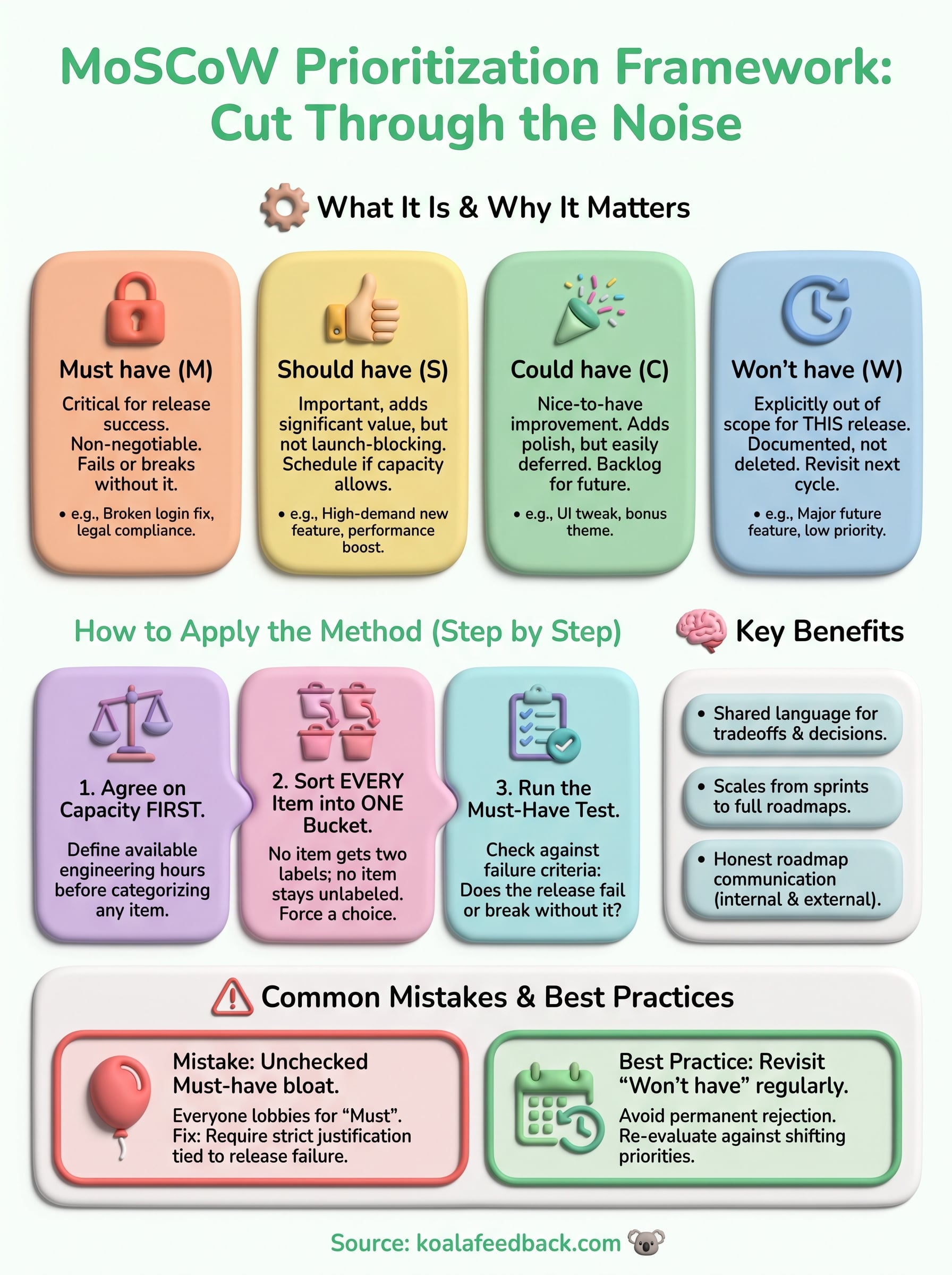
MoSCoW prioritization isn't complicated, but it does require discipline. Four categories, a strict must-have test, and a habit of revisiting labels every cycle will do more for your roadmap than any elaborate scoring spreadsheet. Categorizing feature requests only works, though, if you can see what users are actually asking for and how loudly they're asking for it. Guessing at demand defeats the whole point of the method.
That's the piece a spreadsheet can't give you: a live, organized view of feedback, votes, and roadmap status in one place. Sorting sticky notes works for a single planning meeting, but it falls apart the moment requests keep rolling in from every direction. You need somewhere for those requests to land, get grouped, and stay visible as your Must, Should, Could, and Won't labels shift over time.
If you're ready to run MoSCoW on real data instead of guesswork, put every feature request in one feedback portal with Koala Feedback and connect it directly to your roadmap.

Start today and have your feedback portal up and running in minutes.