Innovation and new product development are two halves of one job. Innovation is the new idea: a product, feature, or method that is meaningfully better or different for customers. New product development (NPD) is the process a company follows to turn that idea into something people can buy, from the first sketch through launch. Innovation without a process stays an idea on a whiteboard. A process without innovation ships more of the same.
This article explains how the two fit together. You will see why innovation matters inside the development process, the three main types of product innovation, and the stages a product moves through on its way to market. Then you will see how to build innovation into each stage, with a worked scoring example, and which mistakes and metrics to watch.
Koala Feedback sits at the two ends of this process. Our platform helps product teams collect user requests, let users vote on them, prioritize what matters, and share a public roadmap. Those are the places where innovation ideas usually begin, and where many of them quietly die without a clear way to evaluate them.
Innovation matters because a development process on its own only produces products. Innovation gives those products a reason to exist: a better answer to a customer problem than what is already on the market. Without it, you ship on schedule and still lose to a competitor who solved the problem differently.
Think of innovation as the what and NPD as the how. Innovation is the creation of a new or improved product, service, or process. NPD is the complete process of bringing a new product to market, including the unglamorous steps of screening, costing, building, testing, and launching.
Researcher Robert Veryzer, in a 1998 study in the Journal of Product Innovation Management, describes discontinuous innovation as radically new products that involve dramatic leaps in customer familiarity and use. Airplanes, automobiles, personal computers, and televisions all fit that description when they first appeared. His study also found that most product development effort goes into incremental work, such as improvements, upgrades, and line extensions, not breakthroughs.
Innovation decides what is worth building. Development decides whether it ever reaches a customer.
When innovation is built into your development process, a handful of things change for the business:
Innovation also carries real costs. Development is expensive, market acceptance is uncertain, and customers sometimes need educating about a product they have never seen. That is why you need a structured process around it. The process does not remove the risk. It lets you spend small amounts to learn early instead of large amounts to learn late.
Product innovation comes in three main types: incremental, radical, and disruptive. They differ in how much changes for the customer and how much risk the company carries. Knowing which type you are attempting tells you how much evidence you need before committing budget.
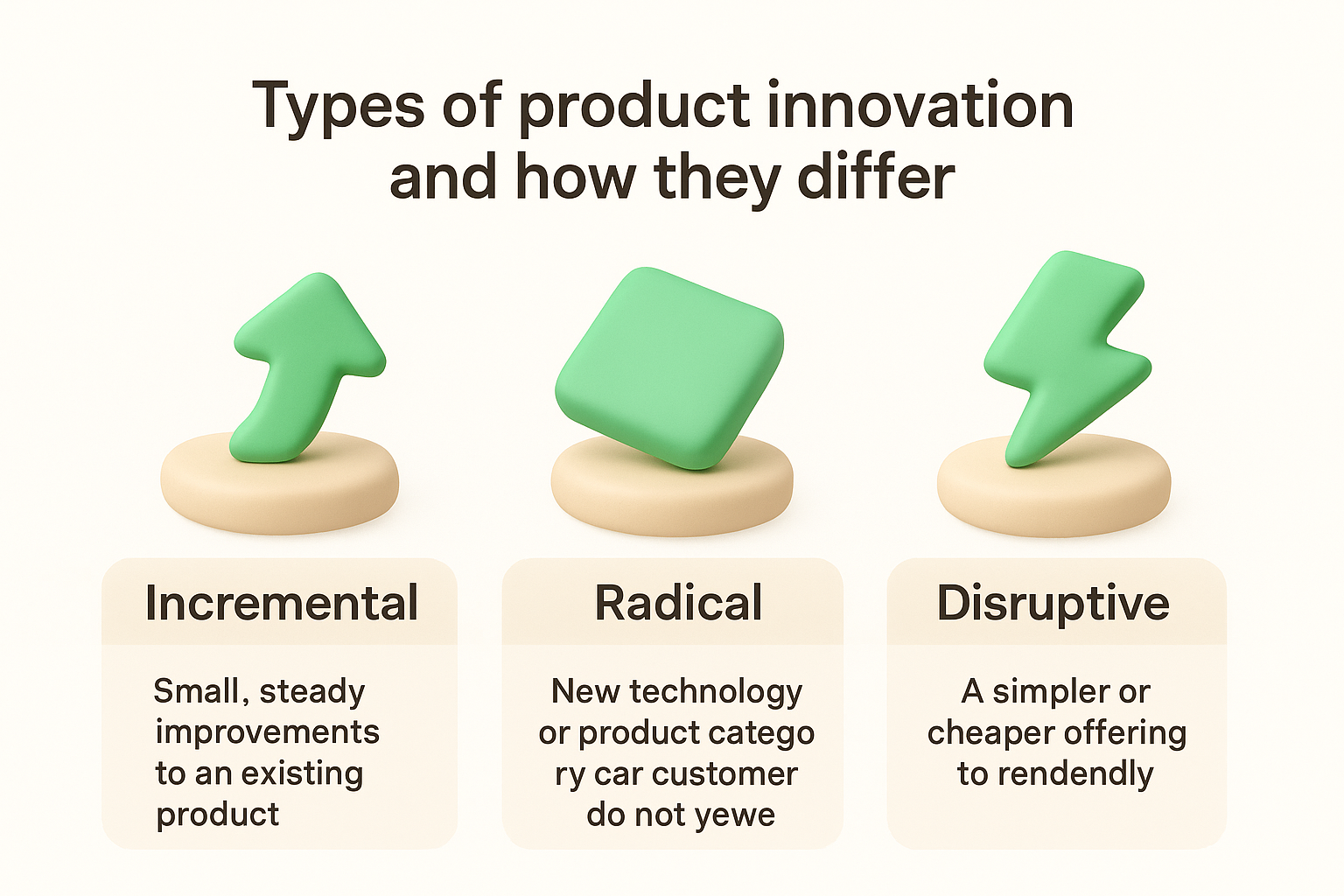
The table sets the three side by side.
| Type | What changes | Risk level | Example |
|---|---|---|---|
| Incremental | Small, steady improvements to an existing product | Low | A phone maker adds a better camera and longer battery life each year |
| Radical (discontinuous) | A new technology or product category that customers do not yet know how to use | High | The first personal computers |
| Disruptive | A simpler or cheaper offering that starts with overlooked customers, then moves upmarket | Medium to high | Video streaming, which began as a convenient alternative to renting discs and later pulled viewers from cable |
Incremental innovation dominates in practice because it is predictable. You already know the customer, the market, and the technology. Radical innovation is the opposite: both the technology and the market are uncertain, so you cannot forecast demand with any confidence. Disruptive innovation is easy to confuse with radical. The difference is that a disruptive product usually starts out worse on the traditional measures but better on price or convenience.
Most teams should run a portfolio, not pick one type. Keep the bulk of your capacity on incremental work that protects your current customers, and reserve a small, protected slice for bigger bets. Mixing them in one backlog is the usual failure, because a safe feature with a clear payoff always beats a risky idea in a side-by-side comparison.
Beyond product innovation, you will hear about process innovation (changing how you build or deliver), platform innovation (a foundation others build on), and marketing innovation (new ways to reach customers). They support product innovation, but they answer different questions, so keep them out of your product scoring.
Match the amount of evidence you demand to the type of innovation, not to your comfort level.
Most models describe NPD as a sequence of about seven stages: idea generation, screening, concept development, business analysis, development, testing, and commercialization. Each stage answers one question and produces one output, which lets you stop a weak idea cheaply before it consumes real money.
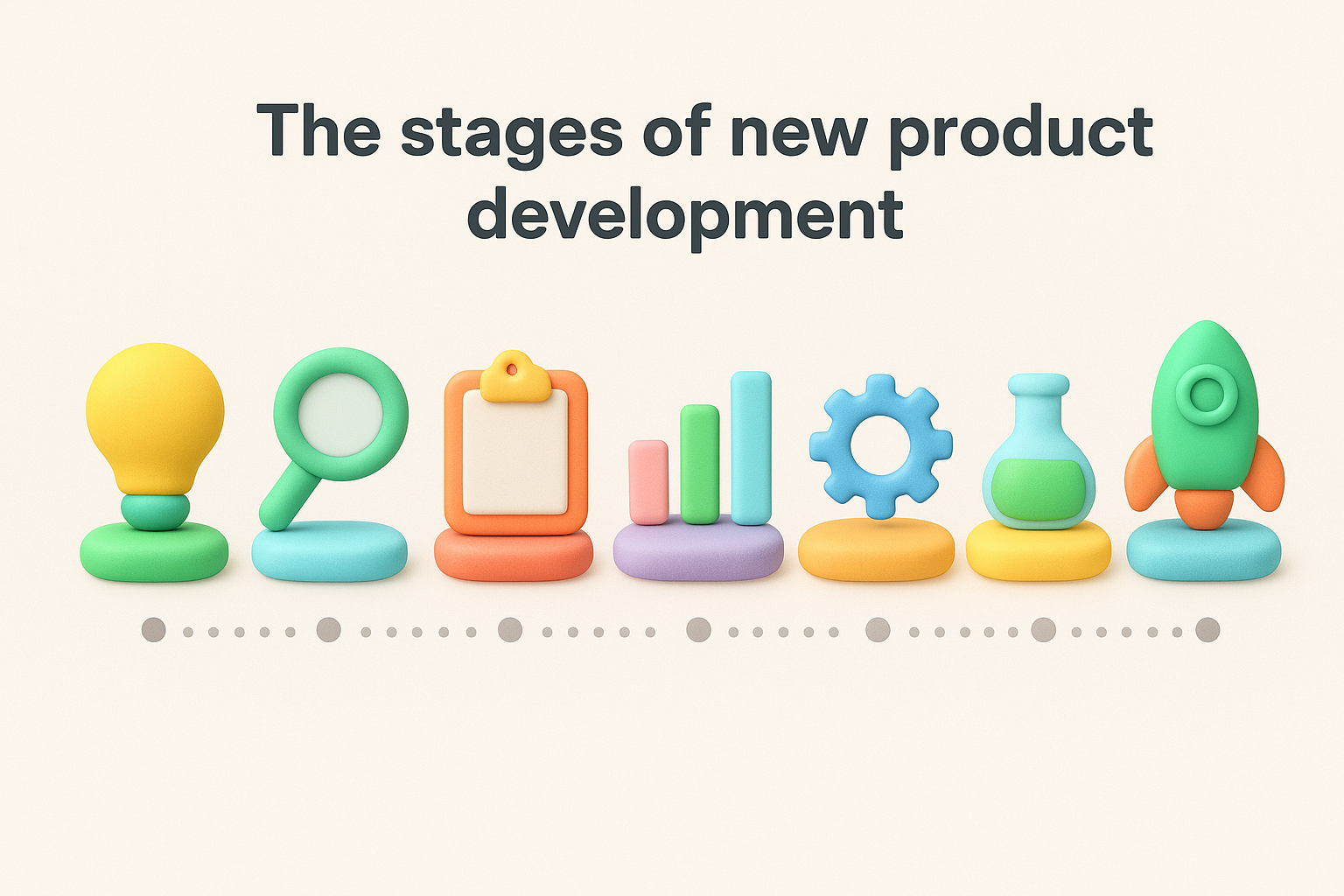
| Stage | Question it answers | Output |
|---|---|---|
| 1. Idea generation | What problems and opportunities exist? | A pool of raw ideas |
| 2. Screening | Which ideas deserve a closer look? | A shortlist |
| 3. Concept development and testing | Do target customers understand and want this? | A tested concept |
| 4. Business analysis | Will it make money, and what will it cost? | Go or no-go with a budget |
| 5. Development | Can we actually build it? | A prototype or minimum viable product |
| 6. Market testing | Do real users behave the way we assumed? | A validated, refined product |
| 7. Commercialization | How do we launch and support it? | A product in the market |
Launch is not the end. After stage 7, you track whether customers adopt the product and whether it meets its goals, then feed what you learn back into stage 1.
You will see versions with five stages and versions with nine. The difference is mostly packaging. A five-stage model merges screening into idea generation and folds business analysis into concept work. A nine-stage model splits out steps like opportunity identification, feasibility, and post-launch monitoring. The substance is the same: learn cheaply first, commit money later.
Also, the stages overlap in practice. Research on the process has long noted that phases run in parallel and loop back, not in a strict line. Treat the stages as decision gates rather than a conveyor belt. At each gate, ask whether the evidence justifies the next, larger spend.
A stage is only useful if it can end in a no.
You build innovation into new product development by feeding the process real customer problems, scoring ideas against clear criteria, testing the riskiest assumptions first, and giving radical ideas a different route than routine improvements. Here is how that looks in practice.
The best innovation input is a recurring customer problem. A suggestion box that asks employees for "anything" tends to produce generic ideas like "add an AI feature." Share customer pain points with the team first, then ask for solutions to those specific problems.
For a software team, a feedback portal is the practical version of this. Users submit requests, vote, and comment, and deduplication keeps the same request from appearing ten times with ten different wordings. The vote counts become a demand signal you can use at the screening stage. Koala Feedback is built for exactly this step, and signing up is free.
Screening needs a simple, repeatable score. Here is a weighted example for three ideas, each rated 1 to 5. Customer demand carries a weight of 3, strategic fit a weight of 2, and ease of building a weight of 1, so the maximum is 30.
| Idea | Demand (x3) | Fit (x2) | Ease (x1) | Total |
|---|---|---|---|---|
| Chat tool integration | 5 = 15 | 3 = 6 | 2 = 2 | 23 |
| Bulk data export | 3 = 9 | 2 = 4 | 5 = 5 | 18 |
| AI-generated suggestions | 2 = 6 | 4 = 8 | 1 = 1 | 15 |
The integration wins on the numbers and goes to concept testing. The AI idea scores poorly, but the score is not trustworthy, because demand for something new is hard to rate. That is where assumption testing comes in. List what must be true, such as "users want this" or "the output is good enough to trust," then run cheap experiments. A landing page with a sign-up button tests interest, and a rough prototype shown to five users tests usefulness. Test the assumption that would kill the idea first.
Veryzer's study of eight discontinuous projects found that firms built prototypes earlier than in typical incremental development, and did so before formal market analysis and financial projections. Their process was more exploratory and less driven by customer requests. Customers cannot ask for something they have never imagined, so a prototype becomes the way you learn what the product is for.
In practice, run two lanes. Incremental ideas go through the standard score-and-build route. Radical ideas get a small team, a capped budget, and a short timeframe, and they must hit a learning goal before they earn more funding. Once a product is moving toward launch, a public roadmap with clear statuses such as planned, in progress, and completed keeps users informed and sets expectations.
Score the ideas you can measure. Test the ones you cannot.
The most common mistakes are skipping early validation, letting risky ideas compete with safe ones in the same backlog, and launching without a way to tell whether the product worked. Fixing these costs far less than the rework they prevent.
These are the ones to watch for:
Pick a small set of measures before launch, so the result cannot be reinterpreted afterward. Useful ones include adoption, retention, revenue from new products, and time from idea to launch. Adoption is the simplest to calculate: users who used the new feature divided by active users, times 100. If 120 of your 800 active users tried a new feature, adoption is 15%.
A number only helps against a target. Set the target at the concept stage, such as "15% adoption within 90 days," and review it at a fixed date. If the product misses, check the assumptions you listed earlier. That tells you whether the idea was wrong or the launch was.
Decide what success looks like before you launch, not after.
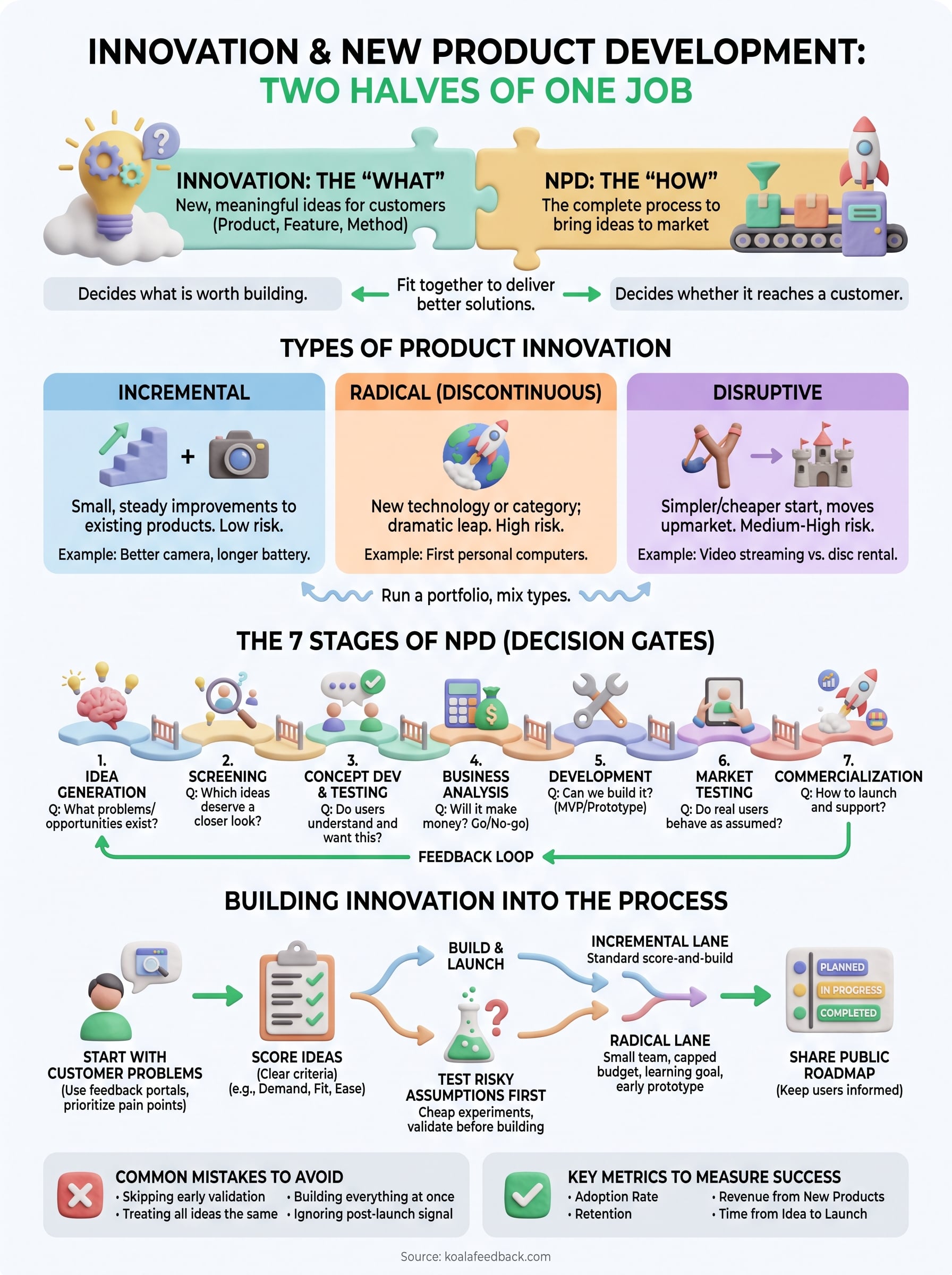
Innovation and new product development work as a pair. Innovation supplies the better idea, and the development process supplies the discipline to test it, fund it, build it, and learn from it. Know which type of innovation you are attempting, move it through the stages as a series of go or no-go decisions, and hold radical ideas to a learning goal instead of a forecast.
The loop starts and ends with customers. Collecting their requests, seeing which ones attract votes, and showing them what you plan to build gives your process better inputs and better outcomes. If you want a simple place to start, set up a free feedback portal with Koala Feedback and let your users tell you which problems are worth solving first.

Start today and have your feedback portal up and running in minutes.