Software product management is the discipline of deciding what software gets built, who it is for, and why, then guiding it from the first idea to retirement. A software product manager (PM) sits between customers, engineers, and the business, and owns the outcome: whether the product solves a real problem and earns its place in the market. The PM does not write the code or run the sprints. The PM makes sure the team builds the right thing.
This guide goes past the definition. You will see why the discipline matters, what a software PM does across the product lifecycle, and a repeatable process you can apply. You will also learn how engineers move into the role, which skills count, and how courses, certifications, and salary expectations fit into getting your first job.
Koala Feedback builds tools that let product teams collect user feedback, prioritize requests, and share roadmaps. That is a core part of the PM's work, so the practical examples below lean on how feedback turns into product decisions.
Software product management matters because building software is expensive, and building the wrong software is the most expensive mistake a team can make. The function exists to cut that risk. It puts one person in charge of choosing the problem worth solving before a team spends months on a solution.
Teams without clear product ownership still make product decisions. They just make them by accident. Engineering decides by default and builds what is easiest or most interesting. Sales pushes for whatever the last prospect asked for. Executives add pet projects. The product drifts.
You can spot the pattern quickly:
Software product management turns "what could we build?" into "what should we build next, and how will we know it worked?"
People often confuse the PM with the project manager, the product owner, or the engineering manager. The overlap is real, but each role owns a different question.
| Role | What it owns | Core question |
|---|---|---|
| Software product manager | Product strategy, roadmap, outcomes | What should we build, and why? |
| Project manager | Schedule, scope, budget, risks | Will it ship on time? |
| Product owner (Scrum) | Backlog and priorities for one team | What does the team build this sprint? |
| Engineering manager | People, process, technical health | Can the team deliver sustainably? |
| Product marketing manager | Positioning, messaging, launch | How will buyers find and choose it? |
In small companies one person covers several rows. That works at ten people. It breaks when the PM becomes a delivery manager who chases tickets all week. The PM oversees release planning and development, but does not run it. A PM who is buried in delivery has no time left to talk to customers.
Product management began outside software. In 1931, Neil McElroy at Procter & Gamble wrote a memo proposing "brand men" who would take full responsibility for a product, from sales tracking to advertising. Software inherited that idea, then changed three things.
First, releases are continuous, so many decisions can be reversed cheaply. Second, usage is measurable, so you can see what people actually do instead of guessing. Third, every feature you ship has an ongoing cost, because someone must support, document, and test it for as long as it exists. That is why saying no is a core skill in product management for software.
A software product manager owns the product's success across its whole lifecycle. That means finding problems worth solving, deciding what to build, overseeing development, launching, and improving the product after release. The PM leads through influence rather than authority, because the engineers, designers, and marketers on the team do not report to them.
Most software PM work maps to five stages. Each has a distinct job and a distinct output.
| Stage | What the PM does | Typical output |
|---|---|---|
| Discovery | Interviews users, reviews feedback and data, sizes the opportunity | Problem statements, opportunity briefs |
| Planning | Sets vision and goals, prioritizes, sequences work | Product strategy, roadmap |
| Development | Defines requirements and acceptance criteria, answers questions, protects scope | Prioritized backlog, specs |
| Launch | Coordinates marketing, sales, support, and documentation | Launch plan, release notes, training |
| Post-launch | Tracks adoption and satisfaction, decides what to fix or retire | Metrics reviews, iteration plan |
The stages repeat. A product ships many releases, so you loop through planning, development, launch, and post-launch again and again. Discovery and strategy never stop. Only end-of-life happens once.
The job is not to manage the build. It is to make sure the build is worth doing and worth shipping.
No two weeks match, and the job changes with company size. At a startup you might write specs, triage support tickets, and set pricing in the same week. At a large company you may own one slice of a larger product. A realistic mix includes:
Look at that list again. Most of it is conversation and writing. Communication is the main work, and the quality of your decisions depends on how well you gather evidence and explain your reasoning.
Titles vary, but five types show up repeatedly in job postings:
If you come from engineering, the technical and platform tracks are the natural fit. If you come from marketing or analytics, growth is often easier to enter.
You practice software product management by running a loop: collect evidence, choose the problem, prioritize, plan, build with engineers, launch, and measure. The steps below work for a solo PM at a startup and for a PM on a large team.
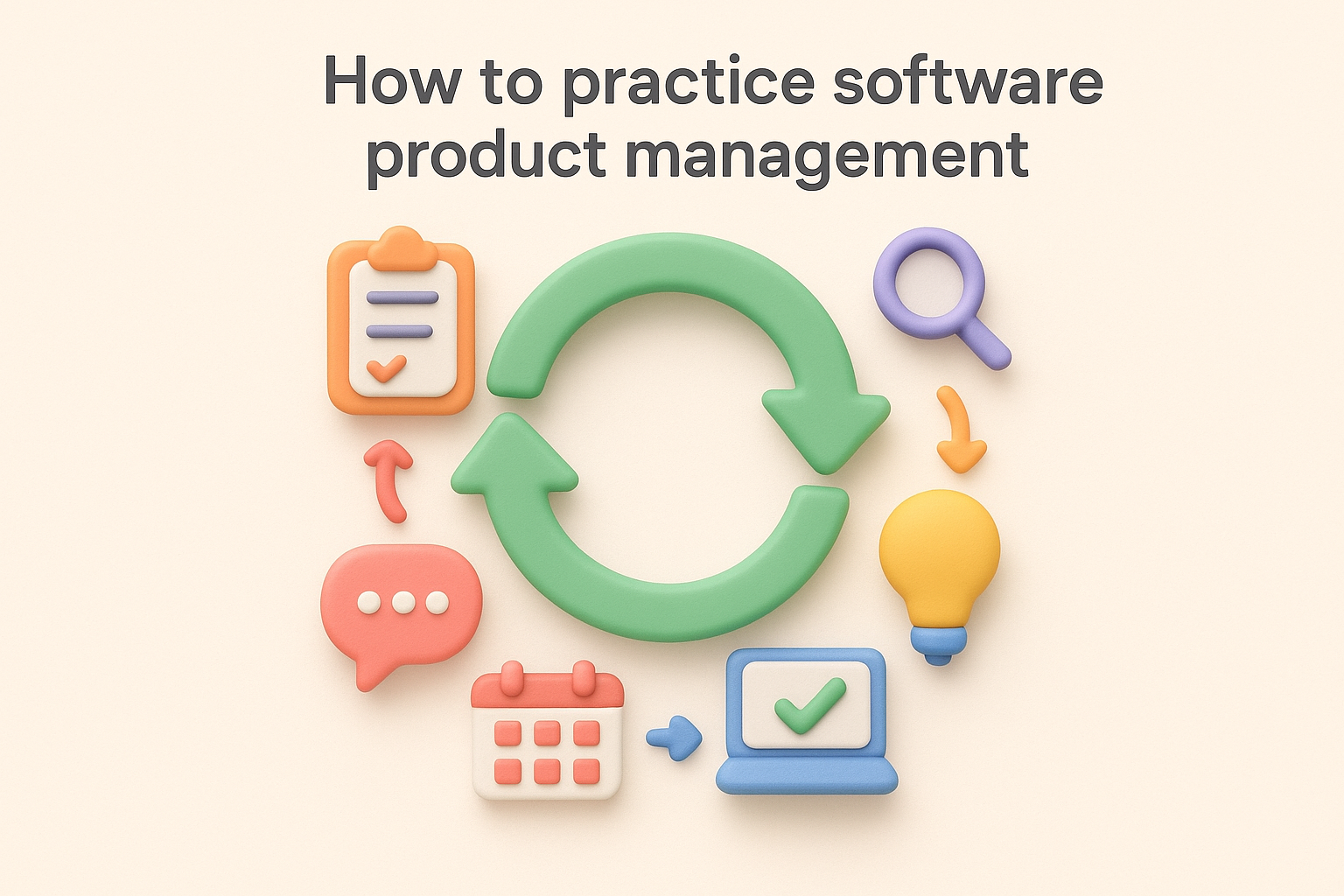
Skipping step 7 is the most common failure. A team that never checks results cannot learn which of its bets were good.
RICE is a simple scoring model: Reach (users affected per quarter) times Impact (3 massive, 2 high, 1 medium, 0.5 low) times Confidence (a percentage), divided by Effort (person-months). Here is a worked example with three candidate features.
| Feature | Reach | Impact | Confidence | Effort | RICE score |
|---|---|---|---|---|---|
| A: Saved filters | 2,000 | 2 | 80% | 4 | 800 |
| B: Slack alerts | 500 | 3 | 50% | 1 | 750 |
| C: CSV export | 5,000 | 1 | 100% | 8 | 625 |
Feature A scores 2,000 × 2 × 0.8 ÷ 4 = 800. Feature B scores 500 × 3 × 0.5 ÷ 1 = 750. Feature C scores 5,000 × 1 × 1 ÷ 8 = 625. The ranking is A, B, C, but A and B are close. B has low confidence, so a quick customer test could raise or sink its score. Use the score to start the discussion, not to end it.
Steps 2, 3, 5, and 7 all depend on one thing: a place where feedback, priorities, and status live together. A spreadsheet works for a few weeks. After that, duplicates pile up and nobody remembers who asked for what.
A feedback tool such as Koala Feedback covers this loop. Users submit ideas through a portal, vote, and comment. Feedback is deduplicated and categorized automatically, and boards organize it by product area. A public roadmap with statuses shows what is planned, in progress, and done. The Starter plan is free and includes 3 boards, 5 statuses, 1 admin, unlimited users, and 100 active posts. The Growth plan is $29 a month, billed annually, and adds unlimited boards and unlimited active posts. For a small product, that is enough to run the whole loop.
Product management for software engineers means shifting from building the thing right to deciding the right thing to build. Engineers start with an edge: they earn the dev team's trust quickly and sense feasibility early. The gap is in customer insight, business thinking, and influencing without authority.
An engineer's output is working code. A PM's output is decisions, alignment, and results that show up weeks or months later. The feedback loop is slower and fuzzier, which many engineers find uncomfortable at first.
| Software engineer | Software PM | |
|---|---|---|
| Main question | How do we build this well? | Should we build this at all? |
| "Done" looks like | Code merged and working | Metric moved, customers satisfied |
| Main tool | Code, tests, architecture | Evidence, writing, conversation |
| Typical mistake | Over-building a solution | Specifying the solution too early |
The last row matters most. Former engineers often write detailed solutions because that is what they know. Describe the problem and the evidence, then let your team design the solution. You will get better answers and a more engaged team.
You rarely get hired as a PM straight from a course. The most reliable route is to start doing the work in your current job.
A technical product manager role is the easiest bridge. It keeps you close to the code and gradually adds customer and business work.
In software development product management, the PM and the team share one backlog but hold different jobs. The PM owns the "what" and "why". Engineers own the "how" and the estimate. Trouble starts when either side crosses the line without a conversation.
Three habits keep the partnership healthy. Bring engineers into product discovery early, so feasibility questions surface before the roadmap is promised. Write acceptance criteria together, so "done" means the same thing to everyone. Explain the reason behind every item in the sprint, because engineers who understand the user make better small decisions than any spec can anticipate.
Give engineers the problem and the evidence, not just the ticket, and they will usually find a smaller solution than the one you had in mind.
A software product manager needs five skill areas: business and strategy, domain knowledge, technology and design, systems and process, and leadership and communication. Almost nobody is strong in all five, so you build the weak ones deliberately and lean on teammates for the rest.
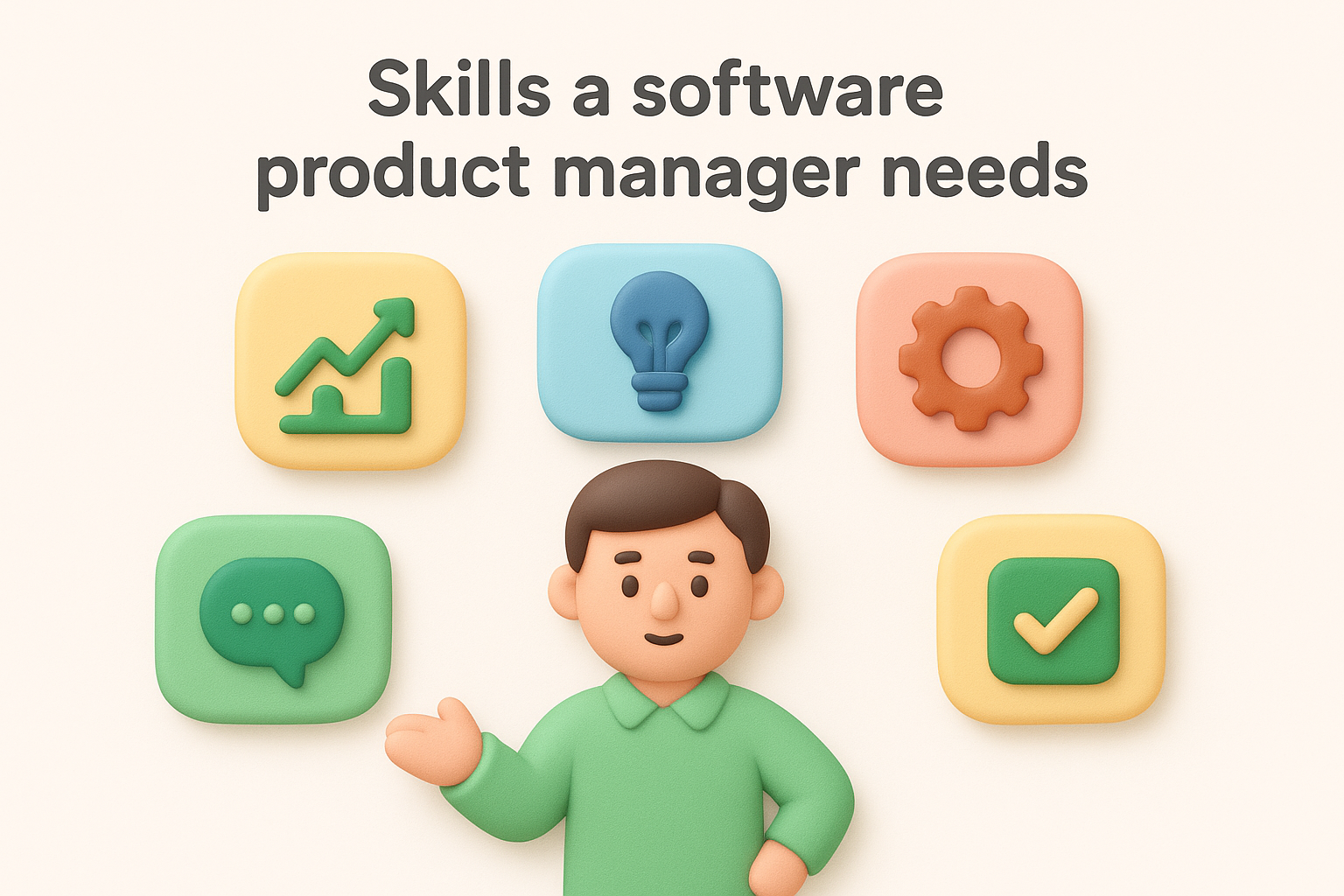
| Skill area | What it means in practice | How to build it |
|---|---|---|
| Business and strategy | Tie features to revenue, retention, or cost; read basic unit economics | Own one metric; study how your company makes money |
| Domain knowledge | Know customers, market, and competitors well | Talk to customers every week; use competing products |
| Technology and design | Understand architecture limits, APIs, and UX basics | Pair with engineers; sit in design reviews |
| Systems and process | Spot friction between idea and release | Map your release path; remove one bottleneck |
| Leadership and communication | Align people without authority; write clearly | Write decision memos; run your own reviews |
Of the five, leadership and communication matter most. Without them a PM becomes a tactician at the mercy of larger teams. Practice by writing short, clear documents that state the decision, the reasoning, and the alternatives you rejected.
You do not need to code. You do need enough fluency to follow a discussion about data models, APIs, latency, and technical debt, and to ask a good question when an estimate looks off. Think of it as being able to hold a real conversation with an engineer about tradeoffs.
Technical PM roles ask for more: reading API documentation, understanding system dependencies, and sometimes writing queries. If you lack this background, start with your own product. Learn how it is built, where its data lives, and which parts are fragile.
No, but it will change what the job spends time on. AI is already useful for summarizing interviews, clustering feedback, drafting briefs, and writing first-pass user stories. Those tasks used to eat hours, and they will shrink.
What AI cannot do is own the bet. Someone must decide which problem matters when evidence conflicts, negotiate tradeoffs between teams, and take responsibility when a launch misses. Judgment and trust remain human work. Use AI for synthesis, but check its summaries against raw customer quotes, because a smooth summary can hide the one comment that changes the decision.
You do not need a specific degree to become a software product manager. Employers look for evidence of product judgment. A course gives you structure, a certification signals process knowledge, and real shipped work proves you can do the job.
PMs come from engineering, design, marketing, analytics, and support, so no single credential gates the role. The options below solve different problems.
| Option | Best for | Limits |
|---|---|---|
| University certificate in software product management | Structure, a recognized name, evening or weekend schedules | Cost and time; little hands-on shipping |
| Online multi-course specialization | Learning Agile practices and team leadership at your own pace | Certificates alone rarely impress hiring managers |
| Agile certifications (PSPO, SAFe Product Owner/Product Manager) | Roles on Scrum or SAFe teams | Cover process, not discovery or strategy |
| Bootcamps and vendor programs | Guided practice, feedback, networking | Quality varies widely; ask for real outcomes |
| Self-study plus a real project | Proof of judgment at low cost | No credential; takes discipline |
For self-study, Inspired by Marty Cagan and The Lean Product Playbook by Dan Olsen are widely recommended starting points. Pick one structured option and one real project. The project is what you will talk about in interviews.
Product manager pay is generally strong compared with many roles, and software PM roles sit at the higher end. The exact figure depends on company size, location, seniority, and whether equity is included. Large tech companies typically pay more than early-stage startups, though startups may offer more equity.
Do not rely on a single number from an article. Several US states now require salary ranges in job postings, so compare current postings for your level and metro area. That gives you a more accurate target than any national average.
Hiring managers want to see how you think. Four things you can do now, without a PM title:
Each of these produces something you can show. A short, honest write-up of a decision and its outcome often does more for your candidacy than another certificate.
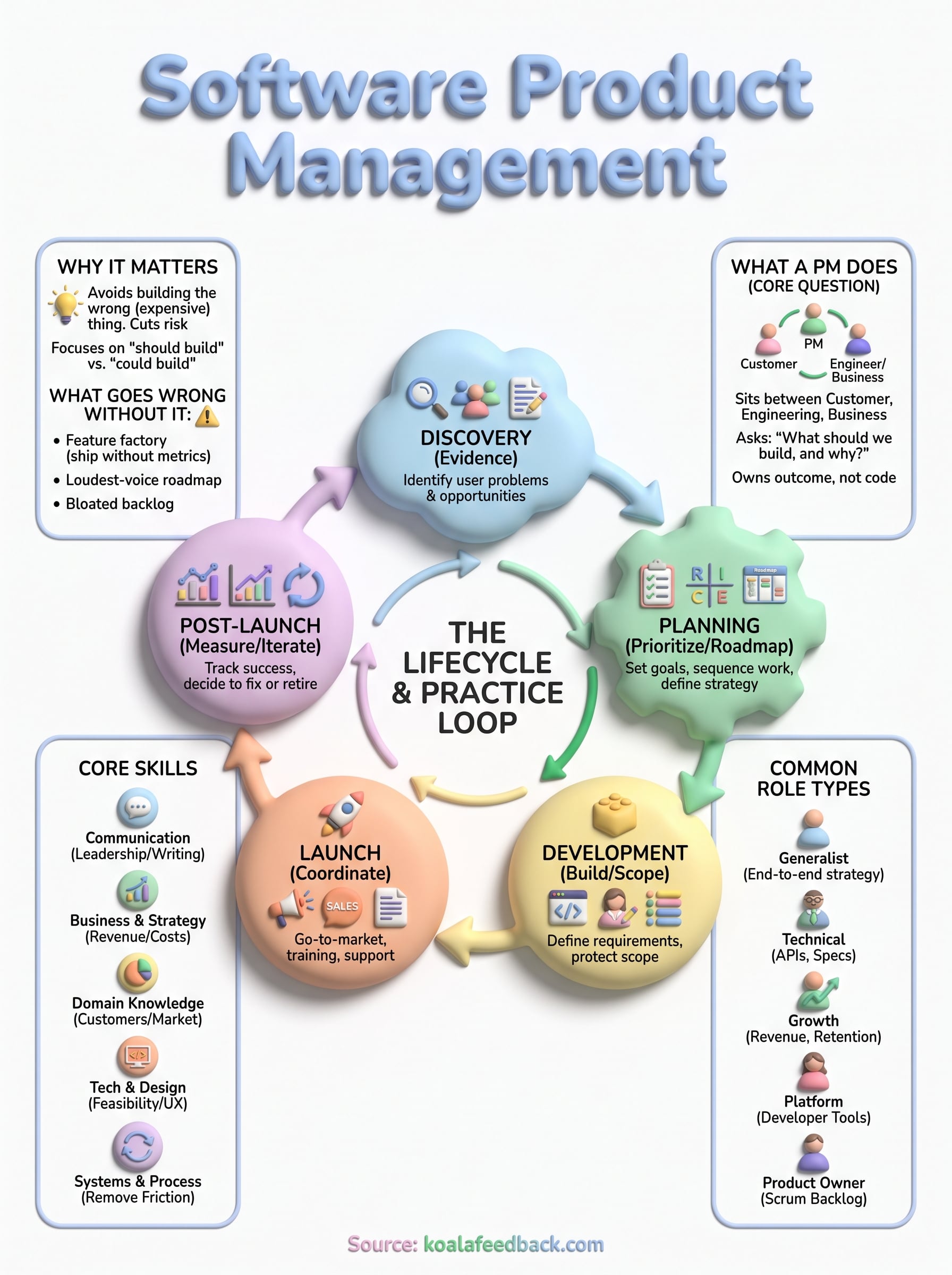
Software product management is the work of choosing what to build and proving it was the right call. The role covers the whole lifecycle, from discovery to retirement. You do the work through evidence, prioritization, clear writing, and a good working relationship with engineers. The skills are learnable, and the fastest way to learn them is to start practicing on a real product.
Begin with the loop: gather feedback in one place, group it into themes, score it against a goal, share a roadmap, and check the result. If you want a ready-made setup for that loop, you can try Koala Feedback for free and run it on your own product this week.

Start today and have your feedback portal up and running in minutes.