Every product you use today went through a series of predictable phases before it ever reached your screen, and every phase demanded something different from the person steering it. If you're trying to map out where your product sits right now, or you're new to the role and need a clear picture of what's ahead, understanding the product manager lifecycle matters more than memorizing a framework from a textbook.
This article breaks down each stage of the product management life cycle, from the first spark of an idea through launch, growth, maturity, and eventual decline, explaining exactly what a product manager does and decides at every point along the way, and how it all fits into what product lifecycle management is. You'll see how priorities shift as a product matures, and why the skills that get you through discovery aren't the same ones that carry you through scaling.
We'll also look at how tools like feedback portals and prioritization board tools fit into this product manager life cycle, since collecting real user input and turning it into a visible roadmap is what separates guesswork from informed decisions at each stage.
Understanding the product manager lifecycle isn't an academic exercise. It's the difference between shipping features nobody asked for and building a product people actually stick with. When you know which stage your product is in, you know what questions to ask, what data to trust, and what to ignore. A product in discovery needs validation, not a marketing budget. A product in maturity needs retention tactics, not a rushed feature list. Skip this step and you'll end up applying growth-stage tactics to a product that's still finding its first ten customers, or worse, treating a mature product like it still needs to prove its core value.
Getting everyone aligned on the current stage prevents the kind of friction that slows teams down for months. Engineering might want to polish a feature that's already validated, while sales is pushing for something the market hasn't asked for yet. Cross-functional alignment only happens when everyone agrees on where the product actually sits in its life cycle, not where each department wishes it were. This is where a shared product roadmap earns its keep. When your team can see the same public roadmap you're working from, arguments about priorities shrink because the stage-appropriate goals are visible to everyone, not buried in your head or a slide deck from last quarter's planning meeting.
A product manager who knows the current stage always outworks one who's guessing.
Budget and headcount get wasted fast when nobody's tracking which phase a product occupies. Launching a full-scale paid acquisition campaign for a product still in beta burns cash on users who'll churn before the product is ready for them. Pouring engineering hours into net-new features for a product already sliding into decline ignores the fact that sunset planning or a pivot might serve the business better. Recognizing the stage tells you where to spend, where to hold back, and when to stop investing altogether. This single decision, more than almost any other a product manager makes, determines whether a quarter's resources produce results or just produce activity.
Customers and executives both respond better to honesty about where a product stands. Telling users a feature is "planned" versus "in progress" versus "live" through a customizable status system on a public roadmap builds trust because it matches reality instead of overpromising. Leadership, too, needs a realistic read on lifecycle stage before they approve budgets, set revenue targets, or greenlight a sunset. Without that shared understanding, you get executives expecting hockey-stick growth from a product that's actually plateauing, and users frustrated that a promised feature never showed up. Transparency tied to lifecycle stage removes most of that friction before it starts.
Granting equal weight to every piece of feedback is one of the fastest ways to derail a roadmap. Feedback from early adopters during discovery often points to missing core functionality, while feedback during maturity tends to cluster around edge cases and polish. Ranking requests without factoring in lifecycle stage means you risk chasing noise instead of signal. Tools built for organizing product feedback, like the ones inside Koala Feedback, help you sort submissions by theme and volume so you can tell which requests actually match what your product needs right now, rather than treating every vote as equally urgent regardless of where you are in the life cycle. That context turns a pile of comments into a prioritized, stage-appropriate action list, which is exactly what separates a reactive product manager from a strategic one.
Every stage of the product management life cycle calls for a different playbook, and applying the wrong one wastes time you can't get back. Managing each phase well means matching your actions, not just your mindset, to where the product actually stands. Below is a practical breakdown of what to do at each point, so you're not guessing which lever to pull.
During discovery, your job is to validate the problem before you build anything, and during launch, your job is to get the smallest workable version in front of real users fast. Skipping validation to chase a launch date is how teams end up shipping features nobody wanted, and no amount of polish fixes a product built on the wrong assumption.
Build the wrong thing fast, and you've still built the wrong thing.
Once a product finds traction, the job shifts from validation to acceleration, then to defense, and eventually to a clear-eyed exit plan, and each of these growth and decline phases asks for different tactics. Confusing these phases, treating a mature product like it's still in growth mode, is one of the most common mistakes a product manager makes, and it's an expensive one.
| Stage | Primary PM focus | Signal to watch |
|---|---|---|
| Growth | Scaling what works, removing onboarding friction | Rising activation and referral rates |
| Maturity | Retention, upsells, defending market share | Flattening growth, rising churn |
| Decline | Sunset planning, migration paths, resource reallocation | Falling usage, shrinking revenue per account |
Recognizing which row you're in tells you whether to add headcount, tighten the roadmap, or start planning an end-of-life announcement. A public roadmap with customizable statuses makes this transition visible to users, so nobody's caught off guard when priorities shift from expansion to sunset.
Ask five product managers how many stages the product manager lifecycle has, and you'll likely get five different answers. Some textbooks describe four stages: introduction, growth, maturity, and decline, borrowed straight from classic marketing theory. Others expand that into six or seven stages of product development by splitting ideation from discovery, or by carving sunset out as its own phase separate from decline. Neither version is wrong. The disagreement comes from how granular you want to get, not from any real difference in what actually happens to a product over time.
Counting stages matters less than recognizing the transitions between them. What actually changes at each transition is your job, not the label on the slide. A five-stage model and a seven-stage model describe the same journey, just with different amounts of detail carved out of the middle.
The number of stages on a slide matters less than knowing which one you're actually in.
Strip away the terminology differences and most frameworks converge on the same five checkpoints, whether they're teaching product management life cycle theory in a business school or running a sprint retro at a startup:
Collapsing or expanding any of these into sub-stages doesn't change the work involved. It just changes how finely you slice the reporting.
Sources disagree mainly because they're built for different audiences. Marketing-oriented frameworks tend to fold discovery and development into a single "introduction" phase because their focus is market positioning, not build decisions. Product-oriented frameworks split those apart because a product manager's day-to-day work in discovery looks nothing like the work in development, even though a marketer might treat both as pre-launch. Startups often add an explicit "validation" stage before development because skipping it is the single most common reason early products fail.
Rather than memorizing a fixed number, build your own stage map based on what triggers a real shift in your team's priorities. If you track your roadmap inside a tool like Koala Feedback's roadmap feature, you can define your own statuses to match whatever stage breakdown actually reflects how your team works, instead of forcing your product into someone else's textbook framework.
Confusing these two roles is one of the fastest ways to stall a product's momentum, and it happens more often than most teams admit. A product manager owns the product management life cycle end to end, deciding what gets built and why, based on user feedback, market signals, and business goals. A project manager owns how and when the work gets done, tracking timelines, dependencies, and resources so the plan actually ships. Both roles matter, but mixing them up means either nobody's asking whether a feature should exist, or nobody's making sure it ships on schedule.
Smaller teams often blend these responsibilities into one person, and that's fine early on, when a single product manager can reasonably run discovery calls in the morning and update a sprint board in the afternoon. The trouble starts once a company scales and that same person is still expected to do both jobs at full depth. Product strategy work versus day-to-day product management suffers first, because strategic thinking needs uninterrupted time, and that's exactly what gets sacrificed when someone's also chasing down blocked tickets. Separating the roles as headcount allows is one of the clearest signs a company is maturing past its earliest stage.
Looking at the two roles side by side across a typical product's life makes the difference concrete:
| Lifecycle stage | Product manager focus | Project manager focus |
|---|---|---|
| Discovery | Validating the problem, talking to users | N/A or lightweight scheduling |
| Development | Prioritizing features, writing requirements | Sprint planning, tracking velocity |
| Launch | Setting success metrics, coordinating go-to-market | Managing the launch timeline and dependencies |
| Growth | Deciding what to build next based on feedback | Keeping delivery on pace with roadmap commitments |
| Decline | Planning sunset or pivot | Coordinating migration timelines and deprecation tasks |
A product manager decides what matters; a project manager makes sure it happens on time.
Running both functions off the same source of truth keeps this split from turning into finger-pointing. When your prioritization boards and public roadmap live in one place, the product manager's decisions about what's next are visible to the project manager planning the sprint, and nobody's reconciling two conflicting spreadsheets. Teams that skip this step tend to relearn the hard way that a roadmap nobody can see isn't a roadmap, it's a guess shared by exactly one person.
Guessing where your product stands in the product manager lifecycle is easy when you're not tracking the right numbers. Every stage has its own signal, and watching the wrong metric at the wrong time leads to decisions that look reasonable on paper but miss what's actually happening with users, which is why it helps to know the KPIs every PM should track. Pairing each stage with a specific metric, and a tool that surfaces it without manual digging, keeps your read on the product honest instead of hopeful.
Before picking a dashboard, figure out what question you're actually trying to answer. A discovery-stage product needs proof of demand, while a maturity-stage product needs proof of retention, and conflating the two wastes a quarter chasing the wrong number.
| Stage | Metric to watch | What it tells you |
|---|---|---|
| Discovery | Problem validation rate from user interviews | Whether the pain point is real |
| Launch | Activation rate | Whether new users reach first value |
| Growth | Referral and expansion revenue | Whether growth is compounding |
| Maturity | Churn and net revenue retention | Whether you're defending share |
| Decline | Active accounts and usage frequency | How fast the product is fading |
Track the metric that matches your stage, not the one that's easiest to screenshot for a board meeting.
Numbers only help if they're paired with context about why users behave the way they do, and that context usually comes straight from feedback rather than analytics alone. A tool for collecting user feedback captures raw requests as they happen, so you're not relying on quarterly surveys to tell you what users already told you months ago. Voting and comment counts inside that portal give you a rough proxy for demand intensity, which matters most during growth when you're deciding what to build next.
Running these tools alongside your analytics stack closes the gap between what the numbers say and why they're moving. A dashboard alone tells you churn is rising; a categorized feedback stream tells you it's rising because a specific workflow broke after your last release. That combination, quantitative signal plus qualitative reason, is what actually lets you manage a stage instead of just observing it.
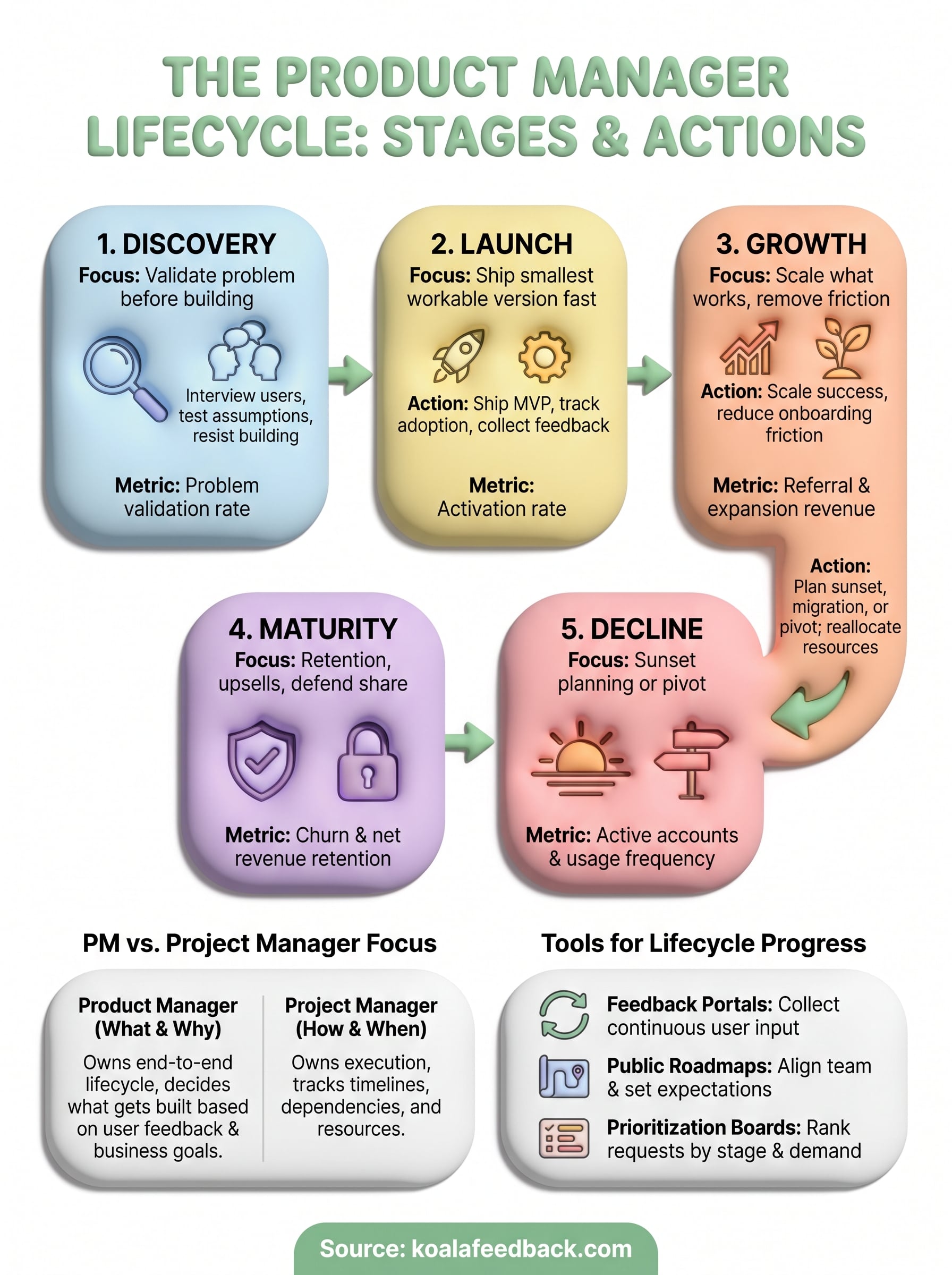
Every stage of the product manager lifecycle asks for a different kind of attention, and the products that survive long-term are the ones whose managers stop applying yesterday's playbook to today's problem. Discovery rewards curiosity, launch rewards speed, growth rewards focus, and decline rewards honesty about when to stop. None of that requires a perfect framework or an agreed-upon number of stages. It requires knowing where you actually stand and choosing the right lever for that moment.
Getting that read right consistently is hard when feedback lives in scattered spreadsheets and your roadmap only exists in your head. Centralizing both gives you the visibility to match your actions to your stage instead of guessing. If you're ready to see exactly where your product stands and what your users actually want next, collect and act on user feedback with Koala Feedback and start building what matters, at the stage that actually matters.

Start today and have your feedback portal up and running in minutes.