If you've ever sat in a meeting where someone asks "is that a strategy question or a roadmap question?" and nobody has a good answer, you've felt the friction between these two roles. The debate over product strategy vs product management shows up constantly on product teams, especially as companies scale and start splitting responsibilities that used to sit with one person. Getting the distinction wrong leads to duplicated work, missed priorities, and teams that build features nobody asked for.
Here's the short version: product strategy sets the direction, the market position, and the long-term bets a company makes on what to build and why. Product management executes that direction day to day, turning strategy into backlogs, sprints, and shipped features. One answers "where are we going," the other answers "how do we get there."
In this article, we'll break down the specific responsibilities that separate the two roles, look at how they differ in time horizon and focus, and cover what this split means for your career path and team structure. We'll also touch on how tools like a centralized feedback portal help both strategists and managers stay grounded in what users actually want.
Blurring product strategy vs product management creates real damage, not just confusion in meetings. When one person or team owns both without a clear split, strategic thinking gets crowded out by the urgency of daily execution. You end up with a roadmap full of small, safe features because nobody had the bandwidth to step back and ask whether the company is even building toward the right market position.
When strategy and execution blur together, execution always wins, and the long-term vision quietly disappears.
Startups often survive without a formal split because the founder holds both roles in their head. That works at ten employees. It breaks down at fifty, when a product manager is buried in sprint planning and nobody is watching competitor moves, market shifts, or customer trends that should reshape the plan. Teams in this spot usually show a few warning signs:
Companies that separate the two roles, even informally, tend to ship features with a clearer purpose. The strategist defines which problems matter and why, and the manager translates that into a plan the engineering team can actually execute. This division also protects morale. Product managers stop feeling like they have to be visionaries and strategists on top of running standups, and strategists stop getting pulled into ticket triage. Everyone knows what they're accountable for, and that clarity shows up in faster decisions and fewer reversed priorities down the line.
Think of the two roles as a relay, not a hierarchy. Product strategy hands off a clear direction, then product management carries that direction through sprints, releases, and customer conversations. Neither role works well in isolation. A strategist without a manager produces plans that never ship. A manager without a strategist ships features that solve the wrong problems.
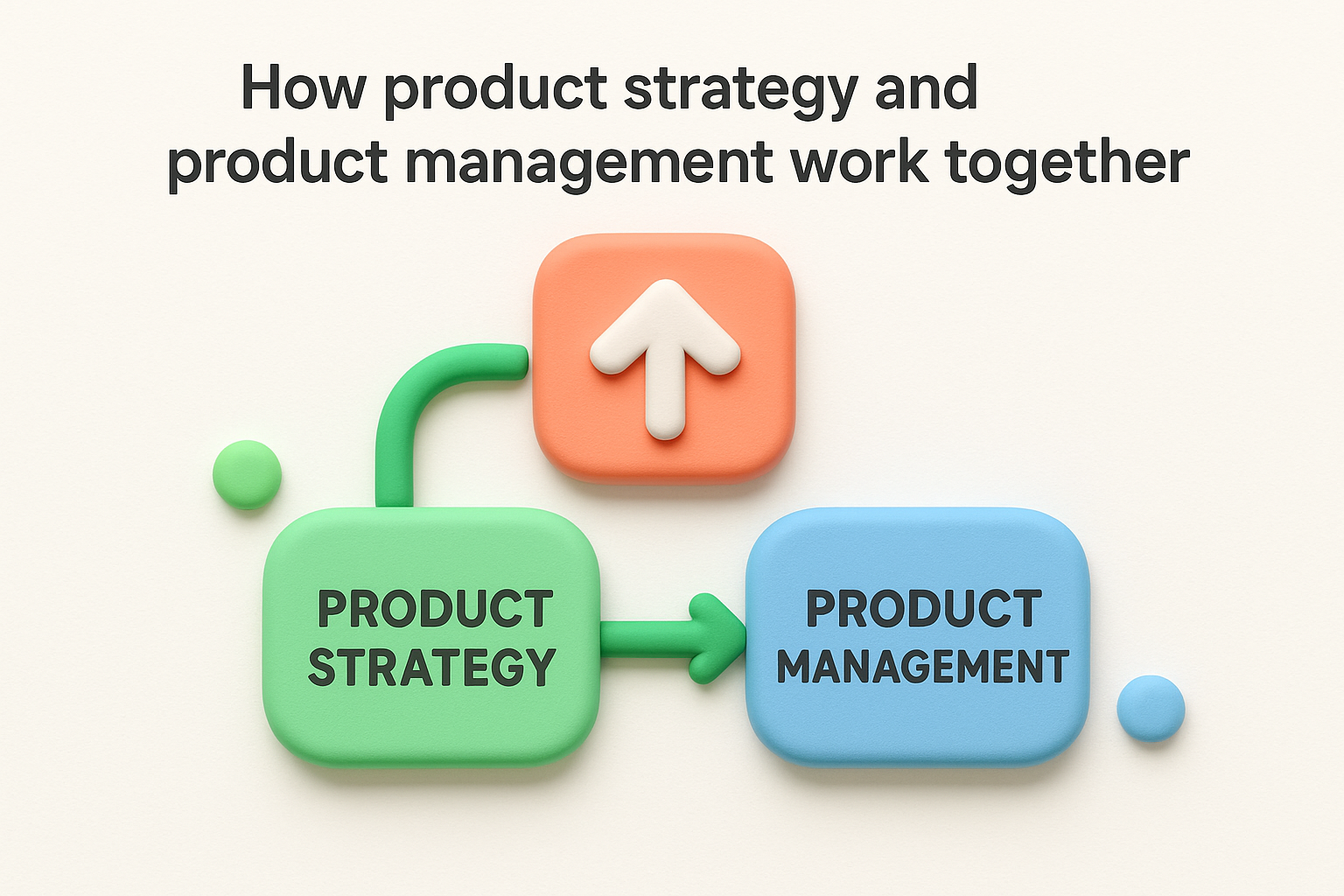
Strategy without execution is a slideshow, and execution without strategy is just busywork.
The cleanest teams build a regular rhythm around this handoff instead of leaving it to chance:
This loop keeps the product roadmap honest. Strategy stays informed by what's actually shippable, and execution stays anchored to a direction bigger than the current backlog. When companies skip this rhythm, the two functions drift apart until someone has to force a painful reset.
Look at a typical Tuesday for each role and the split becomes obvious. A product strategist spends time on market research, competitive analysis, and pricing models, asking questions that won't get answered for months. A product manager spends Tuesday in standups, writing user stories, and unblocking engineers stuck on an edge case. Same product, completely different clocks.
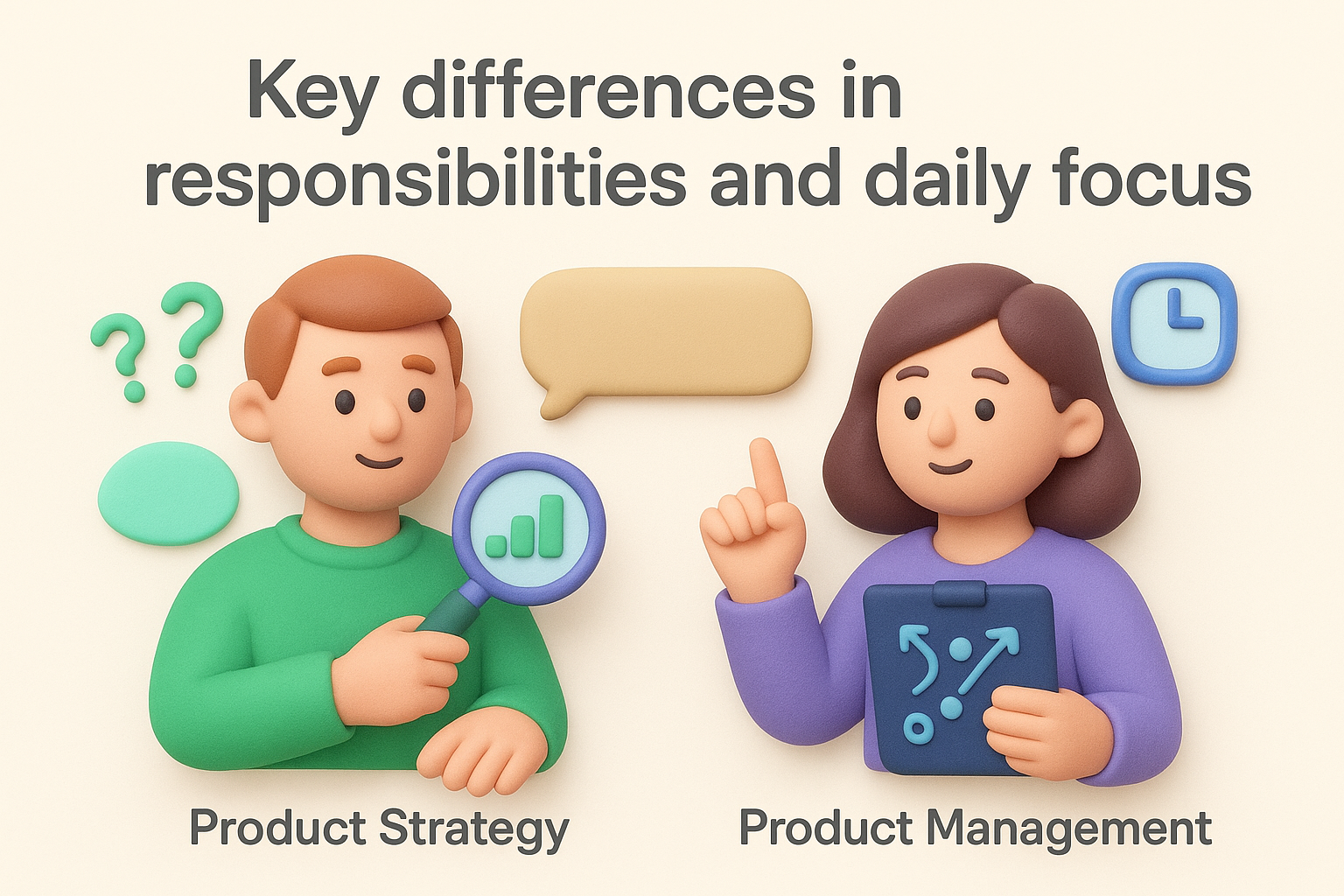
If your calendar is full of sprint tickets, you're managing. If it's full of market questions, you're strategizing.
| Area | Product Strategy | Product Management |
|---|---|---|
| Time horizon | 1-3 years | Days to weeks |
| Core question | Why should we build this? | How and when do we build it? |
| Main output | Market thesis, positioning | Backlog, sprint plan, release |
| Key stakeholders | Executives, board, sales | Engineering, design, support |
| Success metric | Market share, revenue growth | Feature adoption, delivery speed |
Notice how the metrics differ too. Strategy gets judged on whether the company moved in the right direction. Management gets judged on whether the team shipped what it promised, on time and without breaking things.
Career trajectories for product strategist and product manager roles look different from day one, even though many people move between them over a career. Strategists tend to come from backgrounds in consulting, business analysis, or market research, and they lean hard on skills like competitive analysis, financial modeling, and storytelling to executives. Managers often start in engineering, design, or customer support, and their strength comes from prioritization, stakeholder communication, and a tolerance for constant context switching.
The best product leaders eventually learn both crafts, but they rarely start there.
Some skills serve both roles well, while others only matter on one side of the fence:
Promotion paths often run through management first. Companies want proof you can ship before they hand you responsibility for direction. That said, some product management veterans stall out because they never build the market-facing muscles a strategy role demands, so it pays to seek out strategy exposure early, even from a management seat.
Customer feedback feeds both roles, but each one uses it differently. A product strategist scans feedback for patterns that suggest a market shift, like a cluster of requests pointing toward a whole new use case the company hasn't addressed. A product manager scans the same feedback for specific fixes and features that fit into the next sprint. Same data, different lens.
Feedback only becomes strategy when someone steps back far enough to see the pattern, not just the request.
This is where a tool like Koala Feedback earns its place on the team. Instead of feedback scattered across support tickets, sales calls, and stray Slack messages, a feedback portal puts every request in one place, deduplicated and categorized. Strategists get a clear view of recurring themes across the whole user base. Managers get a prioritized list tied directly to the features customers are voting on.
Running both roles off the same feedback source keeps them aligned instead of arguing over which anecdote matters most. Voting counts and comment threads give strategists real market signal, while managers get a built-in prioritization tool for the next roadmap cycle.
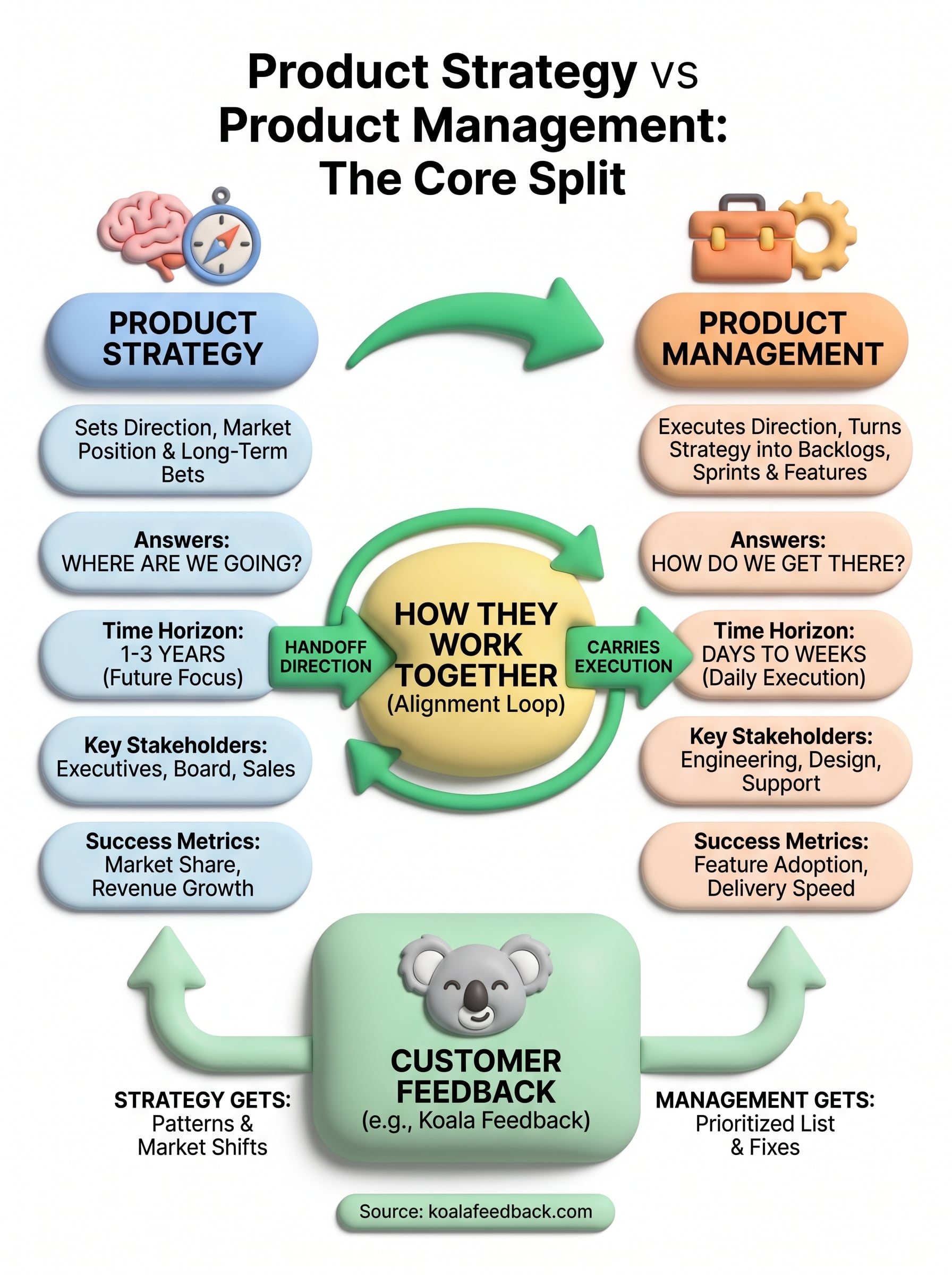
The debate over product strategy vs product management isn't about picking a winner. Strategy sets the direction, management builds the path, and neither one works without the other feeding it real information. Teams that draw a clear line between the two make faster decisions, ship features with a purpose, and stop arguing over whose job it is to answer the hard questions.
What keeps both roles honest is the same thing: a steady stream of customer feedback that shows what people actually want, not what someone assumes they want. Strategists need the pattern, managers need the priority list, and both need it in one place instead of scattered across tools nobody checks.
If you want that single source of truth for your team, try Koala Feedback and give your strategists and managers the same clear signal to work from.

Start today and have your feedback portal up and running in minutes.