The fastest way to build a product marketing strategy is to work in four steps. Research your buyers and competitors, write a positioning statement and message hierarchy, set pricing and pick two or three channels, then plan the launch and the metrics that show whether it worked. Each step produces one short document, and together they fit on a few pages.
Most teams stall because they treat the strategy as a giant deck. They write the announcement before they know who the product is for, or they set a price by copying a competitor. The result is a launch that feels busy and says little. Buyers see a feature list instead of a reason to switch.
This guide walks through the four steps with templates and a running example, an imaginary scheduling tool called ChairTime for dental clinics. You will also see how customer feedback feeds every step, which is the part we know best at Koala Feedback. By the end you can write a first version in an afternoon and adjust it after launch.
A product marketing strategy is the plan for how you position, price, promote, and launch one product to a defined audience. It is narrower than a company marketing plan, and it is different from a product strategy.
Product strategy decides what you build. Product marketing strategy decides who you build it for and how they hear about it. Both rely on the same customer knowledge, which is why the steps below start with research.
A good strategy answers four questions: who the product is for, why they should choose you, what it costs, and where they will hear about it.
The classic marketing mix of product, price, place, and promotion maps onto the steps in this guide. Versions with five or seven Ps add people, process, and physical evidence, which matter most for service businesses. The table shows how each part of the strategy connects.
| Part of the strategy | Question it answers | Marketing mix link |
|---|---|---|
| Market research | Who buys, and what do they use today? | Informs all four Ps |
| Positioning and messaging | Why you instead of the alternatives? | Product, promotion |
| Pricing | What do you charge, and how do you package it? | Price |
| Channels | Where do buyers look for a solution? | Place, promotion |
| Launch and measurement | How do you go live and know it worked? | Promotion |
Throughout the guide, ChairTime serves as the example so you can see each step filled in.
Start by choosing one primary buyer and learning what they use today. Your research is done when you can describe the buyer's trigger, their alternatives, and the words they use for the problem.
Pick one primary segment and write a one-line profile: role, company type, and the event that makes them look for a solution. For ChairTime it reads: office managers at clinics with two to six dentists who just lost revenue to a double-booked chair.
Then interview five to ten people who fit the profile. Ask what they tried first, what frustrated them, and how they describe the problem. Copy their phrases word for word.
List three to five alternatives, including spreadsheets and doing nothing. For each one, note the price, the main promise, and the complaint you hear most often. The gaps in that list become your differentiators.
If you already have users, mine them. A feedback portal where people submit ideas and vote, like the one in Koala Feedback, shows what users ask for most, in their own words. Those words belong in your messaging.
Your buyers' own words beat your best copywriting, so collect them before you write a single headline.
Positioning decides where your product sits in the buyer's mind. Messaging is how you say it. Write the positioning statement first, then build every message from it.
Copy this template and fill each bracket from your research.
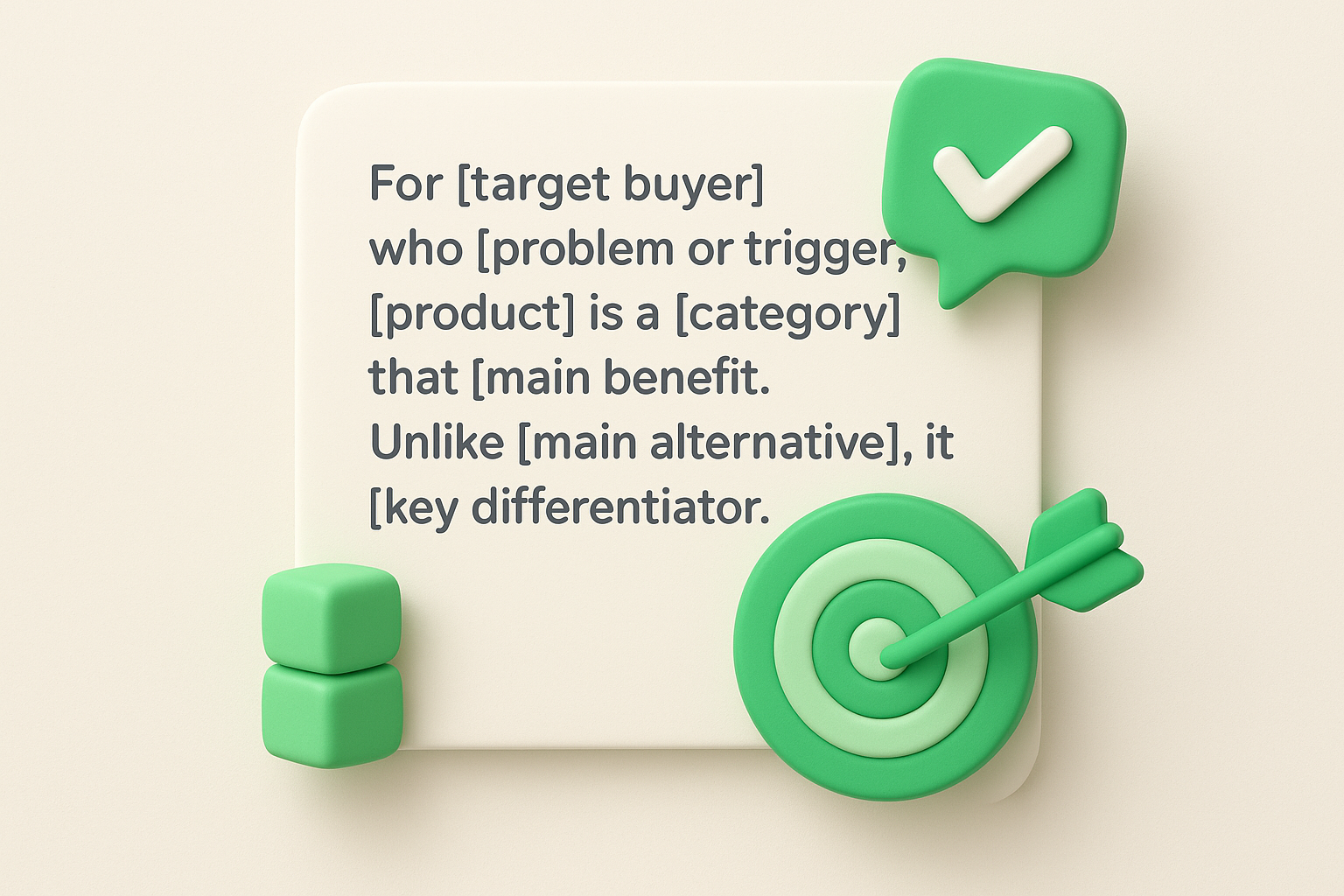
For [target buyer] who [problem or trigger],
[product] is a [category] that [main benefit].
Unlike [main alternative], it [key differentiator].
For ChairTime: "For office managers at small dental clinics who lose revenue to double-booked chairs, ChairTime is a scheduling tool that keeps every chair filled without phone tag. Unlike spreadsheets and general calendars, it blocks conflicts before they happen."
If the statement could describe your competitor too, the differentiator is not specific enough.
A message hierarchy keeps every page, email, and ad consistent. Build it in four layers:
Test the headline on five people from your target segment. If they cannot repeat the promise in their own words, simplify it.
Price against the value the buyer gets, then choose the two or three channels where that buyer already looks. Both decisions should follow from the positioning you just wrote.
Three anchors are common: cost-plus, competitor-based, and value-based. For software, value-based pricing usually fits best, because the cost to serve says little about what the product is worth. Here is a hypothetical ChairTime example. If it prevents four missed appointments a week at $150 each, that is $600 a week, or about $2,400 a month. A price of $99 per month captures roughly 4% of that value.
Tiers then let different buyers self-select. Koala Feedback offers Starter (free), Growth ($29 per month), and Business ($89 per month), all billed annually. Starter allows 3 boards and 100 active posts, while Growth removes both limits. That is a clear reason to upgrade without hiding the entry tier.
Price against the value your buyer gets, not against what the product cost you to build.
Choose channels by where your buyer looks for help, not by what is fashionable.
| Channel | Use it when | ChairTime example |
|---|---|---|
| Search content | Buyers search for the problem | A guide targeting "dental scheduling software" |
| Email outreach | You know the roles and companies | A short note to clinic office managers |
| Communities and associations | Buyers trust peers | A sponsored slot in a dental association newsletter |
Limit yourself to two or three channels and track each one separately. Spreading a small team across eight channels produces thin results everywhere.
Launch on a dated plan, track one metric per stage, and keep collecting feedback after day one. A strategy only counts once you can see whether it works.
Work backward from the launch date:

Keep the plan to one page with a named owner for each task.
Set targets before launch so you cannot move the goalposts afterward. One metric per stage is enough.
| Stage | Metric |
|---|---|
| Awareness | Visits to the product page |
| Activation | Signups that complete the first key action |
| Revenue | Trial-to-paid conversion rate |
| Retention | Accounts still active after 90 days |
After launch, keep the feedback loop open. A public roadmap with statuses like planned, in progress, and completed shows buyers that you act on what they tell you. It also feeds the next round of research in Step 1.
A launch is the start of your learning, so schedule the review before you announce anything.
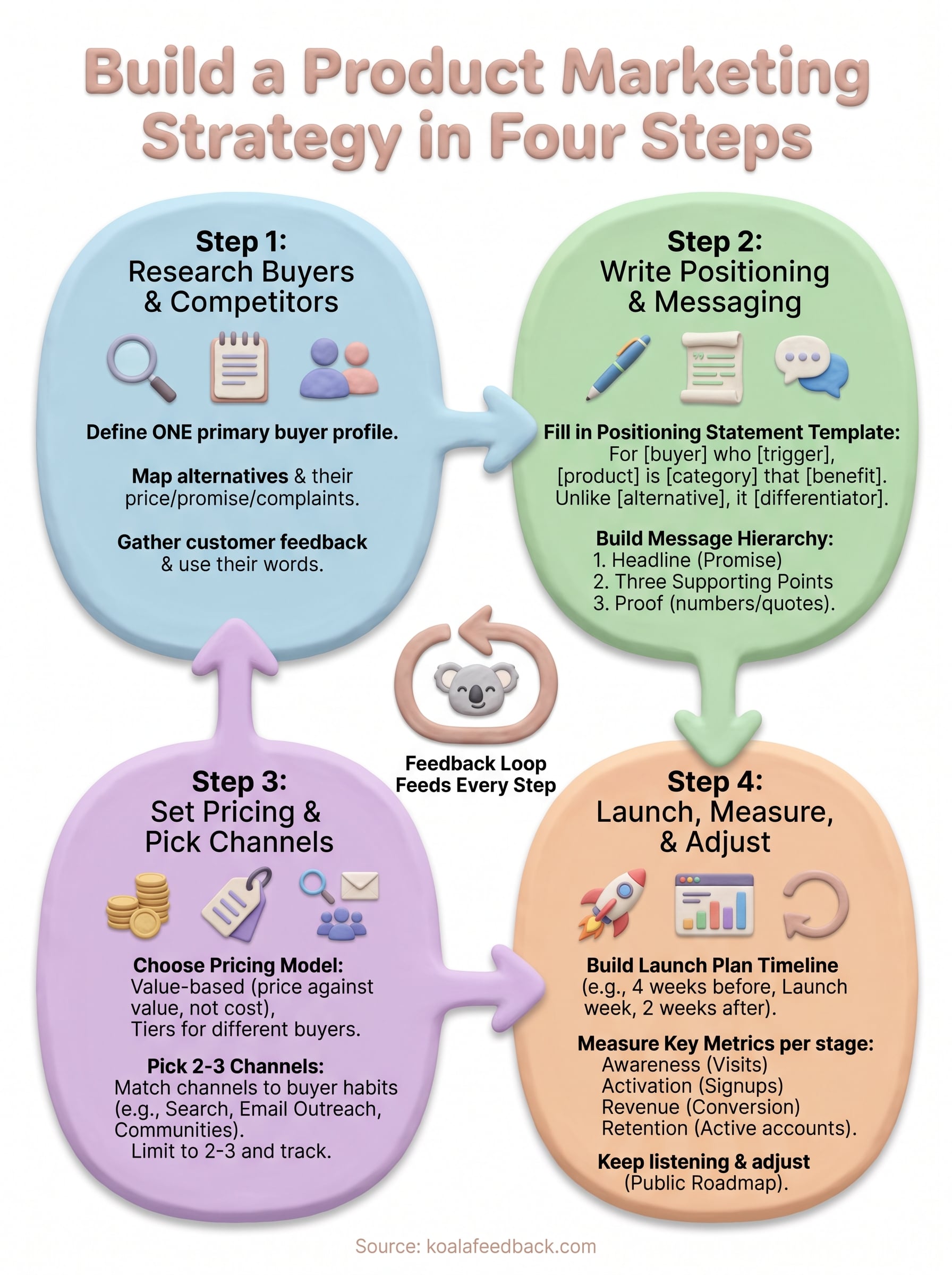
A product marketing strategy comes down to four moves. Research one buyer, write a positioning statement and a message hierarchy, price against value and pick two or three channels, then launch with metrics and a feedback loop. Each move builds on the last, and the whole plan fits on a single page you can share with your team.
Start small. Fill in the positioning template today, test the headline on five buyers this week, and set your launch metrics before you write any copy. Revisit the page after each launch, because the answers will change as you learn.
If you want a ready way to gather the feedback that powers every step, you can start a free feedback portal with Koala Feedback and see what your users ask for, in their own words.

Start today and have your feedback portal up and running in minutes.