A product manager roadmap is a staged plan: learn the core concepts, practice on real projects, prove your skills with a portfolio and interviews, then widen your scope toward senior roles. For most people studying alongside a job, the first three stages take roughly 6 to 12 months. Growing beyond your first PM role takes years. Each stage ends with something you can show to a hiring manager, not just something you read.
Most advice on this topic fails in the same way. You get a catalog of courses, a list of 40 skills, and a pile of tools, with no order and no finish line. Other results confuse the career path with the product roadmap document that teams ship. You end up reading for months and still have nothing to put in front of an interviewer.
This guide fixes the order. It starts with a short grounding section, then walks through four steps with exercises, a scored prioritization example, and a copy-ready roadmap template. At Koala Feedback we build tools for collecting user feedback, prioritizing requests, and sharing public roadmaps, so the practice projects lean on the habits that real product work depends on.
A product manager roadmap is an ordered path from zero experience to a PM role and then to senior scope. It differs from a product roadmap, which is the document a team uses to show what it will build and why. You will learn to make the second one as part of the first.
Skill lists fail because skills depend on each other. You cannot prioritize well before you understand discovery, and you cannot discuss your decisions in an interview if you never made any.
Order beats volume: learn a concept, apply it to a project, then move on.
No specific degree is required for most PM jobs. People move in from engineering, design, customer support, marketing, sales, and analytics. What you do need is simple. You should be curious about why users behave as they do, comfortable with basic numbers in a spreadsheet, and able to write a clear page of text.
If you already work at a software company, you have an advantage. You can practice on your own product and borrow real constraints. If you do not, you will use a side project, a community, or a product you know well.
Each stage has a time box, a focus, and a deliverable. The times assume 5 to 8 hours a week.
| Stage | Timing | Focus | What you finish with |
|---|---|---|---|
| 1. Learn the core | Months 1 to 3 | Concepts, vocabulary, prioritization | One scored backlog |
| 2. Practice | Months 3 to 6 | Interviews, user stories, PRD, roadmap | Three project write-ups |
| 3. Show and land | Months 6 to 12 | Portfolio, resume, interviews | Portfolio and interview stories |
| 4. Grow | Year 2 onward | Strategy, influence, specialization | Outcomes you own |
Start with six concepts, and attach one small exercise to each so the knowledge sticks. Skip the tool tutorials for now. Tools change, but these ideas do not.
| Concept | What to know | Exercise |
|---|---|---|
| Product lifecycle | Stages from idea to launch to maturity | Map the lifecycle of an app you use daily |
| Discovery | Finding real user problems before building | List five problems your favorite app does not solve |
| User stories | "As a [user], I want [goal], so that [reason]" | Write five stories for a feature you wish existed |
| Prioritization | Scoring ideas against each other | Score a 10-item backlog (see below) |
| Metrics | Activation, retention, conversion | Pick one metric for a product and defend it |
| Agile basics | Backlogs, sprints, retrospectives | Plan one week of work as a mini sprint |
Read widely, but do the exercises in writing. A written answer exposes gaps that reading hides.
Prioritization is the skill interviewers test most, so practice it early. RICE is a good starting framework. It scores each idea as Reach times Impact times Confidence, divided by Effort.

Here is a worked example. Reach is users affected per quarter, impact runs from 1 to 3, confidence is a percentage, and effort is in person-months.
| Idea | Reach | Impact | Confidence | Effort | Score |
|---|---|---|---|---|---|
| CSV export | 2,000 | 2 | 80% | 4 | 800 |
| Onboarding checklist | 500 | 3 | 100% | 1 | 1,500 |
The checklist wins even though it reaches fewer people, because it is cheap and you are sure of its impact. Treat the score as a conversation starter, not a verdict. When the math disagrees with your gut, find out which input you guessed.
A score is useful only when you can explain every number in it.
Practice means producing real artifacts, not watching more videos. Complete these five projects in order, and keep every output.
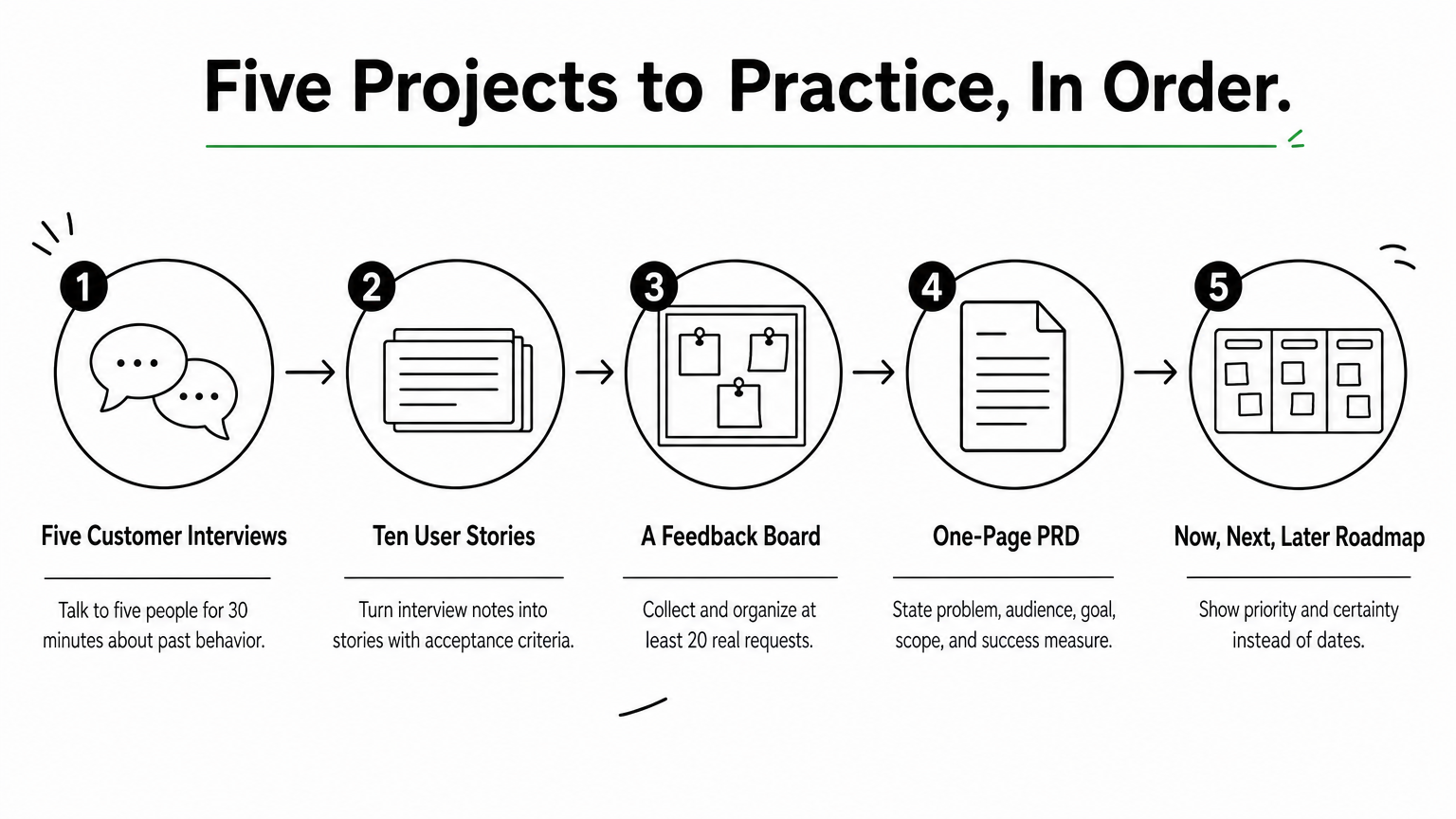
Budget about 4 to 6 hours for each project except the interviews, which take longer because you must recruit people.
Every project should end with a document someone else could read and challenge.
Dates make early roadmaps brittle. A Now, Next, Later layout shows priority and certainty instead. Copy this into a doc or whiteboard and fill it in for your own project.
Product: [name]
Goal this quarter: [one measurable outcome]

NOW (building, committed)
- [Initiative] | Problem: [user problem] | Success metric: [metric]

NEXT (planned, scope still flexible)
- [Initiative] | Problem: [user problem] | Evidence: [interviews, votes]

LATER (exploring, no dates)
- [Initiative] | Problem: [user problem] | Open question: [what we must learn]
Every row names a problem and evidence. That is what separates a roadmap from a wish list, and it is exactly what a hiring manager looks for.
Project three works best with real people. Set up a public feedback portal for a side project, a community, or a product you already work on. Koala Feedback's free Starter plan includes 3 boards, 100 active posts, and unlimited users, and a portal can be live in minutes. Let people submit and vote on ideas, then sort the requests into boards by product area.
Then publish a simple public roadmap and use statuses to set expectations. You will learn quickly how users phrase problems and how duplicate requests stack up.
Your portfolio is three to four short write-ups, not a gallery of screenshots. Hiring managers want to see how you think. Use the same structure for each one:
Label simulated projects as simulated. Honest framing builds more trust than inflated claims, and interviewers will ask follow-up questions anyway.
You probably have more PM experience than you think. Support agents prioritize tickets, engineers weigh tradeoffs, and marketers run experiments. Rewrite each past achievement as a product decision, using this pattern: verb, decision, evidence, outcome.
An example: "Prioritized the three most-reported onboarding issues from 120 support tickets, cutting repeat contacts on setup questions." Use numbers only when they are true and you can explain where they came from.
Expect four question types: product sense (design or improve something), prioritization, metrics (how would you measure this), and behavioral stories. Prepare five stories from your work and projects, each with a clear conflict, a decision, and an outcome. Rehearse out loud with a friend, because reading answers silently does not prepare you for talking.
An interviewer remembers your reasoning far longer than your conclusion.
Growth in product management mostly means a wider scope and more ambiguity, not more features shipped. Titles vary by company, but the pattern is consistent.

| Level | Typical scope | How your roadmap work changes |
|---|---|---|
| Early-career PM | One feature area | You execute roadmap items and write specs |
| PM | A product area | You own the roadmap, metrics, and tradeoffs |
| Senior PM | Several teams or a product line | You set strategy and settle conflicts between teams |
| Director and up | A portfolio of products | You set vision and develop other PMs |
At each step, you spend less time deciding how to build and more time deciding what deserves a team's attention at all.
After a year or two, pick a direction. A technical product manager roadmap adds system basics: how APIs work, how to read architecture diagrams, and enough SQL to answer your own questions. A data-driven track adds experimentation, A/B testing, and dashboards. Platform, growth, and AI product roles each have their own vocabulary.
Choose based on the problems you enjoy, not on which title is trending. Depth in one area makes you easier to hire and easier to trust.
Senior PMs are judged by how well they communicate plans. A development team needs the strategy and the reasons behind priorities, usually with sprint-level detail. Executives want progress toward company goals by quarter. Sales teams want benefits and customer value, ideally without hard dates that become promises. Customers want a high-level view of what is coming.
Keep one source of truth, then show each audience the slice it needs. Review it on a regular schedule. If stakeholders keep asking you for updates, your roadmap is stale or hard to find.
The same roadmap, shown at the right level of detail, builds trust with every audience.
The path is simple to state. Learn six core concepts, practice with five small projects, turn them into honest write-ups, and then grow your scope through specialization and better communication. You do not need permission or a title to begin, only a product to study and a habit of writing down your decisions.
Pick one exercise from Step 1 and finish it before the weekend. Then set up a real feedback board so your practice runs on actual user input. You can create a free Koala Feedback portal and publish your first public roadmap in a single sitting.

Start today and have your feedback portal up and running in minutes.