Process innovation vs product innovation comes down to what changes. Product innovation changes what you sell: a new or clearly improved product or service. Process innovation changes how you make, deliver, or support it. A new feature is product innovation. An automated deployment pipeline is process innovation. Customers see the first and rarely notice the second.
The distinction matters in practice because the two need different goals, owners, and metrics. At Koala Feedback, we help product teams collect and prioritize user feedback, which is raw material for product innovation. How a team handles that feedback is a process question, so both ideas show up in the daily work of the people we build for.
This article explains why the difference matters, how to tell the two apart, and what real examples of each look like. It then shows how to apply both in your own business, and where a third type, business model innovation, fits in.
The two types matter separately because they pay off differently, on different timelines, and get measured differently. Mix them up and you pick the wrong projects or call good ones failures.
Product innovation mainly grows revenue. A better offer wins new customers, supports higher prices, or opens a new market. Process innovation mainly protects margin. It lowers cost, shortens cycle time, and cuts defects, so you earn more from every sale you already make.
You can see the split in the numbers. A product win appears in sign-ups, sales, and retention. A process win appears in cost per unit, delivery time, and error rates.
Product innovation changes what customers buy, and process innovation changes what it costs you to deliver it.
Teams that judge a process project by revenue watch it "fail" even as costs fall. Teams that judge a product project by cost savings kill ideas that need an investment first. Both mistakes come from using one scorecard for two different jobs.
A company that only does product innovation also ships on a creaky process, and quality suffers. A company that only does process innovation ends up polishing a product nobody wants.
The fastest way to separate them is to ask what the change touches: the offer or the operation. The table lays out the contrasts.
| Dimension | Product innovation | Process innovation |
|---|---|---|
| What changes | The product or service itself | How it is produced, delivered, or supported |
| Who notices | Customers | Mostly your team, sometimes customers indirectly |
| Main goal | New revenue, differentiation | Lower cost, speed, quality |
| Typical metrics | Sales, adoption, retention | Cost per unit, cycle time, defect rate |
| Typical owners | Product, design, R&D | Operations, engineering, finance |
| Main risk | Building something nobody wants | Optimizing something that should not exist |
Ask this: would a customer see the change in what they receive? If yes, it is product innovation. If it only changes how your team works, it is process innovation.
Some changes do both. Faster delivery is a process change that customers feel. Classify it by what you changed, not by what it enables. The OECD's Oslo Manual, the standard reference for measuring innovation, draws the same line between products and business processes.
Neither type is automatically small or large. Both can be incremental or radical. A tweaked onboarding checklist is an incremental process change, while the first moving assembly line was a radical one. Adding a filter to a feature is incremental, and the first smartphone was radical.
Size does not decide the type. Ask whether the offer or the operation changed.
Real examples make the line easy to see. In each case below, notice whether the change reaches the customer's hands or stays behind the scenes.
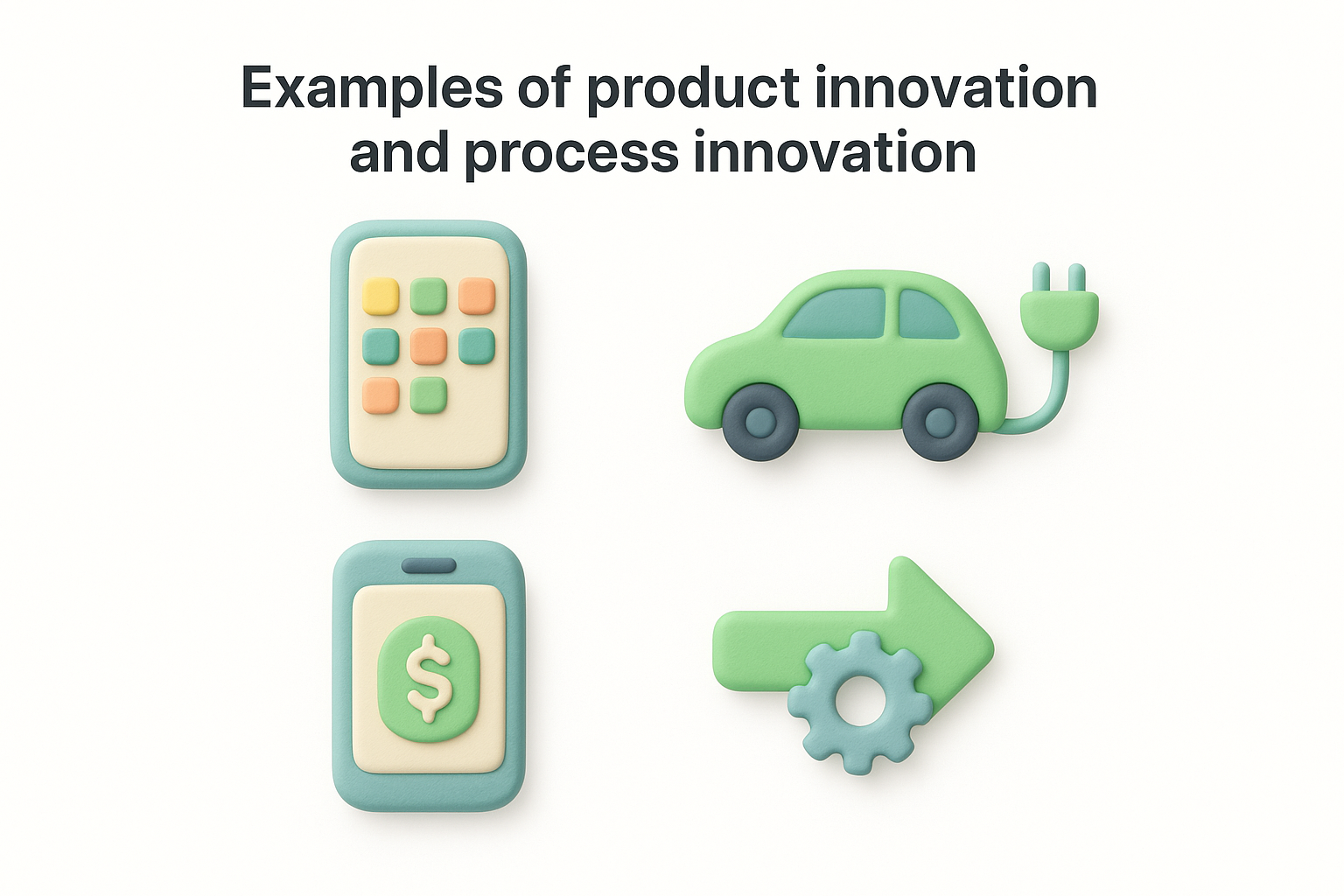
In each process example, the customer gets the same kind of product. It simply arrives cheaper, faster, or more reliably.
If the customer could not tell you what changed, you are probably looking at process innovation.
Apply both by sorting your work into two lists, sourcing ideas differently for each, and setting the right metric before you start.
Take a hypothetical eight-person SaaS team. It spends 10 hours a week manually sorting about 150 feedback requests. Automating the sorting cuts that to 2 hours, so the team saves 8 hours a week. Over 50 working weeks, that is 400 hours. At a loaded cost of $60 per hour, the saving is $24,000 a year.
That is process innovation. The product side is what the sorted feedback reveals, such as a feature many customers asked for. This is where a tool like Koala Feedback fits. Its portal with voting and comments surfaces product ideas, and its automatic deduplication and categorization handle the sorting.
Use customer feedback to decide what to build, and use team friction to decide what to streamline.
Most frameworks list three major types of innovation: product, process, and business model. Business model innovation changes how a company creates and captures value, not just what it sells or how it makes it. Moving software from one-time licenses to subscriptions is a classic case.
Product and process innovation often depend on each other. A new product can demand a new production method, as electric vehicles required new battery manufacturing. A better process can free up time and budget for product work, as automating routine tasks lets a team build more.
Some models add more categories. Tidd and Bessant's well-known framework, for example, adds position and paradigm innovation, which cover where you sell and how you frame what you do. For most teams, product and process are the two to master first.
Strong companies treat the two as partners: products win customers, and processes make winning affordable.
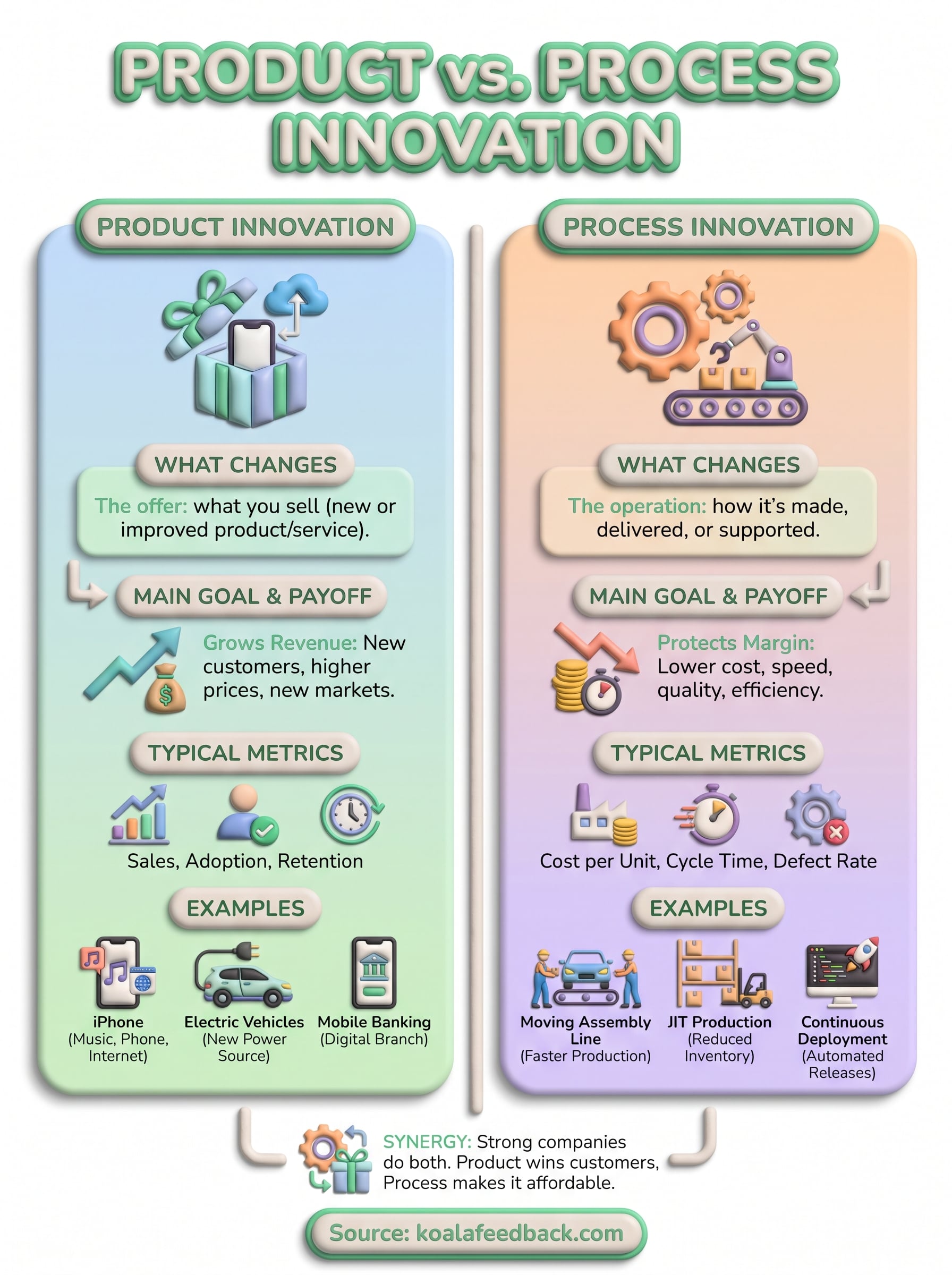
Product innovation changes the offer, and process innovation changes the operation. Use product innovation when you need growth and differentiation, and process innovation when you need lower cost, speed, or quality. Judge each by its own metric, and let the two feed each other.
If you build software, start with what your users are already telling you. You can collect, prioritize, and share feedback with Koala Feedback, and signing up is free.

Start today and have your feedback portal up and running in minutes.