Every product you build, ship, or manage moves through a predictable pattern of growth, peak, and eventual decline. Understanding the lifecycle product stages helps you make smarter calls about when to invest in new features, when to double down on marketing, and when to plan a graceful exit or pivot. If you have ever wondered why a once-popular feature suddenly stops getting traction, the answer usually traces back to where it sits in this cycle.
So what is life cycle of product, exactly? It is the series of stages a product passes through from the moment it launches to the moment it gets retired: introduction, growth, maturity, and decline, the foundation of managing a product across its full lifecycle. Each stage brings different customer behavior, revenue patterns, and priorities for your team, and recognizing which stage you are in changes how you should respond.
In this article, we break down each stage in plain terms, show you real examples of products moving through the cycle, and explain how tracking user feedback at every stage helps you extend a product's life or know when it's time to move on. By the end, you will have a clear framework for thinking about your own product roadmap decisions.
Every stage of the product lifecycle demands a different playbook. Treat a mature product like it just launched, and you'll waste budget on awareness campaigns nobody needs. Treat a growth-stage product like it's already established, and you'll starve it of the investment that could make it a category leader. Strategic decisions tied to the wrong stage cost you time, money, and credibility with your team, which is exactly how product strategy fuels SaaS growth or quietly stalls it. That's why mapping your lifecycle product stage accurately, before you plan quarterly goals, matters more than most roadmap meetings acknowledge.
Get the stage wrong, and every strategic decision that follows is built on a bad assumption.
Budgets should never look the same across the lifecycle. During introduction, you're spending heavily on customer acquisition and product education with little revenue to show for it. Growth brings scaling costs, more support staff, more infrastructure, but also your steepest revenue climb. Maturity is where profit margins peak because acquisition costs drop and your product runs efficiently. Decline calls for cost-cutting and a decision about sunset timing or reinvention.
| Stage | Revenue trend | Primary spending focus | Team priority |
|---|---|---|---|
| Introduction | Low, slow growth | Marketing, education | Prove product-market fit |
| Growth | Rapid increase | Scaling infrastructure, support | Capture market share |
| Maturity | Peaks, then flattens | Retention, efficiency | Defend position, optimize |
| Decline | Falling | Cost reduction | Sunset, pivot, or reinvest |
Recognizing exactly where your product sits in this cycle tells you where your next dollar should go and which resource allocation decisions deserve priority this quarter.
Without a lifecycle framework, teams tend to build features reactively, chasing whatever request landed most recently in their inbox. This kind of reactive feature building often adds complexity to a mature product that should be simplifying, or under-invests in a growth-stage product that needs bold moves to keep pace with demand. A feature request that makes sense during growth, like an integration that helps you land bigger accounts, might be a distraction during decline, when your energy is better spent stabilizing revenue.
Grounding your roadmap in lifecycle stage keeps your approach to prioritizing feature requests honest. Instead of asking "does this sound like a good idea," you ask "does this move the needle for where we are right now." Tools like Koala Feedback's prioritization boards help teams sort incoming requests by product area and stage, so a growth-stage idea doesn't get buried under maintenance requests meant for a mature product line.
Customers read your public roadmap differently depending on lifecycle stage, so the way you present your roadmap to users matters, and if you don't account for that, your messaging misfires. Early adopters using an introduction-stage product want to see rapid iteration and responsiveness. Users relying on a mature product care more about stability and want confirmation that core features won't break, since they've built their own workflows on top of what already exists.
Sharing a public roadmap that reflects your actual lifecycle stage builds customer trust, because people see planned, in-progress, and completed work that matches what they'd expect at that point in the product's life. A startup shipping weekly features signals momentum during growth. An established platform with a slower, deliberate cadence signals reliability during maturity. Both are appropriate responses; the mismatch between stage and messaging is what erodes confidence.
Ultimately, lifecycle awareness turns your strategy from reactive to intentional. Rather than reacting to whichever metric dipped last quarter, you plan investment, marketing, and communication around where the product actually stands. That distinction separates teams that extend a product's profitable life for years from teams that watch a promising product fade simply because nobody noticed it had already moved from growth into maturity.
Pinpointing where a lifecycle product actually sits takes more than gut feeling, so it helps to know every stage of the product manager lifecycle. You need concrete signals, not just a hunch based on how long the product has been live. Every feature has its own lifecycle from ideation to sunset, so one launched two years ago could still be in growth if adoption keeps climbing, while something released last quarter might already show signs of maturity if the market moved fast. Watching the right indicators keeps you from making decisions based on age alone.
Each stage leaves fingerprints in your data before you ever open a spreadsheet. Introduction shows up as slow, uneven adoption paired with a flood of clarifying questions in your support queue. Growth looks like accelerating sign-ups, expanding word-of-mouth referrals, and feature requests that push for scale rather than basics. Maturity brings flat or slightly declining new-user numbers alongside heavy usage from your existing base, who now ask for refinement over reinvention. Decline shows falling engagement, migration to competitor tools, and support tickets shifting from "how do I" to "why did you remove."
The stage isn't what you assume it is. It's what your usage data says it is.
Run through this quick checklist when you're unsure which stage a product or feature has entered:
Qualitative signals matter, but pairing them with hard numbers removes the guesswork. Monthly active users, churn rate, and revenue growth rate together tell a more reliable story than any single metric alone, and they sit among the essential product management metrics worth tracking.
| Metric | Introduction | Growth | Maturity | Decline |
|---|---|---|---|---|
| MAU trend | Rising slowly | Rising fast | Flat | Falling |
| Churn rate | Moderate, expected | Low | Low, creeping up | High |
| Revenue growth | Minimal | Steep | Slowing | Negative |
| Feature requests | Core functionality | Scale and integrations | Polish and edge cases | Alternatives, exits |
Tracking these four numbers monthly, rather than reacting to a single bad quarter, gives you a trend line instead of a snapshot.
Once you've confirmed the stage, your management tactics need to shift immediately, not gradually. Introduction-stage products need fast iteration cycles and close founder or PM involvement, since every early user interaction shapes the product's direction. Growth-stage products need process, delegation, and infrastructure investment so the team doesn't buckle under demand, which is where strategic frameworks for each growth stage pay off. Maturity calls for a defensive posture: protect what works, automate support where you can, and resist the urge to chase every shiny feature request. Decline requires an honest conversation about sunset timing, migration paths for existing users, or a bold reinvention if the underlying need still exists.
Managing by stage, rather than by instinct, keeps your team's energy pointed at what actually moves the product forward next.
Abstract stages become a lot clearer once you attach them to products you actually recognize. Below are real companies and products that moved through introduction, growth, maturity, and decline, along with what each stage looked like in practice. Notice how the same lifecycle product pattern shows up whether you're looking at hardware, software, or a SaaS tool your team uses every day.
Consumer electronics make the stages easy to spot because adoption curves are public and well documented. The Apple Vision Pro launched in 2024 squarely in the introduction stage: high price, limited software library, and a market still learning what the product was for. Compare that to the iPhone, which spent its first few years in rapid growth, then settled into a long maturity phase where Apple's focus shifted from winning new users to refining camera quality and battery life for an already massive base. BlackBerry tells the decline side of the story. Once the dominant business phone, it lost ground fast once touchscreen competitors arrived, and by 2016 the company had stopped making its own hardware entirely.
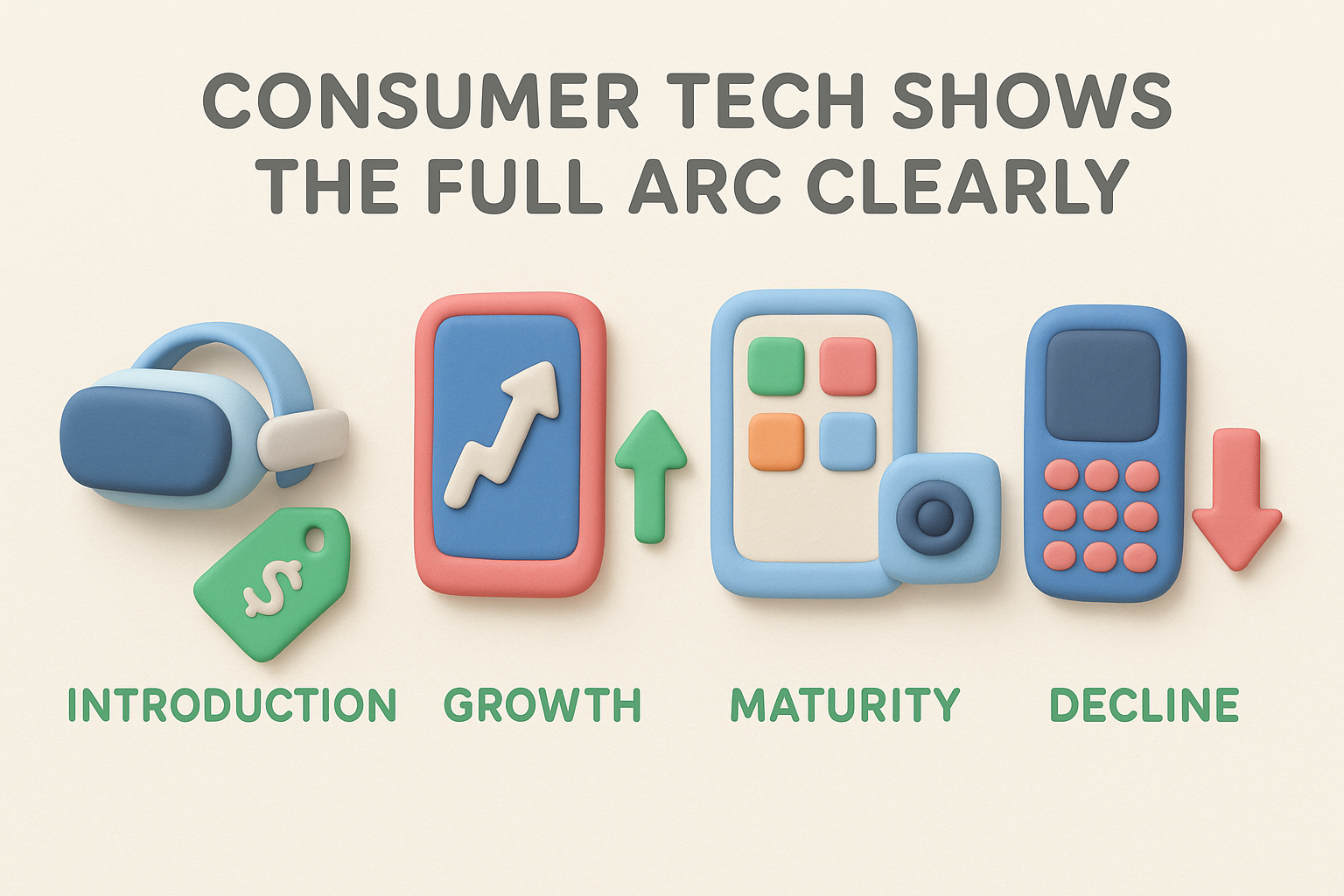
A product's stage isn't permanent. Companies that ignore that fact get caught defending a market that already moved on.
Software products track this cycle just as reliably, though SaaS product lifecycle management usually compresses the timelines into months instead of years. Slack spent its early years in explosive growth, expanding from a single startup's internal tool into a communication platform used by millions, largely through word-of-mouth inside teams. Microsoft Excel represents textbook maturity: the feature set is stable, most updates are refinements rather than reinventions, and the user base is enormous but growing slowly, if at all. Adobe Flash shows what decline looks like when a platform shift makes the underlying technology obsolete. Once essential for web animation and video, Flash lost relevance as HTML5 and mobile browsers took over, and Adobe officially ended support for it in December 2020.
| Product | Stage example | What signaled the stage |
|---|---|---|
| Apple Vision Pro | Introduction | High price, limited use cases, market still learning |
| Slack (early years) | Growth | Rapid user expansion, viral team adoption |
| Microsoft Excel | Maturity | Stable feature set, refinement over reinvention |
| Adobe Flash | Decline | Platform shift made the technology obsolete |
| BlackBerry | Decline | Lost ground to touchscreen competitors, exited hardware |
Together, these examples answer the common question of what is life cycle of product in a way a chart alone can't: the stages aren't theoretical, they show up in product decisions you can trace back years later. Every one of these companies made choices, some smart and some too late, based on where they believed their product stood. The ones that read the signals early adjusted their roadmap and messaging in time. The ones that didn't spent years trying to market a mature or declining product like it was still fresh out the gate.
Feedback means something different at every point in the lifecycle product curve, and treating it the same way regardless of stage wastes the insight sitting in your inbox. Early on, you're listening for validation. Later, you're listening for expansion opportunities. Near the end, you're listening for permission to sunset or reinvent. Knowing what to look for in a customer feedback portal helps, because capturing every request in one place makes it far easier to spot which type of signal you're actually getting, instead of treating every comment as equally urgent.
During introduction, feedback tells you whether you built the right thing at all. Comments at this point skew toward basic usability questions and confusion about what the product even does, which is normal and expected. Founders and product managers should read every submission personally here, because the volume is low enough to catch patterns by hand, and the stakes of missing a signal are high. A recurring complaint about onboarding at this stage isn't noise, it's a roadmap item.
Growth brings a flood of requests, and without structure you'll drown in them. This is where categorizing feedback with themes and tags earns its keep, grouping duplicate requests so you see real demand instead of counting the same idea five different times under five different names. Voting features matter enormously here too, since they let your most engaged users surface the requests that actually deserve engineering time.
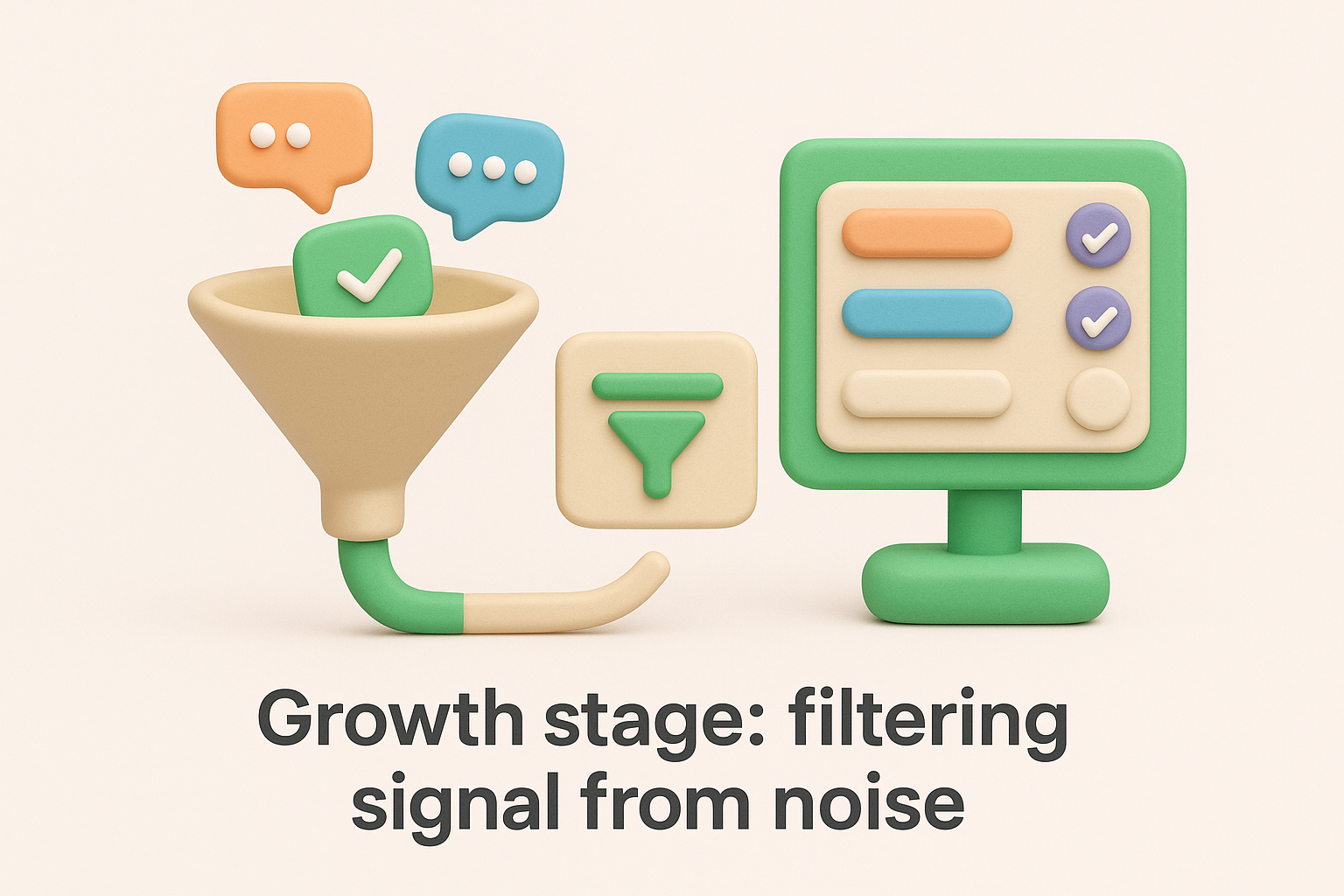
When feedback volume outpaces your ability to read it manually, that's the clearest sign you've entered growth.
Use a simple filter during this stage:
Maturity flips the feedback dynamic. Requests shift toward edge cases and polish, and your existing base gets vocal any time a change threatens a workflow they've relied on for years. Prioritization boards help here by keeping refinement requests separate from the occasional big swing idea, so your team doesn't accidentally destabilize a stable product chasing a low-vote feature that only one loud customer wanted.
Decline-stage feedback answers a different question entirely: does the underlying need still exist, or has the market moved on? Watching requests turn into complaints about missing features that competitors already offer tells you the product needs reinvention, not another patch. Comments asking for migration help or data export tell you users have already mentally moved on, and a graceful sunset serves them better than false promises of a comeback. Either way, the feedback itself, read honestly, usually points to the right call before your revenue numbers confirm it.
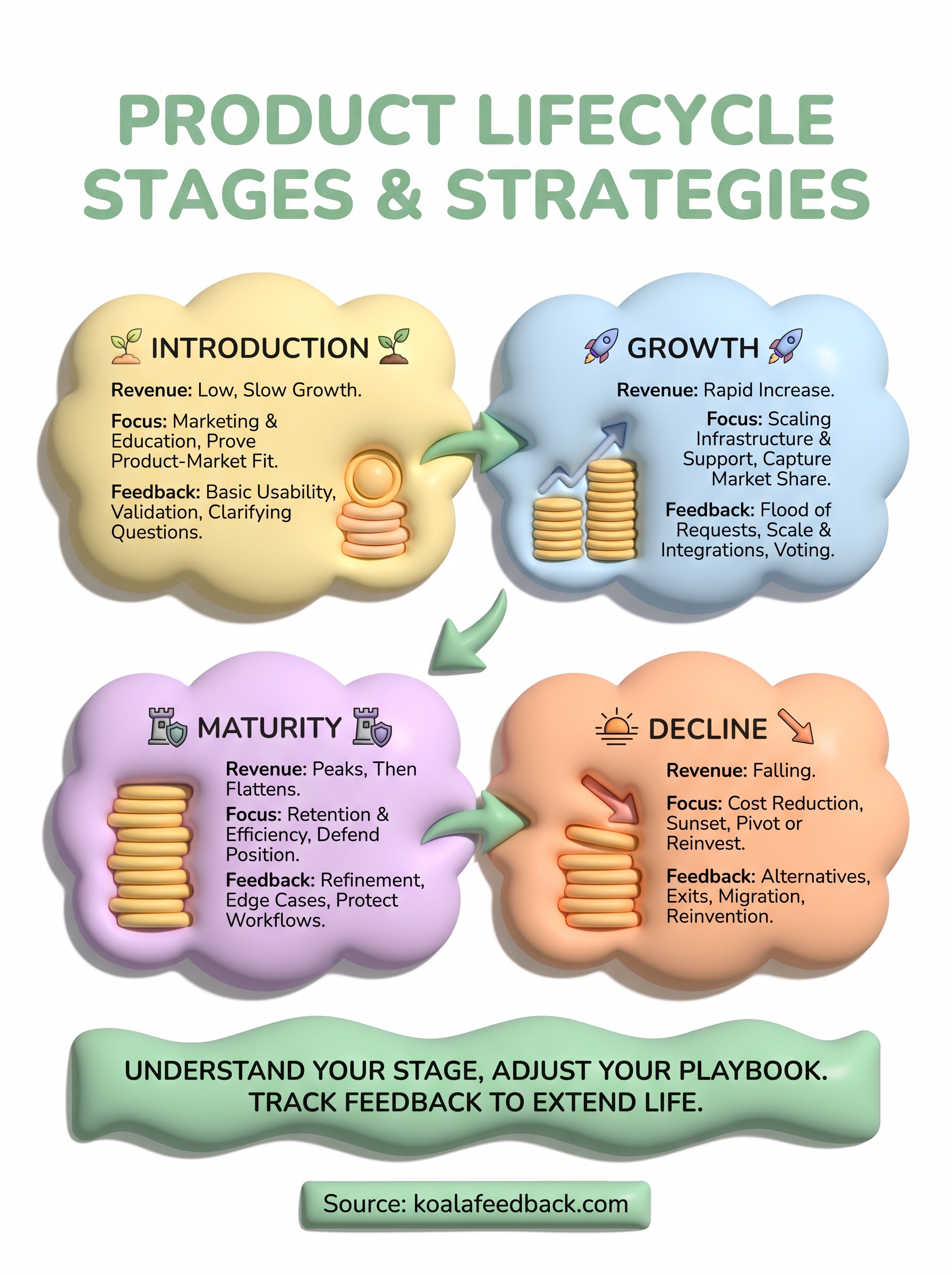
Knowing the four stages is one thing. Recognizing which one your product sits in right now, before you plan next quarter's roadmap, is what actually changes outcomes. The lifecycle product framework only pays off when you pair it with real signals: adoption trends, support ticket tone, and the feedback your users volunteer every day. Guessing gets you a roadmap built on assumptions. Watching the data gets you one built on evidence.
Questions like what is life cycle of product management always trace back to the same answer: listen closely at every stage, and let that feedback guide what you build next. A validation comment during introduction, a vote-heavy request during growth, a polish request during maturity, all of it points somewhere specific if you're organized enough to catch it.
If you're ready to turn scattered feedback into a clear, stage-aware roadmap, see how you can capture and prioritize feedback at every lifecycle stage with Koala Feedback.

Start today and have your feedback portal up and running in minutes.