Most companies think they're good at talking to their customers. The reality? Customers often feel ignored, especially when they share feedback and hear nothing back. Knowing how to improve customer communication isn't just about being polite on support calls, it's about building systems that make customers feel heard at every touchpoint.
Strong customer communication drives retention, reduces churn, and gives your product team the clarity they need to build features people actually want. But it breaks down fast when feedback gets buried in spreadsheets, emails go unanswered, or your roadmap is a mystery to the people using your product. That's exactly the problem we built Koala Feedback to solve, giving teams a centralized place to collect feedback, share progress, and keep the conversation going with their users.
Whether you're a product manager juggling requests or a founder trying to stay close to your users, these eight tips will give you concrete ways to communicate better with your customers. No theory, no fluff, just practical steps you can start using this week.
Scattered feedback is one of the biggest barriers to good customer communication. When requests arrive through email, Slack, support tickets, and social media at the same time, important signals get missed and customers never hear what happened to the things they shared with you.
The core problem is that fragmented feedback creates fragmented responses. When your team pulls from five different sources, you duplicate effort, miss patterns, and end up responding to the loudest voice rather than the most common need. A single source of truth gives everyone the same picture, so your communication reflects what customers actually want, not just what you happened to see last.
Customers who feel heard are far more likely to stay, and centralization is what makes "feeling heard" scale across your entire user base.
Koala Feedback's feedback portal lets customers submit ideas, vote on existing requests, and leave comments without contacting your support team directly. You can embed the portal inside your product, link to it from your emails, or share it as a standalone page. Keeping the submission process simple removes friction and gets more of your customers to participate regularly.
Collecting feedback is only half the job. Closing the loop with users who submitted a request is where most teams fall short. Koala Feedback lets you update the status of any request and automatically notify users when their idea moves forward. This converts a one-way form into an ongoing conversation, showing customers that their input directly shapes your roadmap.
Once you centralize, measure whether the system is actually moving. Track submission volume per week to confirm customers are using the portal. Monitor how many open requests receive a status update within 30 days, and watch your response-to-resolution rate over time. If you want to understand how to improve customer communication at a process level, these numbers give your team the data it needs to adjust quickly.
One of the fastest ways to learn how to improve customer communication is to match your channel choice to the situation. Sending a complex billing issue through chat and a quick confirmation through a 30-minute phone call are both mismatches that waste time and frustrate customers.
Email works best for detailed updates, formal confirmations, and anything customers need to reference later. Live chat fits quick questions with short answers. Phone calls belong to high-stakes conversations where tone and trust matter, like resolving a serious complaint or closing a deal. In-app messages are ideal for context-specific guidance, reaching users exactly when they're looking at the relevant feature.
Your customers already have preferred channels before they contact you. Check your support data to see where most inbound requests originate, and invest in those channels first rather than spreading thin across every platform. If 70% of your requests come through email, refine that experience before adding a new tool.
The goal isn't to be everywhere. It's to be excellent in the places your customers actually use.
Customers should never have to repeat themselves. Shared customer records give any team member full visibility into prior conversations, purchases, and open issues, regardless of which channel the customer used before.
Monitor first-contact resolution rate by channel and track how often customers switch channels mid-issue. High channel-switching rates usually signal a gap in one channel's ability to fully resolve requests.
Customers don't just want answers. They want to know when an answer is coming and who is responsible for giving it. Ambiguity around response times is one of the most common ways to erode trust, and fixing it is a straightforward part of learning how to improve customer communication at a structural level.
Service level agreements (SLAs) define the maximum time your team will take to respond based on issue type or customer tier. Share these commitments with your customers so they're never left guessing. Pair your SLAs with autoresponders that confirm receipt, set a specific timeframe, and tell the customer what happens next.
Customers can handle waiting. What they can't handle is silence.
Routing delays are usually the hidden culprit behind slow responses. Tag incoming requests by topic, urgency, and customer type immediately so the right team member picks them up without a handoff chain. Assigning clear ownership to every open request means nothing sits in a queue unattended while team members assume someone else is handling it.
Every open request needs a clear resolution step or a scheduled follow-up. Set internal reminders for requests that haven't moved in 24 to 48 hours, and make sure your customer hears from you before they need to ask again.
Track median first response time and resolution time broken down by channel and request type. Reviewing these weekly helps your team spot bottlenecks before they become patterns customers complain about.
Most communication failures don't start with a bad response. They start with a missed signal. Active listening is one of the most direct ways to learn how to improve customer communication because it changes what happens before you ever type or say a word back.
Active listening means giving your full attention to what a customer says and resisting the urge to respond before you fully understand. In a support context, this means reading the entire message before drafting a reply. In a sales call, it means letting the customer finish a thought before you redirect. Both situations require you to slow down your own reaction so you can reflect back what you actually heard.
Customers often describe the symptom, not the cause. Open-ended questions like "Can you walk me through what you expected to happen?" or "How long has this been affecting your workflow?" pull out the full picture. These questions signal that you're invested in the real issue, not just the fastest path to closing the ticket.
The right question often does more work than the most detailed answer.
Before ending any interaction, restate what you heard and what happens next. A short confirmation like "Here's what I understand you need, and here's what I'm doing about it" prevents misalignment before it turns into a follow-up complaint.
Monitor your reopened ticket rate, which rises when customers feel their original issue was misunderstood. Pair this with periodic customer satisfaction scores tied to specific interactions to find where listening gaps are costing you the most.
The words you choose in customer communication shape how customers feel about your company long after the conversation ends. Unclear, cold, or defensive messages push customers toward frustration even when the underlying answer is correct. Knowing how to improve customer communication through better writing is one of the fastest wins available to any team.
Every technical term or internal phrase you use is a risk. Customers may nod along and then follow up because they didn't fully understand your answer. Write at a reading level your least technical customer can follow, and cut any word that doesn't add meaning. Short sentences and concrete next steps resolve issues faster and reduce the number of follow-up messages you handle.
Acknowledging frustration is important, but stacking apologies signals weakness and slows the conversation down. Name the specific inconvenience the customer experienced, then move directly to what you're doing about it. Customers want resolution, not guilt.
One direct acknowledgment paired with a clear action plan lands better than three apologies with no forward momentum.
Swap phrases like "unfortunately we can't" with "here's what we can do" to keep the tone solution-focused. Avoid passive constructions like "the issue was caused by" and instead say "we identified the cause and fixed it" so the customer understands someone is accountable.
Review customer satisfaction scores tied to written interactions and flag responses that generate follow-up complaints. Reading a sample of low-rated exchanges each week shows you exactly which language patterns are costing you trust.
Personalization is one of the most effective ways to improve customer communication, but the line between helpful and intrusive is thin. Customers respond well when you reference their actual history with your product. They get uncomfortable when it feels like you're pulling data points they never knowingly shared.
Meaningful personalization means using what customers have already told you through their actions and words. Their plan type, recent support history, features they use most, and goals they've stated in past conversations are all fair game. You don't need to go further than that.
Customers want to feel known, not monitored.
When a customer contacts you, pull up their account record before you respond. Reference the specific feature they've been using or the request they submitted previously. This small step shows you treated their issue as individual, not as one of a thousand identical tickets.
Personalization breaks down when different team members give different experiences. A shared customer record keeps everyone on the same page, so a customer who explained their situation to one person doesn't have to repeat it to another. Update the record after every interaction so the next person starts informed.
Track customer satisfaction scores segmented by whether an interaction referenced prior context. Compare repeat contact rates between personalized and generic responses to see where tailored communication reduces friction.
Waiting for customers to notice a problem and contact you is a reactive pattern that damages trust fast. Proactive communication puts you in control of the narrative and is a key part of how to improve customer communication at scale.
Not every change needs a broadcast, but several situations always do. Reach out before customers experience impact in these cases:
Keep these messages short and specific. Lead with what happened, follow with the impact on the customer, and close with what you're doing about it and a clear timeframe. Avoid vague reassurances like "we're working on it" with no deadline attached.
Customers handle bad news far better when they hear it from you first, with a plan attached.
Define your update frequency during an ongoing issue before any incident happens. A rule like "update customers every two hours until resolved" removes guesswork under pressure. Escalation paths should name who takes over communication when an issue hits a certain severity level.
Monitor the ratio of inbound contacts to proactive outbound messages during incidents. A high inbound rate during an outage signals your message arrived too late or missed too many customers. Track this number after each incident and use it to adjust your notification triggers going forward.
A well-built self-service system is one of the most scalable answers to the question of how to improve customer communication. When customers find clear, accurate answers on their own, your team handles fewer repetitive tickets and frees up time for conversations that actually need a human.
Common, repeatable questions belong in self-service, while complex situations need a human. Use this split as a starting guide:
Write your help content around the exact phrases customers use when they search, not internal product terminology. Each article should answer one question fully, with step-by-step instructions and screenshots where the process has more than two steps.
Customers who find the answer themselves are often more confident using your product than those who waited for a reply.
Assign clear ownership to your help content so someone updates articles whenever a feature changes. A quarterly review cycle catches outdated screenshots, broken links, and content gaps that accumulate silently between product releases.
Monitor your self-service deflection rate, which measures how often customers find answers without opening a ticket. Track article search exit rates to identify topics where your current content fails to satisfy the query.
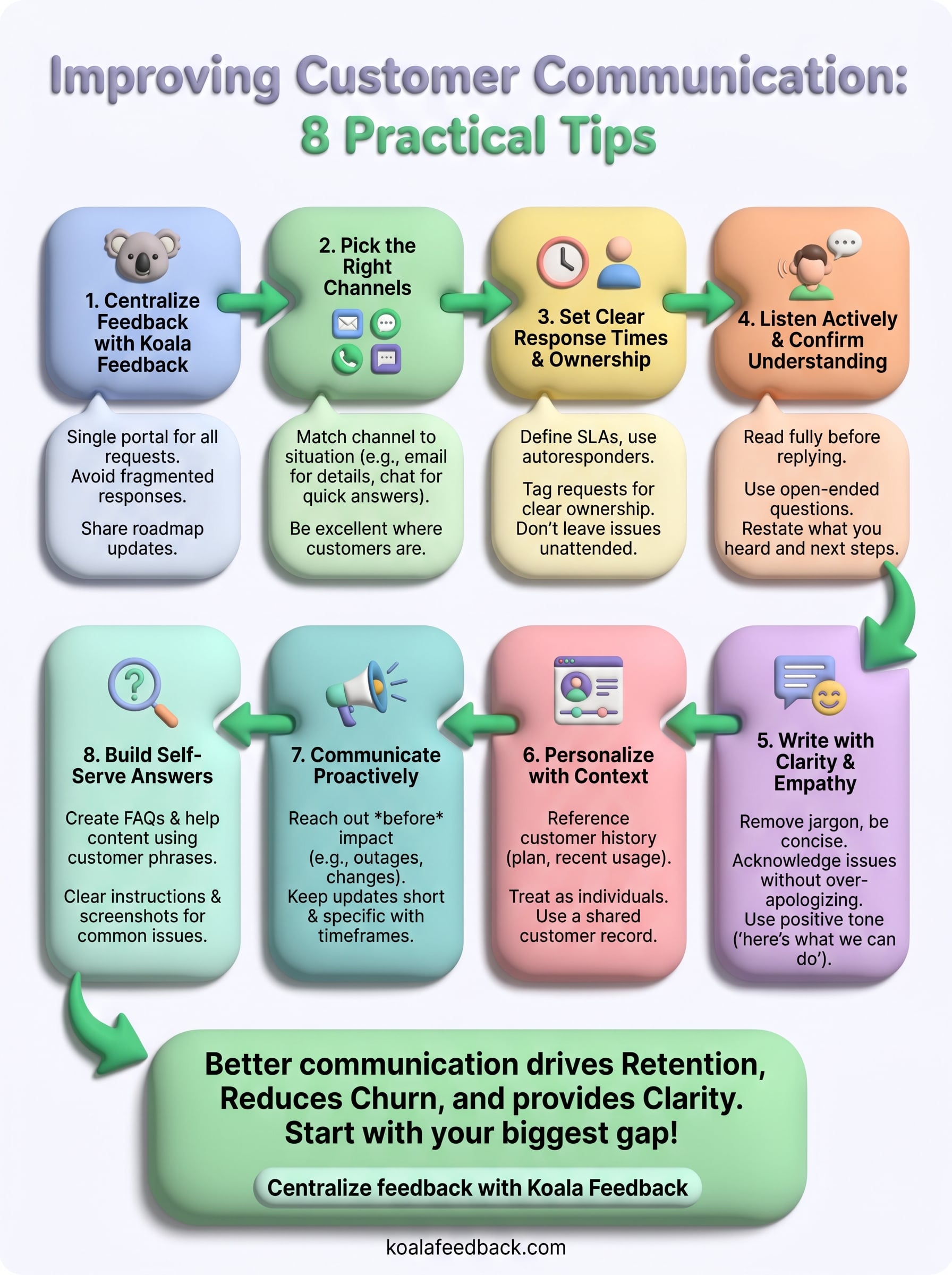
You now have eight concrete ways to work on how to improve customer communication inside your business. Each tip targets a specific failure point: scattered feedback, wrong channels, slow responses, shallow listening, unclear writing, generic replies, reactive silence, and overloaded support queues. Fixing even two or three of these will produce a noticeable shift in how your customers experience your team.
Start with the tip that matches your biggest current gap. If customers submit feedback and never hear back, centralization is your first move. If your team is drowning in repetitive tickets, self-service deserves your attention this week. Pick one area, measure it, and build from there.
When you're ready to close the feedback loop and keep customers informed, Koala Feedback gives you the tools to collect requests, prioritize what matters, and share your roadmap in one place. Sign up and see how it works for your team.

Start today and have your feedback portal up and running in minutes.