You've probably searched harvard business review customer satisfaction because you want more than another blog opinion. You want research-backed thinking from people who study why customers stay, spend more, and recommend you to others. HBR has spent decades publishing exactly that, and pulling the right insights out of that archive can change how your team approaches retention and product decisions.
This article does that work for you. It breaks down five findings from Harvard Business Review that hold up across industries, covering topics like the real cost of poor service and why customer effort matters more than delight in most interactions. Each insight comes with a practical read on what it means for a product or support team trying to act on it this quarter.
We wrote this because we build feedback tools at Koala Feedback, and we see daily how teams struggle to turn customer sentiment into action. These five insights connect directly to that challenge. You'll walk away with a clearer framework for thinking about satisfaction and a shortlist of research you can cite the next time you're making a case internally.
The HBR article "Stop Trying to Delight Your Customers" by Matthew Dixon, Karen Freeman, and Nicholas Toman studied thousands of customer service interactions and found something that surprised a lot of executives: delighting customers barely affects loyalty. What actually drives loyalty is reducing the effort customers have to put in to get their problem solved. The research team built the Customer Effort Score around this finding, and it's held up well in the years since publication. You can read the original research summary on hbr.org.
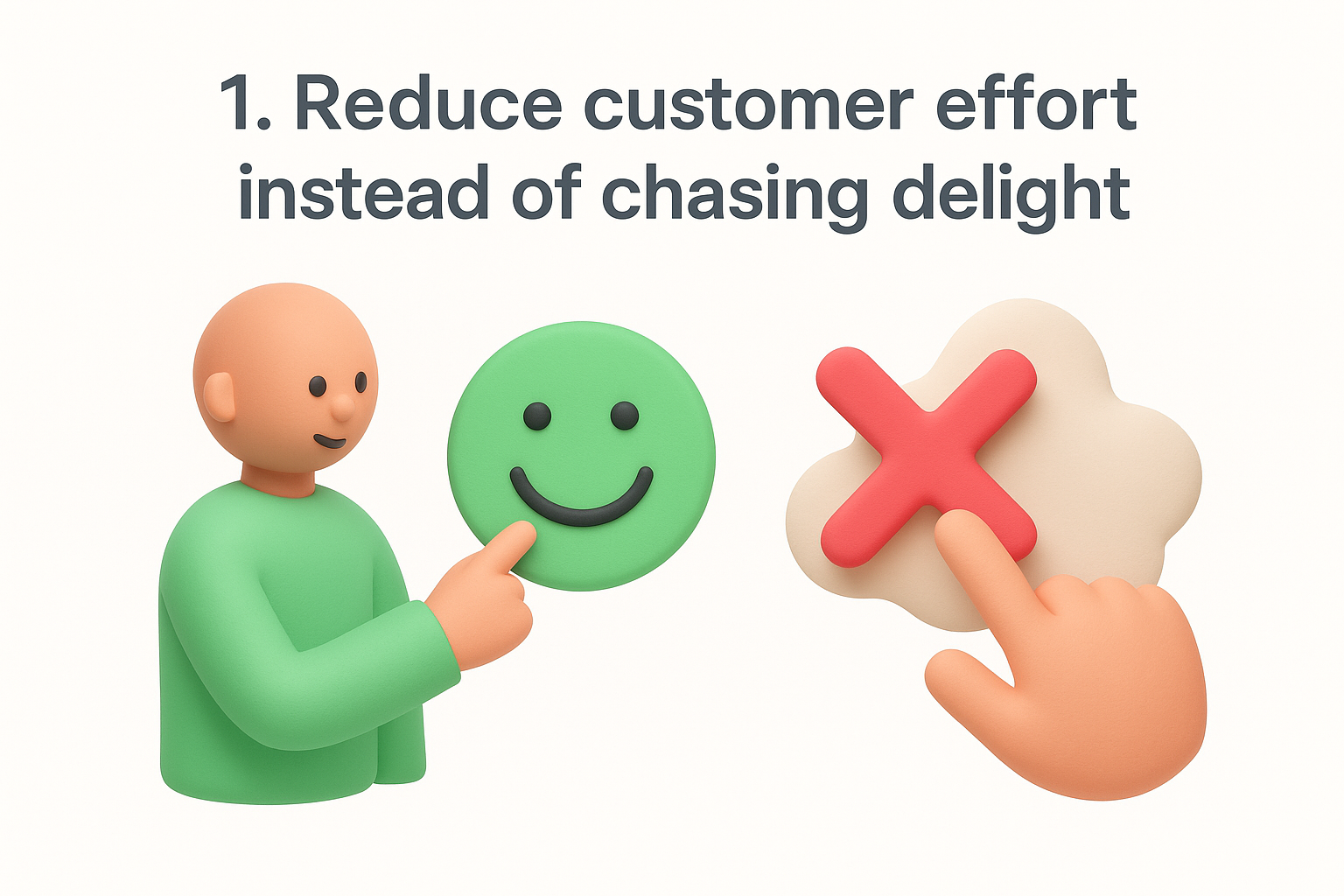
This flips a lot of conventional wisdom about customer experience. Teams spend budget on surprise gestures, free upgrades, and cheerful scripted interactions, assuming that positive emotion builds loyalty. HBR's data says otherwise. Customers remember friction far more vividly than they remember a nice gesture. A support ticket that requires three follow-up emails does more damage than a lack of confetti does good. If your team is optimizing for warm feelings instead of removing obstacles, you're likely spending effort in the wrong place.
Customers don't reward you for delight. They punish you for friction.
Start by mapping where customers currently have to work hardest to get what they need from you. Common friction points include:
That last point connects directly to product feedback management. When customers submit a feature request and hear nothing back, they've spent effort with no payoff. A centralized feedback portal with visible statuses removes that friction because customers can check progress themselves instead of emailing to ask. Pair that with categorization tools that group similar requests, so you're not asking the same customer to explain their idea three different times to three different people. Lowering effort is rarely glamorous work, but it's the lever HBR's research says actually moves loyalty.
Harvard Business Review's research on customer experience measurement points out that a single satisfaction score at the end of a transaction misses most of what actually shapes loyalty. HBR's work on experience management argues that companies need to track the full journey, not just the moment right after a support call ends. A high CSAT score on one interaction can hide a pattern of frustration building across weeks of touchpoints.
Teams that lean too hard on one number get a false sense of security. Satisfaction scores are easy to collect and easy to report up the chain, so they become the default metric even when they don't capture the whole picture. A customer might rate a single chat interaction five stars while quietly getting fed up with your product overall. Relying on that one score means you miss the slow erosion happening underneath it.
One good interaction can mask a bad relationship.
Widen your view beyond transactional scores. Track patterns over time using:
A feedback portal that logs requests and comments over time gives you that longer view, so you catch friction before it shows up as churn.
Researchers writing in Harvard Business Review identified a set of roughly ten drivers that consistently predict satisfaction across industries, things like meeting expectations, resolving issues on the first attempt, and treating customers fairly. Rather than one silver bullet, satisfaction turns out to be the sum of specific, measurable behaviors that show up in every interaction.
This matters because it gives you something concrete to manage instead of a vague goal like "be more customer-focused." Fairness and first-contact resolution aren't feelings you can wish into existence; they're operational outcomes you can track and improve. Teams that treat satisfaction as one abstract score often miss which specific driver is actually broken.
Satisfaction isn't one thing. It's ten things done consistently well.
Audit your own product and support experience against these drivers directly:
| Driver | Question to ask |
|---|---|
| First-contact resolution | Do most issues get solved without a follow-up? |
| Expectation setting | Do customers know what's coming next? |
| Fairness | Are policies applied consistently? |
Use a public roadmap with customizable statuses to keep expectation-setting honest. When customers can see what's planned, in progress, or shipped, you're addressing one driver without adding extra support work.
Harvard Business Review research on service strategy makes a simple point that a lot of companies ignore: not every customer wants the same kind of help. Some segments want fast, low-touch self-service. Others want a dedicated human they can call by name. HBR's work on service differentiation shows that companies applying one uniform model across all customers waste money serving simple needs and frustrate customers with complex ones.

Guessing at this gets expensive fast. Overserving a customer who just wants a quick self-service answer burns support hours on something a help doc could've solved. Underserving a customer with a genuinely complex account problem pushes them toward a competitor who offers real human help. Matching the model to the need protects both your margins and your retention.
The right service model isn't the fanciest one. It's the one that fits the customer in front of you.
Segment your customers by complexity and value, then build tiers deliberately:
A feedback portal with voting and comments fits naturally into the self-service tier. Customers find existing requests, add their voice, and get answers without opening a ticket at all.
Harvard Business Review's research on service growth highlights a pattern that trips up fast-growing companies: quality drops as volume rises, even when headcount grows alongside it. HBR case studies on scaling service operations show that the processes and training that worked for a small support team break down once ticket volume multiplies, unless companies rebuild those processes deliberately rather than just adding people.
Growth exposes cracks that low volume used to hide. Inconsistent answers from different reps, slower response times, and knowledge that lives only in a few senior employees' heads all become visible once you're handling ten times the requests. Customers don't grade you against your growth curve. They grade you against the last good experience they had, whenever that was.
Scaling support without scaling process just multiplies your mistakes.
Build systems that keep quality flat as volume climbs:
A feedback and roadmap tool that categorizes requests automatically does a lot of this work for you, catching repeat issues before your team has to notice them manually.
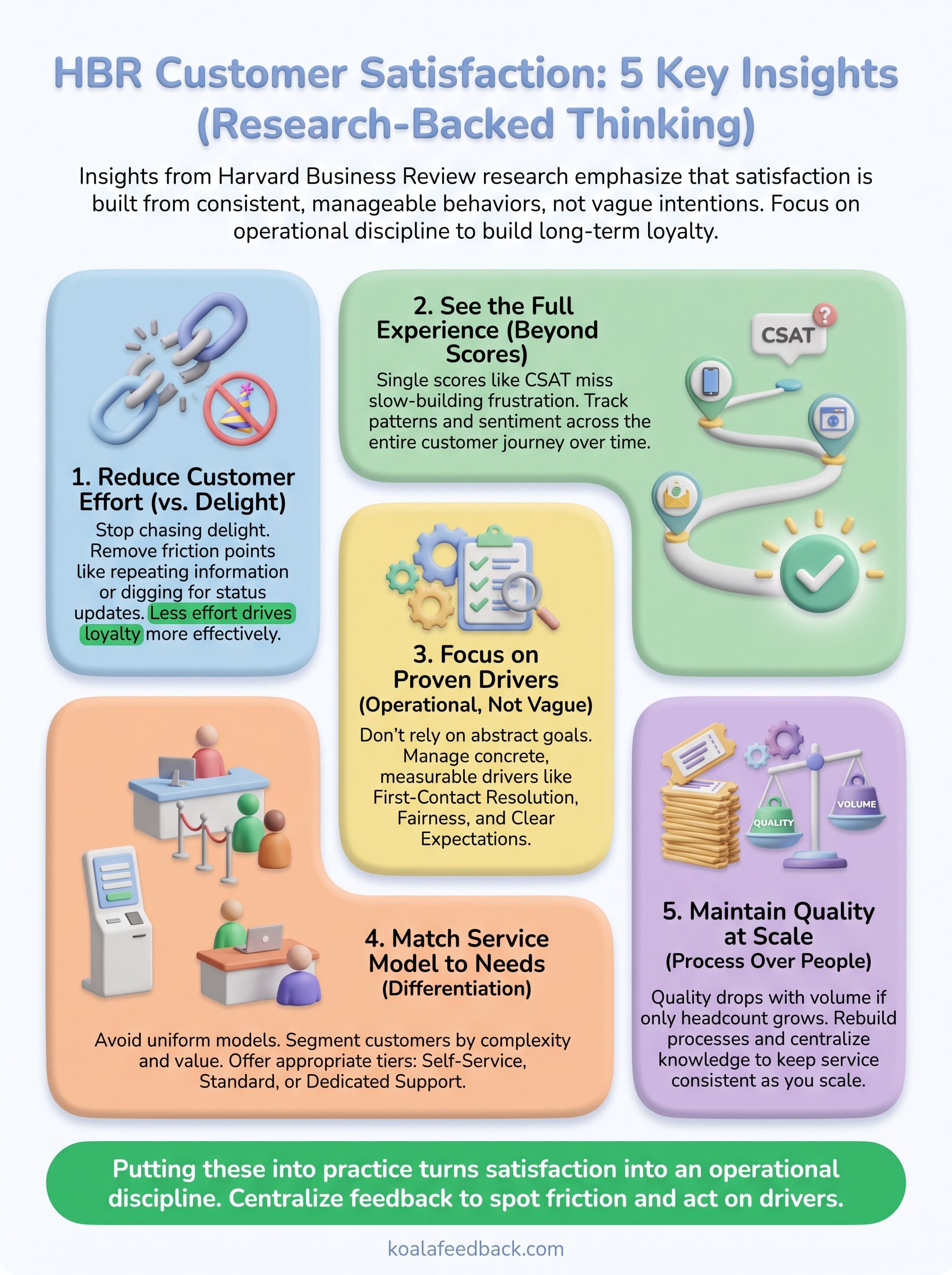
Harvard Business Review's research keeps circling back to the same theme: satisfaction is built from specific, manageable behaviors, not vague good intentions. Reducing effort, watching the full customer journey, tracking the ten real drivers, matching service models to actual needs, and protecting quality as you scale all point in one direction. Customers notice friction more than they notice gestures, and the companies that win long-term are the ones that treat satisfaction as an operational discipline rather than a feeling to chase.
Getting there starts with visibility. You can't reduce effort or spot broken drivers if feedback lives scattered across email threads and support tickets nobody reviews together. A centralized system for collecting, categorizing, and acting on customer input turns these research findings into daily practice instead of a slide deck nobody revisits.
If you're ready to put this into action, start collecting and prioritizing feedback with Koala Feedback and see which drivers need your attention first.

Start today and have your feedback portal up and running in minutes.