The best replies to positive feedback are short, use the customer's name, repeat one specific thing they praised, and end with a reason to come back. The ten responding to customer feedback examples below turn that formula into copy-paste text. Use the general and five-star replies when you need speed. Use the team-member and feature replies when a review is detailed. Use the first-purchase, loyalty, and survey replies when you want to build a repeat relationship.
Most businesses answer complaints within hours and let happy reviews sit for weeks. Others paste the same "Thanks for the feedback!" under every one. Readers notice, and you waste the one moment when a customer is already on your side. Each section below covers one situation, a sample of what the customer wrote, and three replies (short, medium, and long) you can paste in.
At Koala Feedback we build tools that help product teams collect and act on user feedback, so we see daily how much closing the loop matters. Praise can arrive as a Google review, an app store comment, a survey answer, or a vote on a feedback portal. The principles are the same for all of them. After the examples, you'll find a quick method for personalizing any reply in about two minutes.
Use this reply when a customer says they enjoyed your product or service but gives you no detail to build on. It is the most common case when you are responding to customer feedback, and it is where canned replies creep in. Add the customer's name and one concrete detail, and a generic template becomes a real answer.
Swap the brackets and you can post any of these within a minute.
Short:
Thanks, [Name]! We're glad your [visit/order/experience] with [Business] went so well. See you again soon.

Medium:
Hi [Name], thank you for taking the time to write this. It means a lot to our team to hear that you'd recommend us. If there's ever anything we can do to make your next [visit/order] even better, just let us know. [Your Name]

Long:
Hi [Name], thank you for such a kind review. Hearing that you'd recommend [Business] to others is the best compliment we can get, and I'm sharing it with the team today. We'd love to see you again, and if you think of anything that would make [product/service] better, please tell us. [Your Name], [Role]
The reply thanks the person, repeats the recommendation they made, and invites them back. That is the full formula, and every other example in this article is a variation of it.
To personalize it, replace "experience" with the real thing. "Your Saturday brunch" or "your first week on the Pro plan" takes five seconds to type and changes how the reply reads.
A good general reply names the person, echoes their compliment, and asks them back.
A five-star rating with no text is easy to ignore, which is exactly why a reply stands out. You cannot echo a detail that is not there, so thank them for the rating and ask, lightly, what they liked. Never guess at what they enjoyed, because a wrong guess looks careless.
Short:
Thank you for the five-star rating, [Name]! We really appreciate it.

Medium:
Thanks for the five stars, [Name]! We're so glad you had a good experience with [Business]. If there's something you especially enjoyed, we'd love to hear it. [Your Name]

Long:
Hi [Name], thank you for the five-star rating. A rating takes a few seconds, but it helps other people decide whether to try [Business], and we're grateful for it. If you ever want to tell us what stood out, or what we could do better, our door is always open. [Your Name]
Keep the reply as brief as the review. The customer spent five seconds on you, so a three-line answer matches their effort and does not feel pushy.
The gentle question at the end can also pull out details later. If the customer answers, you now have a specific sample of praise you can use in your next reply or share with your team.
When a customer says nothing, a short thank-you and one open question is the right amount of reply.
Use this one when a review names an employee, such as a support agent, a server, a technician, or an account manager. Naming the person in your reply does two jobs. It tells the customer you read the review closely, and it tells your employee the praise was seen. Always tell the employee before or right after you post.
Short:
Thank you, [Name]! I've shared your note with [Team Member], who will be thrilled to hear it.

Medium:
Hi [Name], thanks for the great review. [Team Member] takes real pride in helping customers, and it's wonderful to see that you noticed. I've passed your kind words along to them and to the rest of the team. [Your Name]

Long:
Hi [Name], thank you for taking the time to mention [Team Member] by name. Resolving [issue/request] quickly is exactly what we want every customer to experience, and your review shows it landed. I've shared it with the whole team, and it will mean a lot to [Team Member]. We're here whenever you need us. [Your Name]
The reply credits a real person instead of a faceless "team." Prospective customers reading the review learn that a human at your company solves problems.
For a stronger version, quote the employee's own reaction. "[Team Member] was grinning when I read this out" is true, specific, and impossible to fake with a template. Post the review in your team channel first and you will have a real reaction to quote.
Praise for one person should be answered by naming that person and promising to share it.

Use this reply when the customer calls out a specific product, dish, plan, or software feature. These reviews are valuable because other buyers scan them for proof the product does what it claims. Your reply is a chance to restate that proof in a friendly way.
Short:
Thanks, [Name]! We're so glad [feature/product] is saving you time. That's exactly what we built it for.

Medium:
Hi [Name], thank you for the kind words about [feature/product]. We put a lot of care into making it [benefit], so it's great to hear it's working for you. If you have ideas for making it even better, we'd love to hear them. [Your Name]

Long:
Hi [Name], thank you for this review. [Feature/product] was designed to [purpose], and your note about [specific result] is the best confirmation we could ask for. I'm sharing it with the people who built it. If there's anything else you'd like to see us improve, tell us anytime. [Your Name]
The reply names the feature in your own words, which reinforces the review's keywords for anyone reading. It also ties the praise to the purpose behind the product, so the customer feels part of a story and not a sales transaction.
For a personal touch, include one small fact only your team would know, such as who built the feature or how long it took. Keep any call to action soft. A customer who is already happy does not need a hard sell in the reply.
Echo the feature the customer praised, and let their words do the selling.
Use this reply when a review mentions a first purchase, first visit, or first week with your product. First-time buyers are deciding whether to stay, so your reply should feel like a welcome. It also tells readers that new customers get the same attention as regulars.
Short:
Welcome to [Business], [Name]! We're glad your first [order/visit] went smoothly.

Medium:
Hi [Name], thank you for choosing us for your first [order/visit], and for taking the time to review it. We hope you enjoy your [product/service]. If you have any questions along the way, just reach out. [Your Name]

Long:
Hi [Name], welcome to the [Business] family, and thank you for the kind review. It's great to hear your first experience with us went so well. If you'd like recommendations for what to try next, or have any questions about [product/service], we'd be happy to help. [Your Name]
The reply acknowledges the first-time status the customer volunteered. It gives them a clear next step, which is to ask you anything. That is how a one-time buyer starts becoming a repeat customer.
A small personalization trick is to recommend one specific next thing. "Many people who liked the Starter plan find the reports feature useful" is better than "check out our other products." It should be relevant and honest, not a sales pitch in disguise.
A first-time customer wants to feel welcomed, not marketed to.
Use this reply when the reviewer mentions how long they have been with you or how often they come back. These customers are your most credible voices, and a generic thank-you undersells them. Name the length of the relationship and say plainly that it matters.
Short:
Three years already, [Name]? Thank you for sticking with us. It means a lot.

Medium:
Hi [Name], thank you for this review and for being with us for [time period]. Customers like you are the reason we keep raising the bar at [Business]. We look forward to what's ahead. [Your Name]

Long:
Hi [Name], reading this made our day. Having you with us for [time period] is a real vote of confidence, and your feedback over the years has shaped how we work. Thank you for trusting [Business] again and again. If there's ever something we can do better, you'll be the first person we ask. [Your Name]
The reply mirrors the specific number the customer gave, whether that is three years or fifty visits. It treats loyalty as a relationship, not a statistic.
Mention a small, true detail of shared history when you can. "You were one of our first customers" is stronger than any adjective. If you do offer a loyalty perk, say so plainly. If you do not, do not invent one just to fill the reply.
Loyal customers deserve replies that count their years, not just thank them.
Use this reply when the rating is four stars, with or without text. The customer was happy, but something held back the fifth star. Your goal is to thank them first and invite them to say what would make it better. Never ask them to change their rating, which comes across as pressure.
Short:
Thanks for the four stars, [Name]! We're glad you had a good experience, and we'd love to hear how we can make the next one even better.

Medium:
Hi [Name], thank you for your review. We're happy you enjoyed [product/service]. If there's anything that would have made it even better, we'd really like to know. We're always looking for ways to improve. [Your Name]

Long:
Hi [Name], thank you for the four-star review and for choosing [Business]. We're glad most of your experience was a good one. If something fell short of what you hoped for, we'd value hearing about it, either here or at [contact info]. Your feedback helps us improve, and we hope to see you again soon. [Your Name]
Four-star customers are often the most honest feedback source you have. They like you, so they speak openly. The reply makes it easy for them to share what is missing without feeling like they are complaining.
Keep the tone relaxed and curious. A reply that sounds anxious about the missing star will make the review look worse to readers than the rating itself does.
Treat a four-star review as a conversation starter, never as a rating to fix.
Use this reply when a customer who requested or voted for a feature thanks you after it ships. This is closing the loop at its best. On a public feedback portal such as Koala Feedback, customers submit ideas, vote, and comment, and a roadmap with statuses like planned, in progress, and completed shows where each idea stands. Replying in the same thread keeps the whole story in one place.
Short:
Thanks, [Name]! [Feature] is live because customers like you asked for it. Let us know how it works for you.

Medium:
Hi [Name], thank you for the kind words. [Feature] was one of the most requested ideas on our portal, and your vote helped put it at the top. If anything about it could work better, add a comment on the idea and we'll take a look. [Your Name]

Long:
Hi [Name], thank you for letting us know. Your vote and comments on [Feature] were part of what moved it from planned to completed, and we're happy it does what you hoped. Keep the ideas coming on our feedback portal. We read every one, and what you share shapes what we build next. [Your Name]
The reply shows a visible link between customer input and product decisions. People who see that link are more likely to vote and comment again, which gives you better data next time.
To personalize it, reference the original request in your own words. "You asked for exports back in the spring, and here they are" proves someone is listening.
A feature request that gets a thank-you reply keeps customers talking to you.
Use this reply when a review is positive overall but mentions something the customer would change. This is constructive feedback wrapped in praise, and your reply should handle both halves. Thank them for the compliment, then address the suggestion honestly.
Short:
Thank you, [Name]! We're glad you love [product]. Your idea about [suggestion] is a good one, and we've passed it to the team.

Medium:
Hi [Name], thank you for the great review and for the suggestion. We hear you on [suggestion], and I've added it to our list of ideas we're tracking. We can't promise a date, but customer input like yours directly shapes what we work on. [Your Name]

Long:
Hi [Name], thanks for such a thoughtful review. We're thrilled you enjoy [product], and we appreciate you telling us about [suggestion]. [Honest status: It's on our roadmap / We're considering it / It isn't something we plan to do right now, because [reason].] Please keep the feedback coming. It makes a real difference. [Your Name]
The customer is giving you free product advice, so the reply thanks them for both parts. Readers also see that you take suggestions seriously, which is more convincing than an all-praise thread.
The honest status line is the key detail. Even "we're not planning that right now, here's why" earns more trust than silence. Use the bracketed line in the long version to pick the status that is true for your business.
When praise comes with a suggestion, thank both and tell the truth about what happens next.
Use this reply when praise arrives privately, through a reply to your newsletter, a support follow-up, or a satisfaction or NPS survey comment. Private feedback lets you write a bit more personally. It is also the natural moment to ask for a public review, because the customer has just told you they are happy.
Short:
Subject: Thank you, [Name]!
Hi [Name], thank you for the kind note. It made our day. Reach out anytime. [Your Name]

Medium:
Subject: Thanks for your feedback
Hi [Name], thank you for telling us about [specific thing]. We love hearing that it helped. If you have a minute, a public review would help others find us: [Review Link]. Either way, thank you. [Your Name]

Long:
Subject: Your note meant a lot to us
Hi [Name], thank you for taking the time to share your feedback on [specific thing]. I've passed it on to [Team Member/Team], and it gave everyone a boost. If you'd be open to sharing your thoughts publicly, here's the link: [Review Link]. No pressure at all, and thanks again for being a customer. [Your Name]
Because email is private, you can reference real context such as the call, the ticket number, or the survey question. That detail does more than any warm adjective to show the message was read by a person.
The review request works best when it is optional and specific. Linking directly to the review page saves the customer effort, and a "no pressure" line keeps the exchange friendly.
A private compliment is the best time to invite a public review, as long as you keep it optional.
Every template above follows the same four parts, so you can write a reply from scratch when none of them fit. Thank the customer for the specific thing they did, repeat one detail from their feedback, add a forward-looking line, and sign with a real first name.
Hi [Name],
[Thank them for the specific thing, not just for the review.]
[Repeat one detail from their feedback in your own words.]
[Add one forward-looking line: a return visit, a new feature, or a question.]
[Your first name], [Business]
The second line is where the personalization lives. This table shows which detail to pull from different kinds of feedback.
| If the review mentions | Echo it by |
|---|---|
| A person's name | Naming them and saying you shared it |
| A product or feature | Naming it and what it is meant to do |
| Speed or timing | Repeating the word they used, such as "fast" |
| A first visit or purchase | Welcoming them |
| How long they've been a customer | Naming the time period |
| A location | Naming the branch or city |
Personalizing a reply means pulling one real detail out of the review and handing it back.
Aim to reply within 24 to 48 hours. A thoughtful reply the next day beats a robotic one in two minutes. Reply on the platform where the review was left, whether that is Google, an app store, or your feedback portal, so the next reader sees it next to the praise.
Match the customer's tone. An exclamation-heavy review can take a warm, upbeat reply. A calm, professional one deserves the same back. Rotate between at least three versions of each template so a scrolling reader does not see identical text repeated.
Here is the time cost. If you get 15 positive reviews a week and spend two minutes on each, that is 30 minutes a week. It is a small price for a visible record of attention.
Most bad replies fail in the same few ways. A reply that could sit under any review is the biggest one, followed by replies that sell too hard.
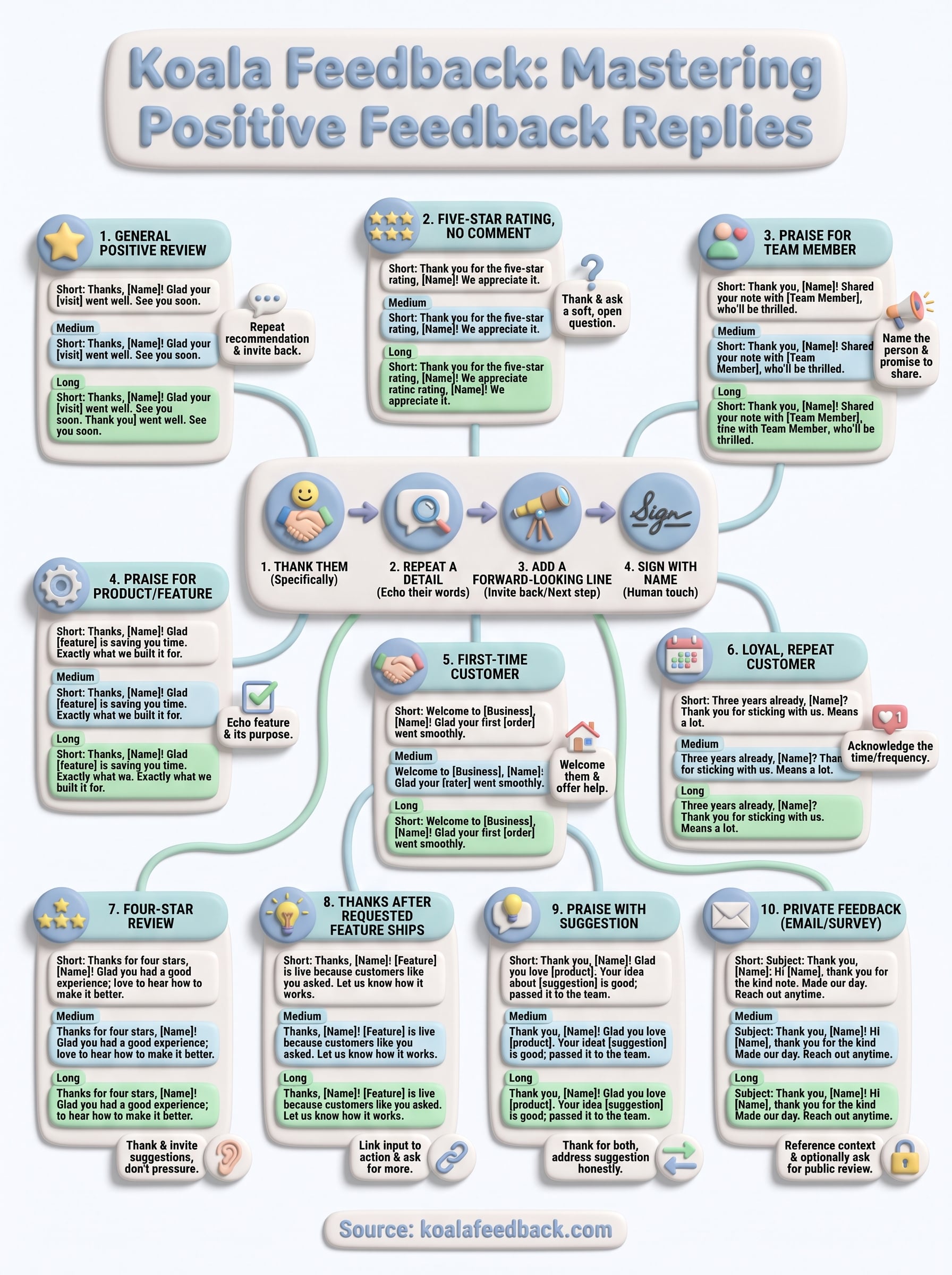
Responding to customer feedback well comes down to a small habit. Thank the person by name, repeat one real detail, and give them a reason to come back. The ten situations above cover most of the praise you will see, from a silent five-star rating to a customer who finally got the feature they voted for. Start with the template closest to your next review and change one detail.
The replies work best when you can see all your feedback in one place. If you want a single home for the ideas, votes, and comments you are answering, you can start with Koala Feedback for free and set up a feedback portal in minutes.

Start today and have your feedback portal up and running in minutes.