Most product teams start each quarter the same way: scrambling to figure out what to build next. Without a structured approach to quarterly roadmap planning, priorities get driven by whoever talks the loudest, not by what actually moves the needle. The result? Wasted sprints, misaligned teams, and features nobody asked for.
A 90-day planning cycle fixes this. It's long enough to ship meaningful work but short enough to course-correct when priorities shift. The key is grounding every decision in real user feedback rather than gut feelings. That's exactly why we built Koala Feedback, to give product teams a centralized place to collect, prioritize, and act on what users actually want, then communicate progress through a public roadmap.
This guide walks you through the entire process step by step. You'll learn how to audit your current roadmap, set focused quarterly goals, prioritize features using structured frameworks, and align your team around a plan that holds up beyond week one. We've also included downloadable templates so you can put this into practice immediately. Let's get into it.
Quarterly roadmap planning is the practice of setting a focused, time-boxed product direction every 90 days. Rather than maintaining a vague, ever-growing backlog or locking into a rigid annual plan, you define clear outcomes for the next quarter, map initiatives to those outcomes, and give your team a concrete target to hit. Think of it as a strategic snapshot: broad enough to capture business direction, specific enough to drive daily decisions without micromanaging every sprint.
A quarterly roadmap is not a list of features. It's a statement of what you're trying to achieve, what you'll build to get there, and how you'll measure success.
A quarterly roadmap is more than a Gantt chart. It connects user problems to business goals with enough detail to guide engineering and design decisions while leaving room for execution judgment. A solid quarterly roadmap typically contains:
This structure keeps the plan grounded in outcomes rather than raw output, so your team spends time building things that actually move the needle instead of just shipping volume.
Not every team needs a quarterly cadence. Annual planning alone works fine when your product is stable and your market moves slowly. But for most SaaS teams, user needs shift faster than a yearly review can catch. You need the 90-day cycle when:
The quarterly cycle gives you enough runway to ship meaningful work while forcing you to re-evaluate your assumptions every three months. For teams using a user feedback platform like Koala Feedback, quarterly planning also creates a natural checkpoint to revisit what users are actually asking for and adjust your direction before small misalignments turn into costly detours.
Before you plan forward, you need to understand what just happened. Most teams skip this step and repeat the same prioritization mistakes quarter after quarter. A structured retrospective gives you clean context for your next decisions and helps you avoid carrying forward work that never had a clear owner or a measurable outcome attached to it.
Skipping the quarterly retrospective is how teams end up building the same half-finished features twice.
Pull data from the previous quarter and evaluate three areas: what shipped, what stalled, and why. You're not running a blame session. You're looking for patterns that will sharpen your next round of quarterly roadmap planning. For each item on last quarter's roadmap, answer these questions:
Capture your audit in a simple retrospective table so every stakeholder walks into the planning session with the same baseline understanding. Use this template as a starting point:
| Initiative | Status | Metric impact | Key blocker (if any) |
|---|---|---|---|
| Feature A | Shipped | +12% activation | None |
| Feature B | Partial | Not measured | Scope unclear |
| Feature C | Not started | N/A | Engineering capacity |
Once the table is complete, summarize the top three takeaways in one or two sentences each. These takeaways feed directly into your outcome-setting in Step 2, so keep them specific. Vague conclusions like "we moved too slow" are useless. Specific ones like "we underestimated backend complexity for two of four initiatives" give you something concrete to fix.
With your retrospective complete, you have the context you need to set focused objectives for the next 90 days. This is where most quarterly roadmap planning sessions go wrong: teams list features instead of outcomes. Your job at this stage is to define what success looks like before you touch the backlog.
Outcomes tell your team where to go. Features are just one path to get there.
Limit yourself to two to four outcomes per quarter. More than that and you're spreading focus too thin. Each outcome should complete this sentence: "By the end of this quarter, we will have [measurable result] for [audience]." For example: "By end of Q3, we will have reduced onboarding drop-off by 20% for new signups."
Use this template to document your outcomes before moving to the backlog:
| Outcome | Target audience | Evidence from last quarter |
|---|---|---|
| Reduce onboarding drop-off by 20% | New signups | Churn data from Q2 audit |
| Increase report feature adoption | Power users | Highest-voted feedback item |
Each outcome needs one primary metric so your team knows when it has actually hit the target. Avoid vanity metrics like total page views. Instead, pick behavioral metrics that reflect real changes in how users interact with your product:
Guardrails are explicit constraints your team agrees on before building the roadmap. Document them so everyone has a shared reference when new requests arrive mid-quarter. Common guardrails include capacity limits per initiative, a freeze on infrastructure rewrites, and a swap rule that requires removing an existing initiative before adding a new one.
With your outcomes and metrics locked, your next job is to translate raw user feedback into a ranked list of initiatives that map directly to those outcomes. This is where quarterly roadmap planning gets concrete. Without a structured approach to feedback analysis, you end up cherry-picking requests from the loudest users rather than the most impacted ones.
The goal isn't to build every requested feature. It's to find the requests that align with your outcomes and carry the broadest user impact.
Pull your top feedback items and score each one against the outcomes you defined in Step 2. A simple scoring table keeps the process fast and removes personal bias from the conversation.
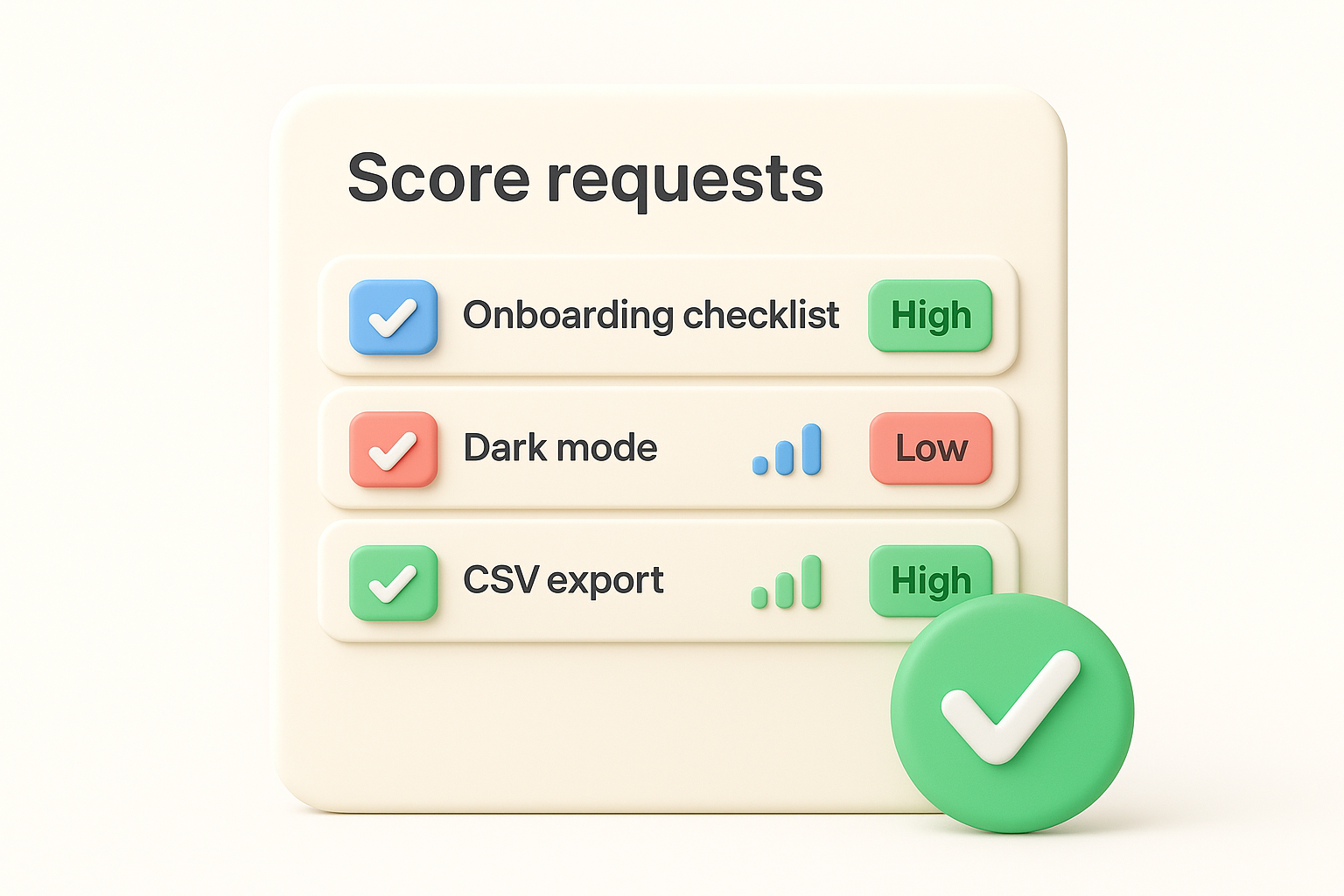
| Feedback item | Maps to outcome? | User impact | Effort (S/M/L) | Priority |
|---|---|---|---|---|
| Onboarding checklist | Yes (drop-off) | High | M | High |
| Dark mode | No | Medium | L | Low |
| CSV export | Yes (adoption) | High | S | High |
Give each item a priority score based on outcome alignment first, user impact second, then estimated effort. Any item that doesn't map to an outcome this quarter belongs in a holding backlog for future cycles, not on your 90-day roadmap.
Before you finalize the list, deduplicate overlapping requests that users described differently but want the same thing. "Better filtering" and "search within reports" often point to the same core need. Collapsing these early prevents your team from building two partial solutions when one focused initiative would satisfy both groups. Group similar requests, confirm the pattern with usage data, and write a single initiative brief that captures the full scope.
You now have prioritized initiatives tied to clear outcomes. Your final job is to sequence those initiatives across 90 days and make sure every person on your team understands what they're building and why. A roadmap that lives only in a product manager's head isn't a roadmap. It needs to be visible, shared, and agreed on before the quarter starts.
A roadmap only works when the people executing it helped shape it.
Break your 90 days into three monthly phases: foundation, build, and validate. Assign each initiative to a phase based on its dependencies and the time you need to measure results before quarter-end. Use this template to map your plan:
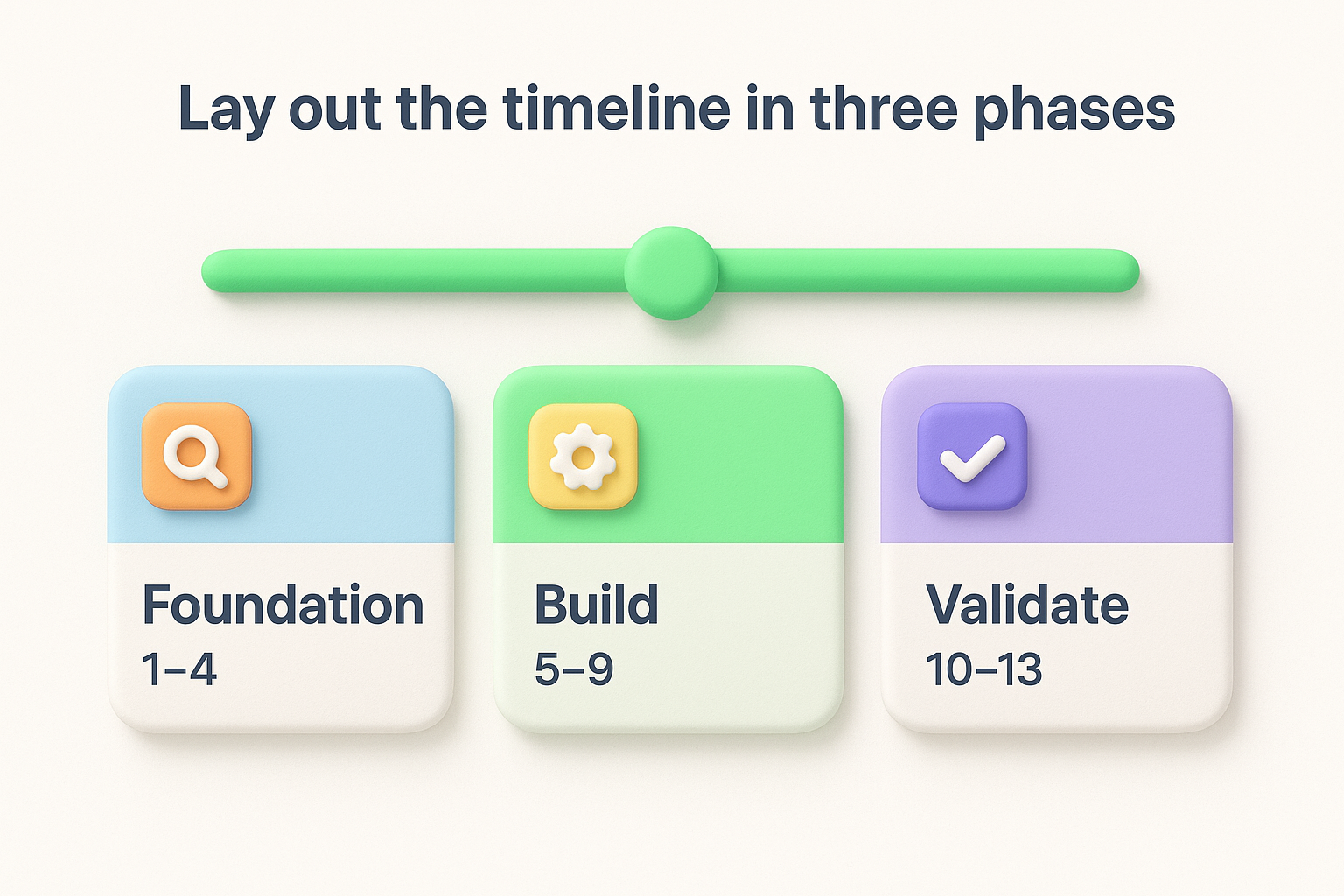
| Phase | Weeks | Focus | Initiatives |
|---|---|---|---|
| Foundation | 1-4 | Discovery and setup | Onboarding checklist, CSV export scoping |
| Build | 5-9 | Core development | Onboarding checklist ship, CSV export build |
| Validate | 10-13 | Testing and measurement | Activation rate review, user interviews |
Place high-effort initiatives in the foundation phase so your team has maximum runway. Keep week 12 and 13 open for measurement, not new shipping. This discipline is what separates quarterly roadmap planning that actually delivers from plans that fall apart in month two.
Schedule a 60-minute roadmap review with engineering leads, design, and key stakeholders before the quarter begins. Walk through the phased timeline, explain the outcome each initiative maps to, and confirm capacity estimates. Ask each lead to flag conflicts or risks out loud. Document every agreement in a shared reference document so the roadmap stays the single source of truth when scope debates emerge later.
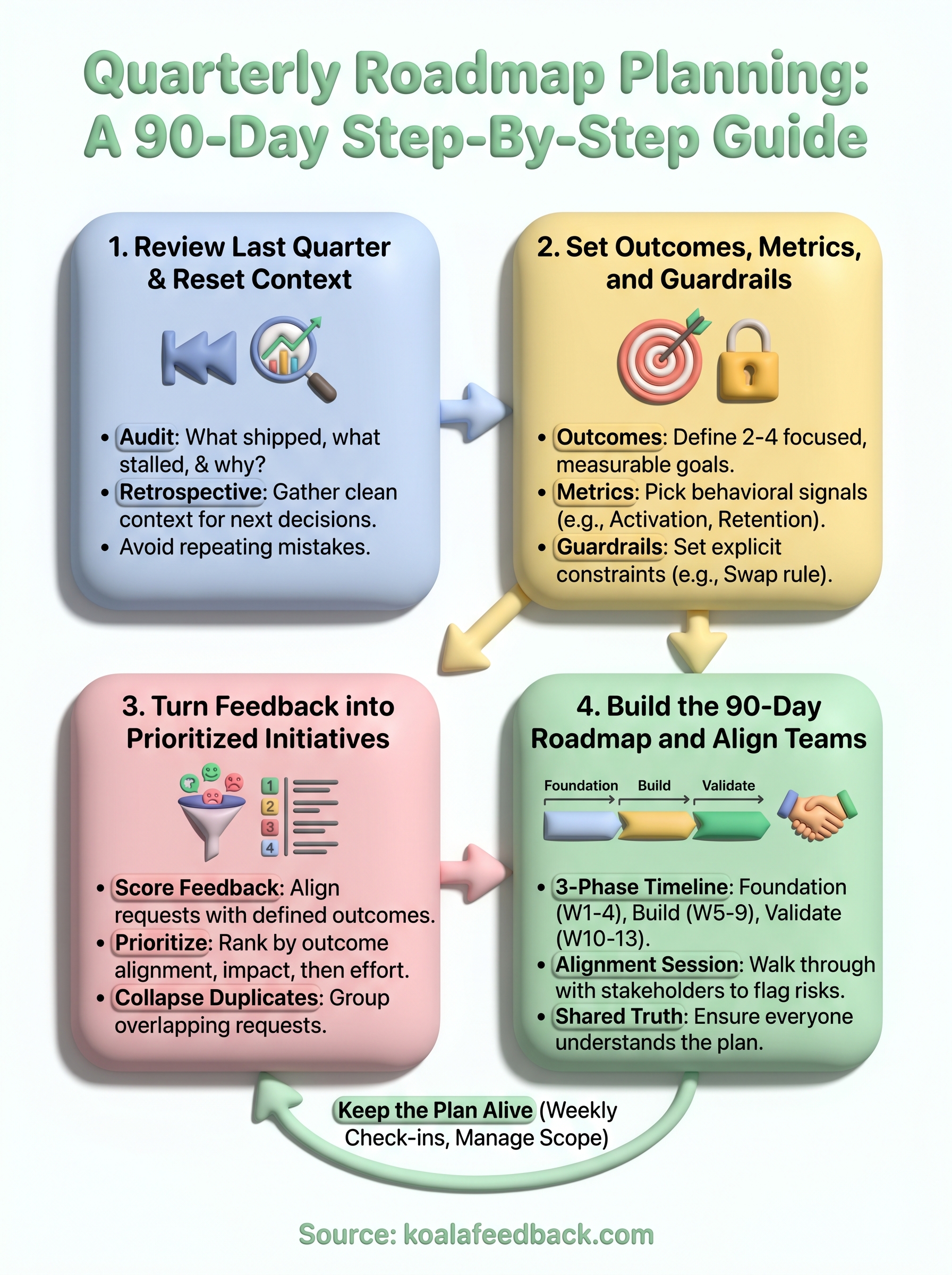
A roadmap only works if your team treats it as a living reference, not a document you file away after the kickoff meeting. Check in weekly to confirm initiatives are on track, flag blockers early, and make explicit decisions about scope changes rather than letting them accumulate silently. When a new request arrives mid-quarter, run it through your scoring table from Step 3 before adding it to the plan. If it doesn't map to a current outcome, it waits for the next cycle.
Your quarterly roadmap planning process gets stronger every 90 days because your retrospective data improves and your team gets faster at scoping realistic work. The entire loop, from collecting feedback to shipping and communicating progress, runs more smoothly when your users are part of it. If you want a central place to capture requests, track votes, and share your roadmap publicly, start with Koala Feedback and put every step in this guide into practice today.

Start today and have your feedback portal up and running in minutes.