Innovation and product development together describe how a team turns a new idea into a product that customers actually want. Product development is the process of taking a product from concept to launch. Innovation is what makes the result new, or meaningfully better, in a way customers value.
The two are not the same thing. A team can ship a product on time and on budget without innovating at all. A team can also have a brilliant idea and fail because it has no process to build, test, and launch it. The combination is what matters: a repeatable way to find unmet needs and turn them into working products.
This article covers why innovation matters in product development, how it differs from standard development, the stages that take an idea to market, and the main types of product innovation with real examples. It also shows how user feedback feeds the process. At Koala Feedback we build tools that help product teams collect feedback and share roadmaps, so we see every day where good ideas start: with what users say.
Innovation matters because a product that only keeps pace with competitors slowly becomes a commodity. It competes on price and loses its reason to exist. Innovative product development gives customers a reason to choose you, stay, and pay for value instead of features.
Standard development delivers a defined product. Innovative development searches for a better definition first. The difference shows up in almost every part of the work.
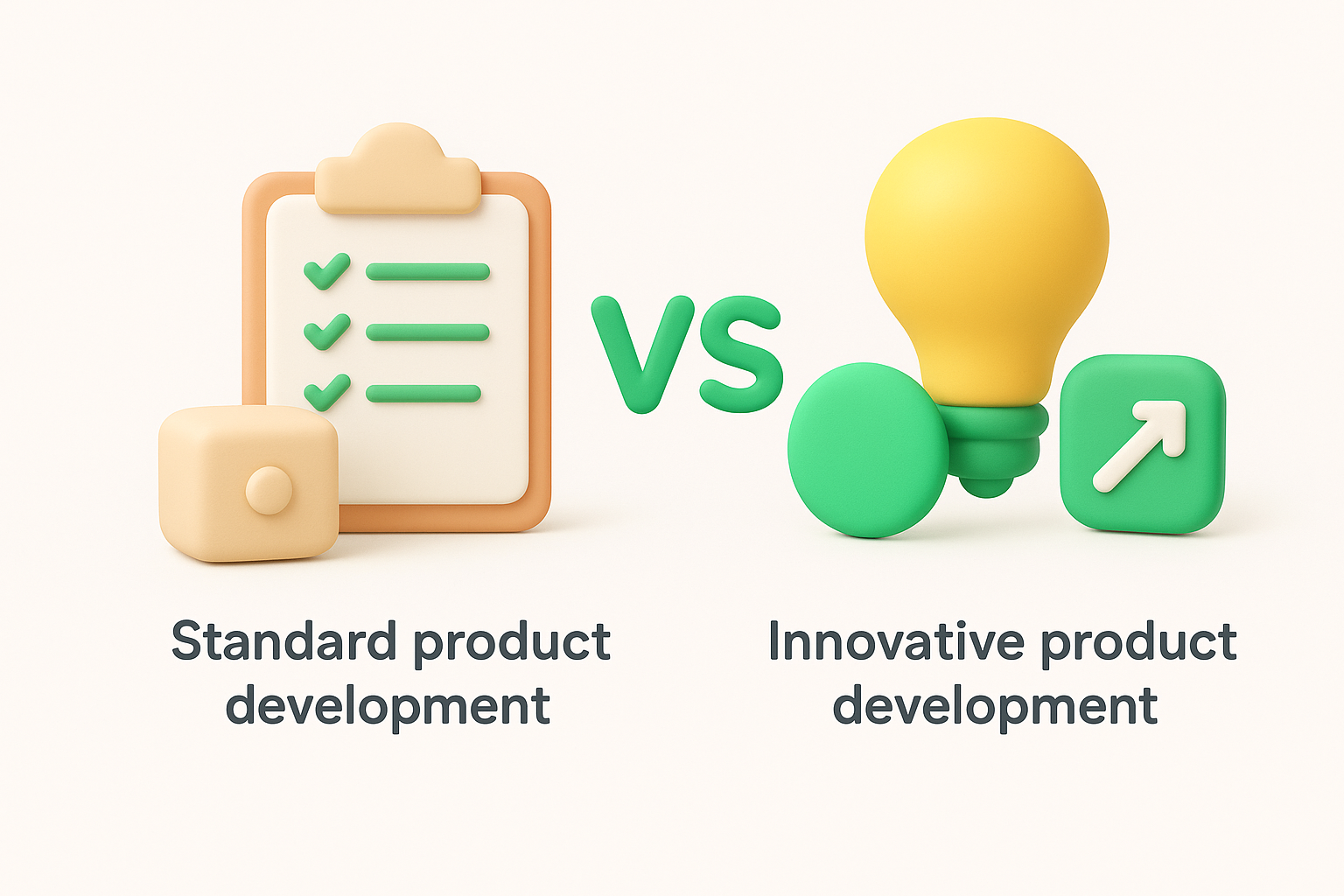
| Standard product development | Innovative product development | |
|---|---|---|
| Goal | Deliver a defined product to spec | Create new or clearly better value |
| Starting point | Known requirements and a roadmap | An unmet customer need |
| Main risk | Execution: late or over budget | Market: will anyone want it? |
| Process | Planned scope, linear phases | Short experiments, early stop decisions |
| Success measure | On time, on budget | Adoption, retention, new revenue |
Most teams need both. Standard development keeps the current product healthy. Innovation finds the next one.
Standard development asks "did we build it right?" and innovation asks "should we build it at all?"
Innovation protects relevance and opens new growth. Customers' needs shift, new entrants appear, and technology changes what is possible. A team that studies those shifts can respond early. A team that does not usually finds out when customers leave.
Apply innovation by adding a decision gate at every stage of development, so weak ideas stop early and strong ones get resources. Frameworks differ on whether they list five stages or seven. This seven-stage version covers the ground of both.
The first mistake is skipping validation. Teams fall in love with a solution and build it for months before a customer sees it. The second is treating innovation as a side project. If no one owns the gates and no one is allowed to kill ideas, the process fills with half-finished work.
Innovation is not a burst of creativity. It is a sequence of cheap tests that make expensive mistakes less likely.
Product innovation falls into three types: sustaining innovation, low-end disruption, and new-market disruption. They differ in how they relate to the existing market, and each calls for a different strategy.
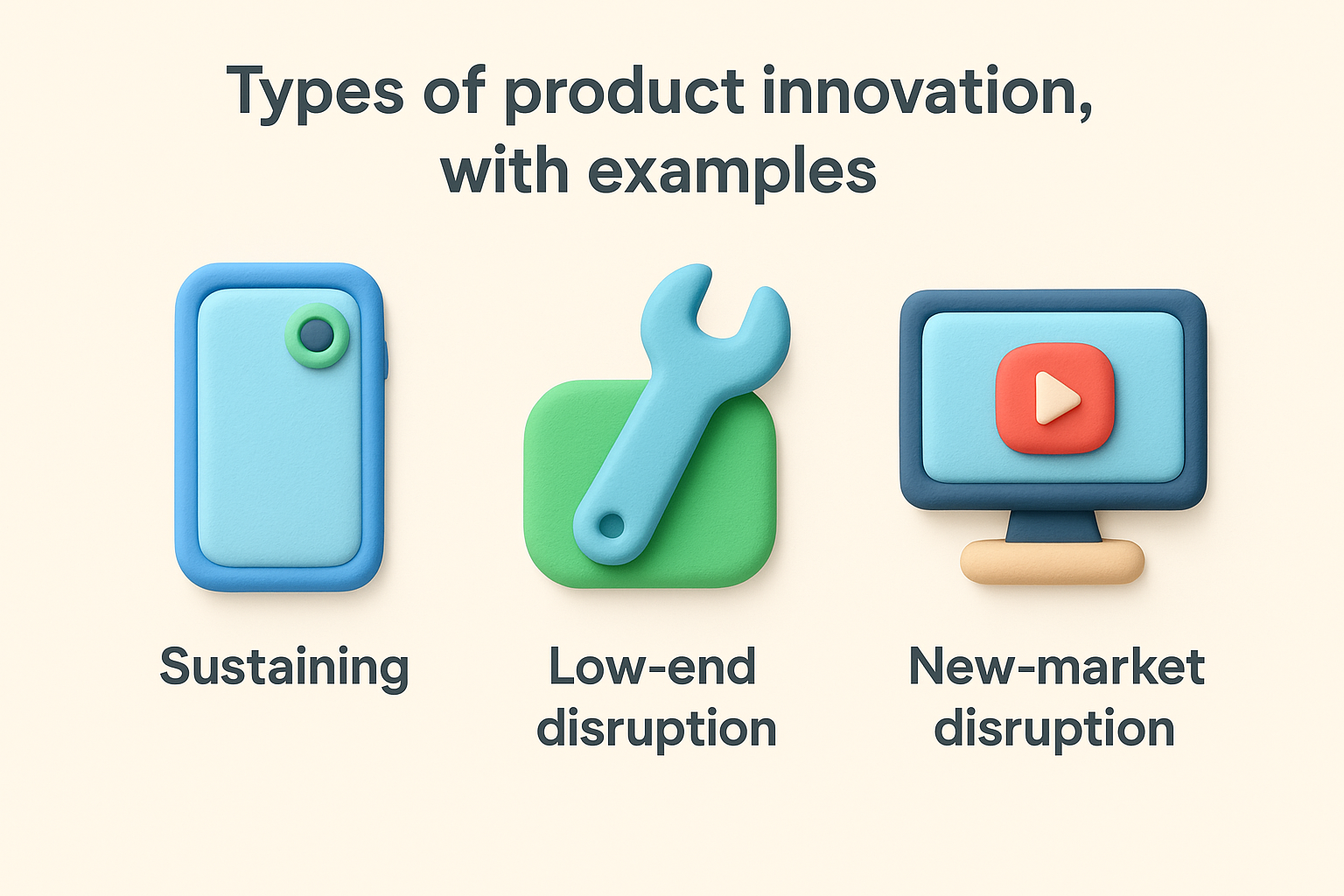
| Type | What it does | Illustration |
|---|---|---|
| Sustaining | Improves a product for the customers who already pay the most | A flagship phone adding a better camera |
| Low-end disruption | Offers a "good enough" product at a lower price and margin | A lightweight tool covering most of what a costly enterprise suite does |
| New-market disruption | Creates a new segment that the old product never served | Streaming video for people who never visited a rental store |
You will also hear incremental and radical innovation. Incremental means small, steady improvements. Radical means a leap that changes what the product category is. Sustaining work is usually incremental. Disruptive work is more often radical.
The iPhone, launched in 2007, was radical innovation. It combined a phone, a music player, and an internet device around a touchscreen. Netflix introduced streaming that same year and moved from mailing DVDs to on-demand viewing. Amazon Web Services launched in 2006 and turned computing infrastructure into a product that others could rent.
A smaller, illustrative case: a SaaS team notices that dozens of customers keep asking for the same spreadsheet export. The requests look like a feature. Interviews show customers are building weekly reports for their managers. The team ships a scheduled report instead, which solves the real job and is far more valuable than the export.
Big or small, the pattern is the same: find the job the customer needs done, then build for that job instead of the request.
User feedback fuels innovation because it is the cheapest source of validated problems. Customers show you friction, workarounds, and missing pieces that no brainstorm would uncover. The catch is that customers describe problems better than solutions, so treat requests as clues, not specifications.
A feedback process needs five things: a place to collect, a way to group, a signal of demand, a way to prioritize, and a way to close the loop. In Koala Feedback, a feedback portal lets users submit ideas. The platform deduplicates and categorizes posts, and voting and comments show how strongly people want each one. Prioritization boards organize requests by product area, and a public roadmap with customizable statuses tells users what is planned, in progress, or done.
You can start on the free Starter plan, which includes 3 boards, 5 statuses, unlimited users, and up to 100 active posts. Portals can be running in minutes, so it is easy to test the process before committing to it.
Votes tell you what current users want. They do not tell you what non-users need. Pair the data with interviews of churned users and prospects to spot new-market opportunities. Look for repeated workarounds, requests that describe the same underlying need in different words, and comments that explain why someone wants a feature. Those patterns point to ideas worth screening in stage two.
Feedback will not hand you the innovation, but it will show you where to look.
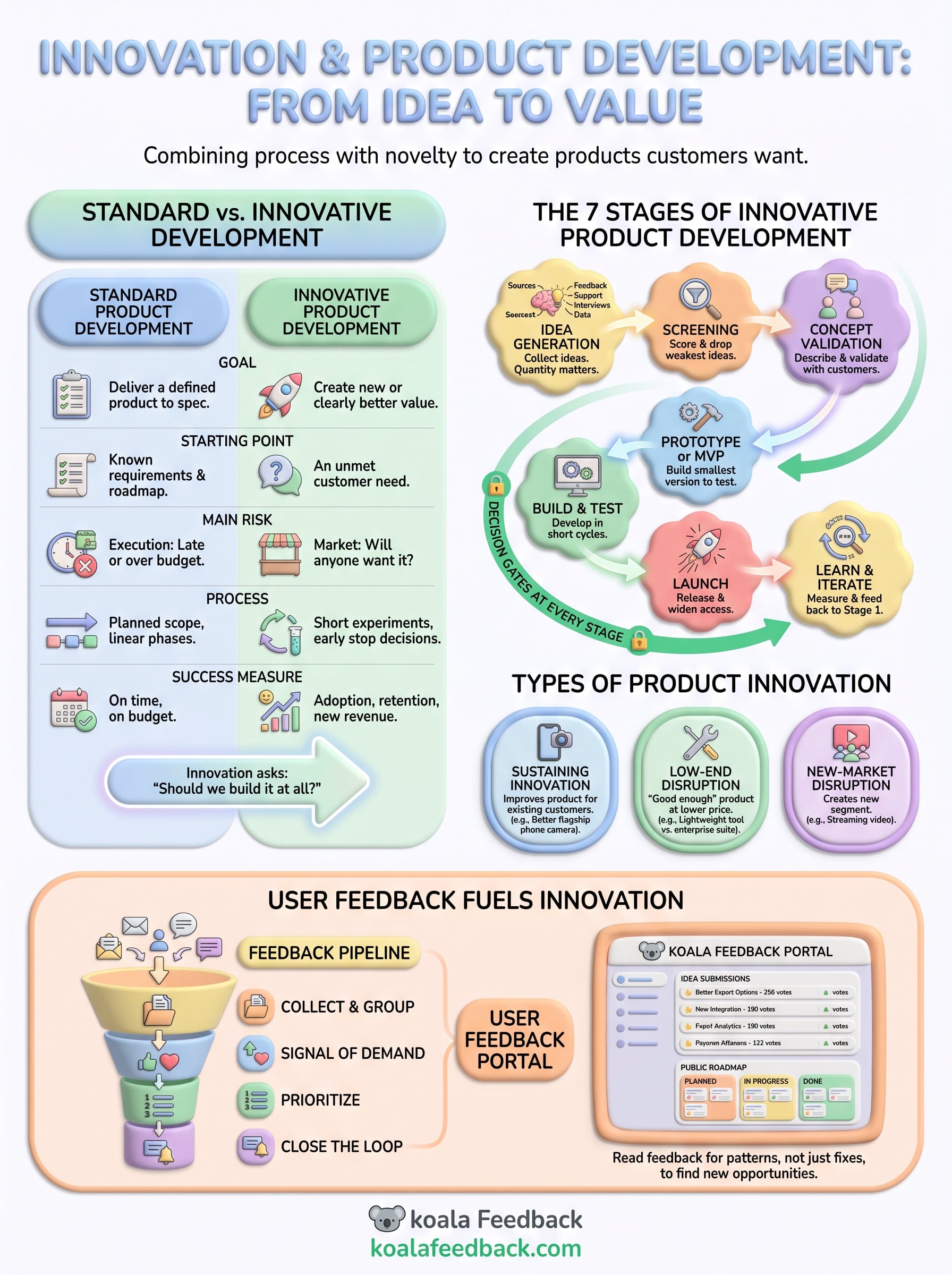
Innovation in product development means finding a problem worth solving, validating it cheaply, and building the solution through a staged process. It differs from standard development in its starting point, its risks, and how it measures success. The types and examples above show that the scale can vary, but the pattern holds.
The practical first step is to collect what your users are already telling you. Group it, rank it, and share your plans back. If you want a simple place to do that, you can start on the free Starter plan of Koala Feedback, set up a feedback portal and public roadmap, and let your users point the way to your next product idea.

Start today and have your feedback portal up and running in minutes.